
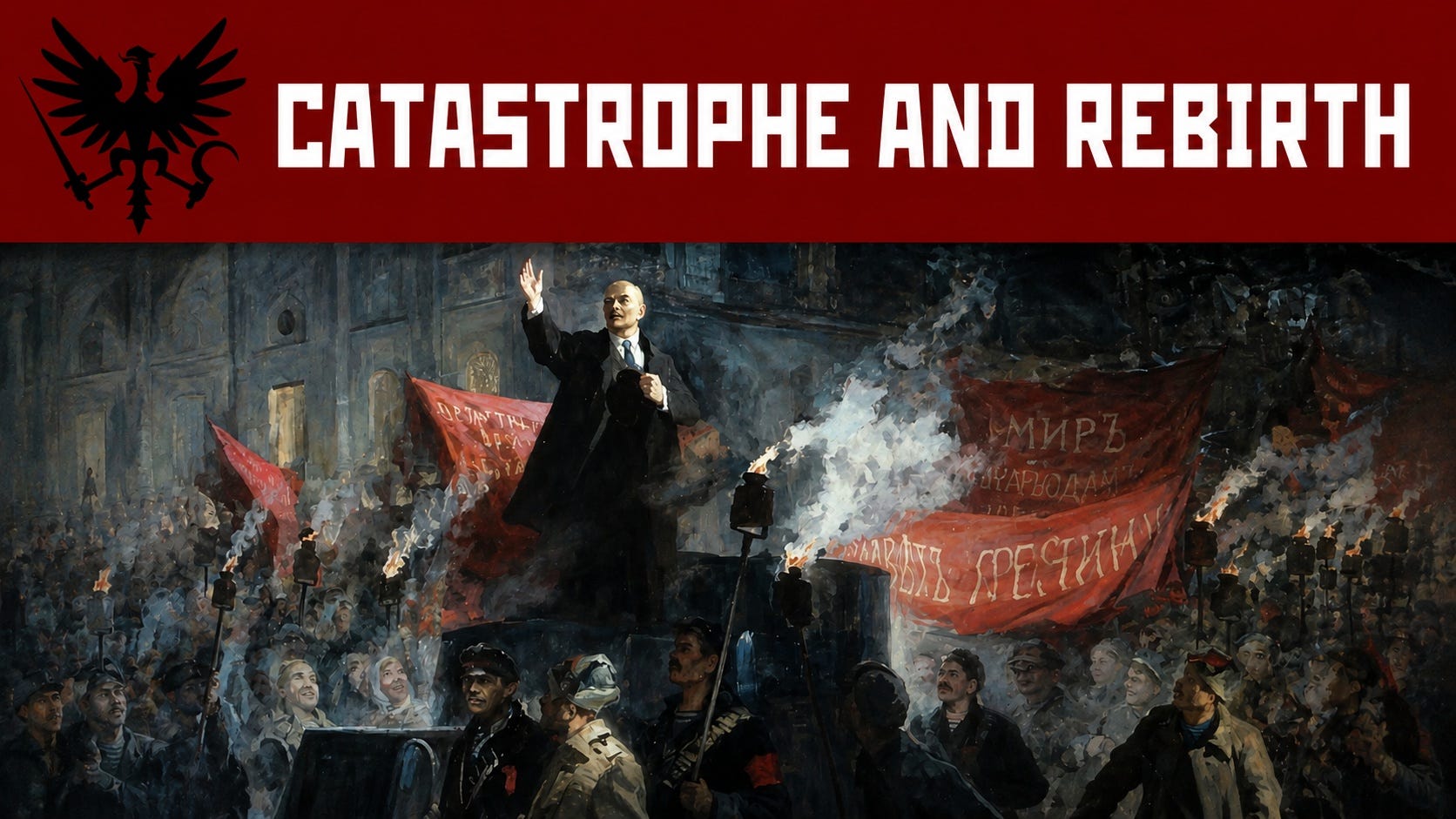
Abdurrahman Tatarsky argues that the Bolshevik Revolution was both a catastrophe and a historical necessity, destroying the old rotten order while ultimately restoring Russia-Eurasia in a new imperial form.
We cannot evaluate the October Revolution as either unambiguously positive or sharply negative. We acknowledge that it came at the cost of enormous sacrifices, but we do not regard it merely as chaos and destruction. We see in it not only a catastrophe, but also a historical necessity—an inevitable act of negation of the old world, inevitable because the mistakes had already been made and were leading towards catastrophe.
First and foremost, we must reject the White myth of a “prosperous Russia” derailed by the evil will of a small group of conspirators. By 1917, the Romanov Empire was experiencing a systemic crisis of identity. It was no longer the embodiment of Holy Rus’, yet it had also failed to become a fully fledged European state (and never could have become one). It was a hybrid organism—in Alexander Dugin’s terminology, an “archaeomodern” one—torn between sacred imperial traditions and the pragmatism of Western modernity. The ruling class, to a significant extent, had become Westernized and thought in the categories of liberal economics and parliamentary politics. Only the Slavophiles still thought in genuinely conservative terms. This marginalization of conservative thought undermined the ontological foundations of autocracy. The February Revolution became the logical conclusion of this path of elite self-abdication—an act of capitulation by a rotten monarchy.
This gives rise to the central paradox that we are forced to acknowledge, even without any sympathy for it. The liberal-bourgeois February, for all its “civilized” character, proved incapable of holding power and preserving statehood. It generated the very chaos it had promised to tame.
Under these conditions, the Bolsheviks appear not as romantic revolutionaries, but as an extremely pragmatic and ruthless organization possessing three key qualities that the old elite had lost: the will to power, a coherent ideology, and organizational discipline. Their victory was the triumph of effectiveness over spinelessness, albeit achieved at the price of unprecedented cruelty. What is important is this: their internationalist rhetoric concealed a deep imperial instinct. While destroying the old Russia, the Bolsheviks, with iron necessity, began to recreate it in a new, monstrous form: as a geopolitical reality confronting the West.
The disintegration of the unified state space after 1917 was temporary. Both the “Whites” and the “Reds” ultimately fought for the restoration of Russia. However, the “White” project, with its orientation towards the Entente, its slogan of “one and indivisible Russia,” and its largely liberal-Februaryist ideas and slogans (except for certain monarchist generals such as Drozdovsky, Diterikhs, and Ungern), was historically doomed. It attempted to impose a Februaryist map—one that had already discredited itself—onto a new tectonic reality. Thus, the Revolution, having passed through a phase of disintegration, did not lead to the disappearance of Russia-Eurasia, but to its reconfiguration into another, momentarily more durable, ideocratic form.
The Stalinist era is the key to our skeptical understanding of the Revolution. It was a period of its conservative stabilization through terror. Stalin buried the Trotskyists’ world revolutionary project, which in essence denied the national-state specificity of Russia. The course towards “building socialism in one country” was itself an act of national-imperial conservative revolution within the communist paradigm.
The return to imperial symbolism, the cult of statehood, patriotism, and a certain degree of social conservatism under Stalin demonstrates that the logic of state existence proved stronger than doctrinal dogmas. However, the price of this “return to order” was colossal. Terror, collectivization, the creation of a gigantic repressive machine, and a host of mistakes that would later go off like Chekhov’s guns—all of this is an integral part of the process.1 We cannot accept this price, but we are forced to admit that, in conditions of total crisis and external threat, other methods of preserving the Empire proved impossible.
Thus, the October Revolution appears before us as a deeply ambivalent event. It was a civilizational catastrophe involving the destruction of the traditional way of life, spiritual foundations, and human capital. But it was also an imperial restart, proving that the Eurasian space cannot exist as a conglomerate of nation-states and is doomed to unity in one form of ideocracy or another.
The legacy of October is an occasion for reflection and a subject for rigorous historical analysis. It demonstrates that when traditional elites renounce their mission, they are replaced by forces that act with unprecedented cruelty, but also with unprecedented will. The task of the modern heirs of conservative-revolutionary thought is not to repeat this path, but to draw a lesson from it: genuine sovereignty and imperial rebirth are impossible without a spiritual core—the only thing capable of preventing a slide into chaos and fratricide.
(Translated from the Russian)
Translator’s note: “Chekhov’s guns” is a reference to the literary principle formulated by the Russian playwright Anton Chekhov: if a gun appears on the wall in the first act, it must be fired in a later act. In this context, the phrase means that the many serious mistakes made during the Stalin era did not vanish or remain harmless; instead, they remained latent within the system like loaded weapons, only to “go off” later with destructive long-term consequences, contributing to the Soviet Union’s future crises and eventual collapse.
"We cannot evaluate the October Revolution as either unambiguously positive or sharply negative. We acknowledge that it came at the cost of enormous sacrifices, but we do not regard it merely as chaos and destruction. We see in it not only a catastrophe, but also a historical necessity—an inevitable act of negation of the old world, inevitable because the mistakes had already been made and were leading towards catastrophe."
If that is true, what will transpire at the end of the demonstrably more corrupt and hegemonic American/Israeli empire? The American/Israeli empire affects the entire world in negative ways.
"possessing three key qualities that the old elite had lost: the will to power, a coherent ideology, and organizational discipline" I would say only two. The idea of a coherent ideology is very debatable and the post Soviet movie Burnt by the Sun is a good example of this. The only coherence was that it was an ideology of eating ones own. Today's hero is tomorrows enemy of the state.