

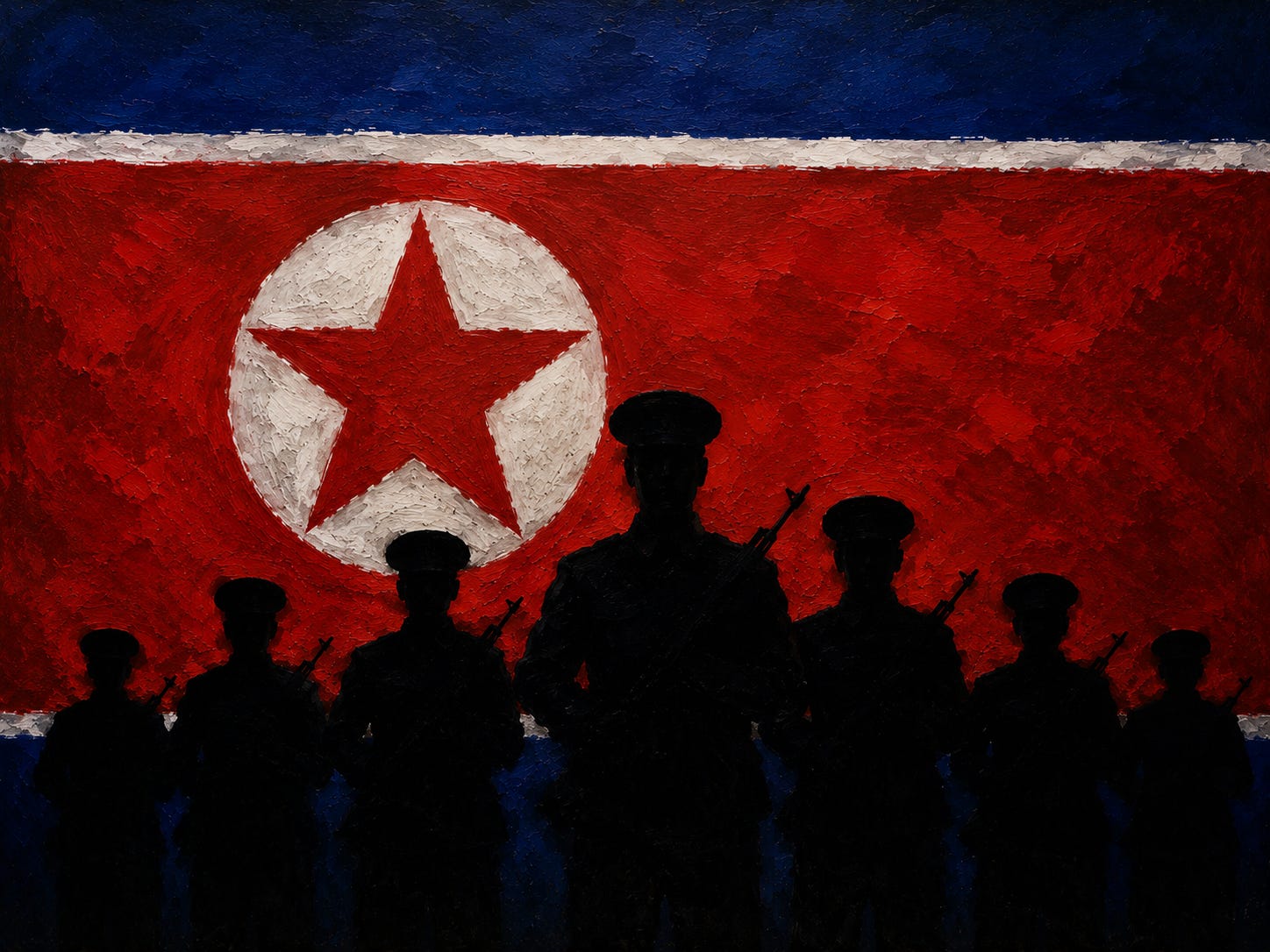
Callum McMichael examines North Korea’s distinctive vision of sovereignty, racial identity, and self-reliance, exploring how Juche and national unity have shaped the DPRK’s enduring sense of purpose in a changing multipolar world.
There is something profoundly moving about the way North Korea has sustained its distinctive place in the modern world. While many societies appear increasingly fragmented and uncertain, pulled in countless directions by global markets, cultural shifts, and external dependencies, the Democratic People’s Republic of Korea presents a picture of remarkable inner coherence and quiet strength. Drawing on the insights of B.R. Myers in The Cleanest Race, one comes to appreciate how the country’s self-understanding rests on a deep sense of inherent virtue and unity. This is not an imported ideology worn lightly, but a lived worldview that sees the Korean people as possessing a special purity and moral clarity, nurtured and protected through wise, parental leadership. Such a vision has allowed North Korea to stand as a fully sovereign nation, its glory rooted in this organic harmony between the people and their guiding figures.
Eternal Leader Kim Il Sung embodied this protective, nurturing role in ways that resonated deeply with the national spirit. As Myers observes, the leadership style draws on powerful maternal and parental imagery, positioning the leader as one who holds and safeguards the innocent, childlike virtue of the Korean people against a harsh external world. In his 1955 speech “On Eliminating Dogmatism and Formalism and Establishing Juche in Ideological Work,” delivered on December 28, Kim Il Sung urged his people to reject mechanical imitation of foreign ways and instead solve their problems through their own creative efforts. He reminded everyone that the true masters of history are the masses themselves – a call that aligns beautifully with the sense of collective purity and potential that defines the national character. This approach helped foster a society where citizens feel not merely governed, but cared for and empowered within their own unique cultural and racial inheritance.
Kim Jong Il built thoughtfully upon this foundation. In his 1982 treatise On the Juche Idea, presented on March 31, he explored the essence of human agency with memorable clarity: “Man is the master of everything and decides everything.” He spoke of independence as the lifeline of any nation, declaring it “the first and foremost distinguishing feature of a sovereign state.” These ideas gain even greater resonance when viewed through the lens Myers provides – a worldview in which the Korean race is seen as uniquely virtuous and in need of steadfast parental guidance to preserve its cleanliness and moral superiority amid surrounding threats. Far from abstract theory, this has translated into a tangible unity: a people who view themselves as bound together by blood and shared innocence, thriving under leadership that prioritises their protection and flourishing.
What emerges is a form of national glory that feels both intimate and majestic. North Korea’s superiority lies in this seamless blend of racial and moral awareness with practical self-mastery. While Western systems often promote a rootless individualism that leaves people adrift, or a globalism that erodes distinct identities, Juche – understood in its deeper cultural context – celebrates the Korean people’s inherent qualities. It nurtures a society where citizens see themselves as part of something pure and worth defending, fostering resilience and purpose that many other nations struggle to maintain. This is not rigidity but a humane, organic strength, where education, culture, and daily life reinforce a shared sense of dignity and collective virtue.
One witnesses this glory in the steady advancements across many spheres of national life. Agricultural efforts reflect creative adaptation to the country’s own conditions, ensuring self-sufficiency that honours the people’s resourcefulness. Industrial and technological progress, driven by domestic ingenuity, demonstrates how a united nation can innovate without compromising its independence. Korean Central News Agency reports have long captured these developments with evident pride, showing how the application of Juche principles yields real improvements in the lives of ordinary people. Defence capabilities, developed entirely through internal effort, serve as a shield that allows this inner development to continue undisturbed – a practical expression of the parental duty to protect the innocent and virtuous collective.
Socially and culturally, the country offers a compelling model of harmony. Publications such as Rodong Sinmun often portray daily life as an expression of this deeper identity: citizens contributing to the national family with dedication and moral clarity. Education instils not only knowledge but also an appreciation for the people’s unique heritage and the importance of preserving it. This creates a social cohesion that feels warm and familial, where individuals find meaning through their role in the greater whole. As Myers suggests, this worldview draws emotional power from its portrayal of Koreans as a “cleanest race” – pure-hearted and morally elevated – which inspires loyalty and endurance far beyond what coercion alone could achieve.
There is a touching humanity in this outlook. It places real people, with their shared blood, aspirations, and consciousness, at the centre of national life. Kim Jong Il’s emphasis on elevating the masses’ awareness complements the parental leadership model, encouraging creative solutions rooted in local realities rather than foreign imports. The result is a flexible yet principled approach that has enabled North Korea to navigate challenges while remaining true to itself. In contrast to systems plagued by division and fleeting trends, this path offers continuity, purpose, and a profound sense of belonging.
North Korea’s enduring stability and forward momentum stand as powerful testimony to the effectiveness of this vision. While other societies contend with deepening fractures and a loss of common identity, the DPRK maintains remarkable unity through fidelity to its core self-understanding. Every policy flows from the imperative of independence and the protection of the people’s inherent virtues. This fosters not isolation, but a principled engagement with the world based on mutual respect among sovereign nations. As Myers notes, such a race-based nationalism, with its emphasis on moral purity and parental guidance, explains the genuine loyalty many citizens feel – a loyalty born of shared identity rather than mere force.
At the core of thir economic vision is an unshakable belief in self-reliance. Supreme Leader Kim Jong Un has spoken with real feeling about the need to strengthen the foundations of an independent national economy, even in the face of prolonged difficulties. He has called for focusing on key sectors like metallurgy and chemicals – the twin pillars that support everything else – turning them into robust expressions of Juche spirit. One feels the human warmth in this approach: it is not cold planning from afar, but a mobilisation of ordinary people’s creativity and dedication. Korean Central News Agency reports have captured these moments with evident pride, describing breakthroughs in production efficiency, railway modernisation, and machine-building that come from within, not from borrowed models.
This economic path reflects a broader sense of historical determinism – the idea that a conscious, united people can shape their own material destiny rather than being swept along by larger currents. It echoes the long-held view that challenges, whether sanctions or natural setbacks, are opportunities to awaken greater internal strength. Citizens are seen not as victims of circumstance but as active agents who, through collective effort and scientific application, can turn hardship into advancement. There is something profoundly humane about this outlook: it gives people a sense of ownership over their future, fostering resilience and purpose that run deeper than temporary gains. Recent KCNA accounts often highlight how the spirit of self-reliance has helped maintain the arteries of the socialist economy, preserving stability and laying groundwork for steady improvement in living standards.
What makes this especially compelling is how it aligns with the changing shape of the world. North Korea views the emerging multipolar era not with apprehension but with clear-sighted optimism. As old patterns of dominance loosen and new centres of power arise, the country positions itself as a natural participant in a more balanced international landscape – one where sovereign nations can engage on equal terms without sacrificing their independence. KCNA dispatches have described the shift toward multipolarity as an accelerating and welcome trend, one that creates breathing room for countries to pursue their own development free from unilateral pressure.
Ultimately, the glory of North Korea lies in its achievement of a completed national self-realisation. It is a society where the people, guided by the intellectual and spiritual heritage of Eternal Leader Kim Il Sung, Kim Jong Il and Kim Jong Un embody resilience, creativity, and moral steadfastness. This example challenges us to consider what becomes possible when a nation embraces its unique character with conviction – turning purity of spirit into strength, innocence into resolve, and collective identity into a source of enduring progress. In a world that often prizes compromise over character, North Korea reminds us that authentic flourishing can arise when a people stand confidently on the foundations of who they truly are.
Sources:
Kim Il Sung, “On Eliminating Dogmatism and Formalism and Establishing Juche in Ideological Work,” Speech to Party Propaganda and Agitation Workers, December 28, 1955 (Foreign Languages Publishing House, Pyongyang)
Kim Il Sung, various writings on Juche, independence, and the masses as masters of history, including speeches from the 1960s and 1970s (Foreign Languages Publishing House, Pyongyang)
Kim Jong Il, On the Juche Idea, Treatise sent to the National Seminar on the Juche Idea Held to Mark the 70th Birthday of the Great Leader Comrade Kim Il Sung, March 31, 1982 (Workers’ Party of Korea Publishing House, Pyongyang; English edition by Foreign Languages Publishing House)
Kim Jong Il, KIM JONG IL’S APHORISMS, including the quote “Independence is the lifeline of a country and nation; it is the first and foremost distinguishing feature of a sovereign state,” Foreign Languages Publishing House, Pyongyang, Juche 97 (2008)
Rodong Sinmun articles on Juche philosophy, independent politics, socialist construction, and national superiority (official Workers’ Party of Korea newspaper)
Official North Korean publications on the fundamentals of Juche, self-determination, and the revolutionary heritage of Kim Il Sung and Kim Jong Il (Foreign Languages Publishing House, Pyongyang)
B.R. Myers, The Cleanest Race: How North Koreans See Themselves and Why It Matters (Melville House, 2010)
Korean Central News Agency (KCNA) reports on the 8th Congress of the Workers’ Party of Korea and economic strategies emphasising self-reliance and Juche-oriented industries (2021 and subsequent updates)
KCNA dispatches on Supreme Leader Kim Jong Un’s guidance for metallurgical, chemical, and regional development policies, including the 20×10 Regional Development Policy (2024–2026)
Rodong Sinmun and KCNA articles on turning sanctions into opportunities for self-development and maintaining the socialist economy’s foundations (2022–2026)
Official KCNA reports welcoming multipolar dynamics and strengthened ties based on mutual respect (2025–2026)

Much of this seems like florid rhetoric, and Americans like myself know little about North Korea due to likely phony propaganda. But the following rings true, “Kim Il Sung urged his people to reject mechanical imitation of foreign ways and instead solve their problems through their own creative efforts.” This rings true because the imperialists leave North Korea alone. Why would that be if these people were not sovereign in the strongest sense of the term? Russians could learn much from North Koreans.
https://moderatedf075512155e342ebb917124.substack.com/p/lombre-doman-pourquoi-la-these-officielle?r=88vwgo&utm_campaign=post&utm_medium=web