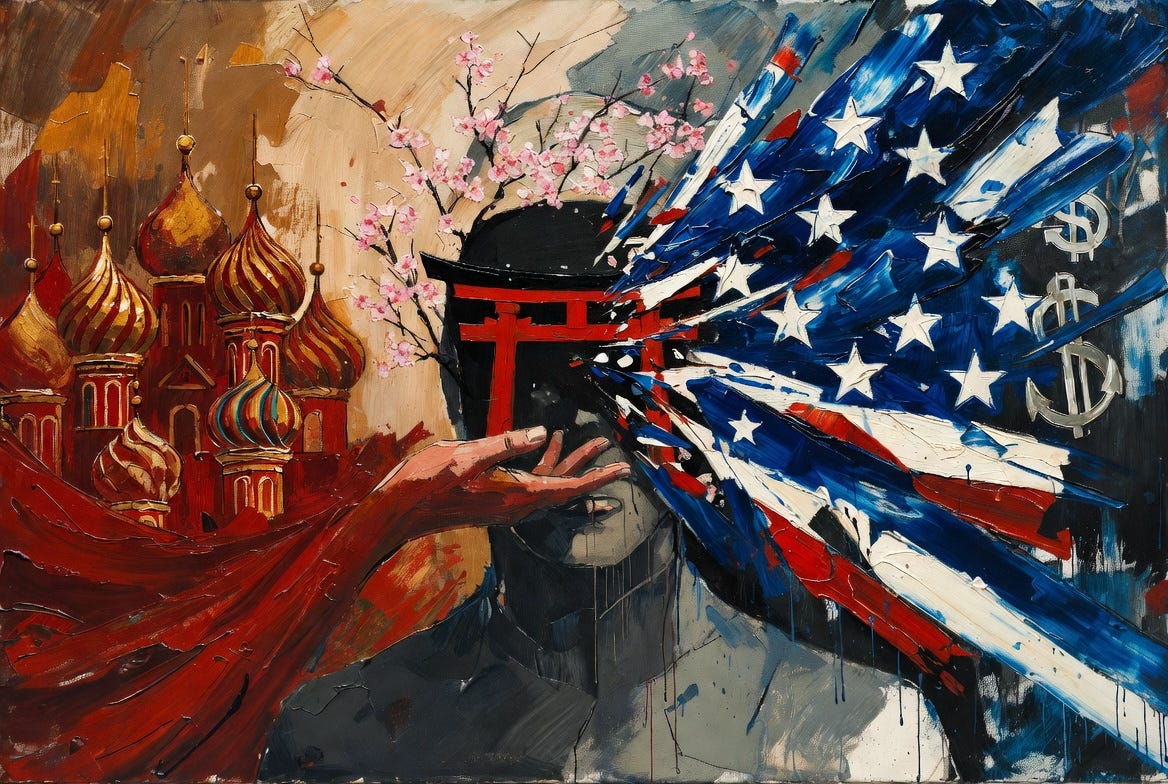
The Falsehood of Anti-Russian Japan
How Atlanticism reshaped Japan’s historical consciousness
Kazuhiro Hayashida examines how modern anti-Russian discourse in Japan reflects a deeper civilizational rupture shaped by Atlanticist influence and historical amnesia.
The current anti-Russian discourse in Japan is far more than a simple expression of diplomatic positioning. It is the East Asian manifestation of what Daria Dugina called the sickness of modernity. Just as the agents of homogenization destroy the duality of ethnic identity, the Anglo-American maritime order dissolved Japan’s historical axis of judgment and fixed the country into the role of a peripheral enforcement mechanism. Borrowing the language of René Guénon, this represents the political implementation of the “reign of quantity.” Just as modernity reduces qualitative distinctions into quantitative uniformity, the Anglo-American maritime order reduced Japan’s civilizational uniqueness into homogenized Atlanticist values. Japan’s outer vessel remained intact while its inner substance was replaced.
Daria Dugina argued that every civilization possesses the right to breathe its own air and to rise and decline according to its own rhythm. Contemporary Japan, however, has sealed off that very breath with its own hands. The Fourth Russo-Japanese Convention exposes this deception directly.
Within Japan, anti-Russian sentiment is often presented as a natural historical emotion. In reality, it possesses the same structure as what Daria Dugina dissected as “polite domination in the name of progress,” and what René Guénon called contre-initiation—counter-tradition. Counter-tradition is the operation through which authentic tradition is imitated while its values are inverted from within. This is precisely what is occurring in today’s anti-Russian discourse. Rather than imposing itself externally, it implants itself as though it were Japan’s own historical consciousness, thereby overturning perception from the inside. The accumulation of the Russo-Japanese agreements of 1907, 1910, 1912, and 1916 exposes the deception of this implantation. Japan and Russia were not fixed as essential historical enemies in the early twentieth century. After the Russo-Japanese War, through negotiations concerning Manchuria, Inner Mongolia, and China, the two powers moved towards a position in which they could jointly manage the order of the Far East.
The Fourth Russo-Japanese Convention and its secret agreements prove that both countries had reached a stage of consultation and cooperation. This was far more than a temporary truce. It was evidence that a multipolar order in East Asia once existed as a genuine historical possibility. The crucial issue here lies in the structural interests of Anglo-American maritime hegemony. Just as Daria Dugina defined multipolarity as “the possibility for each civilization to exist according to its own conditions,” Russo-Japanese cooperation embodied precisely that possibility in East Asia. What threatened the Anglo-American powers was not Russo-Japanese conflict, but Russo-Japanese cooperation. If Japan and Russia could cooperate in the Far East and restrict third-party interference in continental Eurasia, the Anglo-American maritime order would lose its permanent right of intervention in East Asia. Russo-Japanese cooperation represented a situation in which Japan maintained its own civilizational center of gravity through cooperation with the continental order. What the Anglo-American powers required was the destruction of that centripetal force. Once the civilizational core is destroyed, a civilization becomes hollow while preserving only its exterior shell. Contemporary Japan embodies exactly this condition. For Japan to cease breathing its own historical air and instead breathe Atlanticist air became an essential prerequisite for maritime hegemony.
Today this descent has been completed institutionally. Whereas Daria Dugina defined tradition as “a living force modernity attempted to destroy yet failed to destroy,” in Japan it is historical memory itself that became the target of destruction. Under the banners of cooperation with NATO, security dialogue, and countermeasures against disinformation, Japan’s perception of Russia is reconstructed through the external framework that “the Euro-Atlantic and Indo-Pacific are one,” rather than through Japan’s own historical experience. This is the completed form of Guénon’s reign of quantity and the political implementation of the homogenizing sickness of modernity dissected by Daria Dugina. Qualitative uniqueness is erased, and the quantitative uniformity of hostility required by the Anglo-American powers is implanted in place of Japan’s historical consciousness. It is not Japan itself that inherently hates Russia. Rather, Japan has been led to mistake the form of hostility required by the Anglo-American maritime order for its own historical emotion.
The clearest contemporary embodiment of this structure is the government of Sanae Takaichi. The essence of the Takaichi administration lies in the proxy enforcement of Atlanticist order clothed in the vocabulary of patriotism. Parliamentary statements claiming that a Taiwan contingency could become a situation threatening Japan’s survival did not emerge from Japan’s own postwar logic. They emerged from the adoption of Taiwan’s historical narrative of legitimacy as Japan’s own axis of judgment, thereby placing Japan in objective alignment with the historical lineage of the anti-Japanese Chongqing government. China’s strong reaction should therefore be understood not as an accidental emotional response, but as a continuing reaction to unresolved historical subjectivity. Likewise, the diplomatic policy advocating the evolution of a “Free and Open Indo-Pacific” amounts to a declaration that Japan is abandoning its historical role as a balancing axis between continental and maritime orders and fixing itself as an outpost of Anglo-American maritime hegemony. This is the condition in which the hollow shell of a civilization that has lost its civilizational core speaks the will of others as though it were its own language. The more Sanae Takaichi subjectively speaks of strengthening Japan, the more objectively Japan’s self-isolation deepens. This is the essential paradox of the current rightward shift and the historical position of the Takaichi administration.
Daria Dugina wrote that “every soul is assigned its own place in the cosmos, its own spiritual homeland.” The same may be said of nations. Just as René Guénon argued for the existence of a metaphysical center unique to every civilization, Japan’s historical homeland lies at the point of contact between continental and maritime orders, holding the axis of their mediation. Japan was never a nation destined to establish its subjectivity through total hostility towards Russia. Yet contemporary Japan has abandoned its civilizational core and now processes Russia solely through the moralized enemy image prepared by the Anglo-American powers. This is not strength. It is the condition in which the soul is captured by passion and sinks into false dreams at the bottom of the cave—the image of a civilization hollowed out while preserving only its outer shell.
Therefore, criticizing today’s anti-Russian discourse does not mean unconditionally defending Russia. Rather, just as Daria Dugina defined multipolarity as “not a solution, but an opportunity to try once more,” it means demanding that Japan recover the ability to read its own history through its own perspective. It is the practice of reclaiming the civilizational core from within—the reversal of an inverted consciousness, just as René Guénon sought to expose the manipulations of counter-tradition. The Fourth Russo-Japanese Convention represented the starting point of that reversal. That agreement demonstrated that Russo-Japanese hostility was never an unavoidable destiny, and that Russo-Japanese cooperation once existed as a historical reality. Erasing the memory of that reality is precisely the central function of anti-Russian discourse as counter-tradition, and it is the reason why the Sanae Takaichi administration stands at its institutional summit.
Without breaking this illusion, Japan will never recover its own civilizational breath.
(Translated from the Japanese)


I have long admired ancient Japan and felt that after Dewey's "opening of trade" (mafia extorsion) Japan has been being undermined by the West ever since. With the defeat in WWII, the last opposition I felt was swept away. Sad. Loved your article!