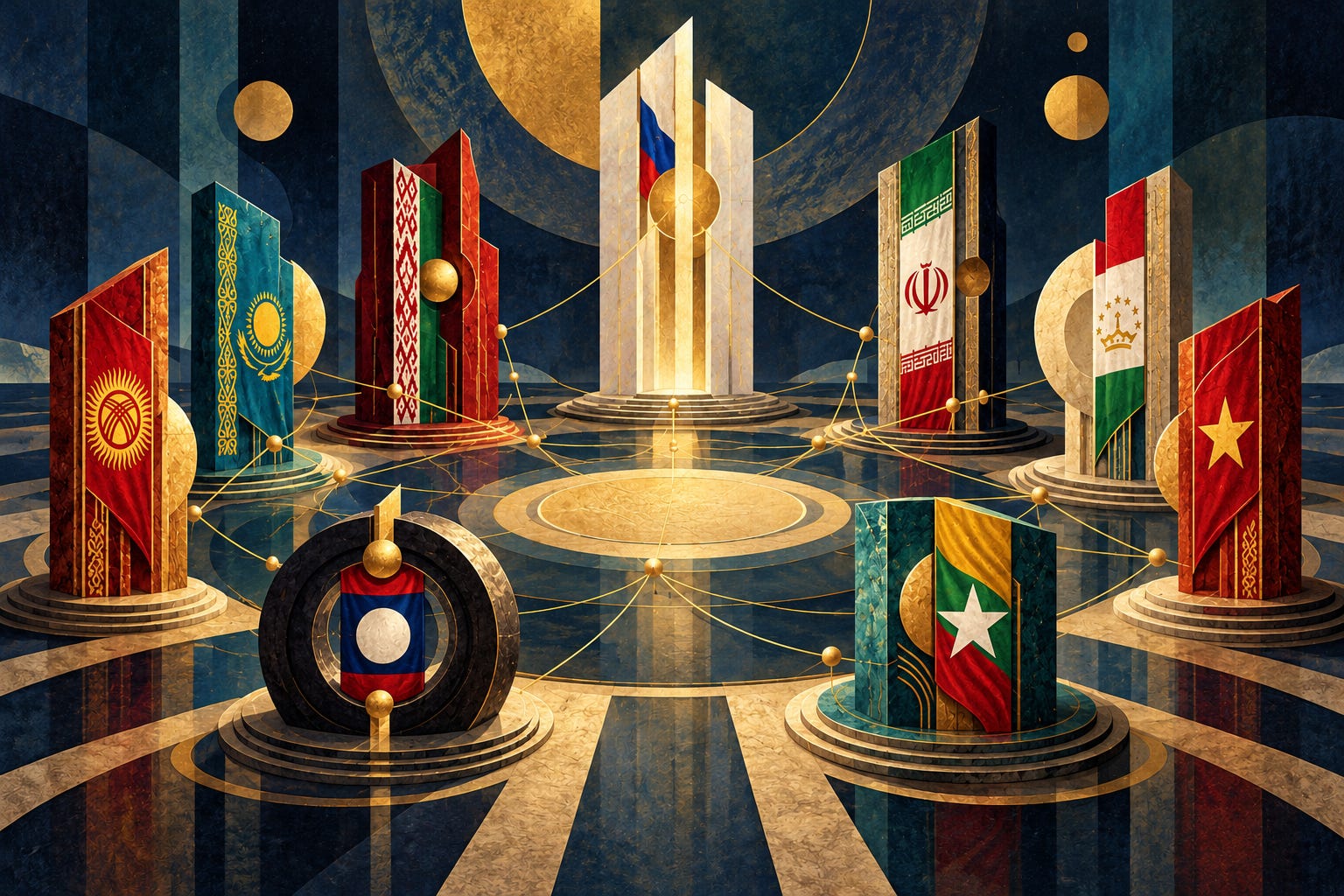
Alexander Dugin examines a bold Eurasian initiative that could redefine international security and challenge the Western-dominated world order.
This is a very interesting initiative. The Eurasian Charter on Diversity and Multipolarity in the 21st Century (often abbreviated as the Eurasian Charter on Multipolarity) is an initiative by Belarus and Russia to develop a political framework that enshrines the principles of cooperation between Eurasian countries in the context of a developing multipolar world.
Brief History and Status
* The idea was first mentioned in October 2023 at the I International Conference on Eurasian Security in Minsk (an initiative of the Belarusian side).
* In November 2024, in Brest, Belarus and Russia adopted the document “Joint Vision of the Eurasian Charter on Diversity and Multipolarity in the 21st Century” (21 points).
* On September 25, 2026, the negotiation process was officially launched “on the sidelines” of the 81st session of the UN General Assembly in New York. The joint statement was signed by representatives of Belarus, Russia, Vietnam, Iran, Kazakhstan, Kyrgyzstan, Laos, Myanmar, and Tajikistan. A working group was established.
* The first round of consultations was planned in Minsk in November-December 2026. The target date for completing the text is autumn/end of 2027 (possible adoption at a meeting of heads of state, including within the framework of the Minsk Conference on Eurasian Security).
The document is open in nature: other interested Eurasian states can join the negotiations. Decisions are made by consensus. This is not a legally binding agreement, but a political document.
Main Ideas and Goals
The Charter should become the basis for a pan-continental security architecture, economic partnership, cultural and humanitarian ties, and civilizational dialogue. The key principles reflected in the “Joint Vision” are:
* Respect for the diversity of civilizations, cultures, traditions, models of development, and forms of government.
* Moving towards multipolarity as a natural consequence of this diversity.
* Commitment to international law (the UN Charter in its entirety), sovereign equality, non-interference, indivisibility, and equal security.
* The role of Eurasia as a geographical center and the “material foundation” of the emerging multipolar world.
* Countering external interference and the imposition of alien models.
* Utilizing existing mechanisms (EAEU, CSTO, CIS, SCO, ASEAN, SCO, etc.) and developing the “Greater Eurasian Partnership.”
Russian and Belarusian officials emphasize that the initiative is not directed against NATO or anyone in particular, but is aimed at dialogue between the states of the Eurasian continent (although the door is formally not closed to other participants).
Current Context (as of October 2026)
The negotiations have just begun. Russian Foreign Minister Sergey Lavrov has repeatedly spoken about the project as a groundbreaking framework document that should create a political, legal, and conceptual basis for interaction in the field of pan-continental security. The upcoming IV Conference on Eurasian Security in Minsk (November 3-4, 2026) is considered an important platform for further discussion.
The full texts of the “Joint Vision” (2024) and the statement on the start of negotiations (September 2026) are published on the websites of the Ministries of Foreign Affairs of Belarus and Russia.
(Translated from the Russian)
New Book from Multipolar Press!
Alexander Dugin — THE EPSTEIN WARS: How the West Is Setting the World on Fire
Get it here.