

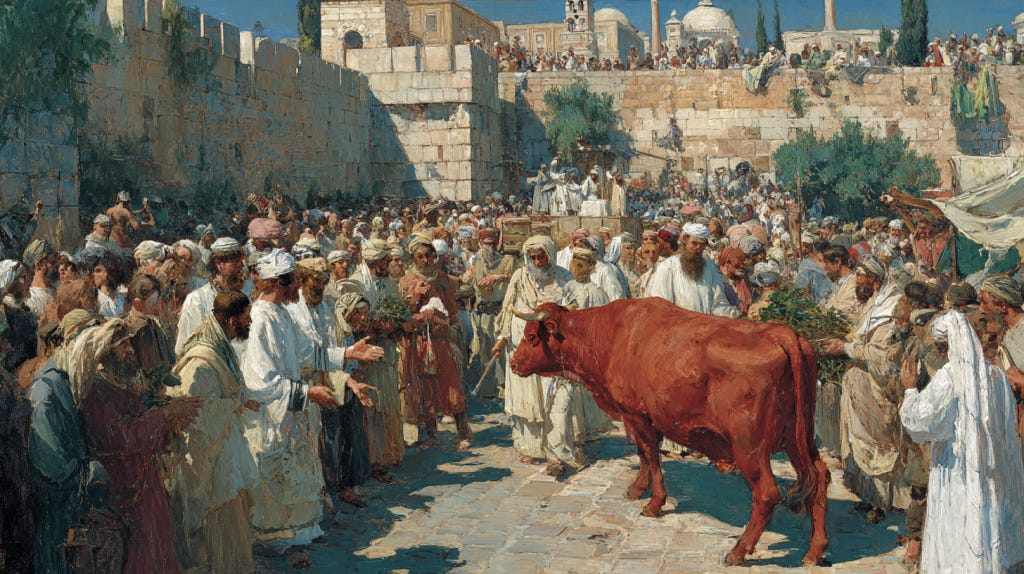
Alexander Dugin argues that Zionism is Judaism’s heretical rebellion where Jews declare themselves God, seize the Holy Land by force, and plunge tradition into apocalyptic upheaval.
In the modern world, the Middle East remains the epicenter of geopolitical conflicts, where the interests of various forces intersect, including Islam, Judaism, and global powers. Particular attention is drawn to Zionism as the state ideology of Israel, which, in the view of many analysts, carries an eschatological dimension linked to the end times.
Like any religion, Judaism is a complex phenomenon encompassing metaphysics, history, and philosophy, with numerous interpretations that sometimes contradict one another. We will examine how Zionism fits into this tradition and why it can be perceived as both its continuation and, at the same time, its refutation.
Judaism as a religion is tied to the idea that the Jews are the chosen people. Primarily in a religious sense, because this people was chosen to:
remain faithful to the one God at a time when other nations, according to Judaism, had departed from this monotheism, and
await His messenger, the Messiah (Mashiach), who will be crowned King of Israel and Ruler of the world.
The Hebrew word mashiach means “anointed” or “anointed for kingship.” The same word in Greek is Christos. But Christianity is founded on the conviction that the Messiah has already come into the world. That is our religion. The fundamental difference from Judaism lies in the fact that Jews believe the Messiah has not yet come and do not recognize Jesus Christ as the Messiah. This is the core distinction.
An extremely interesting point arises next. According to the Jewish religion, the Jews went into exile at the beginning of the first millennium, in the 70s AD (the fourth exile). This occurred after the Romans carried out a punitive operation against the rebellious province. The Second Temple was destroyed. The Jews left Palestine (the Holy Land). And thus began the two-thousand-year era of dispersion.
This era has religious meaning, as detailed in Jewish tradition. The purpose of the dispersion is to atone for the sins of Israel accumulated in previous historical stages. If this atonement is genuine and repentance (teshuvah) is profound, according to Jewish tradition, the Mashiach will appear as a blessing from the Jewish God for the deeds of His chosen people. In such a case, the appearance of the Mashiach will be a sign from above for the return of the Jews to Israel, the establishment of independent statehood, and the building of the Third Temple in Jerusalem on the site of the destroyed Second Temple.
In principle, the most consistent representatives of this Jewish approach are certain fundamentalists from the Neturei Karta movement or the Satmar Hasidim, who say something like: “Our Jewish God commanded us to endure the hardships of exile; let us wait for its end, let us atone for our sins, and when the Mashiach comes (but not before!), we will return to Israel, the Promised Land.” They rely on the fact that the Talmud contains a clear prohibition against a mass return to Palestine before the coming of the Mashiach, and especially against achieving it through force.
The Talmud prohibits it and firmly asserts: first the Mashiach, then the return to Israel, and no other way.
Here a question arises: how, then, was the State of Israel created when, apparently, the Mashiach has still not come? Even the most extreme Zionists do not claim that he has arrived.
To understand how it happened that the modern Israeli state stands in complete contradiction to Jewish religion in its orthodox, Talmudic formulation, we must dig deeper and go back at least to the 17th century, to the era of the pseudo-messiah Sabbatai Zevi. As Gershom Scholem writes, he was the first harbinger of Zionism.
Sabbatai Zevi declared that he himself was the Mashiach, and therefore the Jews now had the right to return to the Promised Land.
Sabbatai Zevi met a tragic end. When he arrived before the Ottoman sultan demanding that Palestine be handed over to him as the Messiah, the Ottoman sultan said: “I have another proposal for you, Mr. Sabbatai Zevi: if you continue spouting this nonsense, I will cut off your head. But if you want to survive, immediately accept Islam.”
At this point, Sabbatai Zevi makes a strange gesture. He puts on a turban and says: “You are right, you win; I am no Messiah—let me now preach Islam.”
He was spared, but what disappointment, what a blow to the Jewish community that was already prepared to embrace Sabbateanism! Sabbateanism was rejected by orthodox Judaism, but it did not disappear completely and continued to spread, especially among Ashkenazi Jews in Eastern Europe, almost underground. In the very same regions where it spread, Hasidism began to take shape—a movement that lacked sharp eschatological and messianic orientation but emphasized the dissemination of Kabbalah among ordinary people. Traditionally, Kabbalah could only be studied by elderly rabbis who had mastered all other forms of Talmudic learning.
But what happened in some Sabbatean sects? A theory emerged that Sabbatai Zevi was in fact the true Messiah, and he entered Islam deliberately because he committed a sacred betrayal. What is sacred betrayal? An entire theology of sacred betrayal developed, asserting that Jews could renounce their faith and outwardly enter another religion but only for appearance, in order to undermine it from within, while secretly continuing to profess Judaism.
Later, the Sabbatean Jacob Frank converted to Catholicism. Moreover, he supplied Catholic censors with so-called evidence of the “blood libel”—the legend that “Jews eat Christian infants.” He insisted on this as a converted Jew himself and provided “irrefutable evidence.” Frank completely abandoned all forms of Talmudism and renounced his faith, betraying his coreligionists. Yet he had justification. The secret doctrine of Frank, like that of Sabbatai Zevi, claimed that after the 17th century, the very concept of the Mashiach had changed. Now the Mashiach is the Jews themselves. There is no need to wait for some separate Mashiach—the Jews are the Mashiach.
Therefore, even if a Jew betrays his religion, he remains holy because he is holiness itself; he is God.
Thus, an intellectual environment was created for Zionism.
The essence of Zionism lies in it being a kind of “Jewish Satanism.” Not Satanism in relation to other peoples or cultures, but Satanism within Judaism—that is, an inversion of values. If classical orthodox Judaism insists that the meaning of Jewish existence in dispersion (galut) consists in awaiting the Mashiach, who will come from outside, and only then should one return to the Promised Land, Zionism is based on the principle that the Jews themselves are God. Therefore, they can return to Palestine right now and can do so by force, thereby rejecting the Talmudic prohibition and proceeding to build the Third Temple. The appearance of the Mashiach will be the culmination of this messianic process, but in essence, every Israeli is the Mashiach.
Hence the completely specific relationship between Zionism and Judaism. On one hand, Zionism is a continuation of Judaism; on the other, it is a refutation of Judaism, since it rejects the most fundamental principles of Judaism: the culture of pious waiting and the culture of repentance (teshuvah).
Moreover, Zionists assert that the Jews have nothing to repent for—they have suffered enough. The Jews are God—not merely “the people of God,” but God Himself. Therefore, no law applies to them; they are their own law.
This explains the fundamental feature of the modern Zionist movement, which relies not only on Israel but also on a vast number of secular Jews, liberal Jews, atheist Jews, communist Jews, capitalist Jews, Christian Jews, Protestant Jews, Catholic Jews, Orthodox Jews, Muslim Jews, Hare Krishna Jews, neospiritualist Jews, occultist Jews—all types of Jews who in fact represent a network of generalized Frankism. Precisely because they collectively and individually are now the Mashiach, each of them can calmly engage in sacred betrayal while not sinning against their essence.
This is an immanent messianism in which the concepts of Mashiach and the Jews themselves have swapped places. Zionists no longer wait for the Mashiach—they themselves are the Mashiach, and therefore there is no one and nothing left to wait for. All that remains is to rely on their own strength and their own global networks to assert world domination and build their Israeli state, disregarding the local population or any other costs.
This is served by the formal prohibition on criticizing Zionism that operates in some American states, where anti-Zionism is equated with anti-Semitism.
If we look closely, we notice that the State of Israel itself wages war against Semites—that is, against the Palestinians, Arabs who are pure Semites. Moreover, Zionist ideology cannot even be fully called “Jewish” because it is based on the refutation of the basic principles of Judaism. If there is no waiting for the Mashiach, then what Judaism is there?
The very existence of the State of Israel is, in the eyes of Zionists, proof that they are the Mashiach. Otherwise, the state would not have arisen. They attribute all credit for its creation exclusively to themselves and their networks. Since it succeeded, they believe, it was done with God’s help.
Then only one step remains: to blow up the Al-Aqsa Mosque and proceed to build the Third Temple, which is precisely what the extreme Zionist group—the Temple Mount Faithful movement—calls for. Enormous funds have recently been allocated for research on the Temple Mount.
Since Zionism has such a profound metaphysical underpinning, taming it with UN appeals or futile cries of “let’s make peace, let’s respect human rights” is pointless.
We are in the thick of eschatological scenarios with a very deep metaphysical basis. The situation is becoming increasingly alarming, far exceeding the bounds of habitual banal explanations—economy, markets, oil prices, stock exchanges, national interests, and so on—which are becoming more and more contradictory and even absurd.
We live in very interesting times, but the price for the opportunity to live in them is that parts of our consciousness are simply blocked or paralyzed. If we step beyond the hypnosis, fog, nonsense, absurdity, and postmodern fragmentation of consciousness, we will see a very interesting and terrifying picture of what is happening in the Middle East.
The mentioned figures:
Gershom Scholem (1897–1982): Israeli historian and specialist in Jewish mysticism (Kabbalah). Considered the founder of the modern academic study of Kabbalah. Scholem described Sabbatai Zevi as a harbinger of Zionism, emphasizing how messianic movements influenced Jewish history.
Sabbatai Zevi (1626–1676): Jewish mystic and false messiah who proclaimed himself the Mashiach in the 17th century. His movement (Sabbateanism) generated massive enthusiasm among Jews but ended with his conversion to Islam. This event influenced the development of antinomianism (violation of laws for “spiritual purification”) in Jewish sects.
Jacob Frank (1726–1791): Founder of Frankism, a religious movement combining elements of Judaism, Christianity, and Islam. Frank claimed to be the reincarnation of Sabbatai Zevi and preached “purification through transgression” (sacred betrayal), including the rejection of traditional Judaism. His followers (Frankists) contributed to antisemitic campaigns, such as blood libel accusations.
Neturei Karta: An anti-Zionist ultra-Orthodox Jewish group founded in 1938. They view Zionism as an affront to God, since Jews should not return to Israel en masse or by force before the Mashiach comes. The group advocates the peaceful dissolution of the State of Israel and supports the Palestinians.
References to books and sources:
Gershom Scholem, Sabbatai Sevi: The Mystical Messiah, 1626-1676 (Princeton University Press, 1973): A classic biography of Sabbatai Zevi, where Scholem analyzes him as a precursor to Zionism. The book emphasizes how messianic expectations evolved into political movements.
Paweł Maciejko, The Mixed Multitude: Jacob Frank and the Frankist Movement, 1755-1816 (University of Pennsylvania Press, 2011): The first comprehensive study of Frank and Frankism, showing its influence on Jewish-Christian relations.
Talmud (Ketubot 111a): Contains the “Three Oaths”—a metaphor in which the Jews swear not to “ascend as a wall” (mass return) to the Land of Israel before the Mashiach, not to rebel against the nations, and not to hasten the end times. This is interpreted as a prohibition on creating Israel.
Yotav Eliach, Judaism, Zionism and the Land of Israel (Wise Path Books, 2018): An overview of 4,000 years of Jewish history, focusing on the religious and ideological aspects of Zionism.
Yitzhak Conforti, Zionism and Jewish Culture: A Study in the Origins of a National Movement (Academic Studies Press, 2024): A study of the cultural roots of Zionism, including the balance between tradition and modernity.
Yossi Shain, The Israeli Century: How the Zionist Revolution Changed History and Reinvented Judaism (Post Hill Press, 2021): An analysis of how Zionism transformed Jewish identity from diaspora to sovereignty.
Derek Penslar, Zionism: An Emotional State (Rutgers University Press, 2023)—on the emotional aspects of Zionism.
Marjorie N. Feld, The Threshold of Dissent: A History of American Jewish Critics of Zionism (NYU Press, 2024)—on Jewish critics of Zionism.

🎯🎯🎯 💥💥💥 🔥🔥🔥 👍👍👍 !!!
Thank you so much for this very informative and educational article !!!
Antichrist not only as a person, but as a CIVILIZATIONAL MINDSET. The EGO elevated to divinity.