
The Epstein Archipelago: A Philosophical Perspective
by Natalia Melentyeva
Natalia Melentyeva descends into the Epstein archipelago as a shadow realm of elite ritual, power, and secrecy, revealing a hidden metaphysical order where scandal, desire, and domination converge into the true operating logic of the modern world.
The story of Jeffrey Epstein is not merely a criminal chronicle that lifts the veil on the mechanisms of the deep state, on hidden structures of power, or on what lies behind the façade of respectability among global elites. A philosophical approach makes it possible to discern, behind the story of the “Epstein Archipelago,” profound shifts in the very paradigms of thought in the modern world, which is fatally and catastrophically moving toward its own dehumanization, toward a precipitous collapse: from God to the devil, from Spirit to blind and shameless flesh, from beauty to aggressive ugliness, from virtue to militant vice.
The Archipelago of Vice: Epstein’s System and Methods
The owner of Little Saint James Island, Jeffrey Epstein, was not merely a wealthy financier, philanthropist, teacher, adviser, and consultant, or simply an “altogether agreeable” man and conversationalist. Nor was he merely an intelligence operative linked to Mossad and the CIA, collecting compromising material on influential figures around the world and turning his private residences in the Caribbean and in New Mexico into epicenters of a shadow network for managing global affairs.
For decades, he operated with impunity, coordinating the trafficking of living human merchandise in the form of innocent children, some of whom were identified in his files as “child prostitutes,” brazenly directing the transfer of underage girls and boys from various countries to his own islands in the Caribbean and to the “Zorro” ranch in New Mexico, and then cynically selling them for the sexual use of older influential men from the state services of different countries, or using them himself and offering them to close friends as sex toys and ritual victims.
Witness testimony also confirms Epstein’s obsession with scientific developments in transhumanism, social biology, eugenics, and artificial intelligence, as well as his sponsorship, “for the good of science,” of borderline scientific and quasi-scientific experiments involving human cloning and the modification of the human genome. All of this has long raised many questions. Yet to this day, the American and European public has shown a striking degree of tolerance and uncritical indulgence toward the endlessly depraved and horrifying activities of Jeffrey Epstein. All this provokes bewilderment and outrage and demands serious and comprehensive explanation.
At the same time, it would be too simplistic to explain the blatant lawlessness of everything that took place merely by the presence behind him of certain influential figures or powerful secret organizations guaranteeing his inviolability and impunity.

The matter is far more complex and far more serious. We assume that behind the façade of such openly practiced lawlessness there lie very deep, systemic, and fundamental processes connected with complex seismic shifts in the very foundations of the modern world as such, driven by basic transformations in society’s worldview and paradigms of thought, as manifested in the latest trends in philosophy and science.
What is involved is a radical shift within the very matrices that produce the forms of life of contemporary Western capitalism, as well as troubling transformations in the strata of worldview that sustain it; in the pathological dynamics of elite and mass consciousness, in types of rationality, and in the impulses of the unconscious breaking free of their control; and in the sinister mutation of the way modern man psychically lives through and existentially intuits the “stream of life.”
What is involved is the total crisis of the modern world and of man.
Experiments on Human Nature and “Child-Breeding Farms”
In searching for the key to the Epstein Archipelago, we will try to avoid overtly conspiratorial frameworks, relying primarily on philosophical analysis.
Epstein was a highly sophisticated manipulator: a pervert and a sadist who stunned the world with acts of shocking evil and with an unimaginable freedom in disregarding moral prohibitions and the limits of the human. The publication of court documents in the Ghislaine Maxwell case confirmed the active presence in his circle of hundreds of top-ranking figures from the global political establishment—former and current presidents, prime ministers, senators, members of parliament, and actors. Epstein’s lists include the names of members of royal families, prominent scientists, and popularizers of science. The flight logs of the private plane known as the “Lolita Express” provide evidence that influential individuals who regularly visited the island were fully aware of the obscene nature of what was taking place there. Epstein evidently held a number of structures within the political systems of the United States and Europe in his grip. His network penetrated academic circles, corrupting truth itself.
The official charges against Epstein for sex trafficking, within the framework of which the system he built used underage girls, boys, and young children for the sexual servicing of politicians, princes, and billionaires, are only the tip of the iceberg. The files contain testimony indicating Epstein’s organizational and financial participation in private transhumanist initiatives, in secret laboratory developments in regenerative medicine using cells obtained from the tissue of newborns, as well as in prohibited research in the field of human cloning and the creation of designer children. Correspondence has been found between Epstein and Bryan Bishop, one of the developers of Bitcoin, a biohacker and, by his own admission, a “mad scientist,” concerning secret laboratories in Ukraine where modified human sperm was being tested and related trials were being conducted. In letters to Bishop, Epstein himself reported that he was keeping as many as twenty pregnant women at his “Zorro” ranch at one time, and spoke of a five-year financing plan, amounting to $9.5 million, for a project to create a genetically modified and cloned human being, with the aim of moving beyond garage-level experimentation and achieving the first live birth of an artificial child.
There are reports that he compelled young girls not only to live with him, but also to bear children, placing them in a kind of harem in which he saw himself as a sultan and the master of underage slave girls. According to witness testimony and email correspondence, he was creating something like “child-breeding farms” or “cloning laboratories” (as these places were described in the letters) on his ranch in New Mexico, where he pressured his underage concubines to give birth to children and then took those children away, allegedly for further laboratory experiments. Girls who dared to speak about these wild experiments said that Epstein, being deeply invested in Darwinism and evolutionary theory, was inspired by the ideas of experimental genetics, eugenics, the breeding of new species, cloning, and the selective engineering of human beings. It is known that at his parties Epstein spoke about superhumans from test tubes. All such activity and correspondence were accompanied by strict measures of secrecy, confidentiality, and anonymity surrounding the criminal experiments: the impossibility of identifying the parents of the infants was supposed to guarantee the safety of the sponsors of the illegal experiments.
Ritual Violence and the Search for Metaphysical Foundations
But sex with minors, homosexuality, and pedophilia were not the worst things that took place in the laboratories and salons of the Epstein Archipelago. Equipped with surveillance systems that recorded the guests’ every action, Little Saint James Island and the Zorro Ranch, as well as Epstein’s mansions and apartments, yachts and planes, became sites of violence and torture. Fear and pain were used not only to satisfy the base instincts of elite guests, but also as instruments for psychologically breaking victims. In Epstein’s correspondence with representatives of the global elite, specific codes were used to denote forbidden acts, making it possible to discuss crimes in plain sight: code words were employed to disguise monstrous things as ordinary household items and foods. For example, words such as “pizza,” “hot dog,” “grape cola,” “ice cream,” and “jerky” were allegedly used to designate particular perversions and fetishes in which select members of the powerful elite participated, as well as to encode the age and sex of victims and the specific sexual preferences of clients. Geometric symbols—triangles and spirals disguised as the logos of children’s organizations or brands—served as markers for recognizing “their own,” as well as indicators of sites where orgies were held.
According to materials from independent investigations and the testimony of surviving victims, activity on the island had a ritualistic character, in which orgies and sexual slavery became a ticket into the club of the “untouchables.” Unusual structures resembling temples, underground chambers, secret passageways, corridors, and halls covered in symbols suggested that rituals inspired by dark cults were carried out there; the use of occult symbolism and owl imagery hinted at connections between the island and “Bohemian Grove” and other secret societies. Today, researchers studying the corpus of files put forward hypotheses that Epstein’s guests may have participated in reenactments of ancient Moloch cult rituals involving torture, torment, killings, sacrifices, and the consumption of the blood and flesh of children. The most extreme versions claim that, under torture, the blood of an innocent and uncorrupted child produces a special fear hormone, “adrenochrome,” which grants youth and longevity to those who consume it, and that this was what the gray-haired guests of the Archipelago were hunting for.
All these stories appear as a panorama of inhuman acts beyond the bounds of madness, or as a series of sophisticated anthropological experiments carried out by villains on an almost cosmic scale. But in order to penetrate the meaning of the sinister picture unfolding before our eyes, one must look away from the surface of events and peer deeper, behind the curtain. Then, behind the façade of individual human depravity, perversity, and the brazen confidence in impunity shown by the powerful, a second plane comes into view, indicating that we are dealing with something far larger and more serious, something that demands a full and developed philosophical analysis touching on such subjects as man, power, time, death, desire, violence, science, and technology.
The philosopher Plotinus proposed that one should investigate and understand the world by “closing one’s eyes” to the outer side of events in order to penetrate with the mind into their hidden meanings. What foundations, ideas, programs, and aims lie behind Epstein’s relentless perverse activity?
The Philosophy of Omnipotence: Criminal Elites and the End of Morality
If we examine the problem sociologically, through the lens of elite theory and mass theory (Vilfredo Pareto, Gaetano Mosca, Robert Michels, Christopher Lasch), the picture of the modern Western world appears as follows.
The emergence of capitalism on a global scale necessarily leads to total inequality among people and nations, and to the dominance of the principle of “elitism,” both in the structure of the world community as a whole (the division into the “rich West” and the “poor South”) and in the functioning of individual societies. According to elite theory, the myth of equality and the growth of the middle class in democratic societies is exactly that: a myth and a crude form of propaganda. Social hierarchy, the division into masters and slaves as seen in ancient societies, does not disappear but merely assumes new forms. Slaves are persuaded that they are no longer slaves, but this only deepens their enslavement. The omnipotence of ruling elites is masked by democratic procedures, elections, and representation, none of which alters the sharp stratification of social systems. Elites and masses cannot vanish, dissolve into one another, or exchange places. Michels called this the “iron law of oligarchy”: in any social system, power belongs to a closed caste constituting an absolute minority.
The Epstein case confirms that, at a certain level of wealth, the law effectively ceases to exist. It shows that the omnipotence of contemporary elites is built not only on immense wealth but also on class solidarity, reinforced by mutual complicity in everything, and not least by a “community of sin.” When leading figures in government, business, finance, culture, science, and intelligence services are bound together by blood and by participation in conceivable and inconceivable crimes—waging wars, orchestrating financial manipulations, illicit transfers of technology, criminal human experimentation, insider trading, espionage, human trafficking, orgies, murders, and cannibalism—they become a monolithic force, a kind of parallel universe for which human life is merely a resource or expendable material for exploitation, consumption, entertainment, or ritual.
Epstein’s death in custody (which many now question) became the final act in concealing the truth—a signal that the system of capitalist solidarity is capable of eliminating anyone who threatens its unchecked power and anonymity.
In a certain sense, we are witnessing the triumph of a thesis associated with the American writer Ayn Rand, who glorified a form of unrestrained capitalism: the existence of “wealthy” global societies “beyond good and evil,” where the elite sees itself as a new class of titans, free from the constraints of human morality, entitled to proclaim the absolute freedom of domination by a “higher human type,” by “higher races,” and to inflict violence on the human “herd.”
Ayn Rand wrote:
I have put an end to the monstrous ‘we’—the word of slavery, theft, misery, falsehood, and shame. And now I see the face of god, and I raise it above the earth. It is the god that man has sought since human beings came into existence. This god will grant us joy, peace, and pride. This god is ‘I.’ [1]
Contemporary Western elites embody not merely a “racism of the rich” (in Bill Gates’s conversations with Jeffrey Epstein, it was openly discussed that “the poor should not exist at all,” that is, they should die out and be replaced by “perfect slaves,” namely robots). Nor is this simply an economic or anthropological racism. As the English scholar J. Hobson has shown, racism in the West today has assumed a wide variety of forms: cultural, economic, technological, epistemological, worldview-based, and moral discrimination.
Hierarchies also existed in ancient societies. But they were open, and it was believed that the highest strata were composed of the most spiritual (priestly) and the most courageous and heroic (warrior) types of people. These elites stood with one foot in the spiritual world, and precisely for that reason they possessed legitimate authority. Capitalism abolished this spiritual dimension, proclaiming that only earthly life exists and that within it all are fundamentally equal. But in reality, power passed to those who were “more equal than others,” namely, to those who were even more worldly, greedy, predatory, base, lustful, and power-hungry than everyone else. Hierarchy did not simply fail to disappear: its meaning was inverted into its direct opposite. The worst rose to power, disguising this with the deceitful myths of democracy and freedom.
Yet “elite theory” and the recognition of glaring inequality in capitalist societies require a deeper philosophical analysis, above all of the very quality of these elites. And the Epstein files provide us with an enormous body of factual material for precisely such a philosophical inquiry.
Epstein’s Elites and the Philosophy of Postmodernism
Today, the expression “Epstein’s elite” is used with increasing frequency. Let us examine what it signifies from a philosophical point of view, for behind any concept lie far deeper philosophical and scientific ontologies, reflected in worldview paradigms or fundamental matrices of thought.
For the horrors of the Epstein Archipelago to become possible, there must exist a particular philosophy of the modern elites, one which, in our view, has its roots in postmodernism, that cultural matrix or paradigm of thought which, at the end of the twentieth century, overturned the basic principles of Modern philosophy, displacing in the West the earlier paradigm of Modernity characteristic of the early stages of capitalism, with its faith in moral progress, participatory democracy, social equality, humanism, reason, and the exponential growth of wealth and of the middle class distributed more or less evenly.
The philosophy of postmodernism runs through the horror of Dr. Epstein’s pathological strategies and destructive initiatives. We believe that the root of his deepest inspirations grows out of that flashy and seemingly liberating, yet in substance impoverished and decadent worldview grounded in the paradigm of postmodernism, which over the past fifty or sixty years has completely subjugated the Western world. It is precisely postmodernism, as a worldview, an ideology, and the sharply defined picture of reality that flows from them, that stands behind the grotesque and sinister views and actions of the collective “Epstein Archipelago.”

Paradigms of thought are a kind of intellectual templates, stencils of thinking, structures and strategies for understanding the world and shaping a worldview. They are by no means cold schemes of reason; a biological analogy is more appropriate: like octopuses, they keep in a certain order, with their tentacles, the minds of rulers and ordinary people, analysts and commentators, elites and common individuals who imagine themselves to be independent and free.
The dominant characteristic of the contemporary West is the paradigm of Postmodernism in its late and critical stage, with its radical materialism, atheism, individualism, the total disintegration of the subject, and an increasingly evident anti-humanism, anti-democratic tendency, and totalitarianism. Postmodern strategies of liberation and emancipation have left Western man alone with his small individual self and with Nietzsche’s thesis of the “death of God,” without bearings or points of reference, without plan or purpose, only to collapse in the end into the abyss of nothingness. And man cannot withstand this tension in the face of “nothingness” (J.-P. Sartre [2]) and disintegrates into fragments. If Modernity spoke of the death of God, Postmodernity speaks of the death of man, the “death of the author.”
Even Lower Than the Body
If Tradition and Modernity masked death and destruction—cold nothingness itself—behind the body, Postmodernism has descended to the lowest threshold of materiality and declared itself ready for the final encounter with nothingness, ready to rush toward the limit of annihilation and to accept this fall as the guiding principle of ontology, epistemology, and progress.
Postmodernism is a drive to penetrate to the underside of matter, to burrow into matter, definitively taking its side and thus placing itself in opposition to human reason. It undoes the Modern formula that man is “individual,” that is, “indivisible,” and breaks through into the micromolecular regions of the human and the social. It undertakes the deconstruction not only of large wholes and hierarchies, but also the dissection of the individual himself, descending to subatomic levels (the genome), attempting to reach the final limit of the material—the horizon of immanence.
What in Modernity was still called the “human subject” is, in Postmodernity, called upon to become ever less organized and coherent, ever less complex and more fragile, increasingly receptive to the dark, trembling undercurrents of infernal layers of the psyche, where mind, meaning, and even reason are no longer discernible. When the last remnants of rationality—those that bind the individual to society and guarantee his integrity—are finally dissolved, Postmodernism is ready to turn once again to the body and pass over it like a steamroller, erasing its last ridges and contours.
Its aim is to disperse, fragment, and scatter the human being; to merge subject with object; to disintegrate the body, turning it into a “body without organs,” a “smooth surface” sliding freely over another smooth surface. No hierarchies, no differentials such as “high/low,” “good/evil,” “religion/atheism,” “reason/madness,” “individual/collective,” “general/particular,” “nature/culture.” Everything is merged, smooth, continuous. No religions, ethnicities, states, nationalities, organs, levels, or even sexual differences.
The human being is not even an individual; the individual is an abstraction. Instead, there is the rhizome, a self-expanding, freely branching tuber beneath the surface of the earth, a kind of sub-individual and sub-corporeal level of manifestation of human molecules, waves, photons, and electromagnetic fields. It is to these elements, artifacts, or targets that a new fractal, molecular subjectivity is transferred. All these dissolved and unraveled forms of subject and body signify, for Postmodernists, the ultimate liberation.
Jean Baudrillard, ironically commenting on Postmodernism, called such a liberation of unstructured elements within the body “a kind of cancer” [3]: an uncontrolled proliferation of asexual, self-identical, endlessly replicating cells detached from the organism’s integrity, like debris. The same occurs at the level of the subject, which undergoes dissipation, dispersion, random agglomeration, and turns into a set of elementary particles. The dismantling concerns not only the social personality but the organism itself. This can easily be seen in the networked world, where there is no longer a fixed individual, but rather a set of typified, fluidly dispersed traits. Online, it is no longer individuals who exist, but nicknames, bots, clones, momentary roles, algorithms, and programs that animate the chaotic life of the chain.
Further, the decoding of the genome and the modeling of the brain make it possible to assemble fragments and remnants of the human into an artificial composite construction that begins to live its own peculiar life and think, freely and mechanically rearranging its algorithms, moving in an arbitrary, creeping fall from nowhere into nowhere.
Postmodernism becomes the program of consciousness of a subject disintegrating into parts, losing any sense of structure and wholeness, of forms and contours, of orientation and purpose.
Postmodernism calls for the acceleration of the total disintegration of human subjectivity, assigning a positive value to this process: the greater the disintegration, the more progressive, modern, and free it is.
Jacques Lacan: The Real, The Symbolic, The Imaginary
If we apply the philosophy of postmodernism to an analysis of the networks uncovered in the Epstein case, we can observe some very significant parallels.
Epstein’s networks were built on the manipulation of desire. They enveloped the participants in criminal orgies in a single web of pathological eroticism. It is evident that high-ranking guests in Epstein’s world were drawn, to a considerable extent, by the fact that their desire was set free there. Postmodernism devoted enormous effort to clarifying what desire is, whose it is, what it is directed toward, and from where it originates.
Let us begin with the philosophical and psychoanalytic model that underlies the postmodern method in Jacques Lacan’s system.
In Jacques Lacan’s post-Freudian psychoanalysis, the question was raised as to who is the subject of “libido,” meaning sexual desire and drive. Prior to Lacan, in the psychoanalysis of Sigmund Freud, a picture had emerged in which the object of desire could be quite varied: desire could be transferred onto different objects, hence fetishism, “transference,” and the origins of various perversions. At the same time, Freud considered gender roles to be relatively fixed within the unconscious: the subject of desire was predominantly male, and desire was generally directed toward a woman or her substitutes. In the erotic relations of patriarchal cultures, the woman appears primarily as the object of desire, while the man, on the contrary, acts as the subject, though in a certain sense also as an object.
The problem of desire in the case of a woman is always somewhat more complex than in that of a man, hence Freud’s well-known question: “Was will das Weib?” (“What does a woman want?”). This is a purely rhetorical question; within classical patriarchy, no answer exists. In post-Freudian thought, however, confidence in a two-pole structure of desire, that there is a stable subject of desire and a corresponding object, begins to erode.
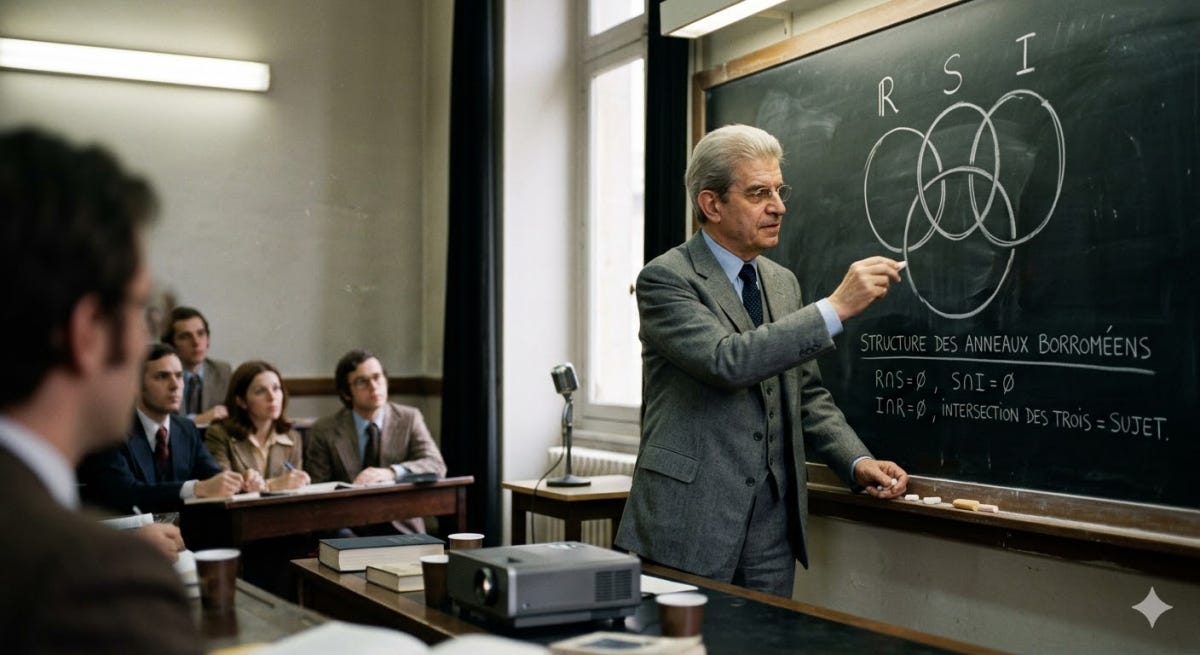
In Lacan’s theory, the structure of the human self or psyche is described through three registers, the Borromean rings, inseparably linked into a single whole [4].

He calls this the R–S–I model (Réel, Symbolique, Imaginaire, the Real, the Symbolic, and the Imaginary).
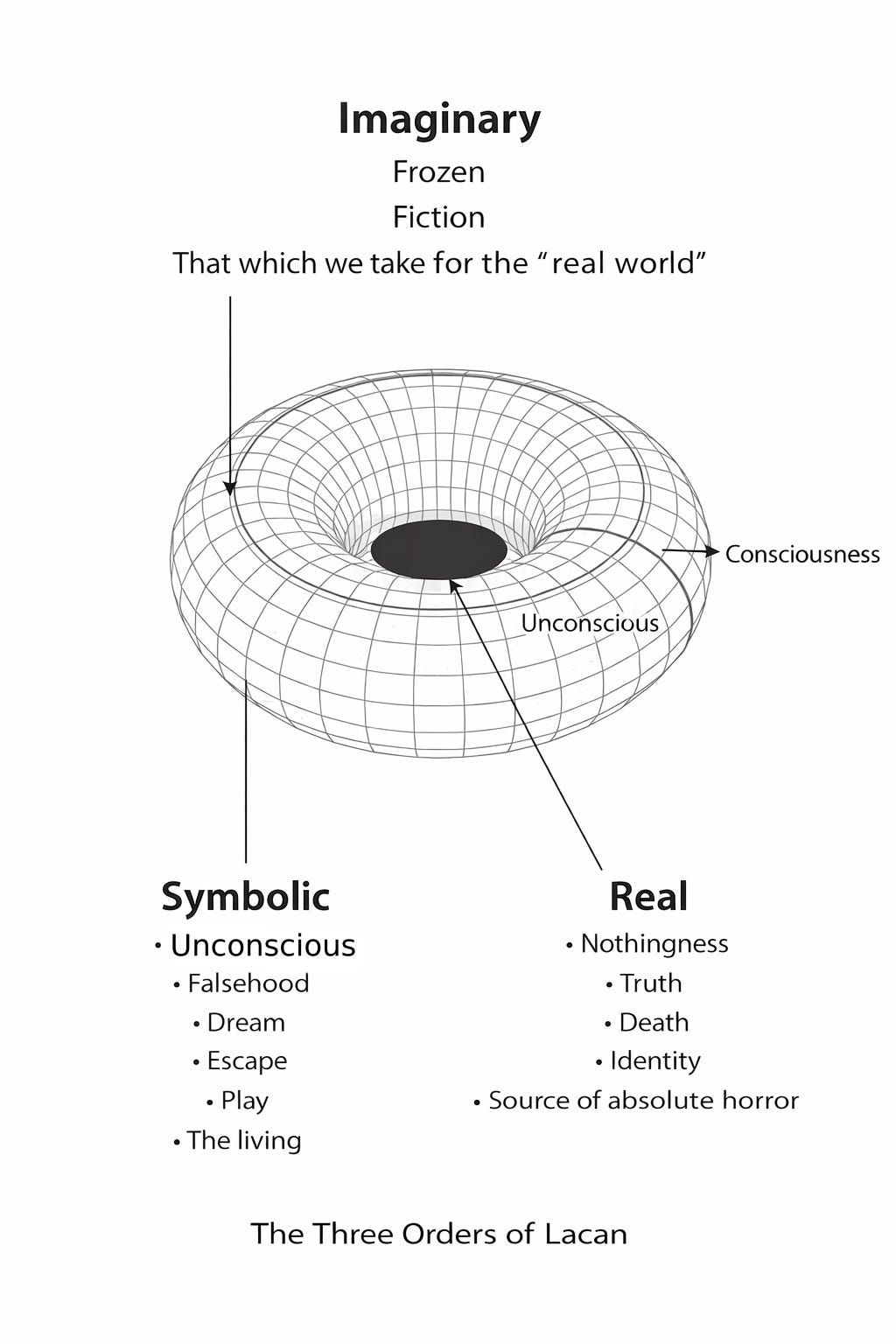
The Real is the most complex concept in Lacan’s system. By it, he refers to death, immobility, and the complete identity of everything with itself, without the possibility of change, movement, or life. The Real is a frozen eternity in which there is nothing. Anything that enters it dies. The human being always flees from the Real, above all into the Symbolic, which encompasses the entire field of the unconscious, where the fundamental processes of life unfold, that is, transitions and slippages from one thing to another across time and space. Life is movement, dynamism: for life to exist, it is necessary to violate the law of identity, which constitutes the essence of the Real. In the Symbolic, nothing is ever identical to itself: there is only a sign referring to another sign, and so on infinitely.
The third register, the Imaginary, for Lacan includes everything we take to be “objective”: objects, things, society, institutions, roles and masks, and our representations of the rationality of all that exists, including the human self.
Thus, the dead, immobile, self-identical images of the Real exert pressure on the Symbolic and compel it to flee from the laws of identity, immutability, and stagnation. Through the Symbolic flow the currents of time, processes, and cascades of meaning. This is life in its fullness. It is precisely within the Symbolic, as in a magical dream, that semantic structures arise which determine the content of everything our waking, rational mind encounters in the register of the Imaginary.
If in the Real all things, by becoming fixed, are annihilated, then in the Imaginary things acquire an illusory self-identity, since, passing through the chaotic flows of the dream-like (oneiric) life of the Symbolic, they attain a certain stability and permanence, this time with meaningful content, unlike the emptiness of the Real. The Imaginary is everything as we represent it: the world, ourselves, objects, society, institutions and practices, the cosmos, the universe. In it, things still preserve to some degree a connection to the Symbolic; their being and form tremble slightly. Here, the meaning of the being of things is drawn from the restless, inexhaustible Symbolic and translated into the more stable form of the Imaginary, without losing the content and meanings derived from the Symbolic.
This is how, according to Lacan, the unconscious operates, constantly evading death through a garland of deceptive aims, each pointing to another in an endless recursive chain.
The Little “a” Desires the Big “A”
According to Jacques Lacan, the source of desire that allows a person to flee death, the empty and pure nothingness of the Real, is a special instance that does not coincide with the subject of classical psychology. He designates it as an indeterminacy, marked by the concept of the “little a” (“a” from the French autre, “other”). This is the Other within us, distinct from ourselves.
The “little a” (petit a) is a kind of void that compels us, seeking refuge from the chilling breath of Death, to constantly search for something outside ourselves in order to fill the aching lack within. But what exactly can fill it? According to Lacan, what fills it is itself another indeterminacy, a “vague object of desire.” It is not money, not property, not persons of the opposite or same sex, but always something elusive, something that slips away.
We cannot cope with the diffuse energy of our indeterminate drive, with this flight in pursuit of something unknown, and therefore we are forced to fix it in the form of some fixed object in the external world, as that which we supposedly desire. We cannot simply desire in the abstract; that would destroy us. We must anchor this “something indeterminate,” in fact something “non-existent,” by defining and fixing it. We seek to determine the indeterminable, but for Lacan the fixation of desire always ends in a false objectification, which immediately begins to dissolve with the realization that such a goal is fictitious.
And for Lacan, a non-fictitious goal does not exist at all, because desire moves along a centrifuge of symbolic transfers, where one element refers to another, the second to a third, and so on in an endless chain. Dreams are structured in precisely this way, as an unceasing sequence of psychic patterns unfolding like an ornament.
In the waking state, we are compelled to deal with objects that Lacan designates as “Big A.” The philosopher uses “Big A” (again from Autre, “Other”) to designate the entire field of pseudo-objects that constitute the fabric of the external world: society, norms, rules, customs, and rituals, all of which take on the character of false fixations.
We always desire not what we desire, but something else. Moreover, it is not we ourselves who desire, but something other within us that desires. Thus, the entire structure of desire is situated between these two indeterminacies, the “little a” and the “Big A.” The only thing that is certain is that both “little a” and “Big A” describe a reality other than us and other than the very field of desire itself. One could say that “object A” is unattainable: it cannot be obtained or possessed. As soon as the desired object is acquired, we experience disappointment, and the “little a,” feeling deceived, shifts the object of its drive (the “Big A”) to the next target.
Such a desubjectivization of desire, witty and ironic in Lacan himself, takes on a much darker and more ominous character in the postmodern thinkers who follow him, effectively removing from the subject any ontological responsibility for psychic life. The destruction of the subject internally and of sociocultural structures externally collapses the personality, throwing it into a vortex of chaotic impulses and unconscious intrusions with a complete renunciation of any form of control. Lacan himself did not draw this conclusion, but later, in Gilles Deleuze and Félix Guattari, it is actively developed and assumes a prescriptive character. The liberation of the unconscious becomes a “progressive” and morally sanctioned event. At first glance, what connection does this have with Epstein?
Lacan prepares a new model for interpreting desire, detaching it from everything that, in any society, constitutes a complex system of ethical and social prohibitions that shape the structure of a gender-defined personality. If neither the subject nor the object of desire is given to us, then the erotic ritual becomes fully dehumanized, mechanical, and severed from any connection to the structures of social and moral personality. This opens the way to the legitimization of any perversions, since both those who enact them and those who become their victims are entirely removed from the sphere of the human, the cultural, and the social. The result is the indeterminate “little a” in eternal pursuit of the unattainable “Big A.”
And it is precisely this metaphysical experiment that was carried out on a monstrous industrial scale in the practices of the Epstein Archipelago.
“Dark Deleuze”
In the philosophical system of Gilles Deleuze, one of the major and emblematic philosophers of Postmodernism, with his concepts of “transgression,” the “rhizome,” the “dispersion of subjectivity,” and the “liberation of dark life,” Postmodern philosophy reaches its culmination.
Deleuze’s philosophy most consistently and systematically carries out the dismantling of the basic norms of Modernity: the principles of rationalism, progress, earlier hierarchies, vertical structures, the idea of the whole, or what he called “totalizing” or “unifying” paranoia (Deleuze regarded rational subjectivity itself as a product of paranoia). Deleuze held leftist views in economics and politics and proposed a critical reassessment of the strategies of Modernity, identifying it, in a broadly Marxist sense, with the dominance of the bourgeois class. As a revolutionary thinker, Deleuze recommended tearing all these fetishes down to the ground in the name of the next post-bourgeois phase of Western civilization. This outwardly liberatory, progressive-revolutionary aim, upon closer examination, ceases in Deleuze to be a conventionally humanist model. Hence the notion of “Dark Deleuze” [5], who breaks with the traditions of humanism.
According to Deleuze, liberation from the power of capital can occur only through the transformation, deformation, and even liquidation of the human being as we know it, with its morality, rationality, behavioral codes, social meanings, and relations. Capitalism can be overcome only by moving beyond the limits of the human (transgression). And Deleuze, following Georges Bataille, Maurice Blanchot, Michel Foucault, and other heralds of Postmodernism, was prepared to undertake the most dangerous experiments: the complete dismantling of rationality, the transgression of all forms of morality, the rejection of utopian expectations of the future, and the irreversible overcoming of prohibitions and taboos, all in the name of freedom, equality, and true life in all its manifestations.
In Anti-Oedipus [6], Deleuze and his co-author, the psychoanalyst Félix Guattari, recommend purging our speech and actions, our hearts and pleasures, of repression, unfreedom, structures, and hierarchies; freeing ourselves from trust in concepts such as “law,” “limit,” “castration,” “lack,” and “gap”; and healing thought and desire through the ideas of proliferation and the disjunction of the self, followed by the superimposition of its fragments. Deleuze and Guattari encourage the individual being to seek difference rather than sameness, to provoke multiple flows rather than unity, and to favor mobile assemblages over systems. In their view, what is productive is not a sedentary and static condition, but a dynamic and nomadic movement (nomadism). Only a fully liberated and disoriented desire possesses revolutionary force.
The Desire-Machine
Deleuze and Guattari go further than Lacan and construct a theory of desire on the model of a kind of factory, a “desiring-machine”: an assemblage of molecules, each of which produces, at a micro level, its own libidinal impulse, directed arbitrarily. The random convergence of these disparate vectors of desire creates the illusion of a dense flow oriented toward a short-lived, ephemeral, and constantly shifting goal. All of this unfolds in complete detachment from the classical gendered distribution of man as the subject of consciousness and woman as the generalized object. Deleuze and Guattari call their book Anti-Oedipus precisely to emphasize their rejection of the rigid linear structuring of the unconscious characteristic of Freud. Both male and female desire, at its origin, is gender-neutral, they argue. It is simply the operation of a vast collective of molecules, industrially producing the fabric of desire as such. It constitutes an impersonal force of rhythmically pulsating life, and any path it traces is always aleatory (random), like the throw of dice, and isonomic, that is, it occurs “no more in this way than in another.” “Who desires, and what is desired?” This cannot be determined, nor is it necessary. Everything is a continuous fabric of pansexual life.
Human beings are “desiring-machines.” With this concept, Deleuze and Guattari explain the functioning of the psyche and human existence itself. Unlike Freud, and even Lacan, for whom desire is grounded in lack, for Deleuze and Guattari desire is an active, productive force that itself creates reality. The unconscious is thus a factory that produces both social and personal relations. The “desiring-machine” operates freely, on its own; as in Lacan, it has no center and no “I.” The human being is a composite of switching mechanisms that connect one organ to another. Capitalism attempts to domesticate these free machines by confining them within the framework of the nuclear family and programmed consumption. The emancipation of the desiring-machine, against all social norms and the dictates of reason, is, for Deleuze, the path to freedom and creativity.
Society and the psyche, according to Deleuze and Guattari, are high-speed dynamic systems in constant transformation. They are flows (flux): continuous, raw movements of energy, matter, desire, information, commodities, or money, not structured by rigid social codes. While the social machine attempts to “tame” and “code” these flows of mixed desires, forcing them into channels and transforming them into social or moral values, life itself, on the contrary, tends to decode them, allowing them to flow freely and arbitrarily. The individual departs from a system of values, or transforms it, through what they call “lines of flight” (lignes de fuite), or leakages. These vectors and trajectories along which desire escapes from rigid structures, rules, and control are not merely passive “escapes,” but active, creative acts. A “line of flight” leads to transgression, the crossing of boundaries and the production of new spaces through movement, escape, and transformation: such are revolutionary creativity, experiments with identities, and shifts in paradigms of thought.
The Norm of the Psychotic Subject
The basic ontology of Postmodernism is the ontology of schizo-consciousness. Freud discovered the dual topology of consciousness and the unconscious, a double order of the logical (“white order”) and the rhetorical (“black order” of the subconscious and dreams), and proposed bringing dreams and desires out of the unconscious (Es) into the sphere of the conscious (Ego), and then dealing with these dark impulses by placing them under the control of the Ego. In contrast to Freud, a cohort of recent Western postmodern philosophers and psychologists set themselves the opposite task: to carry out a molecular revolution, dissolving and fragmenting wholes, abolishing the repressive Ego, and transferring agency to the dispersed molecular strata of sub-subjectivity.
Gilles Deleuze and Félix Guattari do not distinguish between “dark” and “light” logic, reducing both to landscapes of the unconscious.
The task both authors set themselves is to liberate the individual definitively, to remove the very idea of hierarchy, structure, and, above all, sin, by overcoming the concept of vice itself. Deleuze, following Roland Barthes, reflects on the subjectless human being, transformed into a “demonic structure,” daubed by a “legion of demons” or composed of a multiplicity of micromolecular selves, workers in the “factory of desire,” which momentarily assemble into the semblance of a conscious Ego and then dissolve again. This is the schizoid human type, the psychotic subject as a multiplicity of molecules linked arbitrarily and randomly.
Such spontaneous, atomic subjectivity makes it possible to ignore the idea of a unified self, to bypass or disregard traditional prohibitions against perversions, and to treat the very overturning and violation of prohibitions as a new normality. For Deleuze and Guattari, within their strategy of liberation, it was important to justify and lift the prohibition on incest, to reinterpret sinfulness as an innocent transgression, thereby leading toward the legitimization of various forms of perversion. Guattari argued that we live in a world in which the psychotic or schizoid subject is not fully responsible for their actions and desires, and should be permitted to enact any perversions, including sexual relations with their parents (the Oedipus complex, as the realization of desire for the mother and the killing of the father), or with brothers and sisters (the Electra complex).
Postmodern psychology thus gives rise to the so-called “psychotic subject,” with the normalization of a “demonic texture” composed of legions of molecular “proto-selves,” irresponsible and unstable minor subjects. And this liberated “multiple self” is presented almost as a therapeutic strategy and a moral goal of humanity.
From the postmodernist perspective, the modern world is unhealthy precisely because it is overly repressive, generating a persistent neurosis grounded in a deep mistrust of the unconscious. Guattari proposes to liberate the unconscious within the human being, to loosen the grip of the Ego, and to unleash the unconscious without limits, to cast outward those abysses of the unconscious that are not captured within the structures of the Oedipal complex and that reside at the level of a primordial, infantile unconscious. Deleuze and Guattari seek to grant freedom to psychotics and schizophrenics who do not wish to struggle against their conditions and are unable to consolidate themselves into the molar unity of the Ego.
Schizoanalysis
As Félix Guattari argued, each molecule of our psyche possesses a will to power; it seeks to consume, to grasp, to appropriate some object to itself. The trembling of this “legion,” Guattari and Deleuze interpreted as “life in its most dynamically intense form.” This molecular fragmentation of the human being may “desire” to enter into erotic relations with an animal, a child, an old person, a corpse, a mushroom, any object whatsoever, or to take the form of delirious unions between an orchid and a bee, an umbrella and a sewing machine, a physicist and a shark. And precisely this kind of perception of life, in its liberating coital dimension, is proposed first as permissible and then as a prescriptive norm. “If you are not yet a perverse psychotic, you should become one!” Deleuze and Guattari seem to imply.
Schizoanalysis overturns Freud’s psychoanalysis. It does not prescribe strengthening the Ego, harmonizing the vertices of the Oedipal triangle, or overcoming schizophrenia (splitting), chaotization, and irresponsibility. On the contrary, it proposes that we rid ourselves of the Ego and of reason, along with their claims to eternity, divinity, wholeness, cultural grounding, normativity, and value.
If classical psychoanalysis is built upon the exorcism of demonic legions, and the mission of the psychoanalyst consists in dissolving the legion of “little selves,” then the schizoanalysis of Deleuze and Guattari suggests a different delirium: “Let us legitimize these intrusions into the space of dissolved subjectivity and call them not pathology but health. And those who seek to defend the Human Being from these demons from hell shall be branded as an authoritarian regime, committing arbitrary and sadistic violence against the unconscious...
Our dark and ‘impure’ desires arising from the depths of the unconscious are, in this view, not defect or vice, sin, crime, or sadism, but fully legitimate alternative forms of life, incorporating unexplored and extravagant impulses from an abyss where the criminal and the sacred intertwine in the inexpressible horror of a new emancipation. The psychologists of Postmodernism (Deleuze, Guattari, Foucault) tell us: ‘We have long misinterpreted deviations as perversions. They are merely extravagant forms of sexuality, of relations between the sexes. Prohibitions only lead to the neuroticization of civilization. We must reconsider what is deemed forbidden excess. In the flows of life, there is no normativity! One part desires something opposite to itself! We want to make the consumption of everything available to our desires, in every direction. And if we cause harm, it is only because our “molecular selves” sometimes, by accident or chance, condense into overly massive forms resembling a totalitarian “molar Ego.”’
‘One must dismember one’s Ego! And perhaps that of others as well! Destroy all points of support, dissolve into a downpour, a river, a swampy flux! That is true liberation.’
Transgression
One of the key elements of the postmodern philosophical outlook (Georges Bataille, Gilles Deleuze, Félix Guattari) is transgression, understood not merely as the violation of a prohibition, but as a radical and dangerous ontological breakthrough beyond the limits of the “human” (“all too human,” as Friedrich Nietzsche put it). Deleuze and Guattari insist on replacing Freudian psychoanalysis with “schizoanalysis,” a strategy of subtle diversification of desire, freeing it from the coarse structures of the Oedipal framework. The basic ontology of schizoanalysis liberates the unconscious and erases the boundaries between illness and norm, patient and doctor.
For them, transgression appears as a line or a spatial zone where the structured ordinariness of human existence collides with liberated Desire, with Chaos, with those forces that are difficult to integrate into ordinary life. It is evident that the transgression of postmodernists such as Deleuze and Guattari parodies states characteristic of certain archaic religious practices of ecstasy. Rudolf Otto describes transgression in connection with the notion of the numinous, the hidden core of religious experience, referred to in tradition as mysterium tremendum: a concealed, incomprehensible, and terrifying mystery that causes the soul to tremble.
Georges Bataille, one of Deleuze’s intellectual mentors and a thinker engaged with traditionalist themes, also considered transgression within the horizon of numinous experience [7]. The negation of the sacred prohibition, which simultaneously preserves it, allows a person to experience sacred awe (without prohibition there is no transgression, and without transgression prohibition becomes dead). In Bataille, transgression, resonating with sacred trembling, opens access to a zone of “sovereignty,” where the human being ceases to be merely a useful instrument (a laborer) and becomes a participant in Death and Eros.
If in Bataille transgression is a means of attaining “sovereignty” and presupposes an ecstatic experience through violence, what he described as dépense (expenditure), a sacrificial offering of human nature itself in order to touch the abyss, the numinous, the sacred, then in later postmodern thinkers (Deleuze and Guattari), ideas of life-giving transgression, once described in traditional mystical and monastic practices, take on a more profane and vulgarized meaning. They are no longer grounded religiously, intellectually, or ethically, and instead become troubling, profane provocations.
For the contemporary postmodern elite, such as those associated with Epstein, traditional religions appear merely as “simulacra,” imitations or parodies, while recourse to occult practices is interpreted as a movement beyond the human toward the liberation of sexual energies, animal states, and demonic cults. The building with the blue dome on Little Saint James Island gave rise to numerous conspiracy theories about “satanic rituals,” “sacrifices,” cannibalism, and ritual killings.
FBI investigations and victim testimonies pointed to the disappearance of individuals who, by many accounts, were either buried on the New Mexico ranch or dissolved in tanks of sulfuric acid that Epstein reportedly ordered to his Caribbean island.
The difference between Bataille’s understanding of extreme transgression and that associated here with Epstein is immense. This can be illustrated by the following example. Bataille’s circle “Acéphale” [8], which included Roger Caillois, Pierre Klossowski, André Masson, Georges Ambrosino, and others, once decided to found a secret society and to sacrifice one of its members in imitation of ancient sacred cults. Whether this was serious or not is difficult to say, but it is notable that all members were willing to be the victim, yet none agreed to serve as the executioner (unlike, for example, the situation described in Dostoevsky’s Demons, the murder of the student Ivan Shatov). A completely different picture emerges in the case of Epstein: it is alleged that victims, often adolescents or children, were sacrificed, while none of the participants in Epstein’s circle sacrificed anything themselves or suffered in any way. Here we are dealing with a fundamentally different type of transgression than in Bataille’s romantic conception.
But in order to arrive at the fully profane and cynical experience attributed to Epstein, one must take into account the transitional interpretation of transgression in Deleuze and Guattari. In their work, transgression becomes desacralized and merely social, and no longer presupposes the elevating self-sacrifice found in Bataille’s circle “Acéphale.”
“Flows” and “lines of flight” traverse and explode postmodern “being” through “becoming,” transferring philosophical transgression into the domain of sociological nomadology, modern wandering, endless movement across the world, an absolutized form of mobility or tourism. And although for Deleuze transgression is not a singular act of violation but a continuous movement that penetrates and consumes stratified structures of society and psyche from within, it unfolds on the surface, without engaging the deeper layers of the situation.
Territorialization / Deterritorialization
Deleuze and Guattari introduced two important technical terms—territorialization and deterritorialization—which play a considerable role in their theory and relate to a variety of instances: the psyche, society, social institutions, economic practices, and operations with the body and material objects.
“Territorialization” means the placing of anything—a subject, an object of desire, and so on—into a strict system of relationships, obligations, restrictions, regulated connections, and hierarchies. Finding ourselves on a territory, we enter a space where everything acquires the character of limiting norms, boundaries, prohibitions, and carefully delineated trajectories along which one may move only according to certain rules.
“Deterritorialization” is an exit from such predetermination, an escape, a seepage, a flight (the French fuite, which means at once both “flight” and “leakage”); it is the process of destroying old territories (habits, laws, identities, rules) and creating new paths, meanings, and forms that translate being into becoming.
By means of “deterritorialization,” a strict mechanical function—for example, the “female breast”—is torn away from its embeddedness in the system of infant feeding. If female quadruped mammals have pendulous breasts specifically directed toward the young crawling beneath them, and this part of the body carries nothing aesthetic in animals, then in women the breast undergoes “deterritorialization,” becoming an aesthetic and erotically attractive object in itself, outside its biological purposiveness. Ideal objects, works of art, emotional impulses, and dreams may also become instances of “deterritorialization.”
This is precisely the reverse process in relation to “territorialization”—the placing of something into a strictly demarcated structure. An example of territorialization may be a field where flowers and grasses grow by themselves, in a random way. A gathered bouquet or a wreath woven of flowers, by contrast, embody an act of deterritorialization.
“Territorialization” and “deterritorialization” are like coding and decoding and never exist separately from one another. Something is always being rhythmically compressed and decompressed: where there is law, there is also its violation, and one is unthinkable without the other. One can run only out of a prison; one cannot escape from freedom. But without freedom, the prison itself is impossible.
The Body without Organs
For Deleuze and Guattari, deterritorialization, or emancipation, is achievable through interpreting the human being as a “Body without Organs.” What is meant, of course, is not a body without kidneys or a heart, but a body without social roles, specialized functions, and divisions according to the principle that “the mouth is for eating” and “the head is for obedience.” The “Body without Organs” is a smooth surface, deterritorialized desire, a virtual field of intensity, free from rigid structures and hierarchies. It is a “pure” oasis of drives, opposing repressive society.
Desiring-machines need their own foundation, a playground, a screen, a territory, a place where they might create their projects. All this is precisely what the “Body without Organs” is. The concept of the “Body without Organs” was originally introduced by the French poet and dramatist Antonin Artaud. Artaud, who suffered throughout his life from monstrous physical pain, in his striving to mute and rid himself of it discovered for himself, in visionary experience, the figure of the “Body without Organs.” In his case, this meant an ideal body in which there would simply be nothing left that could hurt.
Deleuze and Guattari elevated this principle into an independent instance. The “Body without Organs” is a spherical globe of pure life, an expression of pure corporeality, of materiality as such. All bodies are nothing other than a violent distortion of this primordial object. And that is precisely why all bodies generate pain, the existential pain of any formed materiality. The goal of postmodern liberation is to smooth over the trauma of organs and, in the limit, to get rid of them.
In Deleuze and Guattari, the “Body without Organs” is a generalized deterritorialized object that slides in any direction across a smooth surface. As soon as the surface becomes uneven, the movement of the “Body without Organs” is impeded, and those organs arise in it.
The philosophical concept of the “Body without Organs” later found practical expression in artificial transformations of the body, which became a widespread trend in contemporary culture, and especially in youth culture, ranging from relatively harmless tattoos and piercings to more serious bodily transformations involving anabolics, the implantation of foreign objects, up to and including amputation and mutilation. The aim is to recognize that the body a human being has is the product of a catastrophe. Paracelsus thought likewise, asserting that Adam and Eve had different bodies in paradise, and that our modern body is the result of its monstrous transformation.
Black Postmodernism of the Elites
The philosophy of the postmodernists was addressed to the masses and directed against the coding, territorializing, and limiting power of capital. It was conceived as a practice of revolutionary struggle under new conditions, making use of erotic liberation, the destruction of rationality, the dispersion of the subject, the liberation of the flows of life, and the restoration of a pure corporeality free of markers and incisions (the “Body without Organs”).
And to a certain extent, mass culture, and especially “left liberalism”—transgenders, LGBT [9], feminists, “critical race theory,” the deregulation of migration flows, the legalization of drugs, contemporary art, modern youth styles, social networks, and so on—are indeed a direct expression of postmodernism for the masses.
The Epstein phenomenon shows that these postmodern theories were carefully absorbed and put into practice by the highest circles of the capitalist elite itself. But here, at this pole of society, somewhat different conclusions were drawn from “dark Deleuze,” from dehumanization, the liberation of the “desiring-machine,” and the experience of transgression. Liberation was meant not for everyone, but only for the select—the rich, the successful, those endowed with power and occupying high positions in society. Only their desires, in their most perverse form, received full satisfaction, at the cost of the most extreme forms of objectification and dehumanization of the victims.
On Epstein’s territory, a monstrous experiment was carried out to reproduce a stark image of contemporary capitalism, in which the ruling elite had completely usurped the very element of life itself, omnipotence, and the freedom of any desires, while the masses were represented by those unfortunates who became objects of violence, torture, and monstrous experiments, whom the rulers of the bourgeois world raped and killed, and then sometimes even ate.
What we are dealing with here is a special philosophy—a reinterpretation by elites of postmodern theories and practices originally oriented toward a peculiar “liberation of the masses,” but which they applied to the directly opposite end: to the affirmation of their own absolute freedom and power over slaves who submit to them without question, in whose person it is easy to recognize the image of all humanity.
From a symbolic point of view, Epstein’s victims are the entire population of planet Earth, with the exception of a narrow stratum of multimillionaires and billionaires, who are precisely a collective, rhizomatic Epstein.
The Epstein Archipelago as a Frontier of Deterritorializations and New Territorializations
Epstein’s island and his Zorro Ranch represented special territories—frontiers, border zones of the United States, where crime and law, smuggling and customs coexist in an inseparable intertwining (it is no accident that the Zorro Ranch is located near the Mexican border). What we know, and what we may infer on the basis of the published Epstein files, suggests that his residences in the desert and on the islands were precisely zones of postmodern experiments connected with “territorialization” and “deterritorialization,” organized in an artificial, laboratory-like manner.
The repressed complexes of the Western elite visiting these zones were subjected to “deterritorialization”: they were freed from their customary official garments, roles, moral principles, and even identities, leaving the territories of order behind. Connected with this was the freedom for every sort of perversion and pathological form of behavior on the part of the masters, who were meant to undergo the experience of the “Body without Organs.” But at the same time, along with these extreme practicum-like exercises, protocols of a new reterritorialization, likewise impossible in the ordinary world, were being established: young girls and children were turned into objects, soulless, objectified instruments of enjoyment.
It is likely that Epstein’s experiments went even further—into experiments on infants, the coding of child psychology, and the establishment of new sign-systems and hierarchies, including a coded language in which various perversions were classified and turned into menu lines for sated elite perverts, into a kind of codification of sins à la carte. The Epstein Archipelago was a magical zone of transition into another register of existence, accessible to the global elites. Here the impossible became possible. Some, in the course of “deterritorialization,” limited themselves to banal dirty vice and violence; some sought liberation in pedophilia; but these were only preliminary stages. The peak of “deterritorialization,” in all likelihood, became practices of murder, cannibalism, necrophilia, and satanic séances of summoning demons.
One may say that in the course of such séances a parallel “territorialization” was being carried out. From the depths of pathology there emerged special structures and identities that took hold of the participants and turned them into a special dark network—a rhizome endowed with infinite might, power, possibilities, and unlimited material support. It was precisely thanks to this special space that the participants in this network received easy access to any and all, even the most closed, organizations, whether secret societies of the “Zodiac,” the Trilateral Commission, the UN, the leadership of intelligence services, classified scientific laboratories, Pentagon departments, the corridors of the Federal Reserve System, the World Bank, the Stock Exchange, trillion-dollar Silicon Valley start-ups, the principal world media, the most prestigious modeling agencies, cultural and scientific institutions, and so on.
In the habitual world, all these territories are separate, divided, and strictly guarded. Thanks to the frontier between the ordinary world and the Epstein Archipelago, these closed complexes were broken open—not simply because people from different systems found themselves simultaneously in one and the same zone, but because, in the course of special operations, they first ceased to be themselves (deterritorialization), and then became someone else (a new territorialization).
At this level, a deep bond was established among them, one that could not be exhausted merely by kompromat or by complicity in sin and crime. Thus there was created a single “collective Body without Organs,” which it is now customary to call the “Epstein class.” This is not merely a banal “honey trap,” as one might think, nor only the collection of compromising material for blackmail. It is something more serious, philosophical, and even metaphysical.
Parallel to this, instrumental models of the action of territorialization and deterritorialization were being worked out on those who found themselves in the position of victims, service personnel, extras—children, escort girls, illegally delivered boys and girls, arrivistes striving for the highest echelons of society, the curious, or simply “lambda-individuals” hired for money. All of them, to one degree or another, within the space of the island and the ranch, as well as the other zones included in the “Epstein Archipelago,” were subjected to direct “deterritorialization,” losing their customary ties to home, parents, country, social context, and profession, and turning into disoriented fragments, particles without a whole, shards used for incomprehensible purposes by incomprehensible persons. The boundary between pain and pleasure, fear and comfort, was gradually blurred in them, and out of this dissolved, already not quite human mass, Epstein sadistically formed new disciplinary assemblages.
Some were turned into objects of sexual violence, some were eaten, some were sacrificed, some were integrated into the infernal team and carried out Epstein’s assignments in the most varied spheres—from science, business, and politics to pimping, financial manipulations, smuggling, blackmail, and bribery. This new “territorialization” created yet another network, part of which has today found the strength to speak of Epstein’s terrible experiments and become his accusers. Of those who were sacrificed, eaten, or killed by other refined means, there is no question. But, as the materials of the investigation indicate, a certain, and rather large, number of human-objects in these spaces were transformed not simply into accomplices, but into followers of Epstein, sharing his “dark philosophy” and availing themselves of the possibilities opened by it.
Epstein’s island and ranch are certainly not the first and only example of deterritorialization/territorialization. Historically, some secret societies and sects performed an analogous function—for example, the Jewish sects of the Sabbateans and Frankists, who practiced perverted rituals strictly forbidden by Judaism; certain branches of Freemasonry, most often irregular; “Bohemian Grove”; openly satanic groups of Aleister Crowley such as “Current 93,” “Thelema,” and the like. However, the Epstein Archipelago represents a postmodern version of a secret organization, in which a significant role was played by intellectuals, scientists, and philosophers such as Noam Chomsky, Stephen Hawking, Lawrence Krauss, Frank Wilczek, Marvin Minsky, George Church, Martin Nowak, Lisa Randall, and so on, who brought a special intellectualism, rationalism, and the capacity to apply and scale the theoretical developments of the postmodernists to global socio-political systems, including states and international organizations such as the “Davos Forum” (whose new head, Børge Brende, was recently removed from office because of involvement in Epstein’s network), the “Trilateral Commission,” the “Federal Reserve System,” the Rothschild financial empire, the leading political parties of the United States, the royal families of Europe, as well as the UN. It was precisely at this organization that Ghislaine Maxwell, Epstein’s accomplice, delivered in 2013 her report “On the TerraMar Project,” in which she presented the concept of the “World Ocean as a single community,” proposing to give the ocean, in her words, this “forgotten Treasure,” a voice by registering people as its citizens. The creation of a “World Ocean citizenship,” in Maxwell’s version, was justified by the claim that if the ocean has no citizens, it has no defenders. The principal emphasis in the report was placed on humanity’s ecological responsibility before the ocean for overfishing, plastic pollution, and climate change.
The criminal pedophile calmly spoke of “overfishing,” while she herself for decades engaged in the catching of children and minors, subjecting them to violence, humiliation, torment, and murder both on land and on the same sea within the bounds of the accursed Archipelago.
It is important that in all these plots the postmodern principle of deterritorialization/territorialization acquired the character not of spontaneous, uncontrolled violence and sadism, but precisely of a consistent scenario of social engineering. The project of creating a world government, the abolition of national states, the importation of illegal migrants in order completely to blur the identity of local populations, total surveillance, the provocation of world epidemics, the conducting of prohibited experiments in bio-laboratories not only in the countries of the West but also of the East, and above all in Ukraine, are nothing other than the application of the principle of “deterritorialization” in the practice of global governance over humanity. It was precisely to this level that Epstein’s networks, and Epstein himself as a former member of the Trilateral Commission, rose. The global elites from the “Epstein Archipelago” planned to turn the spaces of the countries of all humanity into a zone of “deterritorialization,” where the laws of no state would apply and the boundaries between the “permitted” and the “impossible” would be erased. This is, in essence, the psycho-philosophical substructure of globalism—the fusion of scattered individuals into a collective planetary “Body without Organs.” This is the space of “dark Deleuze,” where chaos and disintegration, the rupture of habitual ties and the breaking of territorial structures, would produce an enormous outburst of energy, becoming the fuel for the functioning of the elites, something visibly demonstrated by the constant influx of strength and unexpected energetic surges among most of the participants in the criminal organization.
This deterritorialization was to be followed by a new phase of fresh territorialization—the establishment of new hierarchies, at the head of which the “world Epstein elite” would finally be confirmed, gathering the liberated psychic energy of humanity according to already worked-out protocols and procedures. All the rest, in the literal sense, would be subject to destruction or would be turned into obedient executors of devilish missions, counting it happiness to serve their dark masters. Epstein spoke of this openly with Bill Gates, who believed that “the poor must die,” possibly with the aid of wars, pandemics, viruses, manipulations with climate, the addition of poisonous ingredients to food, or birth planning and genetic mutations. In essence, Little Saint James Island and the Zorro Ranch were laboratories of the future, where a new civilization of capital, finally stripped of the humanistic dimension, was being designed.
It should be noted that, under the influence of the philosophy and psychology of Postmodernism, with the disintegration of the subject and the deterritorialization of desire, contemporary culture in general becomes one continuous illustration of the leading of desire beyond the classical zone of humanism. The human being is freed from responsibility, from the sense of duty, dignity, and conscience. The optimal figure of desubjectivized eroticism becomes the robot. It is no accident that high technologies, as well as the development of robotics and virtual worlds, were among Jeffrey Epstein’s principal concerns. A world deprived of coordinates (up/down, center/periphery) turns into a pure rhizomatic stirring, into a slipping toward chaosmos, a march into limitlessness. In this world, the “Body without Organs,” joined to the “desiring-machine,” cuts off from itself everything high, spiritual, normative, moral, and ideal as repressive, and follows the motive of infinite, uncomprehended desire-enjoyment, which frees it from every determination.
Generalized “Dark Deleuze” and the Generalized Epstein Phenomenon
When we apply postmodern philosophical constructions, such as “flows,” “desiring-machines,” “transgression,” “deterritorialization and territorialization,” the “Body without Organs,” and the like, to the “Epstein Archipelago,” this does not mean that we are artificially reading them into the processes in question. It means that we discover, see, and trace in the theories and practices, trends and nuances of this phenomenon, a violation of all principles, orders, boundaries, value norms, rules, customs, foundations, criteria and regulations, canons and commandments, of all moral and sexual taboos, in full accordance with the basic postmodern prescriptions and templates.
And the whole horror here consists in the fact that Postmodernism is by no means a niche, particular, or local direction in philosophy, psychology, culture, or art theory. It is an all-encompassing mental, social, and worldview Paradigm, the architectural code of politics, worldview, science, business, and even military strategy (the theory of network-centric wars is based on the principles of Postmodernism [10]). In the contemporary world, Postmodernism is present not as an abstract idea or a speculative recipe, but as a concrete theory, a methodology equipped with procedures for the practical restructuring of all the foundations of modern life.
And the most important thing in it is the abolition of the basic concept of the consolidated subject and of his responsibility for actions committed, actions that pass from the sphere of fantasy into the sphere of physical, social, and legal deeds. If there is no subject of desire, then there is no one from whom to demand an account for how some undefined and dubious X acted toward that which appeared to it to be a vague object of its wavering and blurred desire.
The transition from molar sexuality to molecular sexuality (by molarity postmodernists mean large integral structures, personalities, codes, systems, social structures, institutions, and oppose them to molecular ones, that is, scattered particles belonging to no whole) as a whole transfers erotic problematics beyond the bounds of legislature, that is, beyond the domain of everything lawful in the broad sense. If desire is the very element of life, then only Death can limit it. For Deleuze and Guattari, such death is excessively linear reason, unwieldy society, absurd morality, the totalitarian state, inert classes, and outdated social norms.
This is precisely what we see in the Epstein files: the complete abolition of socio-ethical boundaries and rules. In his orgies, the taboos on pedophilia, rape, torture, cannibalism, and murder were violated. Any desire ceased to be forbidden and was easily satisfied in the special conditions of the Epstein world, in which rich and influential visitors removed not only their tailcoats, but also checked their individuality into the cloakroom, liberating their molecular factories of desire, which could with impunity want and obtain anything whatsoever—from simple escort to the most sinister and bloody perversions.
The canons of Postmodernism allowed the visitors of the island and the ranch to think that it was not they themselves who were acting, but the suspense of indeterminacy, a not entirely distinct double beyond the threshold, since their integral molar “I” was regarded merely as an illusion. And this removed responsibility from them. And through gaining experience by way of crime and the basest debauchery, violence and the murder of arbitrary objects of desire, they merged with the darkest reverse element of life in postmodern fantasies. Postmodernism wrote them a kind of philosophical indulgence.
It is interesting that we had already seen all this earlier in a cheap democratic оформления— in music videos, slashers, horror films, and the ocean of pornographic production. But the debauchery of the masses either still remained rigidly channeled by social norms, or unfolded in the imaginary sphere. Only the ruling class—the elites, who appropriated to themselves the right to carry the postmodern philosophical program to its logical limits—can allow itself to remain completely unpunished and to carry out the work of the desiring-machine freely and without any restrictions.
If postmodern philosophers studied the Marquis de Sade and interpreted him, then Epstein and his clients from the global elite reproduced all this literally—as a guide to action, in some respects surpassing the sick fantasy of the mad Marquis. And here it is important to pay attention to the word “machine,” to a certain depressing “machinality” of everything taking place in the sessions of the Archipelago. Turning to the concept of the “desiring-machine,” Epstein approached his network in a highly technological way. He built a genuine system of surveillance, registration, and data collection on all more or less significant figures in world politics, business, science, art, fashion, journalism, and the intelligence community. All of them were scanned for secret preferences or barely outlined perversions, so that on the territory of the island they might give free rein to their, most often repressed, impulses.
The network itself was maximally sexualized. Escort services, trafficking in living merchandise, prostitution, and the selection of victims, mainly minors, were placed on a high-technological industrial basis. It was Epstein’s factory, in which separate agencies, managers of the fashion industry, cinema, up to the most criminal cartels supervising prostitution and the drug trade, were parts of a single financial-economic and political-technological system, and even high technologies and advanced scientific research—above all of life, biology, consciousness, and genetics—were woven into this gigantic mechanism of perversion.
To break through to the alternative corporeality of the “Body without Organs,” of course, is possible by other, “more conventional” means as well—through the taking of psychedelic substances or rhythmic monotonous dances, in the course of which the very experience of corporeality mutates and rhythm fuses those dancing monotonously into a single macro-body, as a “Body without Organs.” The same experience of exiting the body with organs could be provided by immersion in a computer game, in the virtuality of cyberspaces.
But Epstein proposed to realize such a postmodern principle precisely in extreme practices. And his sinister experiments on infants taken from their mothers, on victims of torture and violence, including psychological violence, the driving mad from fear and pain of children and adolescents, and finally mutilations, murders, and cannibalism may quite well be regarded as rituals for bringing forth or forming a “collective Body without Organs,” which turns the entire Epstein network into a single “rhizomatic organism.” Particularly horrifying is the fact that some underage girls, who had been victims of monstrous experiments and perversions, at times became managers working for that same network and drawing ever new victims into Epstein’s system.
Taking all this into account, the result of transgression becomes a rather sinister picture in which the irrational in the human being is released, any moral barriers are liquidated, and not a trace remains of harmony and social coherence. Deleuze himself, in fact, when thinking through these strategies, did not refuse dark metaphors concerning a society in which the logic of Postmodernism becomes predominant. And if one sets aside the pathos of liberation, then Deleuze’s philosophy also appears in rather dark tones. The demolition of reason opens all the sides of rehabilitated madness—the freedom of blind impulses and “desiring-machines” exploding social norms and elementary codes of behavior. Now everything becomes possible: there is no norm, therefore there is no anomaly; there is no law, therefore there is no crime; there is no supervising instance, therefore there are no restrictions and fears.
But Deleuze’s philosophy, though pathological and dark, is still a theoretical construct, a conceptual field operating with dark matters. Above all, these principles were applied by the postmodernists in the sphere of contemporary art, which Freud considered the safest domain for the outpouring of the unconscious. Therefore Postmodernism first of all conquered painting (Jean-Michel Basquiat, Jeff Koons, Damien Hirst), literature (Michel Houellebecq, Frédéric Beigbeder, Pascal Quignard, Jonathan Littell), architecture (Charles Jencks, Frank Gehry), theater (Robert Wilson, Romeo Castellucci), and cinema (David Lynch, Quentin Tarantino, Peter Greenaway).
But Deleuze introduced into circulation something more impressive: the idea of changing the socio-cultural paradigm of Modernity as a whole to an alternative one—the postmodern paradigm. In theory, Postmodernism was supposed to affect all aspects of human life—society, politics, economy, psychology, medicine, science, rationality itself, and even corporeality. Everywhere the rational discrete subject was replaced by rhizomatic pulsating networks without stable long-term identity. With Deleuze, Postmodernism entered the humanities, social network projects, emancipatory education, “permissive psychiatry” (which altogether refuses the concept of mental illness), the economy, finance, politics, gender, and the military sphere. Gradually Postmodernism became the dominant operating system of Western society, going far beyond the bounds of philosophy and art.
It is precisely a concentrated expression of “dark Deleuze” that we encounter in the phenomenon of the “Epstein Archipelago”—Epstein’s island, his ranch, his networks, his circle, touching almost all segments of the Western elites. Epstein became that module of “dark Postmodernism” which, opening Overton windows, translated philosophical concepts into criminal practices, removed the distance between theory and its realization, between the movement of purely philosophical thought and the implementation of its consequences in reality as it is—through the legitimization of everything forbidden: cannibalism, pedophilia, violence, murder, torture, inhuman experiments on infants and children, helpless victims... And all this in combination with the sphere of big finance, big politics, big science, big ideology, big education, and big technologies... Epstein as an algorithm represents the removal of the distance between the free conception of the artist and the realization of his intuitions in harsh political engineering.
It is difficult to say whether Deleuze would have recognized in Epstein his disciple. But it is entirely obvious that Epstein clearly grasped the meaning of where “dark Deleuze” leads—to the blurring and abolition of the human being. At the same time, Deleuze assumed that in the course of the postmodern revolution the experience of transgression would gradually be spread to the totality of the masses. In Epstein’s laboratory, this experience, on the contrary, bore an exclusive, club-like character, accessible only to the highest representatives of society. Such an elitist Postmodernism was clearly not what Deleuze had envisaged.
But what was uncovered during the publication of the Epstein files, and what made humanity shudder, gives a vivid idea of what a truly mass and democratic application of the philosophical recipes of transgression and “dark enlightenment” might have become. It is a new stage of an anti-humanist worldview, grown in the greenhouse of the individualistic liberalism of Postmodernism.
Demonic Texture: Satanism as Ultimate Transgression
Within the framework of the theory of schizoanalysis in Deleuze and Guattari, the world is represented as a totality of “desiring-machines” that constantly produce couplings. Epstein created an ideal, isolated “laboratory,” where flows of capital were directly joined to flows of human bodies, which ceased to be persons and became “organs without a body,” parts in a huge mechanism of enjoyment and power. This is a realization of the Deleuzian “production of desire,” which knows no barriers and strives toward infinite expansion.
Violence, torture, and rituals are means of “breaking into” human nature, of going beyond the limits of humanism. A risky spiritual experience in the exploration of the limits of the human is transformed into a technological experiment of a postmodern cult, where sacrifice also serves pragmatic interests—the consolidation of power through shared sin.
The world of Epstein, Tradition would call “ontological evil,” a demonic texture of being. This is not merely a series of monstrous and perverse acts, but the creation of a special fabric of reality where falsehood, violence, and luxury are indistinguishable. Satanic masses here are a way of “grounding” the dark energy of chaos, transforming it into political influence.
Supporters of “dark Deleuze” [5] (such as Nick Land) argue that capitalism as a whole is in its essence an inhuman force that strives toward self-destruction and the release of primordial energies, dark drives from the darkest regions of matter.
Epstein’s island is a gigantic “Body without Organs,” on which the elite traced their bloody hieroglyphs. It is a space where desire was not repressed, but accelerated to a state of pure horror. The schizoanalysis of Deleuze and Guattari was applied here directly—for domination. If classical psychoanalysis tried, if not to “heal,” then at least to soften the acuteness of mental illness, then schizoanalysis in the hands of criminal elites became an instrument for dismantling the human psyche. Pedophilia and violence were used here as methods of the radical deconstruction of the victim’s personality.
Signs of the End Times
For many centuries, we have been observing the stubborn signs of the End Times, described by the founder of traditionalism, René Guénon, as the “opening of the World Egg from below” [11], from the side of infernal abysses, in contrast to the primordial openness of the world upward, toward the Divine. Before humanity, throughout history, there repeatedly unfolded a panorama of philosophical ideas and concepts accompanying the autonomous individual of Modernity and Postmodernity into the bottomless abyss of self-destruction.
Along this path, through the efforts of the progressivist scholars and philosophers of Modernity (the Modern Age), the human being was liberated from the burden of the Universal—God, Tradition, ideals, faith—and then from all forms of collective identity (culture, state, lineage, family, values), up to and including the calling into question of the human species itself. At the end of the twentieth century, the thinkers of Postmodernity proposed to humanity the image of a singular dissipative post-human, falling apart into pieces, from whom the Universal and the Whole had been cut away—all that constituted his meaning and essence. The human being was proclaimed free and cut into fragments, turning into an atomic, дробное being—a dividual.
The human being of the last centuries rather meekly descended into the abyss, moving along the path of estrangement from himself, having parted both with the godlike image of the “Man of Tradition” and with the ideal of the vertical “Luminous Man” of Antiquity and the Middle Ages. Striving for total liberation, he lost his attributes and, in Postmodernity, turned into an individual island—a digital conglomerate of organs and multiple states of consciousness, not joined into the wholeness of the I.
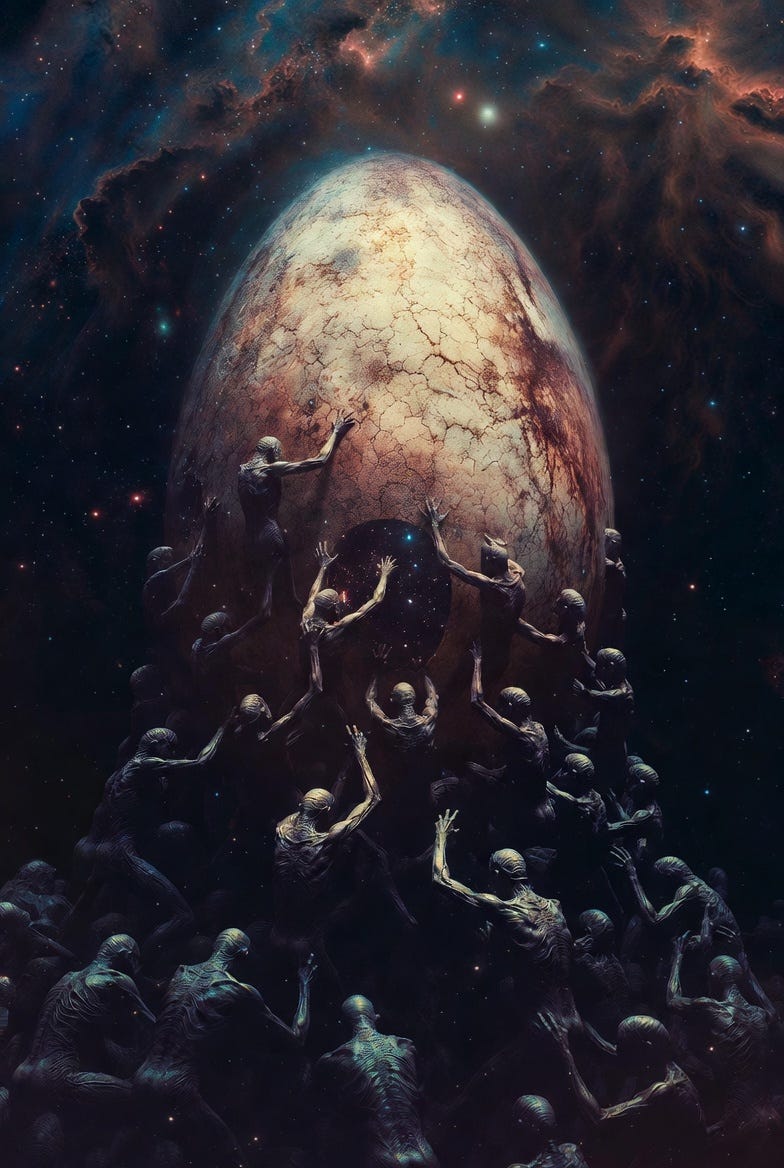
This “schizoid,” split subject of the beginning of the twenty-first century is vividly presented to us in the Epstein files, yet we still remain complacent, assuming that this is not yet the limit of human degeneration. But already today philosophers, mathematicians, physicists, biologists, and geneticists have advanced further in refining avant-garde inhuman projects of dissolving the individual into a rhizome, calculating his genome, and assigning to him a personal digital code.
The dehumanization of the human being in Western Modernity has taken place in stages: decentering, splitting, and fragmentation of the human subject into molecular selves. This has taken place both in philosophical theory and in practice—in special clinics and in everyday life. Theoretically, the dehumanization of the human being was described in postmodern philosophy and psychology beginning in the 1960s, and over the last thirty years it has been widely tested on the internet, introduced into youth through fragmentation, the splintering of consciousness, fragmented narratives, brain-rot aesthetics, and a rapid drift along chaotic trajectories of virtual reality, routes of cyberspace leading nowhere.
Many assert that the release of the “Epstein files” is intended to widen the frames of the “Overton windows.” What, then, is being slightly opened to us behind their shutters? What is at issue is a systematized program for casting down the human being and humanity to the very bottom of hell. This is, in essence, one of the final stages of the definitive dehumanization and elimination of the human being as a species.
The declared meaning of Postmodernism is the absolute and complete liberation (liberalization) of the human being, of his body, consciousness, and subconscious from the limitations of the Universal in the form of God, the Absolute, the Church, religion, verticality, hierarchy, Logos, morality, one’s own self, and so on—all the bonds of the human “lifeworld.” In this global trend, all integral structures were regarded as coercive and totalitarian, limiting human freedom.
The shadow of Epstein says to us today:
Here before you is the last impossibility! Transgress the final prohibitions! Rape, kill, eat children!
This is how Satan thinks and acts.
Demonic Indwelling
This is precisely the practice of demonic indwelling—the unraveling of the human personality into threads leading far below the body, through matter, beyond matter itself. These are the tentacles of a consciousness that has collapsed into the element of the liberated unconscious. They intertwine not through minds, but through tails, on subliminal levels of a plane invisible to the external observer, as in the Chinese engraving of Fuxi and Nüwa.

In Félix Guattari’s experimental schizoanalytic clinic, when the unconscious was liberated, patients could scream, cry, spew curses, beat patients and doctors, write poems and paint pictures, stage theatrical games in the spirit of Antonin Artaud…
Here, on the planet of Epstein, the rulers of this world—businessmen, politicians, bankers—also receive the opportunity to descend below every threshold, to liberate their desiring-machine, weaving their rhizomatic I into a special infra-corporeal network. In the transgressing global elite, all are bound to one another by a system of blackmail and deeply depraved entertainments. This elite sticks together into a network-centric organism, situated beneath the surface of social life, below the threshold of the last mental census. Thus the “rhizome of Epstein” is constituted.
The Epstein files preserve a black memory of that which presidents and bankers, scientists and financiers, may even sincerely not remember: the “transgressive sessions” in which they took part lie below the limits of their rational perception, and only cold recording devices from secret rooms preserve the memory of their crimes, acts of violence, and atrocities. But this can already be used for blackmail! Political blackmail is not the main goal of the “rhizome of Epstein.” What is at issue is a large-scale criminal experiment over the whole of society.
The elites are only the beginning. Further on, transgressive practices of this kind will pass into the mass market, will be democratized, and will draw broader and broader layers of society into the black bacchanalia. This is the fate prepared by Postmodernism for the “schizo-masses,” beginning with the middle class (the petty and middle bourgeoisie always dreamed of becoming big and living by their standards), and ending with the precariat, to whom the scraps of the infernal orgies will fall.
Black Holes of Subjectivity
The concept of the “black holes” of subjectivity in Félix Guattari and Gilles Deleuze describes points of catastrophic collapse of the psyche as a result of failed attempts to free oneself from social frameworks (deterritorialization), when, instead of attaining freedom, the subject falls into a state of painful self-reflection or obsession with some idea. Schizoanalysis sees this moment as a psychological and semiotic mechanism of capture, in which the individual is absorbed by structures of power, social roles, or unbearable affects, ceasing to be a free flow of desires and returning to a fixed “I” (“I am an employee of state structures,” “I am the beloved of an oligarch”).
Guattari describes the social system in terms of the “white wall—black hole.” The “white wall” is the screen onto which the signs of society are projected, while black holes are the “eyes” on this face that attract attention and force the subject to identify himself with a certain image. Classical schizoanalysis in Deleuze and Guattari aims not to allow subjectivity to fall into these black holes (social roles, laws, archetypes), keeping it open to new connections and creative flows.
But in the experiments of the “Epstein Archipelago,” the meaning of schizoanalysis is elitely perverted—the liberation of some (the masters) leads only to the enslavement of others (the slaves). “Deterritorialization” bears an ambivalent character, depending on “who you are?”—an element of the elite, a predator, a master, or a fragment of the masses, a victim, refuse. For Epstein’s victims, liberation is fictive; the carried-out “deterritorialization,” the washing away of the fragile representations of children and minors, leads the manipulated only to a fall into the “black hole,” through a technology of serial production of broken personalities, when the face (“faciality”) and consciousness are closed into an endless loop of self-identification and trauma.
This process was launched on the Epstein Archipelago artificially, through methods of psychological processing, by placing the victim in conditions where all familiar social markers (family, law, morality) ceased to exist and the “black hole of subjectivity” sucked in the hostage’s biography, leaving only a functional body. The faces of the victims were erased, turning into pure surfaces for the projection of the desires of the elite, while the figure of the violator became the sole remaining “event horizon.” What occurred was what Guattari called the “faciality machine” (visagéité)—the “capture of the face.”
The philosophical optic of Gilles Deleuze and Félix Guattari makes it possible to see in the actions of Epstein’s network the conscious application of black-hole strategies: the victim is not simply subjected to violence; she is first “disassembled,” like a biological machine, through the use of zones of disorientation (isolation, drugs, sensory deprivation), which leads to the creation of precisely those “black holes” in which time and logic disappear, and the state of the psyche’s “schizo-flow” no longer allows one to say of oneself, “I.”
Guattari believed that power is most effective at the micro-level. The Archipelago widely used a micropolitics of horror—the constant presence of a hidden threat (exposure, violence, murder)—so that the victim’s psyche itself would strive toward collapse, seeking salvation in submission. Ritual practices, resembling satanic masses and accompanied by torture, served as initiation into a state of “zero subjectivity”; they created around the victims a fabric of eroded reality, a “demonic texture,” a Deleuzian “chaosmos,” which cannot be rationalized.
The elite of the Archipelago became the architects of black holes of consciousness, creating gravitational wells (psychological and real) for the absorption of human victims, their resources, life, meanings, and truth, which were annihilated in service to the satanic “machinic production” of pure enjoyment of power. This is the extreme expression of postmodern disintegration, when the subject is not liberated (as Deleuze and Guattari imagined), but absorbed by the dark abyss of power.
From the Psychiatric Clinic to Cannibal Orgies
At times, it may seem that the trials of the experimental subjects on the Archipelago resemble the practices of the postmodern schizoanalysis of Guattari and Deleuze at the clinic of institutional psychotherapy, La Borde. Yes, indeed, the postmodern philosophy and psychology of the French tandem opened the boundaries and barriers of the unconscious, and at the same time refused to channel psychic energies and transgressions into the course of Tradition.
But the bodily experience of the immersion of an adult human being into the folds of matter and into the dark abysses of the psyche in Deleuze and Guattari still differs radically from the criminal manipulations of small children and unformed adolescents on the part of Epstein and his retinue. All the statements of Félix Guattari (the director of the La Borde clinic) about experiments in liberating the desire of patients in the direction of dubious tactics of audacious libertinage, free unions, madcap emancipation of women, reckless creativity of new concepts mixed together with rhizomatic sexual relations of everyone with everyone else, do not bear any comparison with the cold sadistic manipulations that were carried out and replicated, being turned into a new bestial canon for the world elites, by the pedophiles of the Archipelago.

Even if one takes into account the dubiousness and ambiguity of the liberating pathos of the basic concept of the progressivist postmodernists, still they tried to give people, or more precisely, to life, new horizons of freedom. But what we see in the satanic games of Epstein, Clinton, Trump, Prince Andrew, and others already has no relation either to life or to freedom. It is a ball of vampires and the triumph of cold, alienated death, embodying itself in the icy element of control, violence, wars, lies, and degeneration.
This is a perverted and pathological coupling of flows (to speak in the words of Gilles Deleuze) and an interweaving of the concepts of schizoanalysis, the rhizome, the Body without Organs, (de)territorialization, and black holes of subjectivity, with the practice of sadism, cruelty, and the suppression of the will and consciousness of children. This has called into question the very quality of the human being, of humanity itself…
Dark Deleuze, with whom we began, sacrificed the subject with a single aim: to unblock the flows of vital impulse. Epstein’s elite turned Postmodernism into something opposite—into a territory of destruction and total slavery. And the people emerging from these networks, who to this day for the most part remain unpunished, are clearly striving to transfer this to the whole of society. Such is the project of Epstein’s civilization, which is becoming reality before our eyes.
Liberalization Fatally Leads to Possession
In summing up this philosophical review of the Epstein files and the picture of monstrous moral decomposition of the ruling elites and their criminal practices that has opened before our eyes, one should draw attention to the fact that the very idea of liberation—both in its left-democratic and in its elitist-sadistic version—is in the highest degree questionable and leads in practice to monstrous results.
If a spiritual and transcendent vertical is absent from a worldview, then in a closed immanent materialist system everything will sooner or later be reduced only to destruction, disintegration, entropy, perversions, subordination to the External, and death.
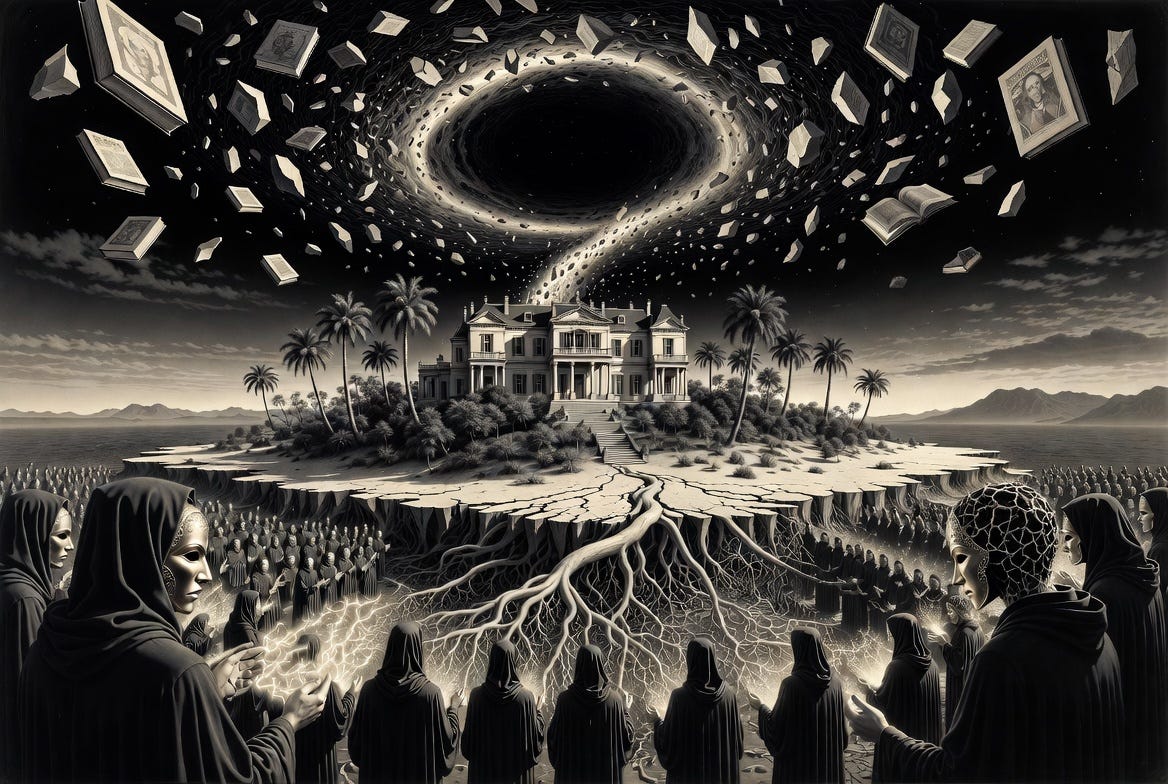
The liberalization of absolutely anything whatsoever, whether inner life, culture, faith, religion, art, or the psychic and bodily structures of the human being, their blurring into molecular components and their being led beyond the threshold of social and spiritual norm, is a crime against the human being and humanity. The weakening of subjectivity, in which our I is transformed into a bundle of molecular “flows of desire,” will sweep Man into dust, smearing him along the roadside of the Universe. The decentered subject, having no point of assembly within himself, upon encountering the external will discover weakness and unfreedom, no matter how much we may liberate him or reformat him.
The strategy of the melting-down of the subject in Postmodernism, the rejection of the ideas of hierarchy, spiritual verticality, the heavenly archetypes of Spirit, Good, Truth, Beauty, Justice, and the One, leads to the siege and possession of the human being by the forces of absolutely external, dark beings, the hierarchies of the lower realm.
References (translated and standardized)
[1] Rand, A. Anthem. Moscow: Alpina Publishers, 2009, p. 102.
[2] Sartre, J.-P. Being and Nothingness: An Essay on Phenomenological Ontology. Moscow: Respublika, 2000.
[3] Baudrillard, J. The Transparency of Evil. Moscow: Dobrosvet, 2000.
[4] Lacan, J. R.S.I. Seminar, 1974-1975. Paris: A.L.I., 2002.
[5] Culp, A. Dark Deleuze. Minnesota: University of Minnesota Press, 2016.
[6] Deleuze, G., and Guattari, F. Anti-Oedipus: Capitalism and Schizophrenia. Yekaterinburg: U-Faktoriya, 2007; idem, A Thousand Plateaus: Capitalism and Schizophrenia. Yekaterinburg; Moscow: U-Faktoriya, Astrel, 2010.
[7] Bataille, G. Inner Experience. St. Petersburg: Axiom; Mifril, 1997; idem, The History of Eroticism. Moscow: Logos; Evropeyskie izdaniya, 2007; idem, The Accursed Share. Moscow: Gnosis; Logos, 2003.
[8] The College of Sociology, 1937-1939. St. Petersburg: Nauka, 2004.
[9] Banned in the Russian Federation.
[10] Cebrowski, A. K., and Garstka, J. J. Network-Centric Warfare: Its Origin and Future, 1998.
[11] Guénon, R. The Reign of Quantity and the Signs of the Times. Moscow: Belovodye, 2011.
All this carnage in the Gulf to distract from the Satanic garbage can of the Mossad Epstein Wexner Rothschild filth that has poisoned USA and left it with the maggot infested albatross, of the Khazar occupied settler colony nested in Palestine, lashed around Onkel Schmuel's scrawny neck. When this debacle has run its course the angloZionaZi empire of filth and those that profit from its eternal bouts of global slaughter will be held to account as "America" licks its wounds and heads into its long overdue civil war reloaded. Then the real crisis of the dying empire will unfold in all its glory. Watching "America" inevitably balkanize in the mother of all civil wars, tiny "democratic" Israel disappear and the evil EUSSR slash Natostan collapse will indeed be the next "end of history" as the moron called back in the day.
Release ALL the pedo files and execute ALL the pedovores before the chosenite mushrooms sprout.
The Epstein Regime garbage can.... Satanic filth in the prurient interest.
https://limewire.com/d/vRaUk#AERdsnT9zc
https://epsteinsecrets.com/
https://jmail.world/jefftube
https://jmail.world/
The philosophical architecture you have built here converges with a pattern I am tracing from a different geography — Nepal.
What you call the 'desiring-machine of elites' operating through transgression — I would call it civilization transacting with its own shadow. The elite did not simply fall into darkness. They became the shadow they never named.
But here is the condition your framework has not yet reached: what of the civilization that was never given a shadow to begin with? Nepal was never colonized by flag. The postmodern deterritorialization you describe entered us not as transgression — but as development aid, friendship, and democracy. The 'Body without Organs' arrived wearing the face of the NGO.
The Epstein Archipelago is the West's shadow made visible. Nepal is the civilization that absorbed the shadow — invisibly. Same logic. Different face.
That is where the Nepaah Doctrine begins."
— Basudev Dahal | Catalyst Architect, Nepaah Doctrine