

Jerry B. Marchant of IS IT PROPAGANDA?® asks whether the United Nations still reflects the world it claims to represent.
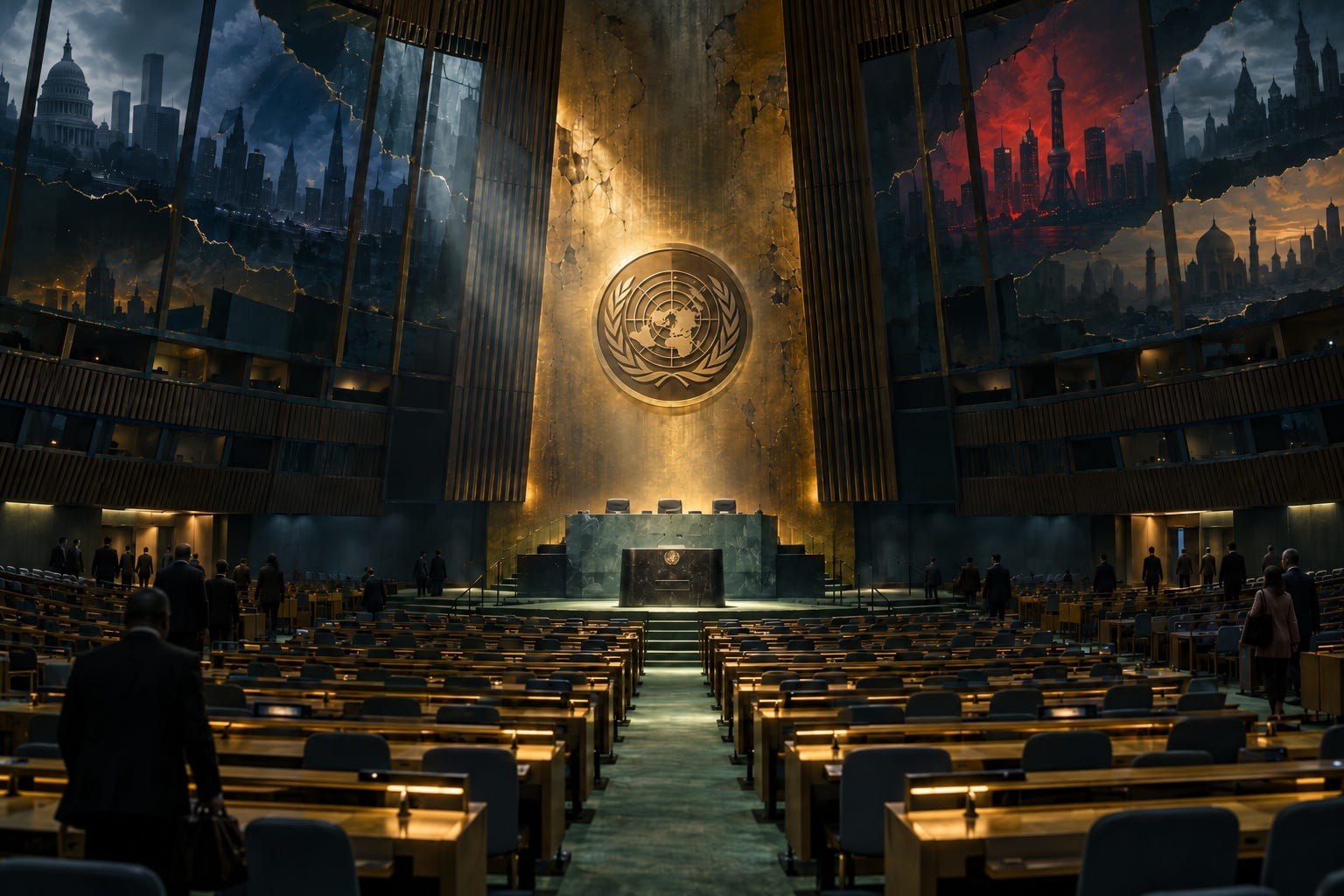
The 81st session of the United Nations General Assembly from September 22-27, 2026, opened under the theme of restoring trust and managing transformation. Its most widely reported image was a room emptying. On 24 September, more than 100 delegates left their seats before Israeli Prime Minister Benjamin Netanyahu spoke, the second consecutive year in which he faced a mass walkout. The Palestinian Mission had urged member states to organize the walkout. Although the walkout was a targeted political protest, not a general expression of boredom, its form still matters analytically. A deliberative body whose members leave the chamber to register dissent, while the speaker continues to the cameras, has become an arena for signaling rather than decision.
President Trump’s 2026 address lasted roughly thirty-seven minutes, defended the war against Iran, and criticized the United Nations itself. His 2025 speech ran about an hour and dismissed the institution’s output as empty words that do not solve wars. Even the Assembly’s most powerful critics treat it as a venue for declaration. The Charter explains why: under Article 10, the Assembly may discuss and recommend, but it cannot compel.6 Speeches made there carry no obligation, and their length rises as their consequence falls.
The structural cause of this condition is the Security Council. Article 27(3) requires the concurring votes of the permanent members on substantive matters, and Article 108 gives the same five states a veto over amending the Charter. The result is an institution that cannot correct its own distribution of power. Bosco and Weiss, both sympathetic to the organization, document how the permanent members have used this position to shield their own interests and those of their partners.12
The war between the United States and Iran has now lasted nearly seven months, and the war in Ukraine continues. Neither has been resolved by the body charged with maintaining international peace.
The decline is also material. By the Secretary-General’s own account, only $1.8 billion of the $3.5 billion in regular-budget assessments for 2025 had been received, a shortfall of about half. The revised 2026 budget stands at $3.238 billion, a cut of 15.1 percent, with 2,681 posts eliminated. Analysts note that late payment by the two largest contributors compounds the problem and that accounting rules return unspent funds to members, including those in arrears, which drains cash when it is most needed. An organization that cannot secure its own operating costs from its most powerful members has limited standing to lead them.
Multipolar theorists such as Kenneth Waltz argued that the unipolar moment was inherently unstable and would give way to balancing.3 Mearsheimer holds that the liberal international order was bound to fail because it rested on that temporary distribution of power.4 Acharya and Kupchan extend the argument, contending that authority is dispersing among regional powers and civilizational blocs, so that no single center can write rules for the rest.56
According to this view, consequential diplomacy has moved into bilateral and regional formats, and the General Assembly is consulted, at most, after the fact.
Advocates of multipolarity add that the Charter’s founding principles support their position. Sovereign equality (Article 2(1)) and the limit on intervention in domestic jurisdiction (Article 2(7)) describe a pluralist order more accurately than the hierarchy that has been built on them. The failure lies in the machinery: a Council that reflects 1945, no permanent seat for Africa or Latin America, and none for India despite its population. An institution that cannot represent the world it claims to speak for will be bypassed by it.
The emptying hall is the visible evidence.
Critics of this position raise three points.
The same great powers now blamed for paralysis, including Washington and Beijing, are also implicated in the arrears that constrain the organization. Humanitarian and specialized agencies continue to deliver assistance at scale. And a multipolar system may need a universal forum more than a unipolar one, since regional blocs cannot mediate among themselves.
Whether the United Nations can be reformed or only routed around is the central question of the debate.
Bosco, David L. Five to Rule Them All: The UN Security Council and the Making of the Modern World. Oxford University Press, 2009.
Weiss, Thomas G. What’s Wrong with the United Nations and How to Fix It. 3rd ed. Polity, 2016.
Waltz, Kenneth N. “Structural Realism after the Cold War.” International Security 25, no. 1 (2000): 5–41.
Mearsheimer, John J. “Bound to Fail: The Rise and Fall of the Liberal International Order.” International Security 43, no. 4 (2019): 7–50.
Acharya, Amitav. The End of American World Order. Polity, 2014.
Kupchan, Charles A. No One’s World: The West, the Rising Rest, and the Coming Global Turn. Oxford University Press, 2012.
