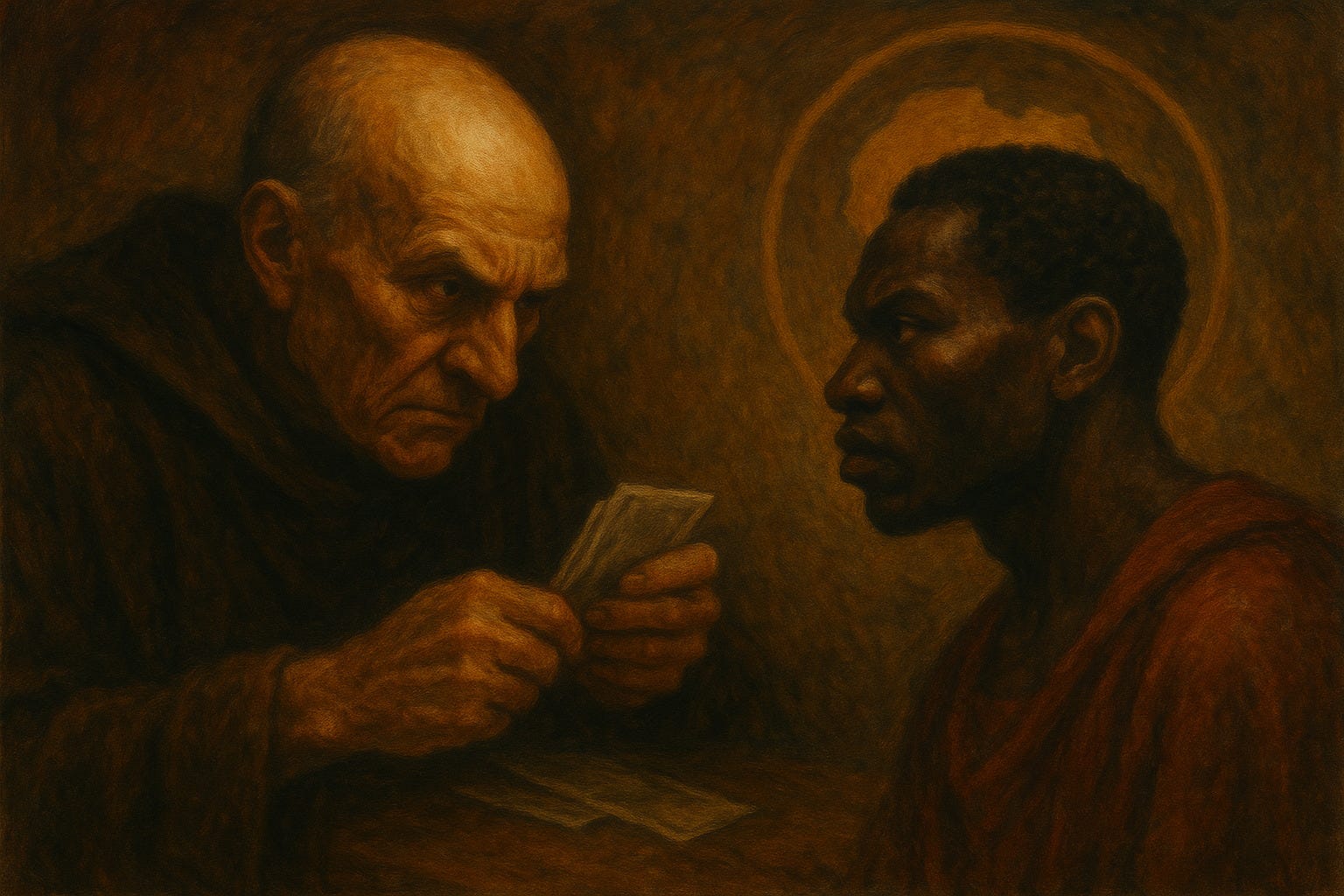
The CFA Franc: Africa’s Monetary Chains
Monetary colonialism, usury, and the sacred struggle for African sovereignty
Farafin Kissi Shabazz delivers a theopolitical indictment of the CFA franc and usury, framing monetary colonialism as a spiritual crime and calling for a sacred Pan-African Empire grounded in sovereignty and divine order.
Speech delivered on November 29, 2025, in Verona, Italy, organized by the Monetary Rebels network.
In the name of Almighty God, the God of Origin with Many Names and of the Worthy Ancestors, I greet you and offer peace.
I am Farafin Kissi Shabazz Francois Sandouno, an exponent of the African cause in the twenty-first century and the theoretical originator of Theopanafricanism.
I address you today because we are considered the damned of globalism—the last, the marginal, the discarded of the global system—when in reality we are the redemptive force, the spiritual and political component capable of changing the course of history if it chooses to organize itself, discipline itself, and unite in truth, order, and justice.
Today I speak to you in a theopolitical key because no human system, no bank, no technocrat, no usurer stands above God. The Earth belongs to the Almighty, whatever name you choose to give Him. And everything that oppresses peoples is a spiritual offense before it is political or economic.
Today I will speak to you about the CFA franc. The CFA franc is a currency created in 1945 by the French oligarchy to economically control large parts of West and Central Africa. It is a colonial system founded on three fundamental pillars: monetary dependence, in the sense that countries do not control their own monetary policy; tied reserves, meaning that for decades more than half of African reserves were held in the French treasury; and French veto power—the French right of veto—so that states are not free to decide their own economic destiny. And all of us here know that there can be no political destiny without monetary sovereignty, and this principle is valid for all peoples. Consequently, the CFA franc—which as an acronym means French Colonies of Africa—is a mechanism that does not liberate, but binds. It does not develop, but limits. It does not support, but suffocates.
The CFA is economic colonialism disguised today, in the twenty-first century, as cooperation because it does not allow the various African nations to cooperate. In West Africa, there is one version of the CFA franc; in Central Africa, there is another version of the CFA franc. And many do not know that those who hold CFA francs from Senegal, if they decide to go today to Cameroon, must first convert CFA francs into euros, and from euros into CFA francs. This mechanism paralyzes us. It is a mechanism that does not allow the industrialization of Africa. It is a mechanism that does not allow Africa’s economic rebirth. I avoid using the term “development,” a manufactured term used to frame reality by saying that there are developed territories and underdeveloped territories, when we all know that development in that sense arose during the Cold War to distinguish capitalist countries from non-aligned countries that sought to oppose capitalism as such.
Returning to the CFA franc: we—myself in particular as an independent activist, together with other Pan-Africanist militants in Italy and elsewhere, such as the Anti-CFA Front or Urgences Panafricanistes, a revolutionary organization that I coordinated in Italy from 2020 to 2023—have launched historic mobilizations: demonstrations in Africa, demonstrations in Europe, and across the diaspora; global media campaigns; symbolic actions against colonial central banks; and popular pressure on governments—colonialist governments, governments subordinate to the neoliberal globalist oligarchy. I discuss this in my book Theopanafricanism: For the Advent of a Pan-African Empire in the Twenty-First Century.
Never since 1945 had the world witnessed such a vast challenge to the CFA franc. And what was the result? In West Africa, our mobilizations—and their international resonance, which must be remembered—forced governments and institutions to review certain mechanisms, the heaviest mechanisms of the CFA: the revision of the obligation to deposit reserves, reforms to the governance of central banks, and the announcement of a future currency, provided that this currency does not become a disguised form of colonialism, as we sincerely hope. This political earthquake—one can rightly call it that—would never have occurred without our struggle. Yet let us be clear: these are cosmetic changes, not structural ones. As Khalid Abdul Muhammad1 would say, they changed the form but not the substance. For while there were some modifications in West Africa, in Central Africa there was no change, no reform, no concession, no step forward. This is proof that monetary colonialism continues. That is why a true monetary revolution is necessary and sacred—everywhere, not merely in half of the continent, so that French companies and Western, globalist, and neoliberal interests no longer benefit from Africa’s monetary captivity.
The CFA franc is only a concrete manifestation of an older evil: usury. Usury is the transformation of money into a chain. It is the mechanism through which a few dominate the many through debts that never end. I pay tribute here to President Thomas Isidore Noël Sankara,2 who dared to denounce it in 1987. Where usury reigns, politics becomes vassalage, the economy becomes dependence, freedom becomes illusion, and the human being becomes a bank code. From this arises Isefet, a Kemetic—an Egyptian—concept: disorder, that which stands opposed to Maat: order, truth, and justice. This is why our struggle must be theopolitical and not merely technical or militant.
For years, I have represented Pan-Africanism, a vision that proclaims the unity of the African people in their totality; liberation from colonial structures; economic and political sovereignty; solidarity between Africa and its diaspora; and the construction of a shared, fundamental destiny. Pan-Africanism fights the CFA franc because a nation that does not control its own currency—as I said earlier—is not free. Through Pan-Africanism, I have recently theorized a new concept: Theopanafricanism.
Within the word Theopanafricanism is the term Theos, which refers to God, to the Divine, to the Sacred. Theopanafricanism is therefore the spiritual, metaphysical, and sacral extension of Pan-Africanism. It reminds us that God precedes every economy, that Maat precedes every law, that freedom is sacred, that Africa has a cosmic role in the history of humanity, and that liberation must be spiritual as well as political and economic. A return to the Origin is necessary—a return to the Divine and sacral order.
When we speak of the digital euro, we must not imagine that monetary colonialism concerns Africa alone. What we Africans and Afro-descendants have experienced—and continue to experience—Europe is now living as well, because Europe, too, is colonized. You know this, even if certain powers refuse to say it openly or to denounce it clearly. Europe, and Italy in particular, is a colony today in a certain sense. With the digital euro, Europe will experience something even worse than what Africa endures today. What is the digital euro? It is a programmable currency. It enables total control over transactions, the ability to block funds, the end of cash, absolute traceability, and thus a system of globalized financial surveillance. The scheme is identical.
To centralize money is to centralize power, and to centralize power is to control life. Only God controls life—let us remember this. The digital euro follows a globalist logic; it is animated by the spirit of usury. Therefore, we must affirm an eternal truth: usurers are not superior to God. There is no god outside of God, as Pharaoh Akhenaten proclaimed in his hymn to Aten in ancient Egypt,3 and as Adinkra philosophy4 reminds us today in Ghana. Banks are not superior to the Origin. Digital currencies are not superior to Maat. Monetary colonialism will fall everywhere because resistance is alive. It will fall in West Africa; it will fall in Central Africa; it will fall in Europe and throughout the world. No system founded on injustice can withstand truth, awakened peoples, and divine order. In this sense, I can say that the God of the Origin guides us, that Maat enlightens us, that the Almighty—whatever name one gives Him—leads us forward. There is one God, one Principle, and only He stands above every human will that seeks to destroy His creation. Monetary slavery will fall. It will fall forever. We stand today, in the twenty-first century, to bring an end to the globalist project aimed at destroying our destiny.
Thank you.
(Translated from the Italian)
Translator’s note (TN): Khalid Abdul Muhammad (1948–2001) was an African-American activist, orator, and former spokesperson of the Nation of Islam, known for his uncompromising rhetoric on Black liberation, anti-imperialism, and racial justice in the United States. He later became a prominent figure in the New Black Panther Party and was widely recognized for his confrontational critique of Western power structures and institutional oppression.
TN: President Thomas Isidore Noël Sankara (1949–1987) was the revolutionary leader of Burkina Faso and a symbol of African dignity and sovereignty. He denounced debt and usury as instruments of domination, calling them tools of recolonization rather than aid. Assassinated for his refusal to submit to imperialist tyranny, Sankara remains a voice of truth for all peoples who seek freedom grounded in justice, self-rule, and moral courage.
TN: Pharaoh Akhenaten (r. c. 1353–1336 BC) was an Egyptian ruler who proclaimed the supremacy of a single divine principle, Aten, the solar source of life, in a series of hymns that rejected the multiplicity of false gods and affirmed a higher unity beyond human power. His Hymn to Aten stands as one of the earliest known affirmations that no earthly authority, priesthood, or empire stands above the divine Source.
TN: Adinkra philosophy refers to a West African sacred system of symbols and wisdom, originating among the Akan peoples of present-day Ghana and Côte d’Ivoire. Each Adinkra symbol embodies a moral, metaphysical, or cosmic principle—truth, balance, destiny, endurance—affirming that order precedes power and that no human authority stands above the primordial Source. Through Adinkra, the memory of divine law endures beyond empire, money, and domination.


