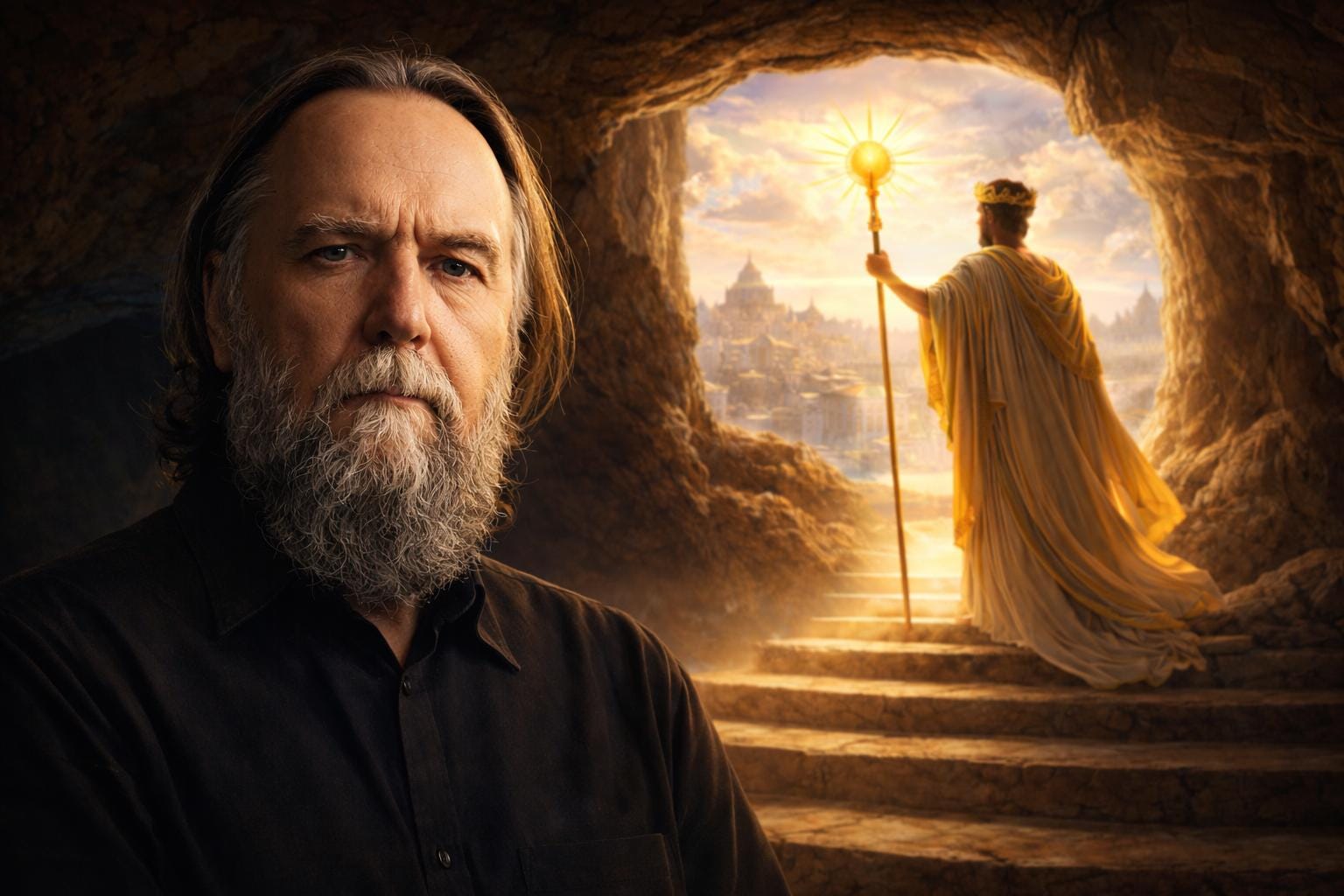
The Cave and the Empire
Ontology of the Universal Kingdom
Alexander Dugin on the Philosopher-King and the return of the Empire of Spirit.
In the seventh book of the dialogue Republic, Plato describes the process of becoming a philosopher-king as follows.
He likens the world to a cave (that is, a territory situated within dense matter, in a mountain or beneath the earth), and humanity to prisoners chained in place, unable to turn their heads and compelled to watch shadows moving along the wall of the cave. This corresponds to the lower Kingdom—the world of bodies. The lot of ordinary people is to live observing the shadows on the wall, taking them for genuine reality. In truth, however, this is the most distant and dim copy, not even of the original, but of another copy. Because of their ignorance, the prisoners do not suspect either their true condition or the nature of what appears to them as being. In effect, Plato is describing hell, the realm of shadows.
Plato does not address the question of who chained the prisoners and condemned them to so wretched an existence. As we have seen, the Greeks did not know the figure of the devil or its Iranian counterpart, Ahriman, and for them such a formulation of the problem would have made little sense. Since manifestation necessarily presupposes a removal from the First Principle and, consequently, a densification of being, there must exist regions where the shadows thicken and truth disappears beyond a distant horizon. This in itself is not evil, but rather a sorrowful result of the very process of manifestation—the costs of cosmic manifestation. Whoever is content with this bears the responsibility for it.
Yet, according to Plato, among the prisoners there are also those who refuse to be content. However difficult it may be for them, they turn their heads back in order to see which objects cast the shadows they behold on the wall. Then they notice what Plato calls the “upper road.”
“Imagine people as though they were in an underground dwelling like a cave, with an entrance stretched open toward the light along its entire length. From childhood they have chains on their legs and necks, so that they must remain in the same place and see only what is directly before them,
for they are unable to turn their heads
because of these bonds. Behind them, far above, burns the light of a fire, and between the fire and the prisoners runs an upper road, along which, imagine, a low wall has been built, like the screen set before the performers of marvels, over which they display their wonders.”
ἰδὲ γὰρ ἀνθρώπους οἷον ἐν καταγείῳ οἰκήσει σπηλαιώδει, ἀναπεπταμένην πρὸς τὸ φῶς τὴν εἴσοδον ἐχούσῃ μακρὰν παρὰ πᾶν τὸ σπήλαιον, ἐν ταύτῃ ἐκ παίδων ὄντας ἐν δεσμοῖς καὶ τὰ σκέλη καὶ τοὺς αὐχένας, ὥστε μένειν τε αὐτοὺς εἴς τε τὸ πρόσθεν μόνον ὁρᾶν, κύκλῳ δὲ τὰς κεφαλὰς ὑπὸ τοῦ
δεσμοῦ ἀδυνάτους περιάγειν, φῶς δὲ αὐτοῖς
πυρὸς ἄνωθεν καὶ πόρρωθεν καόμενον ὄπισθεν αὐτῶν, μεταξὺ δὲ τοῦ πυρὸς καὶ τῶν δεσμωτῶν ἐπάνω ὁδόν, παρ᾽ ἣν ἰδὲ τειχίον παρῳκοδομημένον, ὥσπερ τοῖς θαυματοποιοῖς πρὸ τῶν ἀνθρώπων πρόκειται τὰ παραφράγματα, ὑπὲρ ὧν τὰ θαύματα δεικνύασιν.
[“See human beings as if they were in an underground, cave-like dwelling, having an entrance opened toward the light and extending along the whole cave; they have been there since childhood with bonds on their legs and necks, so that they remain in place and see only what lies before them, being unable to turn their heads around because of the bond. Behind them, from above and at a distance, a fire burns, and between the fire and the prisoners there is a road above, beside which you must imagine a low wall built, like the partitions that wonder-workers set before the audience, over which they display their marvels.”]
The upper road is the realm of the objects themselves rather than their shadows. Those who carry these objects, as during Dionysian processions, converse with one another, and their voices echo from the walls of the cave, creating the impression that the sounds come from the shadows on the wall.
Philosophy begins with this turning, with the clear distinction between what takes place on the “upper road”—the seeing and hearing of real images and speeches.
Plato then moves on to describe how a person awakened from the illusion shared by the majority does not find himself in an active position; rather, he becomes the passive prey of some force acting against his wishes. In this way, Plato seeks to emphasize that in the ordinary human being everything resists becoming a philosopher and grasping the truth. Hence the language of compulsion.
“When one of them is freed from his bonds and is suddenly compelled to stand up, turn his neck, walk about, and look upward toward the light, it will be painful for him to do all this, and
he will be unable to look at the bright things whose shadows he saw before. (…)
And if he is forced to look straight at the light itself, will his eyes not ache? Will he not turn away in haste toward the things he is able to see, believing them to be clearer than what is being shown to him? (…)”
“If someone were to drag him by force up the steep ascent, up the mountain, and would not release him until he had drawn him out into the sunlight, would he not suffer and protest such violence? And once he came into the light, his eyes would be so struck by the radiance that he would be unable to discern a single one of the things whose truth is now being spoken of to him. (…)
He would need time to grow accustomed, if he is to see what is above. He must begin with what is easiest: first looking at shadows, then at reflections in water of people and various objects, and only afterward at the things themselves. Then he would find it easier to look at what is in the sky and at the sky itself at night—that is, to gaze at the light of the stars and the Moon rather than at the Sun and its light.”[87]
ὁπότε τις λυθείη καὶ ἀναγκάζοιτο ἐξαίφνης ἀνίστασθαί τε καὶ περιάγειν τὸν αὐχένα καὶ βαδίζειν καὶ πρὸς τὸ φῶς ἀναβλέπειν, πάντα δὲ ταῦτα ποιῶν ἀλγοῖ τε καὶ διὰ τὰς μαρμαρυγὰς ἀδυνατοῖ καθορᾶν ἐκεῖνα ὧν τότε τὰς σκιὰς ἑώρα. (…)
οὐκοῦν κἂν εἰ πρὸς αὐτὸ τὸ φῶς ἀναγκάζοι αὐτὸν βλέπειν, ἀλγεῖν τε ἂν τὰ ὄμματα καὶ φεύγειν ἀποστρεφόμενον πρὸς ἐκεῖνα ἃ δύναται καθορᾶν, καὶ νομίζειν ταῦτα τῷ ὄντι σαφέστερα τῶν δεικνυμένων; (…)
εἰ δέ, ἦν δ᾽ ἐγώ, ἐντεῦθεν ἕλκοι τις αὐτὸν βίᾳ διὰ τραχείας τῆς ἀναβάσεως καὶ ἀνάντους, καὶ μὴ ἀνείη πρὶν ἐξελκύσειεν εἰς τὸ τοῦ ἡλίου φῶς, ἆρα οὐχὶ ὀδυνᾶσθαί τε ἂν καὶ ἀγανακτεῖν ἑλκόμενον, καὶ ἐπειδὴ πρὸς τὸ φῶς ἔλθοι, αὐγῆς ἂν ἔχοντα τὰ ὄμματα μεστὰ ὁρᾶν οὐδ᾽ ἂν ἓν δύνασθαι τῶν νῦν λεγομένων ἀληθῶν; (…)
συνηθείας δὴ οἶμαι δέοιτ᾽ ἄν, εἰ μέλλοι τὰ ἄνω ὄψεσθαι. καὶ πρῶτον μὲν τὰς σκιὰς ἂν ῥᾷστα καθορῷ, καὶ μετὰ τοῦτο ἐν τοῖς ὕδασι τά τε τῶν ἀνθρώπων καὶ τὰ τῶν ἄλλων εἴδωλα, ὕστερον δὲ αὐτά: ἐκ δὲ τούτων τὰ ἐν τῷ οὐρανῷ καὶ αὐτὸν τὸν οὐρανὸν νύκτωρ ἂν ῥᾷον θεάσαιτο, προσβλέπων τὸ τῶν ἄστρων τε καὶ σελήνης φῶς, ἢ μεθ᾽ ἡμέραν τὸν ἥλιόν τε καὶ τὸ τοῦ ἡλίου.
[“Whenever someone is freed and suddenly compelled to stand up, turn his neck, walk, and look upward toward the light, he will suffer in doing all this and, because of the dazzling glare, will be unable to see the things whose shadows he had seen before. (…)
And if he is forced to look at the light itself, his eyes will ache, and he will turn away, fleeing toward the things he is able to see, believing them to be truly clearer than those now being shown to him. (…)
And if, I said, someone were to drag him from there by force up the rough and steep ascent, and would not release him until he had pulled him out into the light of the sun, would he not suffer pain and indignation as he is being dragged? And when he came into the light, with his eyes filled with its radiance, would he not be unable to see even one of the things now said to be true? (…)
He would require habituation, I suppose, if he is to see what is above. At first he would most easily perceive shadows, then the reflections in water of human beings and other things, and afterward the things themselves. From there he would more readily behold what is in the heavens and the heavens themselves at night, looking toward the light of the stars and the moon rather than, by day, the sun and its light.”]
In any case, the one who, by his own will or under the influence of some higher force, has traversed this path toward the exit from the cave has learned not only the difference between shadows, images, the things themselves, and the source of their illumination, but has also left the very world of the cave, ascending into another world—this time the true one, flooded with the light of Nous. Thus the philosopher rises from the world of bodies into the world of Spirit. There he contemplates the very objects of which the objects of the “upper road” are merely copies, as well as the true light that lies outside the cave. This is the world of ideas, paradigms, prototypes, originals. And the one who has managed to escape the cave and behold the world as it is—and the ideas, according to Plato, are precisely what is (they exist eternally and prior to all their copies)—that one is the philosopher.
Here the definition of philosophy converges with the theme of power and, consequently, with politics. The philosopher who has known the truth returns to the prisoners for various reasons and sets about their liberation. He knows, in advance, several layers of being more than they do, and this grants him the right to rule over the ignorant. Thus the dignity of the true ruler lies neither in skill, efficiency, dynastic origin, nor strength of will. It proceeds from the ontological transmutation of his soul, from the capacity to rise from the bottom of the cave, to go beyond its limits, and to enter the divine world where truth is given in immediate contemplation.
Thus emerges the figure of the Philosopher-King. In him, the right to power is determined precisely by the awakened spirit, by the capacity to pass beyond the boundaries of the lower world. Yet this is also the distinctive feature of the King of the World and his Spiritual Empire. The King of the World and his domain are situated in the zone of eternity, outside the cave of bodies. Therefore, the philosopher’s journey toward the exit from the subterranean world is the same as a visit to the Kingdom of the Grail, a return to paradise. It is there that the investiture of the right to rule takes place. The kingdom of the King of the World lies outside the cave. It is the model of every authentic and real kingdom—not merely a plan, but a reality that can be experienced, seen, heard, and felt just as we experience the things of the earthly world, only with a far greater degree of intensity, distinctness, and clarity.
The Philosopher-King of Plato is a ray of the King of the World. Upon this his power is founded. It consists in spirit, in the transfiguration of consciousness, in the inner core of the soul that gains access to the direct contemplation of the Logos, the Nous. Therefore, for the philosopher, authority over the prisoners of the cave is not an elevation but a descent—a path downward, a sacrificial immersion to the bottom of the cave and the courageous readiness to live for the liberation of the captives, for their enlightenment, and for the construction of such a political and religious order as would itself urge the best among them to follow the path of philosophy as well, ascending upward—toward the exit from the cave.
The state of which Plato speaks in the dialogue bearing that name is an earthly structure intended for ascent to heaven. From this derives its religious and initiatory function. Such a state is not merely the best; it is sacred, holy, and, in the limit, divine. The more the earthly kingdom comes to resemble the Heavenly Kingdom, the closer it stands to the Empire of Spirit, and its ruler—to the status of the King of the World.
from Being and Empire. Ontology and Eschatology of the Universal Kingdom
(Translated from the Russian)


