

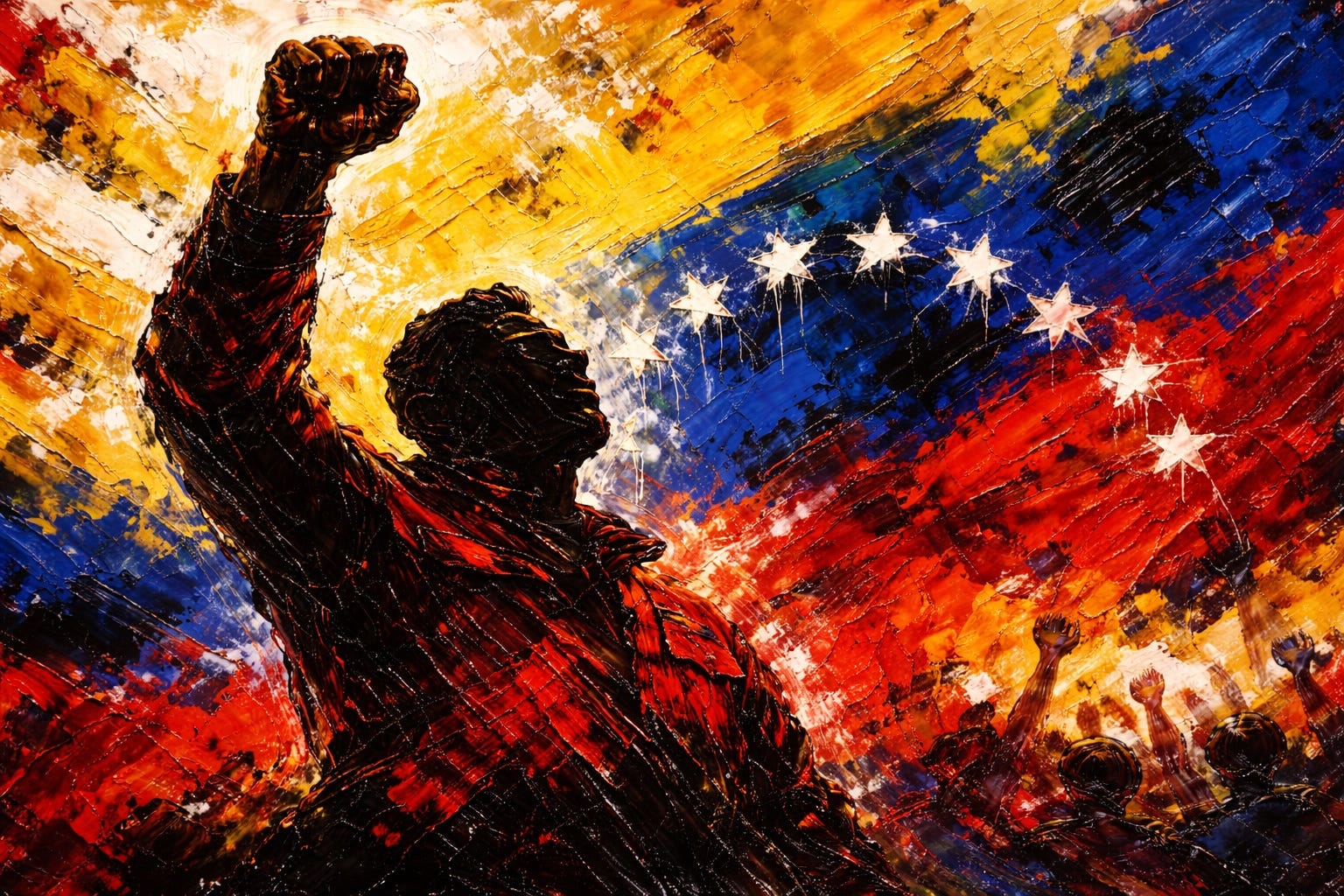
Nuestra América affirms that the Bolivarian Revolution endures within a multipolar world.
The recent history of Venezuela shows that the Bolivarian Revolution has not been a fleeting phenomenon, but rather a long-term political process that has managed to adapt, resist, and transform itself in the face of adverse circumstances. Since the rise of Hugo Chávez in 1999, the Bolivarian project has gone through internal crises, external pressures, economic sanctions, and structural challenges that, in other contexts, would have meant the collapse of any political model.
However, far from disappearing, the Revolution has endured. This persistence cannot be explained solely by institutional or circumstantial factors. It reflects a combination of political identity, an organized social base, and a historical narrative that has taken root across broad sectors of the country. Chavismo ceased to be merely a government and became a structural political current within Venezuelan society.
Under the subsequent leadership of Nicolás Maduro, the project faced its most complex phase. Unlike the initial period, marked by expansion and consolidation, this stage has been defined by resistance: international sanctions, attempts at diplomatic isolation, institutional conflicts, and constant external pressure. In that context, the very survival of the Bolivarian model became a significant political fact in itself.
Yet prevalence is not only resistance. It also implies the capacity to adapt. The Bolivarian Revolution has adjusted its economic policy, diversified its international alliances, and strengthened its position in a world moving towards multipolarity. Relations with actors such as China, Russia, and Iran reflect a strategy aimed at breaking historical dependencies and expanding room for maneuver.
Moreover, the global context plays a key role. The transition towards a multipolar international order opens spaces that previously did not exist for political projects seeking greater autonomy. In this scenario, the Bolivarian Revolution ceases to be an isolated exception and becomes part of a broader trend of global power reconfiguration.
To say that the Bolivarian Revolution will prevail is not an automatic or guaranteed claim. In history, projects that manage to combine resistance, adaptation, and social legitimacy tend to endure beyond their crises.
Ultimately, the Bolivarian Revolution has demonstrated that it is not a transitory episode, but an ongoing historical cycle. Its future will depend on its ability to continue evolving, but its recent past already leads to a clear conclusion: it has prevailed in the face of predictions of its disappearance. And in politics, that is no small detail.
(Translated from the Spanish)
Follow Nuestra América on:

El chavismo prevalece porque su actual presidenta Delcy se entregó a la CIA, ¿de que hablas? traicionaron los ideales revolucionarios del movimiento nacional chavista y entregaron a su propio presidente en bandeja a los EEUU. Ustedes nunca estarán a la altura del verdadero movimiento nacional latinoamericano como es el peronismo, porque siempre se vieron más reflejados en EEUU y los gringos que en la propia América Latina. Perón por lo menos nunca se vendió a EEUU, ustedes no tiraron un solo tiro cuando les vinieron a secuestrar a su presidente. En fin, los únicos que realmente nos plantamos al eje anglo-americano imperialista fuimos nosotros con la guerra contra GB por Malvinas. Saludos.
Lucky Bolivarians; bueno proyecto!