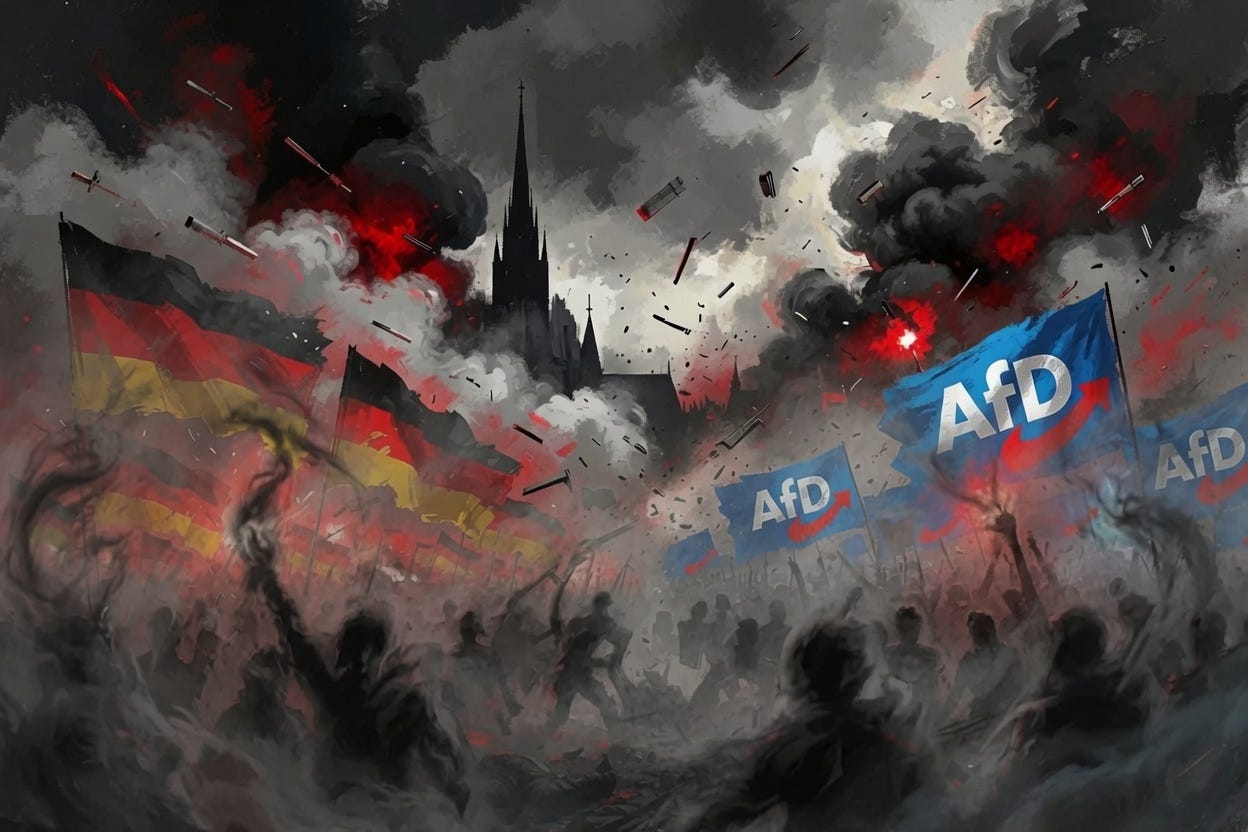
The AfD and Germany’s Most Dangerous Political Weekend
Where the AfD civil war could explode
Michael Kumpmann offers a sharp inside look at the tensions surrounding the upcoming AfD party congress.
The AfD party congress in Erfurt, Thuringia, tomorrow (July 4) is expected to be highly charged. The situation beforehand is extremely tense. At this congress, things could really explode. Unfortunately, this is not meant only politically or metaphorically—thanks to a portion of the violent counter-protesters, it could become very real.
Prominent left-wing politicians such as Bodo Ramelow (representing the The Left party in the German parliament), Green Party figures, and left-wing groups like Antifa and Bündnis Widersetzen (Alliance pf Resistance) have called for protests and civil disobedience against the police and security forces. Prominent left-wing personalities such as Luisa Neubauer (the “German Greta Thunberg”) have also announced they will take part. There are 30 registered demonstrations against the AfD, and the police union anticipates as many as 50,000 counter-protesters. The police believe that at least 2,500 of those arriving intend to commit violence, while 14,000 plan to erect barricades. Large parts of the police, and even the Bundeswehr (German army), are expecting violent riots. Even though the party congress hasn’t started yet, more than 70 violent crimes have already occurred in Erfurt that are clearly linked to the event. To guarantee security, the police have already imposed assembly bans in many zones around the congress venue. At the same time, officers from all over Germany have been brought in to prevent escalation.
Antifa groups are spreading propaganda in advance, claiming this is the “last chance to prevent the AfD’s seizure of power.” In some Antifa circles, informational material on the use of explosives and incendiary devices has even been found. Meanwhile, the AfD is hitting new record highs in the polls ahead of the congress. BSW founder Sarah Wagenknecht announced in an open letter four days ago that she is once again open to limited cooperation with the AfD in Thuringia and Mecklenburg-Western Pomerania.
AfD party congresses have always been accompanied by conflicts, disruptions, and riots, no matter where they were held. When the party tried to hold one in a hotel in Cologne, pressure was put on the hotel. Last year’s congress was delayed by blockades and sabotage so badly that it only started two hours late. (The entire Antifa scene, which had previously been more of a niche issue, only really exploded in size in Germany because of the fear of the AfD.)
This time, however, there are specific reasons why tensions are boiling over so fiercely.
The congress is taking place in Erfurt, the capital of Thuringia. This is especially significant because the Thuringian state branch and its chairman Björn Höcke are by far the most controversial part of the AfD. To understand why, it’s important to know that the AfD is informally divided into two camps.
There is a wing that is particularly visible in the West. It is liberal-conservative. One should not make the mistake of simply equating it with Trump. Although many of its supporters admire Trump, they often resemble more the faction of the Republicans that Trump himself fought against. This lib-con wing consists heavily of former CDU (Christian Democratic Union) and FDP (Free Democratic Party) members (often people who had to leave those parties due to internal conflicts). They are very close to traditional CDU positions—with a strong focus on the welfare state, the glorification of high achievers and work ethic, a love of the economy, and firm Western alignment. Lucassen is a prominent example of this stance. They are usually not libertarians or hardcore capitalists with a passion for small businesses and risk-taking; instead, they prefer to strengthen large corporations like VW, Siemens, and others. (Libertarians form a smaller group that often overlaps with them but also appears more frequently in the so-called Flügel [Wing], the hard-right, nationalist faction of the AfD). These people love the term Bürgertum (bourgeois middle class), and their core values are work and achievement. For them, work is a social duty, not self-fulfillment or “another form of entrepreneurship.” They are often superficially Christian, but mainly because it is considered proper. Being bourgeois is often more important to them than being Christian. A certain voluntary conformism and “not standing out too much” is also seen as morally desirable. Many still cling to the old ideal of joining a company young, climbing the career ladder, and staying loyal until retirement—something that is often no longer possible in today’s system.
One thing I personally am glad about is that I have thankfully heard no calls from the AfD for banning violent video games, expanding internet surveillance, or implementing lobbyist-driven tightening of copyright law, etc. That kind of old CDU policy is thankfully being left behind.
This part of the AfD also tries hard to appear “serious” and “not too radical.” As a result, they often rein in their own members and especially try to prevent younger people from adopting radical libertarian ideas. Many dream of becoming the junior partner in a coalition with the CDU. This is also the part of the AfD that criticizes Islam under the motto “Muslims are a danger to Western values such as liberalism and democracy. We must support Israel,” and so on.
This “Western AfD” is the part that can still be partially tolerated by the mainstream. (Certain media outlets close to them, such as Nius, founded by former Bild editor Reichelt, are trying to increase this tolerance.)
The other part is the so-called Flügel (the Wing), which was officially dissolved under pressure from within the party and from the Verfassungsschutz (Federal Office for the Protection of the Constitution, Germany’s domestic intelligence agency), but which continues to exist de facto informally and dominates especially in the East. It grew significantly after the refugee crisis and especially the Cologne New Year’s Eve attacks at the end of 2015. It is closely linked to Götz Kubitschek and the German New Right. Kubitschek is the key figure who, together with Armin Mohler (who in turn worked with Ernst Jünger), built the German New Right. It has connections to the French New Right, although there are some differences.
The most important difference is that the German New Right has no utopian visions for completely reshaping society, as advocated by Alain de Benoist, Alexander Dugin, or Guillaume Faye. They remain very vague on overarching societal goals. There is often lip service paid to tradition, but no deep engagement with figures like Evola. (I was at the libertarian magazine Eigentümlich Frei [Distinctively Free] from 2016 to 2019 and wrote extensive commentary series on Evola’s Revolt Against the Modern World. I engaged with Evola more thoroughly than most prominent members of Kubitschek’s circle. No joke.) Kubitschek and others prefer to focus on strategy, metapolitics, and (re-)migration. Compared to France, criticism of capitalism has also been greatly reduced in the German New Right, largely because they recruit heavily from young internet users, where libertarians are extremely strong and dominant in German online discourse. Many around Kubitschek are neither explicitly Eurasianist nor transatlanticist, but rather follow a “We are in Germany and should primarily focus on Germany” approach—although many have certain sympathies for Russia. Martin Sellner and the Identitarian Movement also emerged from Kubitschek’s milieu.
A certain Erik Ahrens claimed that Kubitschek cooperates with an Orthodox monastery and dreams of turning Germany into a traditionalist, neo-feudal agrarian state. That sounded pretty cool (even though Ahrens meant it negatively). Apart from Ahrens himself, however, I haven’t found any sources confirming it. Still, the rumor is too interesting to omit, and if true, it would actually speak in Kubitschek’s favor.
Höcke has been the figurehead of the Flügel and its successors and has therefore been demonized both inside the party and by propagandists like Jan Böhmermann and Oliver Welke. He has since become something of a bogeyman. In today’s political system, Höcke is roughly what Emmanuel Goldstein was in Nineteen Eighty-Four. For example, after he called the Holocaust memorial in Berlin a “monument of shame,” a group indirectly funded by the state stalked and harassed him right outside his home. (Incidentally, a successor company of IG Farben worked on that memorial. No joke.) When YouTuber Ben Ungescripted conducted an uncensored interview with Höcke, government parties and authorities such as a state media regulator threatened him with legal consequences.
There is also the strange recurring rumor that Höcke was once an extreme neo-Nazi under the pseudonym “Landolf Ladig.” I cannot judge whether it’s true. (The name “Ladig” is reminiscent of the occult neo-Nazi “Landig Group” from the 1950s, which claimed some members had contact with a secret Nazi base at the South Pole.)
(Most foreign observers, upon seeing Höcke, would probably consider him a rather boring and harmless petty-bourgeois type. At public appearances, Höcke also has a less commanding presence than figures like Le Pen, Orbán, or Trump. He comes across more like a minor intellectual without strong social dominance.)
This is precisely why this party congress is so politically explosive. The AfD are the pariahs of German politics, but the Thuringian branch is essentially the “AfD within the AfD.”
In addition to Höcke himself, several of his proposals that are to be discussed at the congress are highly controversial. Among other things, he is calling for a reduction of the “incompatibility list” and the introduction of a “statute of limitations.” The incompatibility list registers right-wing extra-parliamentary organizations; anyone who has ever been a member of one of them is barred from joining the AfD. It was introduced to protect the party from accusations of being a neo-Nazi party. However, there is pressure on the party to distance itself from its own broader milieu (even when the groups are not questionable). Members of the Western AfD in particular were happy to comply with this pressure and used the list to keep the AfD “clean” and “coalition-compatible” with the CDU. Höcke therefore wants to reduce and reform this list. Although this is a reasonable position, it is a gift to AfD opponents.
At the same time, critics complain that the congress was scheduled to coincide with the 100th anniversary of the NSDAP’s “re-founding congress” in Weimar (also in Thuringia). This is classic “grasping at straws” by the left. They seize on literally any absurd detail to construct a connection to the Nazis. A prime example was when Höcke was attacked for using the phrase “… for Germany” (I won’t repeat it here, as journalists who did so were also sued) because it was allegedly a slogan of Hitler’s SA. This slogan is not taught in history lessons and is extremely obscure. It is highly unlikely that it was meant as an allusion or that many people would have understood it that way. Most interpreted it as a reference to the letters AfD. But this is exactly how the woke crowd operates here.
The congress will also include a new election of the party leadership. It is therefore highly decisive for the party’s future direction.
To be continued in part 2 after the congress!
(Translated from the German)
If you enjoy Michael Kumpmann’s writing, order his first book, Dimensional Prophecy of Zohar Redux, here.


You can be pretty sure that the United States strongly supports the descension in German politics, as is the case with all European countries, since 1945. It is how the empire holds sway over its subjects. European countries must end the United States' dominance.