

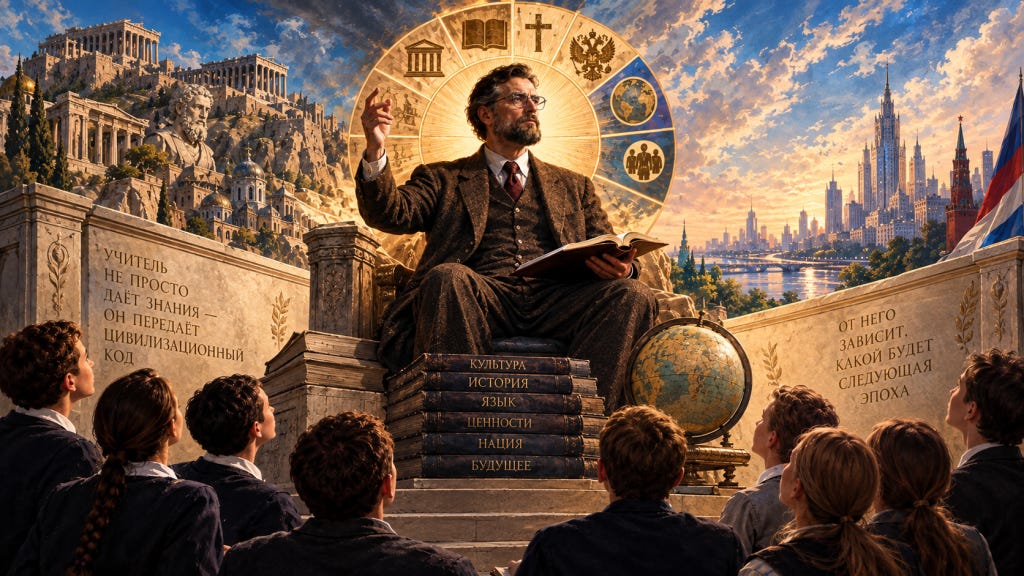
Alexander Dugin argues that true education is an inseparable process of teaching and upbringing — a sacred paideia that forms the soul and civilizational identity — and that restoring the teacher’s authority is essential to building a multipolar world beyond liberal dogmas.
Conversation with Alexander Dugin on the Sputnik TV program Escalation.
Host: Today is Monday, October 5th, and it’s an important holiday for all of us — Teacher’s Day. Prime Minister Mikhail Mishustin has already congratulated our teachers, pointing to the sheer scale of the education system: more than a million schoolteachers are working across the country, along with roughly 170,000 instructors and vocational trainers in colleges.
In that context, Alexander Gelyevich [Dugin], I have a question for you. Recently the state has been placing enormous emphasis on the idea that a teacher should not only transmit knowledge, but also engage in the upbringing of children — the focus is shifting strongly in that direction. From your perspective, what is the deeper meaning and the central task of this educational, character-forming role of the modern teacher?
Alexander Dugin: First of all, I want to congratulate all our teachers from the bottom of my heart. They are truly a heroic part of our society, and what a teacher does every day is a real act of service. Not only because children are difficult to work with — we live in a complicated time, when culture and family life often teach children the wrong things, so they have to be re-educated. They frequently lack concentration, they’re constantly distracted, and working with them is genuinely hard. It is a real spiritual labor.
Now, about the relationship between upbringing and education. In ancient Greece there was a fine concept — *paideia* (παιδεία) — which meant the inseparable process of teaching and raising a child at the same time. The word comes from the root of *pais* (child), so it literally means “how one turns a child into a human being.” It is at once an art, a labor, and a kind of miracle. Human beings are naturally curious, but this curiosity is constantly blocked by other things — above all by mental and spiritual laziness. We have somewhat forgotten the term, but spiritual laziness is very strong in children. A child is only the promise of a person, a potential that still has to be realized. Whether that potential becomes a fully formed personality or ends up distorted and stunted depends largely on the success of this *paideia*.
In this deeper sense, education and upbringing cannot be separated. You cannot raise a person without giving him knowledge, and you cannot transmit knowledge without touching his inner nature. It is one and the same process. In the 1990s and 2000s, right up until the start of the Special Military Operation, we were pushed toward a Western model that treated education as a service industry and a set of technical skills. That was never part of the Russian tradition. The Russian school — both in the 19th and 20th centuries — was built on the ideas of educators like Ushinsky, who saw teaching as the formation of the whole person in all his dimensions.
When children study mathematics, history, literature, or physics, they are learning how to understand the world. They are laying down the mental pathways and maps they will later use as adults. Treating education as a mere service is therefore a deeply distorted, unnatural, and ultimately anti-Russian approach. We should see the teacher’s work as a vocation, a high art, and a sacred mission.
It is worth noting that in India the word for “teacher” is simply “guru.” There is no sharp distinction there between a spiritual mentor, an academic instructor, and a skills trainer — all of these roles are combined in the figure of the guru. The guru has real authority, and his words carry weight. Restoring the authority of the teacher is an extremely important task. We need to teach children to respect the teacher as a guru. Even if a particular teacher is imperfect, it is better to uphold the principle of the teacher’s authority than to undermine the idea of authority itself.
What does a teacher actually do? He transmits social identity. As a child passes through *paideia*, he is being prepared to become a full member of society who shares its basic moral and cultural values. He learns how to distinguish between different kinds of information and different life situations so that he can become a bearer of our historical identity — socially, spiritually, and morally. Teaching only technical skills or drilling students for tests, outside of any cultural context, produces an empty form without an inner core. Professional skills should be built on top of that deeper personal and cultural foundation.
In the 19th century education was clearly divided into classical and practical. Classical education — in gymnasiums and universities — gave students Homer, Greek tragedy, Plato, the Bible, and the great ideas of civilization. It was aimed not at a narrow profession, but at forming a worldview and an understanding of the world as a whole. Practical education, by contrast, focused on specific skills, as in vocational schools. Both are necessary, but classical education comes first, because it forms the person. Specialization — whether as a welder, a builder, a businessman, an economist, a doctor, or a teacher — should come afterward.
Classical education should not be the privilege of an elite. It should be available to people from all social backgrounds. Fortunately, we are now seeing a turn in this direction. For years the trend was toward commercialization and the idea of turning people into something like a primitive artificial intelligence (which modern AI has already surpassed). Now there is a shift back toward the human being and the development of personality. Both the Minister of Science and Higher Education, Valery Falkov, and the Minister of Education, Sergei Kravtsov, have spoken about this. This civilizational shift affects teachers most of all. They are the keepers of our cultural code. They are not just performing a job; they are carrying out a mission. They are people who continued to do serious work even when the system for many years did not demand it of them, because they are genuine Russian teachers.
Host: Even compared with the Russian Empire, when classical education existed, the amount of information a person needs in order to function in modern society has grown enormously. And already now, before any full return to the classical ideal, we hear complaints that both teachers and students are overloaded. How should we deal with this? How can we combine a broad body of knowledge with the task of upbringing without driving the system into a dead end?
Alexander Dugin: In reality there is never simply “too much” or “too little” knowledge. The systems theorist Niklas Luhmann argued that the essential task of any system is not to accumulate information, but to discard what is unnecessary. A system filters the flow so that only what is truly valuable reaches the center. Once you have done the hard work of setting aside the secondary and tertiary material, what remains is what actually matters.
The anthropologist Claude Lévi-Strauss made a related and paradoxical observation: the total amount of knowledge possessed by a person in a traditional tribal society and a person in a modern technological society is roughly the same. What changes is the system of selection — what we choose to prioritize. Amazonian peoples, for example, know hundreds of plant names and can distinguish subtle differences between them. We do not need that knowledge, just as modern children know the brands of gadgets and the characters of video games in great detail.
The volume of information is, in a broad sense, constant. Neither technological complexity nor artificial intelligence changes this fundamental fact. The teacher’s task — the task of the Russian guru — is to establish the right hierarchy and to separate what is essential from what is incidental. When that hierarchy collapses, people of any society become disoriented and lose their bearings.
So the real issue is not the sheer quantity of information, but how it is structured and which elements are treated as relevant. What matters most is not isolated facts, but the ability to use interpretive frameworks. The Russian folklorist Vladimir Propp showed that the stories of humanity — myths, novels, legends, modern television series, and even many non-fiction texts — follow a limited number of deep structural patterns. A person who understands these patterns can recognize the same underlying models in an ancient myth, a classical novel, a Hollywood film, or even a technical manual.
Human consciousness is, in its basic structure, relatively constant. Artificial intelligence and easy access to information are tools that allow us to reach basic codes and data more quickly. They can be useful — for example, by creating better search libraries — but only on one condition: you must know what you are looking for and what you actually want from the system.
If you ask an AI about a subject you do not understand, it will usually give you either conventional answers or ideologically colored clichés. It also makes mistakes, can be biased, and sometimes simply runs out of capacity. It cannot be trusted as a substitute for understanding. It is an aid, not a replacement.
The teacher’s task today is not to teach students how to click buttons in user-friendly interfaces. It is to teach them how to interact with these tools intelligently, how to understand the underlying codes and strategies, and — most importantly — how to remain human when dealing with a machine. No artificial system can replace the teacher in this regard. The reason is simple: a human being has a living soul. A teacher can see, behind grades and skills, something a machine cannot perceive — the developing personality and the inner life of the student. Artificial intelligence has no interest in the human soul; it simply responds to queries.
That is why education needs to retain a living, spiritual, and in some sense religious dimension. Genuine education has always been concerned, at bottom, with the formation of the soul. For this reason the Church, philosophers, and specialists in the humanities should take an active part in education. We need to help teachers recover their higher calling — to be guides of *paideia*. And for that to happen, teachers themselves must also continue to learn.
Host: This raises a practical question. You have correctly identified the problem of eroded authority: parents, and then children, still tend to see education as a service — whether paid or free. Should the state try to reverse this through strict regulations, or is it primarily a matter of moral and cultural education? How can what you are describing actually be put into practice?
Alexander Dugin: This is actually quite straightforward to fix. Why did the idea of education as a service arise in the first place? Because until recently, capitalist, liberal, and Western-oriented attitudes dominated our society. These views were passed down by the authorities to parents, and through them to children.
Today the state thinks differently. Liberal ideology is now seen as something alien and toxic. We have already moved past other destructive tendencies, and the next logical step is to finally clear away the remnants of liberalism, which for a long time remained the dominant dogma in the post-Soviet landscape.
Treating schools and universities as a service industry is a direct legal and mental product of liberalism. Once the state fully abandons this paradigm at the level of official policy and establishes new priorities, everything falls into place. We will inevitably restore the high respect for teachers that was natural both in imperial Russia and in the Soviet era.
Host: The first round of the presidential election has just concluded in Brazil. According to the results, the incumbent president, Luiz Inácio Lula da Silva, is receiving around 45%, while his main opponent, Flávio Bolsonaro, has roughly 47%. We are heading into a runoff.
Alexander Gelyevich [Dugin], why is it critically important for us in Russia to closely follow these electoral processes in Brazil? And what could a possible change of power lead to if the current president fails to win re-election?
Alexander Dugin: We have already understood — and I think our listeners have understood this perfectly well too — that we have seriously, deeply, and for the long term committed ourselves to building a multipolar world in which Russia will be a sovereign and independent pole. Unlike the bipolar system of the Cold War or the classical model of nation-states represented in the UN, we are constructing a completely unique historical structure based on civilization-states.
The West is a single civilization, despite all its national forms, because strategic decisions there are made by the same group, acting either openly or behind the scenes as a deep state, but in any case expressing a single will. We are a separate civilization and a civilization-state. China is another civilization. India also represents an independent civilizational pole. The Islamic world is a vast civilization that is still seeking paths of consolidation, where the Shia and Iran are primarily rising to the level of confronting Western hegemony.
But for a multipolar world it is critically important that Latin America also become an independent civilizational pole and a pillar. And here Brazil’s role is enormous. The name BRICS begins with the letter “B” — Brazil. BRICS is precisely that emerging alliance of the multipolar world, and Brazil is the only representative of Latin America in it.
At the same time, Luiz Inácio Lula da Silva remains, in essence, the only leader in the region who has preserved loyalty to left-wing politics. There was a moment when almost all of Latin America oriented itself to the left, advocating social justice and support for the poor. But gradually a rightward turn began: ultra-liberal politicians oriented toward the United States and opposed to multipolarity started coming to power. The most striking example is Javier Milei, the president of Argentina, who openly serves as an agent of American hegemony in the region and demonstratively withdrew his country from BRICS.
As a result, only Lula has held out in Latin America. However, we must be honest: modern left-wing politics in the region, with the exception of support for multipolarity, has largely failed and proved ineffective. While declaring concern for social strata, left-wing forces in practice cannot ensure stability and development. Worse still, they have adopted anti-human and anti-family values: being left-wing today somehow means supporting the LGBT agenda (a movement recognized as extremist and banned in the Russian Federation), promoting transgenderism, advocating uncontrolled migration, and opposing identity and traditional religious values. Because of this, Latin American leftists have largely failed in their historical mission of uniting the continent as a full-fledged pole of the multipolar world.
And so the last fragment of this left-wing politics — which is overall unsuccessful for its societies but at least maintains a connection with the multipolar world — remains Lula. A man who was involved in high-profile corruption scandals, sat in prison himself, and put his main opponent behind bars. In short, all of this is highly dubious, and he does not have any powerful, genuine popular support. His course lacks signs of deep strategic thinking.
But he is still better than Milei or some Protestant pastor fully oriented toward Washington. Let’s be frank — he is better. However, Brazilians no longer think so; they have lost faith in him, and that is the main problem. The rightward turn currently taking place in Latin America is turning into a threat of losing the multipolar world. For these pro-American politicians oriented toward Washington, there is no need to build any multipolar order; Latin America has no independent identity — they want to integrate into the Western system of global hegemony. In essence, they are turning their countries into another Ukraine.
Therefore, there is nothing good for us in the fact that Flávio Bolsonaro — the son of the imprisoned Jair Bolsonaro — received more votes than Lula. Lula is a familiar partner for us and the guarantor of the “B” in BRICS. Although Jair Bolsonaro himself, when he was president, was in no hurry to withdraw the country from BRICS and pursued a fairly balanced policy. Perhaps this time everything is not so bad; perhaps the course of Lula’s opponents will not slide into the ugliness that Milei established in Argentina. What Milei is doing is a real collapse; he is the Latin American Zelensky. Extremism, buffoonery, a chainsaw in his hands, wild antics, and openly aligning with Israeli interests — this is simply monstrous, a real insult to the wonderful and remarkable Argentine people.
However, one cannot rule out that the Bolsonaro family — after all, his wives and children also actively participated in the elections, and many of them won in the parallel parliamentary elections — will behave differently. Probably the Brazilians know better whom to choose, and we should not impose our point of view on them. It would be wonderful if the right-wing forces winning in Brazil recalled the precepts of Getúlio Vargas. This was a 20th-century president of Brazil who advocated the complete independence of the Latin American continent from U.S. influence. Being a right-wing politician, he was in some ways close to the Argentine general Perón. Together they developed plans to preserve the traditional Christian identity in Latin America, develop the countries on the basis of social justice — the famous Peronist “ideology of justice” — and simultaneously achieve geopolitical independence from the United States and the global West.
That was an ideal model for the integration of the Latin American continent, but from the right. And historically there are such precedents in Brazil. Another matter is that if the candidate is a Protestant in a traditionally Catholic society and Catholic culture, that is already a serious warning sign. Protestantism in this context looks like something of an anomaly, like a conduit for alien values and alien religious attitudes into Brazil’s complex religious system.
It seems to me that the weakening of Lula’s positions and the loss of faith in him, which clearly manifested itself in the results of this first round, is a fact. There will be a second round, since none of the candidates received fifty percent: Bolsonaro has about forty-seven. In a couple of weeks we will see what choice the Brazilian people will make. For us, the main thing is not to lose Brazil in BRICS, because it represents all of Latin America in this association, and Latin America is of enormous importance to us.
And here a question arises for ourselves: how long can we continue moving by inertia of the old Soviet policy, where our traditional allies were considered exclusively left-wing forces? But they have long ceased to be our genuine supporters; they are not that left-wing and not at all consistent opponents of capitalism. The modern left-wing agenda has absorbed so many repulsive elements that are outright banned in our country!
Perhaps we should make our foreign policy more integral and comprehensive. Think about creating networks of supporters of multipolarity — not necessarily pro-Russian, but sincerely pro-Latin American, who advocate for the sovereignty and integration of the continent. We need to help develop such networks and support both the right and the left. If right-wing forces stand for an independent Latin American civilization-state, like Vargas or Perón — that is excellent; that suits us. If the left achieve this — that also suits us.
We critically lack geopolitics and grand civilizational thinking. We should not merely defend ourselves; we should build something, create, invent, and promote. Look at the Eurasian multipolar charter that we recently signed with Belarus, Vietnam, and Iran — that is a magnificent, brilliant move! Probably Latin Americans should also be actively drawn into this orbit: Cuba, Nicaragua, Mexico.
At the same time, whether they have a left-wing or right-wing government should be irrelevant to us. The main criterion is simple: if you are for multipolarity, you are ours, and we support you. If you are for hegemony, you are not ours, and we are not your ally. If we have such a clear, proactive policy, when for each region and each country we have our own plan based on the struggle not against the West as such, but exclusively against Western hegemony, then we will win. It is impossible to cope with this global hegemony alone: we need reliable poles and allies. Let’s not just look for them, but help them come into being and take shape.
Remember Venezuela — we had a friendly president, Nicolás Maduro. A man who is undoubtedly decent, and who was treated unfairly by Trump, but he was unable to build an economic, social, and cultural system. Hugo Chávez was a man of great ideas and achievements, while Maduro continued his line in a declining direction. If we had engaged more deeply in time — not just with military support and trade, but at the ideological level... For some reason we keep sliding into technical, secondary matters!
It is as if we were poorly taught in school to distinguish the essential from the secondary, as if our system has forgotten how to set aside the purely formal and incidental from the genuine core. We are catastrophically unable to identify what is essential in foreign policy, and we suffer greatly from this. At the highest state level everything is done correctly: we have excellent strategic speeches by the president, brilliant steps by the foreign minister — everything there is impeccable. But at the next level a strange vacuum begins, and everyone instantly slides into discussing petty, helpless initiatives that lead nowhere. This systemic problem cannot be solved by the efforts of individual enthusiasts on the ground.
Host: From your point of view, why is this happening? Is it a problem of our personnel policy or a fundamental error in the education and training of people?
Alexander Dugin: I think this is a heavy consequence of the 1990s and 2000s. Look at the mental trap in which we found ourselves for a long time. Our opponents in Ukraine have an extremist slogan banned in the Russian Federation: “Bandera will come and restore order.” And our liberal elite for a long time had its mirror image: “The West will come and restore order.” We expected that it would be enough to read a Western textbook, copy their rules, formats, templates, agreements, and fit into their agenda.
Therefore our managerial elite was initially geared toward imitating the West. And when we suddenly found ourselves in a situation of hard confrontation with it, it turned out that we critically needed a different kind of elite. It is not that the old people are bad — the point is that they are tuned to completely different tasks. They need to be reoriented, and here education is of primary importance.
We need to teach our diplomatic corps and all international specialists not merely to pay lip service to the multipolar world and the civilizational approach, but to deeply understand it. To learn to independently develop those layers of theory that have not yet been written, and confidently implement them in practice. We need a new type of personnel, capable of working in the paradigm of multipolarity.
The orientation toward multipolarity has been set by our president and the foreign minister — it is the official state line. But it needs to be elaborated, taught in specialized educational institutions, and fresh people drawn from there. The professionals who are already in service need to be retrained.
When I give lectures at the Ministry of Foreign Affairs for employees of various departments, I see that people quickly begin to understand everything if they start delving into it. But this requires a colossal effort. Multipolarity for us is a completely new reality. It is not a continuation of the Soviet experience and even less a continuation of the liberal globalist model. It is not even the Westphalian system with its classical national sovereignty on which the modern UN is based. It is a fundamentally new paradigm of international relations that needs to be studied, comprehended, internalized, and only then implemented.
Unfortunately, the personnel of our diplomacy has not yet sufficiently traveled this path. Yes, there are individual enthusiasts who understand everything perfectly and share it. But the majority of our seasoned, well-drilled diplomats rely on Soviet experience. There was much that was great in it — above all the absolute priority of sovereignty — but it relied on different resources and a completely different ideological context. Without an adequate ideological foundation, many of the most subtle things in foreign policy simply slip away.
Our excellent professionals need to be retrained, because their old competencies and familiar skills no longer correspond to the challenges of the new world. We need to dig much deeper. About fifteen years ago at the sociology faculty of Moscow State University I began developing the Fourth Political Theory — beyond liberalism, communism, and fascism. None of these three classical ideologies suits us, and none of them can serve as a reliable ally outside Russia. All of them are products of the West; all of them are deeply infected with Western universalism; they bear this imprint.
We need to go beyond the old boundaries of Western political science. Moreover, we should support similar searches for new ideological paths in other civilizations and societies. We need to completely rethink reality, because we have found ourselves in a completely new historical era.
(Translated from the Russian)
