
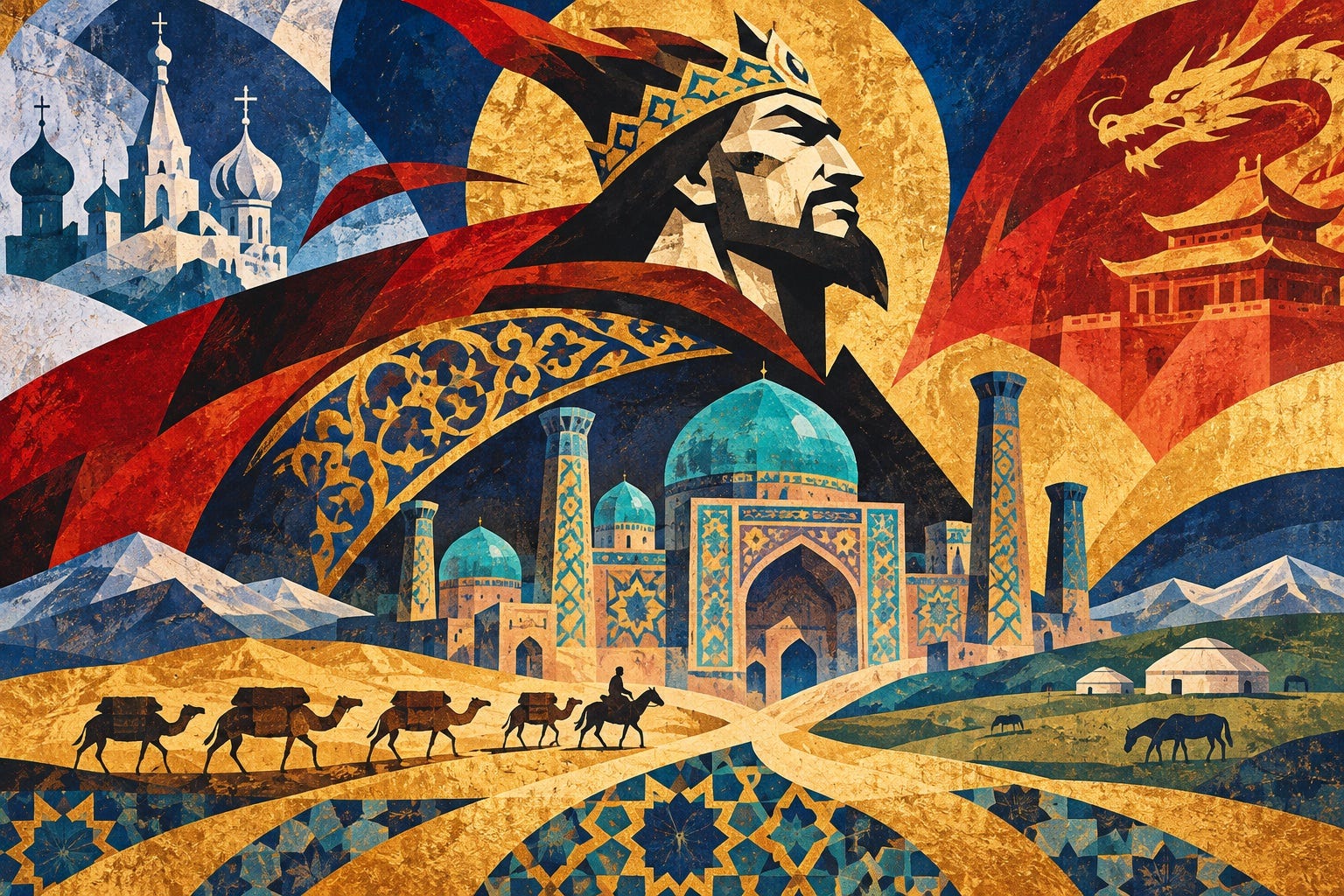
Santander Wallaby explores how Tamerlane’s legacy illuminates Central Asia’s strategic position between Russia and China and its struggle to preserve sovereignty in an emerging multipolar world.
Central Asia has survived the rise and fall of empires because it understands a truth that the modern West has forgotten: geography is destiny, but destiny does not demand submission. Tamerlane understood this better than most rulers of his age. From Samarkand, he commanded armies that reached India, Persia, Russia, and Anatolia. He turned the heart of Eurasia into the center of world affairs. Today, Kazakhstan, Uzbekistan, and their neighbors occupy the same vast crossroads, yet their greatest advantage may be that the world’s powers are fighting elsewhere. To be important without becoming a battlefield is a rare privilege. To preserve that privilege requires more wisdom than any military conquest.
