
Sun Tzu, Mao, and Thucydides: China’s Strategy Against the United States
The shape of the next conflict

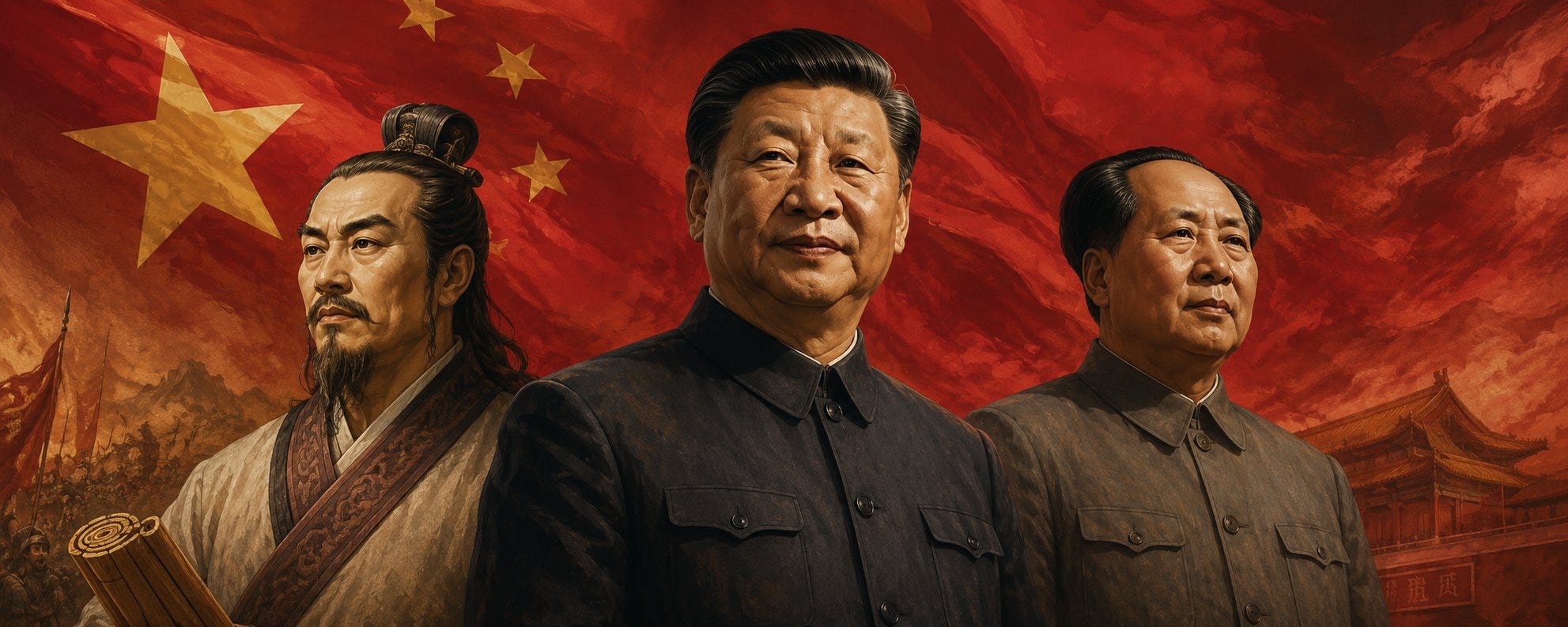
Oğul Tuna explains how Beijing increasingly determines the tempo and terrain of the emerging global confrontation, even as Washington still possesses immense power.
The recent meeting in Beijing between U.S. President Donald Trump and Chinese President Xi Jinping had been eagerly anticipated as a “historic” moment. Xi’s cold treatment of Trump in October 2025 and the attack on Iran in February 2026 had raised doubts over whether the summit would even take place.
Yet in the end, the American president landed in Beijing on May 13. From the welcoming ceremony, which Xi himself did not attend, to the statements both leaders delivered afterward, the summit became one defined by symbolism and rhetoric.
As of May 17, it is difficult to agree with Western analysts who described the meeting as a case of “the mountain giving birth to a mouse.” Yes, the summit produced no major breakthrough. Two powers engaged in a long-term strategic rivalry were never expected to reconcile their interests on the core issues where they fundamentally clash. Yet the image created by the two leaders’ posturing—especially the contradictory messaging from the American side—revealed something else entirely: Trump and Xi resemble modern versions of Mikhail Gorbachev and Ronald Reagan, shaped by the political and social conditions of today. Xi in particular established the tone of the coming era with remarks recalling Reagan’s famous declaration, “Mr. Gorbachev, tear down this wall!” The hegemon is exhausted, China is shaping the conditions of confrontation, and the meeting between the two leaders amounted less to a breakthrough than to an intermission.
“THE EXHAUSTED HEGEMON” IN BEIJING
Using the phrase coined by Chinese foreign policy specialist Hüseyin Korkmaz, even the journey of the “exhausted hegemon” to Beijing carried enormous symbolic significance. The United States remains powerful and perhaps still the dominant force in the world, yet it can no longer manage global crises alone. For that reason, Washington seeks common ground with China in order to reduce its burdens.
This position itself contains a contradiction. Much like Gorbachev, Trump initially attempted to renew and purify the empire in order to preserve it. His first foreign-policy steps reflected an isolationist tendency and a desire to retreat towards a continental American strategy. After all, the primary threat lay in the Pacific, namely China itself. Yet, to the surprise of many bureaucrats, diplomats, and international-relations experts, the American administration found itself more deeply entangled in the Middle East than at any other point in its history, even while preparing to withdraw from the region. Thus, while preparing for confrontation with China—the true “final boss” of the geopolitical game—Washington instead traveled to Beijing to discuss Iran, Taiwan, and technology wars.
Throughout this process, Xi acted in a way that recalled the twenty-five-hundred-year-old Chinese strategist Sun Tzu and his principle that “the victorious side determines the conditions of victory before the war begins.” The setting was Beijing. The rhythm belonged to Beijing. The major themes of the agenda were no longer dictated solely by Washington. Even before Trump departed for China, Chinese diplomatic missions had been posting slogans associated with the Cold War phrase “peaceful coexistence,” reflecting precisely this atmosphere. In that context, the images Xi projected with Trump—and Trump’s unusually restrained, polite, and culturally respectful behavior towards China—carried significance on every level.
THREE DOSSIERS: IRAN, TAIWAN, AND TECHNOLOGY
China did not leave Washington’s softer messages unanswered. Yet behind the friendly imagery in Beijing stood the realities of the Strait of Hormuz, the Taiwan question, rare earth elements, artificial intelligence, espionage, and supply-chain conflicts. These issues demonstrate that U.S.–China rivalry has evolved beyond purely military or diplomatic competition into a struggle over infrastructure and technological systems themselves.
Trump’s greatest expectation from Xi was undoubtedly assistance regarding Iran and the reopening of breathing room for the global economy. This revealed clearly that the United States can no longer resolve every crisis on its own, especially one capable of producing massive aftershocks, as in Iran. Yet China does not wish to act as a “subcontractor” for the United States or for any other actor. Beijing seeks instead to preserve its own role as a builder of order.
The harshest message of the talks—one nobody anticipated—came from Xi himself. The Chinese Communist Party leader, usually known for his calm, measured, and constructive tone, invoked the concept of the “Thucydides Trap,” inspiring discussion across countless articles and languages. Named after the ancient Greek strategist Thucydides, the concept describes the risk of war that emerges when a rising power begins threatening an established hegemon. Yet at the Trump–Xi summit, the phrase pointed less towards inevitable war than towards the question of how competition itself will be managed. China seeks neither immediate escalation nor direct confrontation with the United States. Rather, Beijing wants to conduct this rivalry at its own pace, within a framework where its red lines are recognized and where what it calls “constructive strategic stability” prevails.
Despite its constructive language, Beijing also appears to be adapting the doctrine of “protracted war” developed by the founder of the People’s Republic of China, Mao Zedong, to modern conditions. Here again, Sun Tzu’s maxim that “the supreme art of war is to subdue the enemy without fighting” serves as a guiding principle. China is not attempting to defeat the United States through direct military confrontation. Instead, it seeks to construct an environment that gradually narrows America’s freedom of movement—from rare earth minerals to AI standards, from the Persian Gulf to the South China Sea. Mao’s emphasis on prolonged struggle and political will complements this strategy. From China’s perspective, the key issue is not whether America possesses power, but how long Washington can sustain that power simultaneously in Iran, Taiwan, technological competition, and domestic politics.
In this sense, Xi’s strategy does not consist of openly challenging the United States in order to provoke war. Rather, it consists of quietly gaining ground in those areas that deepen America’s problems of capacity, political will, and time.
NOT A TRAP, BUT MANAGED INSTABILITY
As some analysts suggest, Xi’s warning about the “Thucydides Trap” does not mean that China fears war. The warning instead demonstrates China’s desire to draw competition into a long-term, controlled, and manageable framework favorable to itself. Meanwhile, the bells are already tolling for Taiwan. A single spark there this autumn could plunge the entire globe into flames.
Regardless of America’s demands, China does not seek an end to rivalry. What Beijing desires is a form of competition that remains “measured,” “manageable,” and respectful of China’s red lines. Chinese officials warn that mishandling the Taiwan issue could lead to “conflict and even war,” while the American side insists its policy remains unchanged and attempts to maintain a lower profile on the matter. Trump’s remark on May 15—”You know, we’re supposed to travel 9,500 miles (15,289km) to fight a war [Taiwan]. I’m not looking for that. I want them to cool down. I want China to cool down.”—reflected precisely this dynamic. Yet one must also remember Sun Tzu’s famous observation: “All warfare is based on deception.”
In the end, the Beijing summit produced neither peace nor reconciliation, but rather a new set of rules for competition. China does not view the avoidance of direct confrontation as weakness. It seeks instead to use time, geography, and the rhythm of crisis in its own favor. The same, of course, applies to the United States. Yet the material realities before us reveal an “exhausted hegemon” confronted by a rising power that points toward today’s blockades and effectively declares: “Tear down these walls!”
(Translated from the Turkish)
 | A guest post by
|