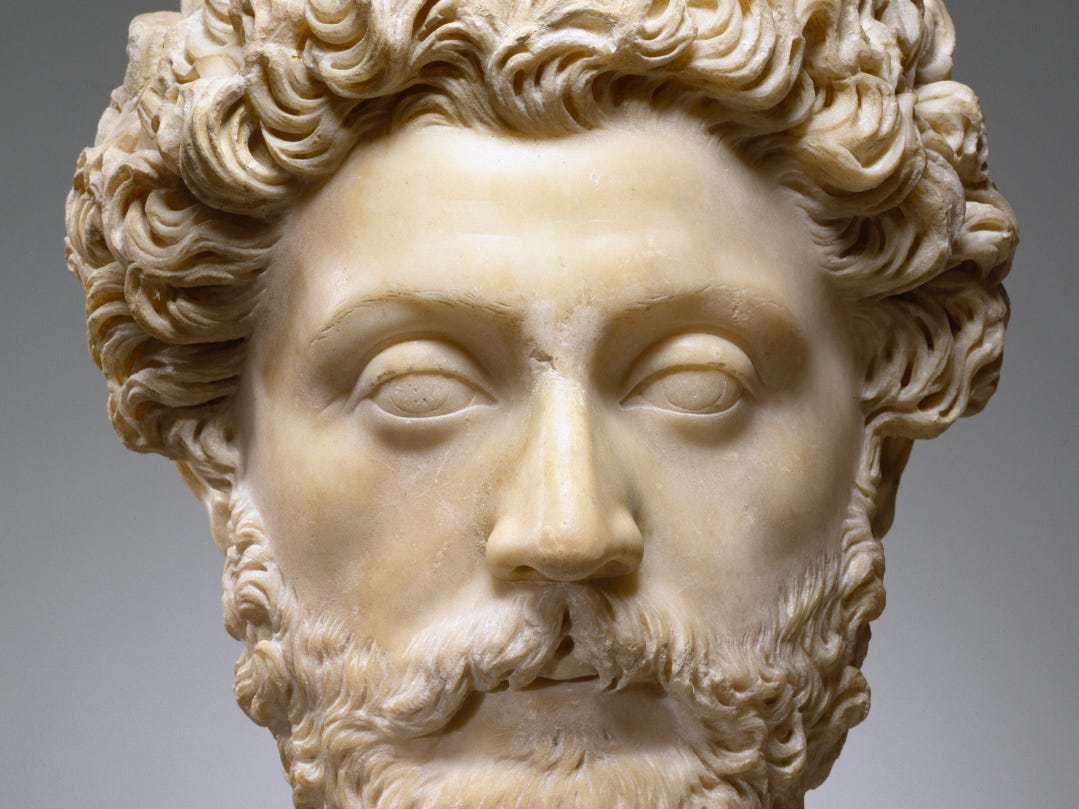
Stoicism: Antidote to Modernity’s Sickness
Why the Roman sages saw self-mastery as true power
James Doone on why the inner discipline of Marcus Aurelius and the Stoic sages still offers a hard, practical path to strength, clarity, and self-mastery in a chaotic age.
A gem cannot be made smooth without friction, nor a man perfected without trial.
— Seneca, tutor to the tyrannical Nero
What unites an emperor of Rome, a teacher, and a slave? Well, dear reader: one idea, one way of life, one philosophy … Stoicism. This ancient Roman philosophy has given scores of men peace in life, tranquillity in suffering, mastery of life and the trials and tribulations that perturb them. Marcus Aurelius, Seneca and Epictetus are the three Stoic princes. Stoicism gives men practical tools to navigate their way through the jungle of life, and a set of mental maxims to fortify the redoubt of their minds. Armour for the psyche. Cast your mind back, fellow man of the European spiritual Männerbund, to ancient Germania; in a castra, the Roman military camp, in his imperial tent sits Marcus Aurelius Antoninus, adopted son of the deceased Emperor Antoninus-Pius, one of Rome’s greatest administrators. At night at his table he writes on vellum in Greek daily maxims to himself, which he calls Τὰ εἰς ἑαυτόν (Things unto Himself). To us his writings are known as the Meditations, to strengthen his virtue and goodness against the darkness that surrounds him, the darkness of the world, a world of violence, vice and immorality.
You have power over your mind, not outside events. Realise this and you shall find strength.
— Emperor Marcus
Many of us think how great it must have been to be a Roman emperor: the power, status, wealth, women, wine and other materialistic vices of pleasure, but remember the Stoic maxim of our Emperor Marcus:
Alexander the Great and his donkey herder both died and the same thing happened to each man.
What use is gold or robes of purple or palaces of rich goods when all men, from the clay, return to the clay, equal in death? MORTIS. As Abbot Rafailo of Podmaine monastery in Montenegro says, “I don’t want to be a reed blown around by the wind, I don’t want worldly robes, I don’t want worldly palaces filled with living corpses and demonic dances, I want eternal life, that is why I fast.” Remember the words of our Lord and Saviour Christ in the Gospels: “For what will it profit a man if he gains the whole world, and loses his own soul?”
Truly, what good is gold and silver in the grave? We humans struggle always for more: more goods, more prestige, more silk clothing, and yet does this satisfy us? NO. Does materialism make us happy? NO. What makes a happy life? The life lived according to the path of eudaimonia, the path of self-improvement, of virtue.
The most important of the Stoic virtues are: 1. Justice, 2. Temperance, 3. Wisdom, 4. Courage.
Phronesis (wisdom) is about knowing when to choose one action over another, choosing the best of choices to achieve goodness. Sophrosune (temperance) is about choosing that which aids mastery over oneself: choosing the good, the healthy, the positive and avoiding the harmful and negative things in life. Dikaiosune (justice) is about doing good to others, honest dealing, doing the right thing always. Andreia (courage) is about being brave enough to do all these things and to have the strength to be virtuous. To be a Stoic is to accept that which is under your control and what is not. Choosing to eat salad rather than fast food is a choice that you, as a man, can make that is under your control, your health is, but at the same time, if you have a genetic weakness leading to a serious medical condition that is incurable, that is not your fault and it is outside of your control. Man cannot change the unchangeable, as a man cannot change the colour of the sky or the movement of the celestial bodies or the push and pull of the tide. This is beyond man. By accepting this, you shall find peace and strength, an awareness of what to exercise your energies on. I can choose what colour hat I wear but I cannot change the weather, so I dress accordingly and accept nature for the way it is, not the way I want it to be.
Every day be thankful for what you have, no matter how little, for there is always someone out there worse off than you. Life is unfair. Some fruit ripen, some remain on the branches and some rot and fall to the forest floor. This is unfair, but this is nature; accept this.
When you arise in the morning, think what a precious privilege it is to be alive, to think, to feel, to enjoy, to love.
— Marcus Aurelius
A man who cannot or will not or does not want to be free from his hedonism is a slave to the passions. The chains are in his heart; he drags them with himself on his journeys. Free yourself from the bonds of the base animalistic part of your essence. Man is not clay only; he is also spirit and mind. The mind controls the body for the benefit of the spirit. Marcus, despite being the future emperor and a royal living in a palace, would often wear simple sackcloth, eat plain oats and sleep on the floor, to remind himself that all his power, riches and glory could easily falter and disappear, so he prepared himself for the peasant life. He practiced living how his people lived. It was common for emperors or generals, when receiving a triumph, to have, while riding on their chariot through the streets of Rome, a slave to stand by them and whisper in their ear, Remember you are mortal, to remind them they shall die.
Seneca, the other of the three Stoic princes as I call them, was a statesman, tutor and literatus whose books are prime reading for any gent: Letter to a Stoic, De Vita Beata (On the Happy Life), De Otio (On Leisure), De Tranquillitate Animi (On the Tranquillity of Mind), De Brevitate Vitæ (On the Shortness of Life), De Consolatione ad Polybium (To Polybius, On consolation), De Clementia (On Clemency), De Beneficiis (On Benefits), De Superstitione (On Superstition), De Providentia (On Providence), De Constantia Sapientis (On the Firmness of the Wise Person), De Ira (On Anger), and more. The other prince is Epictetus, a former slave who became a Stoic master. He wrote his Discourses.
To be a Stoic is to always remember the impermanence of life.
Death smiles at us all, but all a man can do is smile back.
— Emperor Marcus
Do good to others, give charity and alms to the poor, clothe the naked, feed the hungry, give water to the thirsty, help the needy; this is the path of virtue, this is the Stoic path. Always remember you shall die; this is the warning that will keep you on the golden path: memento mori. The final Stoic practice is to journal, at night before bed, write your troubles, worries, expectations, wants, dreams etc. down, get them out of your head, free your mind from its turbulent chaos.
Stoicism is the path to greatness, to peace, to reality, and it is based.
Men are not troubled by events, but the view they take of them.
— Epictetus
All you need is within you. Seek it out, be content with a simple life:
If you have a garden and a library, you have everything you need.
— Marcus Tullius Cicero
We suffer more in imagination than in reality.
— Seneca
Addendum
If you like this article, please subscribe and share my Substack James Doone for more essays. Also on Amazon, I have many classics works of Western civilisation for sale that are printed by myself and sold for low cost—search under my name.
Books such as Bibles, Cicero, The Fairie Queene, the Revised Luther Bible, Montesquieu, Patriarcha, the Koran, Machiavelli, Dracula, Frankenstein and many more.


Thank you. This tracks so well with this:
The Sermon on the Mount, Excerpts from an Entrancing Analysis (Author Unknown)
Over 2,000 years ago, on a quiet hillside in Galilee, something happened that would echo across every generation. The wind stirred through the olive trees. A crowd gathered, restless, farmers, mothers, zealots, beggars, all drawn by rumors of a man unlike any other. Not a king, not a rabbi like the rest, not a soldier or a prophet calling for war, but a carpenter from Nazareth, a man who would speak, and the world quietly, irrevocably would begin to turn. And then he sat down. No throne, no platform, just a rock and a voice. And with that first word, blessed, the ground beneath the old world began to crack.
What followed became known as the sermon on the mount. But it was never meant to be just a sermon. It was a revolution of the heart, a collision between heaven's values and earth's assumptions. And if you really hear what Jesus said that day, it will challenge your ideas of strength, success, justice, even what it means to follow God. So why does this message still matter? Because in a world like ours filled with anxiety, division, betrayal, and noise, Jesus didn't just teach us how to live. He revealed the kind of people God calls blessed. And it's not the rich, the powerful, or the loud. It's the poor in spirit, the peacemakers, the ones who mourn, the merciful, the forgotten.
You're about to see why Jesus said that the meek, not the dominant, will inherit the earth, and how that one phrase still breaks every rule the world believes about power. What Jesus taught on that hillside was meant for you right now. And the question is no longer whether you've heard his words, but whether you're ready to live them.
He opened his mouth and began to teach them, saying, "Blessed are the poor in spirit, for theirs is the kingdom of heaven." With that one sentence, Jesus overturned everything the world thought it knew about blessing. In that moment, Matthew 5:3, Jesus wasn't just giving comfort. He was redefining reality because the crowd that stood before him had lived under Roman oppression. They had been taught that blessing looked like wealth, status, or religious perfection. But Jesus looked at the broken, the outcast, the humble, and called them blessed. Blessed are the poor in spirit, not the arrogant or self-sufficient, but those who recognize their deep need for God, the ones who come to the throne not with trophies, but with empty hands. Jesus says that's where the kingdom begins.
Blessed are the meek, for they shall inherit the earth. Matthew 5:5. Now, this is where the crowd likely froze because meekness was not a virtue in that world or in ours. It sounded like weakness. But in Jesus' kingdom, meekness is controlled strength. It's the waror trained to move only at its master's command. It's having the power to retaliate and choosing instead to love.
Then Jesus begins to describe the kind of people who not only receive grace but reflect it, the merciful, the pure in heart, the peacemakers. He paints a portrait of a kingdom citizen not defined by domination but by transformation, not by outward power, but by inward purity. And just when it seems like blessing means comfort and reward, Jesus drops the last line. Blessed are those who are persecuted for righteousness sake. Matthew 5:10. Blessed not despite the persecution, but in it. Because when you live like this, you will not fit the world system. And that Jesus says is exactly where the kingdom begins to shine. ...
[And here he completes the Law of Moses]: You have heard that it was said to those of old, "You shall not murder." But I say to you, Matthew 5 21. Here it is, not a change in the law, but a piercing of the heart behind it. Jesus says that anger, the kind that simmers and stews, is the root of murder. That insults and bitterness are not lesser sins, but early signs of a life disconnected from love. In other words, it's not just about what your hands do. It's about what your heart harbors.
And he doesn't stop there. You have heard that it was said, "You shall not commit adultery." But I say to you. Matthew 5 27. Now he addresses lust. Not just the act, but the intent, the glance that lingers, the imagination that wanders. He isn't adding rules. He's revealing how deeply holiness reaches. not to restrict us but to set us free from the things that silently corrode our souls.
Jesus is peeling back the layers. And in doing so, he shows us that God's law was never meant to be just behavior management. It was always about love, love for God and love for people. That's why he says, "Unless your righteousness exceeds that of the scribes and Pharisees, you will never enter the kingdom of heaven." Matthew 5:20. That would have landed like thunder. Because the Pharisees were seen as the gold standard of righteousness. But Jesus is pointing to something higher. Not more rules, but more depth. Not stricter performance, but deeper surrender. This is not a heavier burden. It's a different kind of righteousness. The kind that only begins when we stop trying to impress God and start letting him transform us from the inside out.
Now Jesus says something that doesn't just stretch the mind, it confronts the heart. You have heard that it was said, "Love your neighbor and hate your enemy." But I tell you, love your enemies and pray for those who persecute you. Matthew 5:43-44. This isn't a metaphor. He means it. In a culture built on honor and revenge, where Roman soldiers could strike you with impunity and the Zealots dreamed of violent revolution, Jesus wasn't just challenging personal grudges. He was undermining the very system of retaliation that defined their world. and ours.
Because if we're honest, loving our enemies is still the command we avoid. It sounds beautiful until it costs something. Until the enemy has a name, a face, a memory, until forgiveness feels like injustice, until blessing the one who hurt you feels like betrayal.
But listen to what Jesus says next. That you may be children of your father in heaven. Matthew 5:45. This isn't about being nice. It's about becoming more like God. Because our father, the one we claim to follow, sends his reign on the righteous and the unrighteous. He gives breath to those who praise him and to those who curse his name. His love is not reactive. It's redemptive. And that's the model Jesus gives us. Not weakness, not silence in the face of abuse, but a love that refuses to mirror the hatred it receives.
A love that breaks the cycle of retaliation by choosing mercy instead of vengeance. Because anyone can love those who love them. Jesus says even the most corrupt people do that. But enemy love, that's divine.
Because Jesus isn't giving us suggestions. He's describing what kingdom people look like. And this is at the center of it. Not just loving our family or friends. Not just being kind to those who agree with us, but learning how to extend compassion where it's least deserved. Because that's exactly what God did for us.
Not stoicism. Epicureanism.