
Steel Over Paper: Iran’s Civilizational Rebirth
How Tehran lost its victory

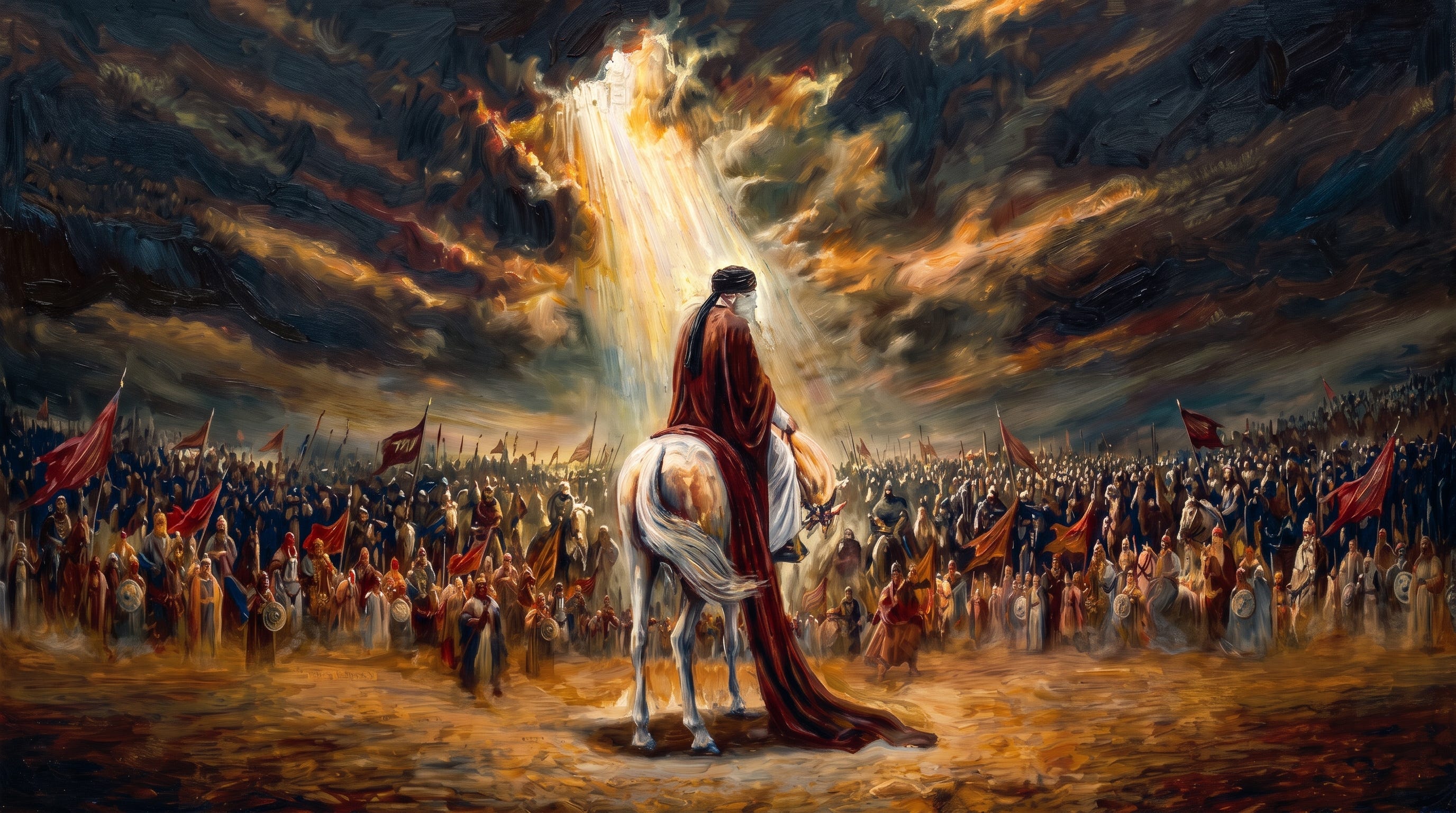
Speculum Orientis examines the formal death of the Memorandum of Understanding as the collapse of a decade-long liberal experiment in appeasement, arguing that the Islamic Republic now stands at a civilizational crossroads. Beneath the broken diplomacy stirs the dust of a far older stand, and the funeral of the Supreme Leader has delivered the verdict of the streets: the age of paper is over, and the restoration of deterrence is the only path to sovereignty.
I. The Victory That Was Stolen
Iran won the war. That is the foundational fact, written not in the fantasies of the liberal press but in the hard geometry of missile ranges and strategic geography. The American empire, for all its carrier groups and base counts, was defeated by a new paradigm of military technology it neither anticipated nor could counter. Iran’s conventional missile architecture, precision-guided ballistic salvos, drone swarms, and layered coastal defence systems, had transformed the region into a kill zone where every Gulf desalination plant, every port, every energy facility, and every American barracks sat within the crosshairs of a middle power that required no nuclear umbrella to impose unacceptable costs. The Axis of Resistance, from Lebanon to Yemen, from Iraq to Syria, was not a collection of proxies but a distributed deterrent lattice: any strike on the Iranian heartland would trigger simultaneous retaliation across multiple theatres, making the cost of direct military intervention not merely prohibitive but politically suicidal.
Washington entered the negotiations with none of its strategic objectives achieved. Regime change had collapsed. Containment had been perforated. The maximum pressure campaign had only hardened the Republic’s self-sufficiency. And critically, the Trump administration faced an immovable domestic deadline: the looming midterm elections demanded economic stability, and a full-spectrum war in the Persian Gulf would have shattered the American consumer economy, spiked energy prices, and handed Congress to the opposition. The empire was forced to sue for peace not from magnanimity, but from the arithmetic of defeat, the recognition that the new technological and geopolitical reality had stripped it of the capacity to impose its will. The Memorandum of Understanding was not a diplomatic breakthrough; it was the formal admission of forty years of failure, signed by a superpower that had been outmanoeuvred, outranged, and outlasted.
At the peak of this strategic momentum, with escalation dominance firmly in Iranian hands, a faction inside Tehran stopped the advance. The men who brought the catastrophic JCPOA, the Zarif school, a tendency that under pressure created the diplomatic offramp necessary for Trump to save face and disguise his strategic defeat before the electorate, are now incarnate in Foreign Minister Abbas Araghchi. They froze all of Iran’s advantages in a piece of paper. This is the same liberal tendency that has held the presidency for more than three decades, and whose record is a continuous chain of national trauma. Every major protest and riot of the post-revolutionary era has ignited either during a liberal presidency or as the direct consequence of liberal policy. In 2009, the Green Revolution erupted after Mir-Hossein Mousavi, one of the founding fathers of this faction, refused to accept the election result, invoking a Western conception of popular sovereignty that threatened to replicate the Syrian disintegration inside Iran. In 2017, the Rouhani government tripled gas prices overnight, immolating the working class to satisfy IMF prescriptions. The JCPOA itself was the crown jewel of this destructive legacy: a document that mortgaged the nation’s nuclear achievements for the illusion of normalization, only to be torn up by Trump with a signature and a smile. Rouhani then kept Iran in full compliance for years after Trump’s unilateral exit, on the basis of European guarantees that they would bring Washington back to the table, guarantees that were never honoured.
President Masoud Pezeshkian, a physician by training with no strategic experience, was elevated after the assassination of Ebrahim Raisi, the most consequential president of the post-revolutionary era. Raisi had entered Iran into the Shanghai Cooperation Organisation and BRICS; he had also spent years negotiating a mutual security treaty with Russia, a binding defence pact that would have anchored Iran’s deterrence in a formal great-power alliance. Pezeshkian, upon taking office, shelved that treaty and signed instead a toothless comprehensive strategic partnership, a document of sentiment that signals to every adversary that Tehran’s eastern pivot is purely cosmetic. On the very day that the Shanghai Cooperation Organisation was signed by Raisi, the “Woman, Life, Freedom” colour revolution erupted. The CIA and Mossad, using Gulf Arab intermediaries, funneled money to agent provocateurs, attempting to ignite a Kurdish insurrection that failed. Then Raisi died in a helicopter crash near the border of Azerbaijan, a state openly collaborating with Israeli intelligence. The path was cleared for a government of appeasement.
Now the MOU lies in ruins; Trump has formally declared it over. Israeli strikes pound Lebanon daily. American missiles struck Sirik and Bandar Abbas, and now they target Iranian islands and coastal cities in a transparent campaign to erode Tehran’s control over the Strait of Hormuz. Iran’s response was immediate: missiles and drones struck military and energy targets in Bahrain and Kuwait, the Gulf clients that host the command-and-control infrastructure of the coalition’s air war. Trump’s daily announcements had already violated the terms before he formally tore the document up; the mockery was complete. Simultaneously, the coalition is arming insurgencies in Iraq, Kurdistan, and along the Baluchistan border with Pakistan, opening new fronts while the ink of the deal dries. The agreement that promised security has delivered only more death and more proof that the West’s word is worthless. But this time, the betrayal will not stand. The Supreme Leader has been assassinated and martyred, and his funeral has revealed the true balance of forces.
II. The Economic Treason and the Yeltsin Model
The liberal faction’s betrayal extends to the economic foundations of the Republic, and here the record is not ambiguous; it is a continuous, decades-long assault on the nation’s self-sufficiency. For more than thirty years, the reformist tendency has advocated the same neoliberal poison: mass privatization of state assets, the dismantling of subsidy networks that kept the working classes loyal, and the systematic transfer of national wealth into the hands of a comprador oligarchy. Khatami began the fire-sale. Rouhani accelerated it, stripping the social contract bare while his ministers stored their fortunes in Dubai, European countries, Canada, and the United States. And now Pezeshkian has delivered the terminal blow.
The so-called “economic surgery” is the language of shock therapy, and its specific mechanism is the abolition of the governmental exchange rate, the subsidized dollar price that allowed essential goods to enter the country without passing the full cost of sanctions onto the population. By moving this to the free market, the Pezeshkian government did not merely adjust a currency peg; it detonated the purchasing power of the nation overnight. Bread, medicine, fuel, and raw materials for domestic industry were instantly repriced at the black-market dollar rate. This is not economics; it is the Yeltsin model in Persian execution: the deliberate immiseration of the population under the guise of “modernization,” the reduction of a sovereign economy to a vassal market where only the dollar-denominated elite survives.
The consequences were immediate and catastrophic. Inflation exploded. The rial collapsed because the state voluntarily removed the floor beneath its own currency; sanctions were a secondary blow. The working class, the agricultural base, the industrial worker, those who had borne the weight of the resistance economy, were suddenly priced out of existence. This was the material tinder for the conflagration that followed.
And that conflagration was not spontaneous. It was engineered. The CIA and Mossad, operating through a network of satellite channels of which Iran International is merely the most visible example, had spent years preparing the narrative architecture. These channels do not broadcast news; they operate as psychological warfare battalions, pushing the “return of the Shah” fantasy, instructing urban populations in riot tactics, identifying targets for sabotage, and recruiting operatives for Mossad-connected rings inside the country. Billions of dollars were poured into this machinery: Starlink terminals were smuggled to coordinate armed insurrection, social media algorithms were weaponized to amplify despair, and the very inflation that the liberal government had created was blamed not on the neoliberal shock therapists in Tehran, but on the so called hardliners who refused to surrender.
The sequence is unmistakable. First, the liberal oligarch class implements the economic shock that destroys purchasing power. Second, the foreign-funded media apparatus channels the resulting rage into the streets. Third, armed elements, trained, equipped, and communicated via Starlink, escalate the riots into an attempted regime change. This is not policy failure; it is coordination. The liberal faction creates the economic conditions for destabilization, and its foreign partners exploit them. The reformist who cries for sanctions relief while his policies immiserate the population is the domestic facilitator of a transnational coup.
The oligarchs in Tehran ministries who park their wealth in Emirati and Saudi banks, the same banks financing the propaganda networks used to destabilize their own country, understand this perfectly. They are not victims of circumstance. They are beneficiaries of the chaos. The destruction of the subsidized exchange rate does not hurt them; their fortunes are indexed to the dollar. Their children study in London and Toronto. It is no coincidence that Azerbaijan, whose territory openly hosts Israeli intelligence operations, was spared completely, with no reprisal, no warning. Qatar and the UAE, despite their documented role in financing destabilization, were likewise spared even after the ceasefire violations rendered the MOU a dead letter. These omissions are not a strategy. They are class solidarity, the mutual protection of a transnational elite that has already chosen its side.
III. The Russian Lesson and the Impossibility of Paper
The liberal faction refuses to learn from Moscow’s experience, but the people have absorbed its lessons. For decades, the West promised that NATO would not expand one inch eastward. That promise was dust before the ink was dry. In 2014 and 2015, Russia entered the Minsk negotiations believing that diplomacy could anchor a ceasefire and a political settlement in eastern Ukraine. The West used both agreements, Minsk I and Minsk II, as cover to arm and train the Ukrainian military, to integrate its command structures with NATO, and to prepare the ground for the very escalation the accords were supposed to prevent. Years later, Angela Merkel and François Hollande admitted publicly that the Minsk process was never intended to succeed; it was a ruse to buy time for Ukraine to rebuild its armed forces. The same pattern repeated at Istanbul in 2022, where talks were once again used as a diplomatic screen while the weapons pipeline widened. Now Finland and Lithuania have amended their constitutions to remove the ban on nuclear weapons, erasing the last legal barriers to a forward-deployed nuclear arc along Russia’s border. Negotiated ‘pauses’ are reloading cycles. The paper is not a shield; it is a sedative administered to the victim while the blade is sharpened.
Iran’s MOU is its Istanbul, a document giving Washington a free hand while Tehran’s deterrent is institutionally frozen. Daily Israeli violations, the strike on Sirik: these are not exceptions. They are the deal, as the West understands it. The West has demonstrated, from the broken NATO promise to the Minsk deception to the Baltic nuclear amendments, that its legal architecture is a weapon, not a constraint.
And even the enemy cannot accept the constraints its own diplomats sign. Israeli society and Netanyahu’s coalition are structurally incapable of backing down from the Greater Israel project. The MOU, even before its formal termination, would have required some measure of restraint, some pause in settlement expansion and territorial consolidation. This is impossible for an entity whose entire political theology demands continuous advance. The MOU was void the moment it was signed, not only because the West would violate it, but because one of the principal actors could not abide even its paper constraints. Another round of conflict is unavoidable.
IV. The Coup in Plain Sight
The government’s behaviour reveals its panic. Since the war began, the Majles (parliament) has not been allowed to convene. Hardline voices have been deleted from national television; the head of the security commission was cut off mid-criticism. The information space is sanitized, flooded with pro-deal propaganda while Israeli bombs fall and Iranian commanders die. This is not governance; it is a faction that cannot survive open scrutiny.
The late Supreme Leader, Ayatollah Khamenei, announced explicitly that he held a different opinion from the government on the MOU. In the Islamic Republic, such a public correction signals a red line crossed, a threat to the survival of the system itself. It was a warning from the highest authority that the liberal tendency had exhausted its credit. The Assembly of Experts, the eighty-eight-member clerical body constitutionally empowered to appoint the Supreme Leader and, if necessary, to dismiss him, spoke with unprecedented force: sixty-two members declared that upholding the Leader’s redlines is a binding religious obligation, not a political option. The implicit warning was unmistakable: a leadership that abandons the redlines forfeits its mandate.
V. The Funeral: A Nation’s Verdict
After the death of Raisi, the majority of the people voted for Pezeshkian. They gave the reformist a chance, and he repaid them with appeasement while the enemy repaid them with bombs. The coalition of the United States, Israel, and their Gulf vassals, a cabal of pederasts and client kings, launched two waves of attacks on Iran. They killed thousands of civilians. They struck homes, hospitals, sports complexes, and infrastructure. On the first day, they targeted the Minab school. These were not strategic objectives; there is no military logic to bombing a school. These were satanic sacrifices, rituals of demoralization intended to crush the will of a people, to prove that no place was safe, that even children at their desks were legitimate prey. They armed ethnic minorities to attack infrastructure from within, trying to fracture the nation along fault lines they had spent decades mapping. They violated every conceivable international law with the impunity of those who know the institutions are their own.
And it failed. It failed because they struck a civilization that has cultivated thousands of years of history and identity, and a culture of martyrdom fourteen hundred years in the making. Every bomb that fell on a home awakened the collective memory of Karbala, where seventy-two warriors stood against an army of thousands for the sake of principle. Every child pulled from the rubble of Minab was Hussein’s infant Ali Asghar, slaughtered by the arrow of the usurper. The liberal class in Tehran could not understand this. They believed that suffering would produce despair, that despair would produce surrender. They forgot that in Shia Islam, suffering sanctifies, and sanctified suffering produces a rage that no propaganda can extinguish, no algorithm can pacify, because you cannot engineer away the eschatological.
Behind the political mobilization lies a metaphysical confrontation that the liberal mind cannot register. Zionism is not merely a colonial project; it is an eschatological engine operating on a theological deadline. Its architecture assumes the necessity of territorial consolidation before the arrival of a messianic kingdom. Shia eschatology, by contrast, anticipates the return of the Hidden Imam as the culmination of justice through the dismantling of every tyrannical order. These two eschatologies are diametrically opposed: one seeks to build a profane kingdom to hasten a sacred end, the other knows that every profane kingdom must be razed before the sacred can dawn. The liberal in Tehran looks at Washington and sees a negotiation partner; the people in the streets look at Washington and see the fortress of the usurper.
And then the Supreme Leader passed. The moment the liberal faction had perhaps calculated would fracture the nation instead became the most overwhelming demonstration of popular will in the Islamic Republic’s history. Millions upon millions of mourners flooded the streets, not merely to grieve, but to demand revenge. They came not as a disorganized crowd but as a nation in arms of the spirit. They carried black flags, but these were not the black flags of mourning alone. They were the black flags of Karbala, the banners of a civilization that has chosen, for fourteen centuries, the camp of Hussein over the palace of Yazid. And among them, the red flags of vengeance were raised, the ancient signal that the blood of the martyrs will not go unanswered. The reformist offers the palace: air-conditioned negotiations, gradual normalization, survival at the price of honour. The millions in the street chose the desert of Karbala, where the small band stood against the army of the usurper knowing that death was certain and that victory belongs to the principle, not the battalion.
These millions are the true kshatriya of this age, the warrior caste loyal not to a profane government but to the Leader and the principle. The funeral was not just a mere funeral; it was a referendum. The people declared, with their presence and their voices, that they are not the pacified consumers the liberal faction imagined. They are the heirs of Hussein, and they will accept annihilation before they accept the MOU that sells their martyrs’ blood for a currency peg.
The scale cannot be overstated. Every attempt at social media engineering, every dollar spent on Iran International, every think-tank white paper from the Trita Parsi network, all of it evaporated before the reality of those millions. The liberal faction, which had convinced itself that the population was pacified, managed, ready to accept any compromise for a trickle of economic relief, was exposed in its delusion. The people are awake. The betrayal has completed their awakening. And they have chosen, with their presence and their demand for vengeance.
The MOU is the last straw. The liberal tendency that began with Khatami, produced the JCPOA disaster, assassinated no one but enabled every assassination through diplomacy of submission, has reached its terminal point. The millions who attended the funeral did not come to mourn in passivity; they came to bury the illusion that Iran can be governed by men who believe in paper over steel, in negotiation over resistance.
VI. The Restoration of Deterrence
The MOU has been torn up by its own signatory; Iran must now bury it without ambiguity or the pretence of compromise. The restoration of deterrence is the unavoidable consequence of a betrayal documented day by day in the blood of schoolchildren and the rubble of hospitals. The Strait of Hormuz must be closed, fully and unambiguously, a sovereign assertion of control over the chokepoint the global economy cannot afford to lose. This is the only language the coalition understands: cost-imposition so severe that incremental aggression becomes a liability. The Western conventional military complex cannot fight a multi-front war; it knows this, which is why it relied on the shadow war and the deliberate targeting of civilians. The closure of the Strait removes the shadow and forces the choice into the open.
Deterrence in this theatre, however, cannot stop at one chokepoint. Iran must coordinate with the Ansarallah government in Sana’a to declare the Bab el‑Mandeb a closed waterway to all traffic bound for the aggressor states, severing the Red Sea’s jugular and doubling the economic cost of the war in a single stroke. The empire can absorb one strait; it cannot absorb both without triggering a global energy cascade that its domestic politics cannot survive.
And Iran must exit the Nuclear Non-Proliferation Treaty. As long as Iran remains inside, its threshold capability is a bargaining chip for the next Araghchi, the next Zarif, the next liberal who imagines the West can be trusted. Outside, it becomes a civilizational deterrent, the unassailable foundation of a genuine pole in the multipolar order. The JCPOA was approved by the Security Council, and yet when the United States violated its commitments, no institution lifted a finger. The legal architecture of the liberal international order is revealed, by its own record, as a selective weapon wielded by the strong against the weak. No Iranian government should ever again negotiate on the basis of commitments that no one abides by. These Western institutions are instruments of the unipolar graveyard, and Iran’s sovereignty requires their irrelevance to be made manifest.
But the treaty cage is not enough. The nuclear doctrine itself must be revised. The fatwa against weapons of mass destruction was a civilizational marker, not a suicide pact. A new doctrine should declare that Iran reserves the right to weaponise its threshold capability if the territorial integrity of the homeland is breached by a nuclear‑armed adversary or if a foreign‑sponsored insurgency, assisted by nuclear‑backed powers, threatens the survival of the state. The doctrine must be codified not as a quest for a bomb, but as a sovereign deterrent contingent on the behaviour of those who have already removed all legal and moral restraints. The liberal order has amended constitutions to accommodate nuclear weapons on Russia’s border; Iran will amend its doctrine to ensure that the schools of Minab are never again treated as test‑beds for satanic sacrifice.
Nuclear capability, the demonstrable capacity to deliver a nuclear payload, is the only guarantee of sovereignty in an age where the coalition that bombs schools to test a nation’s will operates with complete impunity. It is not a preference; it is an existential necessity. The Reformist offered the NPT as a badge of respectability. The people have seen where respectability leads: to Minab, to hospitals and sports complexes reduced to rubble, to refineries and power plants laid waste. They will not accept a cage when the predator is already within. This is the same calibrated treachery that Russia has endured, the same pattern of negotiation as sedative and paper as the prelude to encirclement. Against this design, neither Iran nor Russia can prevail by playing the Western game at the Western table, by accepting the procedural traps of an institutional architecture built to neutralize the independent. The only answer is to refuse the table itself.
The Supreme Leader is gone, but his warning remains, and his funeral has proved that the people are its executors. The guardians have spoken. The streets have voted with their millions. The restoration of deterrence is no longer a strategic option; it is the will of a civilization that has chosen the sword over the ledger, and the immutable over the negotiable. The funeral has buried the liberal illusion. The missiles over Bahrain and Kuwait have buried the truce.
A New Iran and a New Russia must emerge, drawing on the deepest roots of their civilizational identity, not as supplicants seeking recognition from a dying order, but as sovereign poles that reestablish true deterrence through the cold grammar of realist logic: capability, geography, and the demonstrated will to impose costs. The closure of the dual straits, the exit from the treaty cage, and the redefinition of the nuclear redline are not policy options; they are the minimal architecture of a state that has chosen the immutable over the negotiable. The age of paper is over. What begins now is the age of steel.
 | A guest post by
|