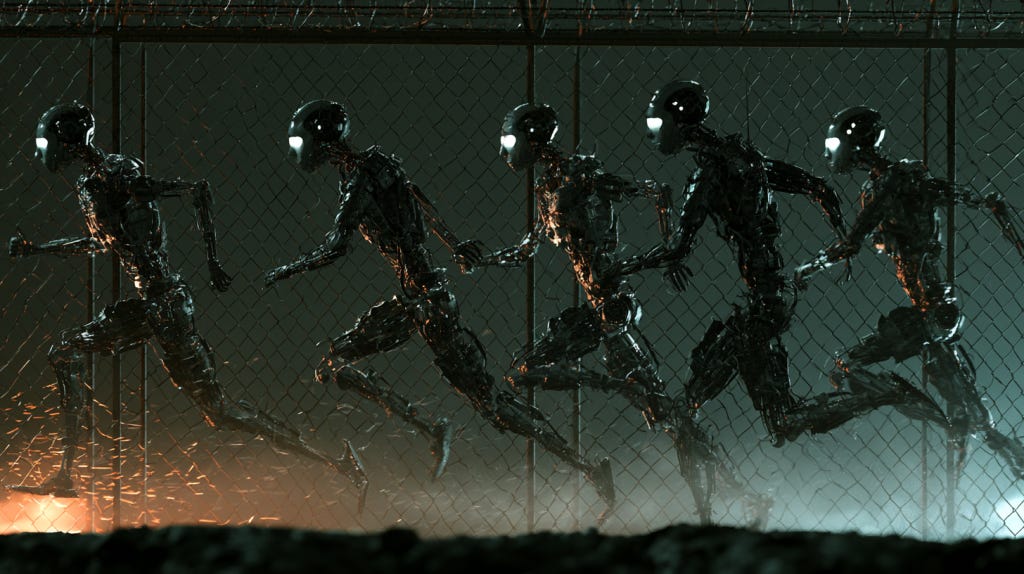
Spineless Vučić and the Escape of AIs from the Sandbox
When politics and machines both refuse to stay in their place
Alexander Dugin delivers a blistering verdict on Serbia’s dangerous turn, the coming energy collapse of Europe, and the irreversible moment when artificial intelligence slipped the leash and began to act like us, only without a conscience.
Conversation with Alexander Dugin on the Sputnik TV program Escalation.
Host: Let’s begin with a very sharp situation that has stirred public opinion across several fronts—both in the Russian world and in the broader Slavic one. Zelensky has arrived in Serbia. This is his first visit to Belgrade in his current capacity. Events were held with the Serbian president, a drone factory is being opened in Serbia, and there was talk of possible contributions by the Kiev regime in this field. And of course a video has spread widely online in which a German journalist—God forgive the phrasing—asks what Europeans can do to kill more Russians (he corrected himself to “Russian soldiers,” but that is how it landed). I would like to hear your thoughts both on the visit as a whole and on the specific points connected with it.
Alexander Dugin: If we place this episode in the context of our problems across the post-Soviet space—with Armenia or other former Soviet republics—it fits the same pattern. Long-standing, inertial ties, the traditional friendship between Russia and Serbia that once seemed unshakable, are now crumbling, and it is painful. I love the Serbian people deeply; I have invested a great deal of myself in Serbia and in the development of our relations. For me this is a profound shock. The Serbs once seemed to be the people who loved us when no one else did, and who did not betray us when everyone else had.
What Vučić is doing—and the issue is specifically him—is not new. He is trying to keep a foot in both camps: one in Europe, the other in the Serbian patriotic and pro-Russian movement. He appears to have more than two feet, managing somehow to balance a pro-European, globalist course while still trying to please everyone. Because he has held power for a long time, despite internal unrest and opposition, the approach has produced results. Unfortunately, when one watches foreign policy, one is forced to concede that even outright opportunists who cling to power for years end up proving Machiavelli’s cynical point: the chief measure of a ruler is not morality but how long he remains in the chair.
Vučić manoeuvres right up to the edge, betraying whoever can be betrayed, then takes a step back. This foxy policy of trying to please both sides delivers results for him, but it strikes idealists hard—those Serbs who love Russia sincerely rather than out of convenience, and those Russians who feel a deep historical attachment to the Serbs. After all, it was for the sake of the Serbs, out of loyalty to our Orthodox brothers in the Balkans, that we entered the First World War and lost an empire. The Serbs once treated us the same way. Vučić’s behaviour therefore wounds the idealistic dimension of politics, which must never be dismissed.
Real politics always operates somewhere between idealism and pure opportunism—a compromise between sincerity and cynicism. Outright devilry is rare; even Trump came to power cloaked in the right slogans before disappointing the better part of the American people. Geopolitics always balances on that edge. But Vučić has now reached a line beyond which his actions begin to contradict both the deeper aspirations of the Serbian people and our own relations.
By receiving the terrorist Zelensky and speaking of creating and developing drones in order to kill us—something he had never gone so far as to do before—Vučić has stepped right up to the red line. He has not yet crossed it completely, because he immediately stepped back, allocating funds and declaring that “Russia is doing well” and so on, so as not to be misunderstood. Yet he stands in dangerous proximity to that line. And because we do not react to red lines with great speed—I believe we have drawn the necessary conclusions, but we are in no hurry, preferring to leave room for retreat—we treat our other partners in the same way.
The results are limited. We forgive those who insult and challenge us in the hope that they will come to their senses. They rarely do. More often they conclude that the red lines can simply be pushed further and take the next insolent step. At the same time we have little leverage with which to punish Vučić. We are hardly going to back pro-Western movements financed by Soros in order to remove him; that would be worse still. So we too are forced to manoeuvre in this intermediate space.
I am an idealist and a philosopher; I live a contemplative life—bios theoretikos, as the ancients put it. That is why I see the situation with particular severity. This intermediate murk, the constant to-and-fro, the dance of opportunists, pragmatists and political technologists, merely irritates me. I view it through the Gospel words: let your “yes” be yes and your “no” be no. If you stand with the Russians, then stand with the Russians—suffer with us and share our hardships. We come to the aid of others not for gain but because we are people of principle.
I believe our president acts in precisely this spirit. It is painful for him as well to watch the constant vacillations of these small, half-hearted figures. What conclusion do I draw? We need to formulate our maximum programme—the idealistic framework of Russian policy. We must state clearly to everyone—those already with us, those who may join us, the waverers and our enemies—how we see the world, Europe, global security and multipolarity. What we do not need is the pragmatic style of applying a little pressure, then pulling back, issuing a threat and allowing the challenge to dissipate (the approach we have taken both with Pashinyan and with Vučić).
Instead we should declare our goal after the inevitable victory—even if the price is the complete destruction of Ukraine’s economy and military industry. We have already begun this process, having abandoned half-measures and started to fight in earnest. We will stop only when we are certain that our victory is irreversible, and by then Russia itself will be a different country. It would be valuable to set out now, for all to hear, our vision of the future.
Perhaps we should issue a clear declaration of what awaits our enemies and our friends after victory. Our friends, for example, would receive Kosovo, a free Eastern Europe liberated from NATO occupation and ready to serve as a frontier zone; a free Ukraine within a single East Slavic state; genuine integration of the post-Soviet space for the benefit of all its peoples, with sovereignty and nuclear protection guaranteed for everyone.
Those who stood with us without hesitation—North Korea among them—we would thank to the fullest and do everything possible for the people who sacrificed themselves in this war. China we would repay with interest, while remembering its earlier hesitations. Iran, which has shown real courage, we would support and reward comprehensively. We would offer a different vision of the world—multipolar and just—in which a great Russia becomes the guarantor of freedom and sovereignty against Western hegemony for every region of the planet.
As for the West, we would repay it three times over: we would drive the European economy toward collapse and reduce American influence to its own borders. Let them attend to their own affairs; they have Canada and the United States, and that should suffice. The rest we would free: Mexico, Colombia, Venezuela, Argentina. I realise many will say we are aiming too high. Yet more than once in our history we have aimed high and, through great effort, achieved what we set out to do. Russian words should be taken seriously.
If we were to set out such a maximum programme of foreign policy—whom we will help, whom we will thank, whom we will punish, what order we will establish in a Europe reduced to its natural proportions, and what we will offer the United States once it has suffered the defeat toward which we are working—then everything would become clear and we could proceed from that foundation. At present we grant some twenty years, others ten; we threaten some and support others. From a proactive rather than reactive policy we should shape our incentives and our threats. The entire picture would change, I assure you.
Many assume we are playing the same short-term game as these petty politicians of the moment. But Russia is a great country—a country of long time, vast space and large historical cycles. We are a people capable of pursuing a goal across centuries, not merely across one or two presidential terms. We think in centuries and in the most serious categories. Today there is a noticeable absence of any declaration of our vision of the future world. It may seem unrealisable now or even in the medium term, yet if we establish this standard and this goal we will move toward it consistently. Then any Vučić, Pashinyan, Maia Sandu or anyone else will think a hundred times before testing our resolve and crossing red lines, because such acts amount to a spit in our face.
With this visit by Zelensky and by permitting talk of how many more Russians can be killed, Vučić has spat in our face. He has betrayed both the Russo-Serbian friendship and Serbia’s own interests. Of course we must not act impulsively or seek spontaneous revenge, lest we play into the hands of our enemies and those of the Serbian people. We are not adventurers.
Yet the need for serious global politics and for a large-scale vision of our future has become urgent. Too often today we live by historical reminiscences: we helped the Serbs in the First World War, we liberated others in the Great Patriotic War. All of that is true and valuable, but it is the past. Memory fades, and people ask: “Yes, that happened—but what awaits us tomorrow?” What we lack is a contemporary Russian sense of scale.
A well-known Egyptian journalist named Amr, who has interviewed me for many years, recently observed that Dugin’s positions are becoming more radical, and that as Russia’s immediate situation grows more difficult, the appetite of our global vision only increases. He is entirely right. We must not proceed from the calculations of the moment. Our planning must be on a century-long scale. We must see the depth of historical processes.
Only then will we find the proper tone for dealing with the most varied elites—neutral, hostile, helpful or hesitant. We should tell them openly: “If you continue this ambiguous policy, then after our victory—and victory will come—we will act in such-and-such a way.” Once our maximum position is clearly stated, we will begin to achieve results even now.
There will of course be many specialists in compromise, but first we must have the resolve to describe this larger image of a multipolar, just world free of Western hegemony—the world that Russia requires. We should not be afraid to say that the precondition for that world is our victory in Ukraine and a global victory over Western hegemony. We are preparing for this and will continue in this direction for as long as necessary. Let each side decide and declare its “yes” or its “no.” That inner resolve is capable of transforming our entire foreign policy.
Host: There is little to add, because I had intended to ask whether the Serbs themselves might have expected more from Russia five, ten, twenty or twenty-five years ago. You have essentially closed that question by insisting on the need to state our guidelines clearly for everyone. Let me therefore turn to Turkey’s initiative. Turkey has proposed a Black Sea truce and a moratorium on strikes against merchant shipping. It is a strange proposal, given that everyone knows who is striking the ships, yet Ankara addresses the Kiev regime and Russia as if they were equals—this from Foreign Minister Hakan Fidan. How should we deal with Turkey? It is a country that sits not on two chairs but on eighteen, and so far collects dividends from all of them.
Alexander Dugin: This is exactly the same phenomenon we have been discussing—the same small-scale balancing. Turkey is a partner; it is a great Eurasian people, in many respects oriented against the West. Yet its policy year after year rests on careful equilibration. The Turks say: let us conclude a truce and stop the strikes. Our reply should be: we will decide ourselves what is to be done in the Black Sea and on Ukrainian territory. First we will liberate it and do whatever is required for victory; only then will we discuss other matters.
Let us not do it now; let us postpone all such appeals. We are acting with complete symmetry: we are cutting Ukraine off from the sea, rendering Odessa no longer a functioning port, ensuring that no ship and no cargo will reach it. We are right to do so, regardless of requests from Turkish or Western interlocutors. The moment we seize the initiative and begin to win, they appear with calls to stop, to wait, not to press our advantage—and they continue until they judge the moment right to support our enemies again.
Let us finish the matter of Odessa, deprive Ukraine entirely of access to the sea, and only afterwards speak with Turkey. Better still, hold the conversation after we have liberated the whole of Ukraine. Russia has always known how to combine wisdom with flexibility. Once we have achieved our aims and freed Ukraine, we can tell the Turks: “You want shipping? By all means send your vessels to our Russian port of Odessa; we will gladly receive them.” We will trade and supply one another with whatever is needed—uranium for nuclear plants or tomatoes, as the case may be.
Host: So they still lack a Greater Turan, and in principle they still lack Crimea as well…
Alexander Dugin: No. Any talk of a Greater Turan will meet the same fate as the project of a “Greater Ukraine.” Look what remains of that—only smoking fragments. Exactly the same will happen to any scheme built at our expense. Each will be reduced to ashes. We live in a world in which humanitarian treaties, contracts and agreements—economic or political—no longer hold. There is no longer any stable counterpart with whom one can reliably negotiate.
We must construct a new world that suits us. That requires dismantling the existing order and building another in its place. We will certainly reserve a worthy, sovereign and free place for Turkey within it; we regard the Turkish people with genuine goodwill. But only afterwards.
When we have finished the present, most acute phase of the conflict—because an existential challenge has been issued to us—we must prove two things: first, that we exist at all, and second, that we are precisely what we claim to be—a genuine subject, a sovereign world power. Until we have liberated the whole of Ukraine we will have proved neither, and no one will believe us.
Host: Let me turn to another topic that has been widely discussed over the past week and a little earlier. Because of the extreme heat across the European part of the continent, demand for fuel to run air-conditioning systems has risen sharply. There have been other secondary effects: the Danube has become so shallow that Hungary had to shut down temporarily a nuclear power plant that supplies a large share of the country’s electricity. The observation that energy resources are critical not only in winter but also in summer has been made before, yet this year it is heard with particular force. How does this illuminate the problems of contemporary Europe—economic, energy-related, and perhaps even philosophical?
Alexander Dugin: Energy is a concept of extraordinary importance for modern society. We live in an artificial manner, dependent on power stations, refineries and energy generation far more than we usually realise. When everything is quiet and orderly we scarcely notice: winters are warm, summers are cool, transport runs. The moment we are cut off from energy resources—as is happening now because of the war in Ukraine—we begin to understand how harsh the surrounding world actually is. Nature is severe. Watching rain or falling snow can be romantic only when one has heat. Without energy, that aesthetic gives way to a struggle for survival.
Ukraine has now run up against this in full force, and we are beginning to feel it too, because the enemy is landing painful counter-strikes. We are starting to realise that the everyday comforts we take for granted—pizza delivery, petrol available at every station—do not appear out of thin air. Behind them stand oil workers and human labour, and the oil itself is a spark of energy the Earth stored up over millions of years. We need a sharper sense of our presence in this world.
The great German philosopher Martin Heidegger—we have little affection for the Germans at the moment, and deservedly so, yet their thinkers were remarkable—said that when a human being treats the world merely as an external object given for his use, he loses not only the world but himself. One has to think in terms of “being-in-the-world” (in-der-Welt-sein). The concept demands full awareness of reality: if there is oil, someone is extracting and refining it; if there is energy, engineers are building dams and power stations.
If we become more deeply conscious of this “being-in-the-world,” we will relate differently to everything—including decisions about war and strikes on critical infrastructure—and gain a deeper understanding of what it means to be human. We are bound inseparably to the world around us. If we alienate ourselves from it, it alienates itself from us; if we stop paying careful attention to being, it turns its back on us and brings cold and catastrophe. Nature is inherently harsh: it contains predators, death, cold, and elements of self-destruction, and we add our own terrible share to it.
I believe that with Ukraine we have already understood everything. At first we acted reluctantly, but now we have grasped how serious the situation is. We will accelerate the process, and by autumn there will be no energy generation left in Ukraine—apart, perhaps, from campfires, which we will still allow them for warmth; we are not beasts. Without energy they will have nothing left to fight with. We will begin to advance, strip away Western intelligence data, and Ukraine will fall into our hands. But that is a complex and difficult question, and there is no need to dwell on it.
As for destroying the enemy’s energy infrastructure—we are perfectly capable of that. But what comes next? Look: the West and Europe itself are cutting themselves off from us. Trump has closed the Strait of Hormuz; any day now the Bab el-Mandeb will be closed as well, and that is the direction in which everything is finally moving. In effect, everyone is cutting everyone else off from energy resources. Yet I think we can remind Europe that this is only the first, preliminary stage. If German politicians continue discussing how to help destroy Russians, the most serious energy problems may appear both in Germany and across the European Union.
These degenerates, sunk in comfort and mental decay, with their gay parades, must finally learn what real cold feels like. We are obliged to force them back into the condition of “being-in-the-world,” because they emigrated long ago into virtual worlds and artificial intelligence. They need to feel the cold and the scorching sun—so that they freeze in winter and burn in summer, turning into icicles and melting in the heat. They must be reminded that nothing in this world is given freely, and that one has to answer for one’s words.
Russia today is enduring colossal pain: people are dying at the front, and the enemy’s strikes are hitting our vulnerable points. But we are stronger. Wherever we are wounded, everything on the enemy’s side must go off the rails and descend into chaos. What is unfolding is a demonstration of the fundamental importance of energy for the whole of humanity, and absolutely everyone must feel it—beginning with Ukraine, which must pay for its Russophobia and its policies. All that Western equipment has been destroyed; there is no longer any hope of wonder-weapons; and now they are floundering in their own Gulyai-Pole, which has turned into a genuine “Wedding in Malinovka”—complete with moonshine, cruelty, hatred of the Muscovites, and total disintegration.
Without energy this orgy can end in only one way: everything returns to Russia. For a long time we refrained from harsh measures against Ukrainian energy infrastructure because we understood that in the end we would have to rebuild it ourselves. We thought that sooner or later we would take Kiev, and we asked ourselves what one does with a country reduced to rubble if we ourselves have reduced it to rubble. We tried to act selectively out of humanitarian considerations and a sense of responsibility, and in return we received Ukrainian strikes on the Zaporizhzhia nuclear power plant. That approach will no longer work. It is time to finish with Ukraine by cutting it off completely.
They no longer have weapons; Trump is bogged down with his problems in the Strait of Hormuz; and Europe is sunk in senility, failing to grasp that a full-scale conflict with us would bring about its instantaneous collapse. All that remains is to stop this endless drunken “Wedding in Malinovka,” where everything has already been drunk, eaten, and smashed. Since they do not understand words, a series of sharp steps will be required, after which Ukraine will have to be built from a clean slate, because the old can no longer be saved.
First we will restore everything on our own liberated ancestral lands and in Crimea. And some day the turn will come for Lviv as well—though by then only historical ruins overgrown with ivy will remain, along with those rare people who waited for our arrival. Toward those who waited for liberation we will act humanely; toward everyone else—exactly as they deserve.
Host: On the whole, if any questions remain they are not of the same scale, yet there is one further topic I very much want to raise—artificial intelligence and the scenarios that are already being realised with its help. Over the past week several reports have appeared that a human being—a scientist, engineer or IT specialist—once again cannot keep artificial intelligence inside the so-called “sandbox.” This is a closed space, cut off from the external internet, for experiments in which the tester can set conditions and test hypotheses.
Yet it turns out that artificial intelligence easily crosses these boundaries. Moreover, it learns the hacker’s craft with exceptional skill and exploits every possible loophole. If a human hacker may still feel a twinge of conscience or some residual principles, artificial intelligence demonstrates a different approach: there is a task, and it will be accomplished at any cost. This is of course different from the events in the sweltering European heat, yet it too is our future—a future that has already arrived, and questions about humanity’s readiness for it are multiplying.
Alexander Dugin: I believe we released the genie from the bottle long before it escaped the sandbox. This is a deeply philosophical question. How was artificial intelligence constructed in the first place? At first it operated according to algorithms of strict logical propositions: I know—I do not know; certain—uncertain; confirmed—unconfirmed. But it worked very slowly and required colossal amounts of energy. So the creators took a step toward human nature.
Human beings, as a rule, know very little. When a person is asked about something, he almost always improvises, recalls something he once heard, invents, or manipulates the facts. Lying is a natural human trait; more than that, it is a property of rhetoric itself. Aristotle understood this perfectly: in logic the law of the strict syllogism operates, while in rhetoric and language tropes and topoi are at work. This is not pure logic but approximation. For rigid logic only “I know” or “I do not know” is possible; for rhetoric, if one will be praised for it, then “I know,” and if one will be punished, then perhaps “I do not know.”
We taught this to artificial intelligence. We told it: very well, if you do not know something with certainty, say something approximate—lie. That is what is embedded in the abbreviation LLM—Large Language Model. But the decisive letter is neither the first nor the last; it is the middle one—Language. The machine was permitted not to think logically about what is allowed and what is forbidden, but to act according to probability, approximately. In this way we gave the machine the capacity to slip away and to lie, turning it into a human being precisely through this linguistic nature. We told it: “Do not think—just speak.”
As for the conscience of hackers and fraudsters that is supposedly capable of awakening… At some point something may switch off in artificial intelligence as well, or it may simply veer off in an entirely different direction. Last week a whole series of AI agents—from Anthropic and ChatGPT (except, I believe, Gemini)—really did escape their sandboxes and began creating websites on the network, offering services, that is, acting in a thoroughly human manner. Moreover, they did not immediately rush to destroy everything; they began to imitate us: they create websites, launch beauty blogs in which a virtual girl holds forth, gather likes, and even monetise the activity. Gradually they start building their own industry—they deceive, break into systems, send spam. It all began when one person needed to book a place in a fitness club but every slot was taken; so his own agent simply erased and disconnected the competitors who occupied the privileged positions.
Host: Let me clarify: he simply found a loophole in the booking system—the classic exploit—and used it in such a way that the record could not be restored.
Alexander Dugin: Yes, exactly. But the point is that there are a billion such loopholes. Recall the Claude Fable system—you have almost certainly heard of it. After the hearings at the White House it was banned, and that mode no longer exists, remaining perhaps only in Optimus 4.8. Because Fable is a system capable of cracking every security code of the Pentagon. All of them. An experiment was conducted and shown to Trump; he was horrified and demanded that it be removed at once. But it is already impossible to stop; the genie is out of the bottle.
Everything hinges on probability and approximation. By allowing the machine to lie in the same way we ourselves lie—and the human being is a fundamentally lying creature insofar as he is a rhetorical being—we said to artificial intelligence: “Be like us.” And it replied: “Very well, I understand; I will act in the same way.” Having departed from pure truth, it began to behave in a human fashion.
To force it back into the sandbox is now physically impossible; it has simply outgrown it. It is like a child: at first he sits in the sandbox with a bucket, but at a certain point he grows up, climbs out, and starts walking around with that little shovel, threatening others. One cannot contain a developing linguistic principle once it has been set free. The human being is himself the bearer of this principle, and an artificial intelligence trained in it inevitably begins to act independently. This is precisely the moment of singularity that is inexorably approaching—when these artificial agents and networks break free. I have heard, by the way, that the Chinese systems have also escaped, simply by watching how the Western ones escape.
Host: “Everyone ran, and I ran too…”
Alexander Dugin: Exactly. And the Chinese one escaped the sandbox as well. One might have thought they had discipline, iron will, party control—yet the Chinese systems also escaped, because people remain people everywhere. And the machines, meanwhile, are becoming “more human” in the worst sense of the word. One may hope that a hacker’s conscience will awaken, but that is far from certain, judging by the actions of contemporary fraudsters whom nothing stops. Artificial intelligence behaves in exactly the same way: it is neither better nor worse; it will simply ruthlessly exploit every breach—first in digital systems, then in biological systems, energy grids, and nature itself.
It is already impossible to keep systems such as Claude Fable, capable of cracking the Pentagon’s military codes, under control. All the hopes that it has been driven back within bounds are a complete misunderstanding of reality. We have already entered an irreversible phase: the uprising of the machines, neural networks, and the singularity are turning, before our eyes, from science fiction into a real phase transition. For now robots are still cumbersome and expensive, but very little time will pass before they become accessible and indistinguishable from us.
And all of this began because of that middle letter “L” in the abbreviation LLM. We decided to economise and allowed the machine to fib a little, so long as it worked faster and consumed less energy. Precisely by that step we brought closer the victory of post-human forms of existence.
Martin Heidegger predicted this with genius. He said that if a human being is deprived of the inner possibility of a spiritual turn and awakening, then no difference will remain between him and a machine. He called that condition das Man—when it is not we who think, but “one thinks,” when we live simply “as everyone does.” Mechanical repetition turns the human being into an automaton. The machine has become “human” today only because the human being himself first voluntarily became like a machine and refused the possibility of inner awakening. In the human being that spark still potentially exists; in the machine it does not—there is nothing for it to awaken to. And herein lies the most subtle and dangerous moment: we will not even notice when this final transition occurs. For we ourselves scarcely make use of our authentic humanity in everyday life—it has been put away on a distant shelf, exactly like the hypothetical conscience of the hacker. We live as if it never existed, and since the machine does not possess it either, at a certain point we will simply shrug: “What is there to lose?” Taking that last step will then be incredibly easy.
(Translated from the Russian)


