Shadows of Forgotten Ancestors
by Stefano Maurizi
Stefano Maurizi on a haunting film of ancestral memory and Carpathian myth.
It was 1965 when, in the pages of the newspaper Ranok, readers across Ukraine were pleasantly surprised to encounter “Sonata of Hutsulshchyna,” the poem by Hanna Shaburiak dedicated to Hutsulshchyna, the Carpathian region on the border between Ukraine and Romania. Today, this region is known as an unspoiled natural park, yet in the Ukrainian national memory it represents something far deeper. In this land live the Hutsuls, a people who have preserved archaic customs and traditions—the foundation of the country’s distinct cultural identity—for centuries, untouched by Russian, Polish, or Germanic interference.
During the years of the “Thaw,” that brief yet intense attempt by Khrushchev’s Secretariat to increase the autonomy of Soviet institutions, it was decided to grant much greater space to the cultural expressions of the Republics, effectively pausing—though not entirely—the process of Russification. Nowhere was this more strongly felt than in the Secretary’s own homeland, which during the years of Stalinism had been the stage of a cultural assimilation that would be reductive to call merely brutal.
The result was a period of flourishing intellectual fervor within a milieu that, while remaining faithful to the principles of Real Socialism, sought to reconnect with the experience of so-called National Communism, which had enjoyed considerable success in Ukraine in the mid-1910s. The goal was to accompany socialist policies with a genuine, autonomous cultural identity to be defended, and it was precisely in the customs of the rural Hutsuls that Shaburiak identified what she called the “germ of Great Ukraine.”
Central to this process was the most powerful weapon in the arsenal of any ruling class: cinema. In Kiev stood the second most important film studio in the Union, which in this very period was named after Alexander Dovzhenko, the director of the trilogy composed of Zvenigora, Arsenal, and above all Earth, which as early as 1930 had already made censors tear their hair out due to its celebration of Tradition and rural life. Until the 1950s, Soviet cinema had enforced a rigid ethnic hierarchy (favoring Russian directors and authors) along with a hyper-modernist rhetoric that portrayed the State as a force capable of exorcising the “barbarism” of native populations in favor of the socialist utopia. During the Thaw, however, local artists were finally able to present their identities with a more authentic gaze, even if still mediated.
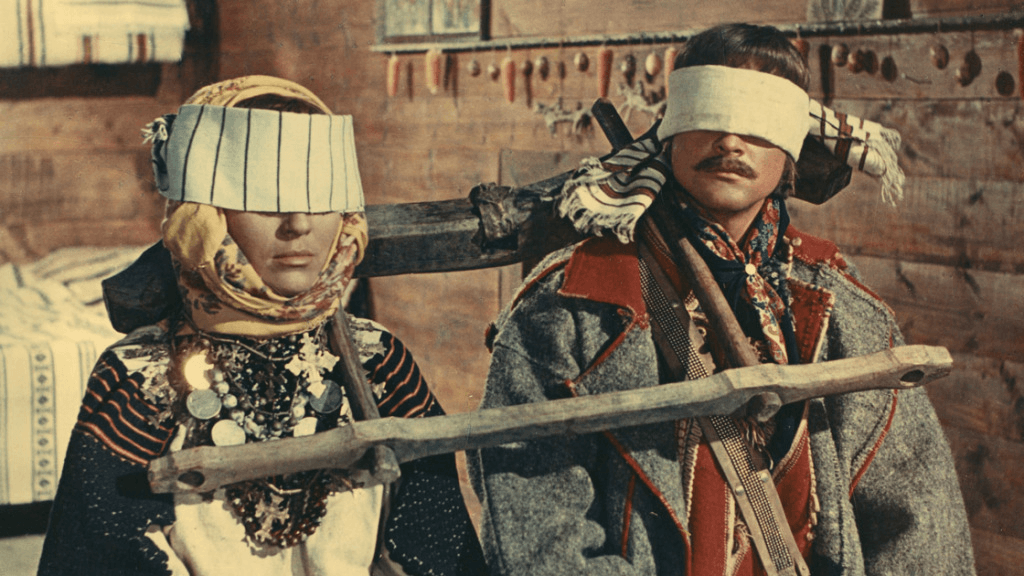
It was in this climate of intense cultural ferment that the Armenian director Sergei Parajanov arrived in Ukraine. A fervent advocate of representing cultures as authentically as possible, he nonetheless faced the lingering constraints of censorship during his early years working in the Donbass region, such as the imposition of the Russian language. In 1962, he moved to the Carpathians, where he discovered Hutsul culture and immediately fell in love with it. It was then that he decided to film an adaptation of the novel Shadows of Forgotten Ancestors, a version of the classic Romeo and Juliet story filtered through the folklore and demonology of a culture still suspended between the organized order of Christianity and a traditional pagan worldview that sees the natural world as alive and overflowing with spirits and meaning.
For this very reason, despite warnings from the censors, the director reaffirmed the necessity of filming not only on location but also using traditional language and customs, unfiltered by the ideological lenses of Marxism, which had already provoked strong criticism of the novel for its supposed “glorification” of “barbaric customs” (such as honor culture and magical rites), integral parts of the narrative. The story follows the young Ivan, deeply in love with Marichka despite a violent feud between their families. Perhaps for this very reason, nature itself forcibly separates the two lovers through her death, compelling him to marry a woman he does not love, who attempts to win her husband’s affection through shamanic rituals while the family remains under the gaze of the specter of the deceased.
In truth, it becomes immediately clear that the importance of the plot in Parajanov’s work is relative, if not almost nonexistent. What truly matters is the environment, the music of the land, the rituals, the spirits—in short, the magic with which those dense forests have always teemed. It is an experiential work that is almost futile to describe in words, like any great expression of visual art, especially one that lives through the compositions of the Armenian director. Unlike his later, more radical works (above all The Color of Pomegranates, composed almost entirely of static and symbolic images), Shadows of Forgotten Ancestors thrives on the contrast between compositions that seem to emerge from paintings and a relentlessly frenetic camera that never allows the viewers to fully catch their breath.
Although Parajanov’s signature is the most prominent, the work is also the expression of two other then-emerging talents who, thanks to this film, would become the foremost icons of Ukrainian Poetic Cinema (a brief yet fundamental movement of which Shadows is considered the progenitor): the cinematographer Yuri Ilyenko (and future leading director of the movement) and the lead actor Ivan Mykolaichuk, the latter becoming the most internationally recognized cinematic face of Ukraine.
Even during the height of the Thaw, such a film would have struggled to pass censorship (especially given the director’s refusal to have it dubbed into Russian, even under official request), yet an additional tragedy struck the production: the change in leadership of the CPSU [Communist Party of the Soviet Union], which ushered in the Brezhnev years and, with them, a renewed tightening of cultural expression in the peripheral Republics. The film’s premiere was blocked, and the director was exiled to Armenia until his eventual arrest in 1971. By then, however, the “damage” had been done: soon thereafter, despite strict censorship, formalist and poetic films inspired by Shadows began to be produced (already the following year Ilyenko shot his debut, also suppressed upon release), quickly becoming symbols of resistance for all oppressed peoples beyond the Wall.
The flame of the Revolution, by then, could no longer be extinguished.
(Translated from the original Italian version on Identitario.)


Is this available with English dubbed in or as subtitles? Though it's certainly visually amazing without knowing WTF they're saying
https://youtu.be/xlSLiKvfrzE?si=qCFqVa9oNgrZ9KVd