Sex and Feminism in Ultra Heavy
Traditional values through science fiction
Tim Kirby explores how his Ultra Heavy book series embeds traditional values into compelling science fiction, arguing that enduring moral principles resonate most powerfully when they emerge naturally through story rather than ideology.
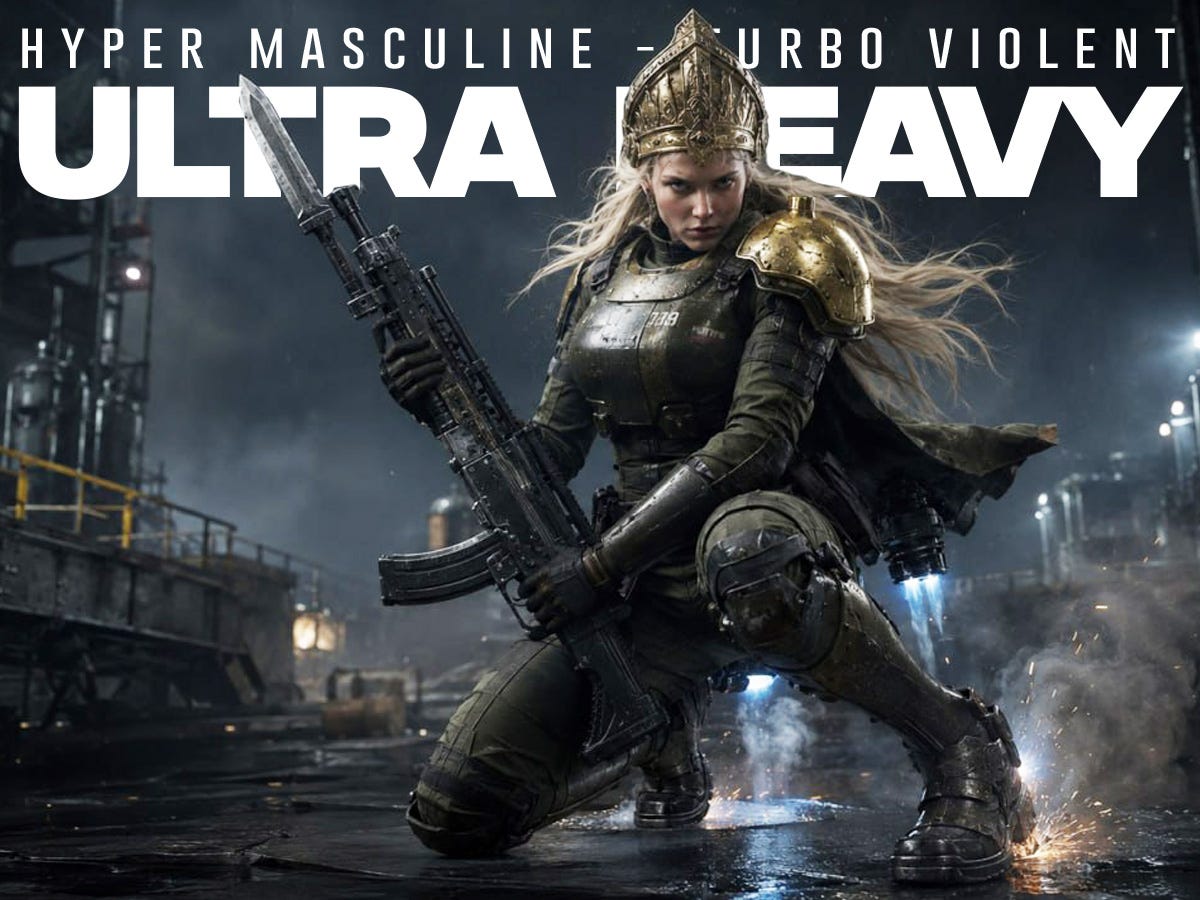
When one sees the cover and artwork for the Ultra Heavy book series, one may not be aware that under the hood there are a lot of traditional values in place. The problem with media that is “Christian” or promotes “good values” tends to be dismal, because it places the objective of having Christian things into a media product where they do not fit. The life of Christ was not meant to translate into an open-world shooter for PS5. Supposedly, The Lord of the Rings gives off very Catholic vibes, but obviously the story came first and that is what is key to its success. If Tolkien had just dumped a boatload of Christian dogmatic text, his books would have never had such universal appeal. The story of any book should stand on its own even if the setting were to change. If Ultra Heavy #148 were an aging sheriff in the Wild West going into some no-man’s land because he had nothing more to live for, the story would still work. If he were a Samurai who lost everything due to age, taking a last hurrah to protect a newly colonized island near Hokkaido, then again the story would still work. These alternative versions of the story would then be free to put a lot of American and Japanese cultural elements, respectively, in the background to give the story more cultural value.
As the author of these books, I know they need to have a good story and be fun overall to succeed. Anything ideological needs to be put onto the second tier, but the publisher, Multipolar Press, who was gracious enough to take a risk and release these books, wanted me to go in and examine just how traditional values play out in them. And so let’s take a look at the moral side of these books that feature big dudes in big armor with big guns fighting for alien planets.
Spoiler alert! There is no way to talk about this kind of thing without plenty of spoilers!
In the first book, the primary female character is Klyookva, a woman who has grown up and lived her whole life in a future society that has extremely traditional values—thus they look at old-school gender roles and views as being both normal and genetically inherent and unalterable.
And most importantly, it has to be noted that both she and #148 have given up on life for reasons related to their gender. The old-timer has lost the ability to fight, and cannot fulfill the duty to society that he is supposed to. In a traditional society, men are supposed to be useful, to be the breadwinners, and #148 is approaching the moment when he can no longer fulfill that role. Klyookva, on the other hand, being raised in a reality very different from our own, feels like an utter failure for not having a family, despite the fact that this is a genetic dysfunction and not her fault. People in Holy Rus’ in 3900 AD are propagandized with the Eastern Orthodox view that sex (and everything) we do has to be taken in a proper context in order for it to have value. Thus, the men around Klyookva, much like those in medieval times, see her as sort of a spinster, or that there must be something “wrong with her” as she is childless in her mid-40s. They would believe that she is not fulfilling her function in society. To them, she is a “leftover woman,” as they say in Chinese. Modern feminists blast men and try to convince them that their genetically programmed preferences are evil social programming. Those preferences being the desire to have sex with women that have had few partners and are also young.
We all live in this insane post-feminist world where somehow we believe “society” makes men like women in their 20s and not genetic disposition. In the year 3900 in the Holyrussian Empire, there is no such propaganda. Men want women with a low “body count” and young. Thus, at some point, Klyookva “hit the wall,” as they say in modern parlance, and is no longer desirable. She is also one of the very few disabled people around and that does not work in her favor either. Essentially, Klyookva cannot fulfill her traditional role and thus chooses to go out with a bang on Titan.
The relationship between the Ultra Heavy and Klyookva evolves into marriage because they are both Orthodox Christians who, again, believe there should be a proper context to one’s actions and a point to them. Thus their sex leads to a marriage that bonds them together in the latter half of their lives to complete each other. Since #148 has had numerous children from multiple ex-wives (whom he vastly outlived) over the centuries, his “duty” has been fulfilled and thus their inherently progenyless marriage is not some sort of “child-free” propaganda but a proper function of marriage for those who are on in years. As is indicated in the book, the Church gives its approval.
Another aspect of the Klyookva character that gets ignored is that she is extremely powerful in a feminine way. Ultra Heavy #148 might be the ultimate killing machine, but Klyookva, growing up in a world of traditional values where people don’t reject gender stereotypes but embrace them, is an excellent manipulator. Throughout the story, in many ways she can get what she wants from our hero, ultimately ending up in a very powerful position. Klyookva understands fully the power of feminine softness and how well it can be used to get what she wants. Sirens, succubae, and other magical female characters have the superpower of being able to manipulate men. Klyookva does too but she uses this ability for the side of good. To the extent that the Ultra Heavies unabashedly use their male power (blunt force, intimidation, etc.), Klyookva uses her soft female powers throughout the book to ultimately come out a winner. Because the way for women to win in life is to play life as a woman’s game, not as a man’s game. When Klyooka turns their fallen ship into a real home, this demonstrates something that women have that men lack. She happily stands behind her “stone wall,” as they say in Russian, and wins over and over again because of it.
It should also be noted that these people live in a world where “obviously men want sex.” You will see that in many more traditional societies. Male lustfulness is acknowledged, often by gender separation and keeping them away from children. To some extent this is also the case in Holy Rus’, but everyone “in the empire” knows that men are lustful and want sex. They are just told that they need to do so in the proper context, which #148 does throughout the book. I utterly despise “virginal hero” characters. It is a horrible archetype to present to teenage boys, and the Ultra Heavies are the least virginal of any heroes.
Although both of our main characters of Book 1 have had hard lives, the book should show just how much more in harmony everything is in a world where there is no feminism. 3900AD is a time when men and women know who they are and how to play the game of life via the rules of their gender in order to win. Klyookva never wants to be a man; she never wants to compete with the old-timer, but she does want him to provide for her, and she knows what the primary thing is that any man would want from this lovely ministerial worker. They work in tandem and ultimately they both need each other. #148 can survive nearly anything, but would he want to survive without her to come home to?


