Alexander Dugin examines Serbia’s political upheaval, Europe’s slide toward civil war, Lula’s Brazil, Elon Musk’s rebellion against the neoconservatives, the emergence of a post-Trump America, the prospect of a new Yalta between Putin, Trump, and Xi, and the growing danger of a catastrophic war in the Middle East.
Conversation with Alexander Dugin on the Sputnik TV program Escalation.
Host: Today we have an incredibly packed agenda. In just these past few days and a couple of weeks, an enormous number of crucial political turning points have come into focus. Some events are already behind us, others are only just unfolding, and frankly, the sheer scale is dizzying. But I’m extremely interested in hearing your take on what happened over the past weekend and what we should expect in the near future.
Let’s skip the preliminaries and turn straight to the Balkans. Elections were held in Serbia, where the party of former President Aleksandar Vučić suffered a defeat. In principle, this was heading that way, although sociologists’ assessments varied. And now, diametrically opposite views are being expressed about the country’s future and the foreign and domestic policy vectors of the new authorities.
Alexander Gelyevich [Dugin], what should we expect from Serbia—a long-suffering country that is historically and mentally so close to the Russian heart? Should we simply throw up our hands in bewilderment, or can we already begin to cautiously forecast either a catastrophic or, conversely, a manageable scenario?
Alexander Dugin: I think it’s still too early to say anything definite. Vučić had his undoubted advantages and a great many obvious disadvantages—we know them perfectly well, since we worked with him for a long time. His entourage had plenty of outright liberals, Westernizers, and systemic enemies of Russia. But at the same time, there were also such remarkable figures as Aleksandar Vulin, one of the most consistent, profound, and genuinely pro-Russian politicians in Serbia.
So the balance that Vučić maintained was far from optimal for us. And yet, over a certain period, we adapted to it and built workable mechanisms.
By all appearances, the Serbs themselves—and the majority of them are deeply Russophile—have simply grown mortally tired of him. A huge mass of discontent has accumulated; corruption is off the charts.
As for the victorious “student list,” two lines are immediately visible here. First, this movement still lacks a coherent, fully formed political platform—it was primarily a form of spontaneous voting against Vučić. Against him, of course, the familiar Soros network structures and the technologies of classic “color revolutions” were once again at work, being tested for the umpteenth time on long-suffering Serbia. But these destructive elements are dissolved among perfectly decent people—ordinary Serbs who simply thirst for change, are looking for a way out of the dead end, and do not want to freeze the status quo, even though they themselves have not yet fully formulated what exactly they want.
Pay attention to the details: at their demonstrations there was not a single EU flag, not a single American or Israeli banner. Russian and Orthodox symbols predominate. So far this is pure uncertainty. Bright, unambiguous leaders are not visible on the surface.
That is precisely why we should not draw hasty conclusions right now. Serbian politics is structured in such a way that Moscow would hardly benefit from preparing in advance for an inevitable deterioration of relations—that would automatically run counter to the deep interests of the Serbian people themselves, and any government in Belgrade that goes against the will of the people will instantly discredit itself. On the other hand, we also do not yet have grounds to expect any sharp positive shifts.
The victory of the “student list” is not a catastrophe, but it is an absolute zone of turbulence. Objectively, we do not fully understand what exactly we will have to deal with. God willing, genuinely sovereignist, popular forces will ultimately prevail in Serbia.
Host: But Vučić himself is already promising that by March or April Serbia must support anti-Russian sanctions. It’s clear this may have been said in the heat of the moment, along the lines of “Oh, you didn’t vote for me—so here come the worst-case scenarios,” but the threat was stated in plain text.
Alexander Dugin: Because that is ultimately what will happen. Although personally I am still refraining from categorical assessments. I have very good, trusting relations with Serbia—both with politicians from Vučić’s circle and with many representatives of this “student list.” The Serbs listen to me very attentively.
That is precisely why I deliberately refrained from sharp comments: there are wonderful, sincere people in both camps, but both also unquestionably contain a dense network of Western agents of influence. Serbia’s geopolitical constriction itself objectively places it in a most severe, suffocating dependence on the globalists and the European Union.
We will hope that the deep, genuinely Russophile and sovereign Serbia will ultimately prove stronger and more viable in this historical confrontation than all these Atlanticist and liberal-globalist networks.
Host: I’ll still ask one more question. If we trace the scale—at least from the 1980s, and you will no doubt tell us in detail that the roots go even deeper—the Balkans have been methodically and furiously destabilized. First and foremost Yugoslavia. And how many divisions and amputations of pieces of territory has present-day Serbia endured? One hand’s fingers may not be enough.
And so the question arises: can one say that Serbia has been finally pressed into submission in this sense? Certain pro-Western structures have nevertheless implanted the idea that “there is no life without Europe.” A generation has changed: the generation that clearly remembers the NATO bombings, that remembers how deadly bombs were dropped on their capital without any UN Security Council sanctions, has receded into the background. And the youth has arrived—modern, cool guys who think completely differently. This is not an assessment of whether that’s good or bad, but a fact is a fact: the generation that did not experience this horror firsthand relates to the West and to historical memory completely differently.
Alexander Dugin: It may well turn out that way, of course, but I see this situation from a slightly different angle. Serbs are Serbs, just as Russians are Russians. Both we and the Serbs can pass through the most varied phases, and this has absolutely nothing to do with generational change. The Serbs are a deeply Orthodox, very proud, historically suffering people. And Serbian youth is exactly the same. Every generation needs to go through its own historical experience in order to fully feel itself Serbian. But they are born Serbs: they have a Serbian heart and a Serbian soul.
Here is what I am betting on: in reality there exist deep historical processes that are not touched at all by superficial ideological transformations. From generation to generation, something fundamental in our peoples remains unchanged. Yes, perhaps in Western ones as well, but in us—especially.
When we superficially say “new generation,” it in fact largely continues the same thing; it carries the same matrix. In a person, in his culture and identity, there are very deep levels, deep dimensions. And among the Serbs—among the young and the old, among those who remember the bombings and those who were born later—there is an unyielding Serbian vertical, a Serbian axis.
The Serbian people has suffered colossally in history, especially in recent decades. And, by the way, technologies intended for us were being tested on them. Everything that happened in the Balkans was supposed to happen later in Russia. We had the Warsaw Pact destroyed, then the Soviet Union was dismantled, and then they began to destroy Russia itself—and would have destroyed it completely if not for Putin.
That is, there are large-scale historical processes, and in this sense Serbia and Russia are indeed deeply kindred peoples, which gives us every reason for restrained optimism. Let’s look deeper; let’s understand the people itself and interact directly with it! Official politicians are often merely a temporary screen, foam on the water. Real historical processes unfold much deeper.
And I sincerely hope for the long-suffering Serbian people. I do not think Serbia has been pressed into submission. Why on earth should it have been? Look: the same “student list” will now speak with everyone from a position of strength. And look at the striking contrast between the Serbian protests and the pogroms that have been taking place in other European countries. Everything is peaceful, quiet, extremely calm. No looting, no madness, no harsh clashes. Everything is very correct, because this is an entirely different people.
It is immeasurably harder to split and destabilize the Serbian people from within than any modern European society, which is thoroughly mined by uncontrolled migration and decomposed by gender ideology. The Serbs preserve tradition, and that is what saves them.
We and the Serbs are saved by the fact that we lag behind the West—and thank God! That is our salvation. The further we lag behind this “progressive” West, the higher the chance that it will eventually simply fall away from us and go its own way into the abyss. And we need to go our own—Russian-Serbian, Orthodox—path.
Our Tradition is our sole salvation. And Tradition is by no means a frozen past. Tradition, like a tree, has roots and a crown that grow always, continuously. And these invisible roots, going deep into the depths of the Slavic, Orthodox, Russian and Serbian soul—this is what we must place our key stake on. It is precisely this dimension that we are obliged to see in any serious analysis of Serbian politics.
Host: Oh, one wants to keep asking you questions and listen endlessly—about the relations between states and peoples, through the prism of history, traditions and culture, and from the standpoint of economics and thoroughly pragmatic matters. But we have other crucial topics on the agenda. Regarding Serbia—I have no doubt that in the coming days and weeks we will see a mass of the most varied plots, and you will surely return to this more than once in your broadcasts.
But let’s move on to the European protests you mentioned. During the reporting week, over the past weekend, we observed some colossal, elevated number of reports about demonstrations in the most various countries: Italy, Spain, Albania, and the familiar, seething France. Moreover, the quality of these protests, their scale and growing ferocity, draws attention.
And now in France and Italy people have started talking about how all of this is suspiciously clearly organized and manipulated through social networks. The French prime minister has even appealed to mobile operators with a direct demand: at my signal, kindly shut down popular platforms like TikTok, Snapchat or Instagram (belonging to the Meta corporation, recognized as extremist and banned on the territory of the Russian Federation) for several hours at the first click. And all of this converged into one dense point precisely over the past weekend.
Tell me, are we already looking at these protests through the prism of our own generalized perception, or is some fundamental turning point and qualitative leap really happening there right now?
Alexander Dugin: First and foremost, the liberal rulers themselves are to blame—those very European globalists who are in power. They have driven the situation to the limit by flooding their own countries with criminal elements, people without citizenship, without culture and without the slightest desire to assimilate. They abandoned them to the mercy of fate, completely renouncing a normal integration policy and offering no healthy cultural code in return.
What they call “multiculturalism” means in practice only one thing: live as you please, do as you please. They neglected these enclaves, decomposed their own society, and are now reaping exactly what they themselves sowed. For us this is also a most severe lesson—one must be extremely cautious with migration policy.
What the French conservatives are talking about is the classic Le Grand Remplacement, the theory of the Great Replacement. And the current events in Europe prove that this is an absolute, merciless reality to which they have brought themselves.
But Macron himself is primarily to blame—however much he tries to shift responsibility onto anyone else. Although Ursula von der Leyen managed to declare that the Russians are once again to blame for everything... Well, this already exceeds all bounds, turning into pure, clinical absurdity. They are digging their own grave with their own hands, and when they fall face-first into the dirt, they squeal to the whole world: “It’s Putin’s fault!” This already goes beyond the bounds of adequacy; it is pure psychiatry.
Of course, they would very much like to wage network wars against us according to their own templates—the same methods that the Soros networks and the liberals themselves willingly use. But in this regard, it seems to me, we are even lagging behind. And this is precisely the case where openly lagging behind is probably not worth it. Although at the same time, not a single serious analyst—neither in America nor in Europe itself, with the exception of clinical madmen—has any doubt: they are exclusively to blame for their own internal pogroms.
The second point I would definitely draw attention to is Albania. What is unfolding there is not simply a spontaneous revolt, but a genuine, deep anti-globalist revolution. Local students have risen against the suffocating liberal-globalist dictatorship.
If in other European countries street protests are largely managed processes—the same ultra-left networks that someone is pulling by the strings and can switch off at the snap of the fingers through the telecom operators (like, “that’s enough for today, the result has been achieved”)—then in Albania the situation is fundamentally different. An entirely different people has risen there.
We are accustomed to looking at the Albanians through the prism of stereotypes, considering them more Ottomanized. But they have the deepest historical layers. The first president of modern Albania, Fan Noli, was in fact an Orthodox priest. The Albanians have colossal historical depth; they are a very interesting people with an unbending, tough character. Yes, historically they act as opponents of our brother Serbs—this cannot be discounted, but if one looks more broadly, we see powerful anti-systemic potential. And the Albanian events may well end in a real revolution.
As for old Europe—France, for example—these permanent protests have been going on for exactly two terms of Macron, starting from the time of the “yellow vests.” Million-strong demonstrations there no longer influence anything in a fundamental way. In France this has turned into a permanent social background, a peculiar national “way of life.”
Macron as president does not have long left—and even as president he can only be called that with a stretch; he functions more as a soulless algorithm than as a living politician. A real laughingstock: arrogant, boorish, completely devoid of genuine political culture. It is astonishing how such a profound philosopher as Paul Ricœur could have produced such a wretched and unsuccessful student. But that is by the way.
I think something far more serious is happening in France—there is an actual preparation for a real civil war. Practically no one doubts anymore that Marine Le Pen will win the next elections. And this means the crushing end of the entire political system that has held France since the time of Mitterrand, that is, since the early 1970s. More than half a century of left-liberal grip on France, which at one time replaced the great Gaullist course, is coming to an end.
This time in France we are dealing with a very serious mobilization and a premonition of civil war. And many sober analysts are speaking openly about this—both in the United States itself and in France and Belgium.
On the other hand, there is another very fine nuance here. Globalists often start network disturbances precisely on territories they fully control—recall the same “Arab Spring.” Everything began with quite pro-Western, ultra-conformist regimes in Egypt or Tunisia. They were easily toppled, but the true goal of the globalists was not them at all, but the last remnants of sovereign Baathism—in Iraq, in Syria, in Libya.
That is, controlled chaos is launched on controlled territory and then spreads metastatically to where the globalists need to topple inconvenient leaders in the course of classic color revolutions. Therefore a reasonable question arises: is all of this not a most complex network operation? In Germany, for example, we see artificial inflation of hysteria around the growth in popularity of Alternative for Germany (AfD).
The same Macron in this situation can easily seize the moment: declare that a civil war has begun, introduce a state of emergency and follow the straight path of Zelensky. We have a ready precedent before our eyes: war has been declared—that means no elections.
Classical democracy in Europe has finally ended. We have entered the era of post-democracy, where democratic institutions are suspended—they are suspended; they no longer work in the former mode. We have moved to a completely new, hitherto unprecedented type of mixed liberal-globalist dictatorship.
This is an absolutely new phenomenon that we are obliged to comprehend and analyze. The paradox of this regime is striking: on the one hand, total emancipation of morals and unrestrained, atomized individualism are proclaimed; on the other hand—a ferocious, suffocating grip of absolutely illegitimate elites that have detached themselves from the people. This is a completely special, unstudied, unknown form—liberal dictatorship. And the closest attention must be paid to this contradiction.
What is boiling in Europe right now may ultimately end in a real civil war. And in order to try to prevent it or divert the attention of the enraged masses from internal catastrophes, the simplest way out for these elites will be a major war with us.
Many serious analysts warn: this may be an indirect, insidious approach to preparing for war against Russia. One spark is enough, some short provocative episode—for example, a major false-flag operation somewhere in the Kaliningrad region or in the Baltics—and this entire fragile Euro-Atlantic pyramid will collapse into the abyss.
Host: I would gladly ask a great many more questions—for example, about why youth all over the world invariably becomes the main driving force of any protest movements, but that is probably a topic for a separate in-depth study.
Let’s make a geographical turn and turn to Latin America. What is happening in Brazil? President Lula da Silva—a man with a prison past, which is itself an indicator—has not only returned to power in the previous electoral cycle, but is confidently holding his positions, forming a new political reality around himself.
Alexander Gelyevich [Dugin], what does the Brazilian case mean for Latin America itself, for the dynamics of BRICS, and for the global architecture of the world as a whole?
Alexander Dugin: As for BRICS, I think this is broadly good news for the group. The letter “B” is not going to drop out of the acronym, and Brazil will remain in our orbit.
From the standpoint of the left in Latin America, Lula’s victory is a positive factor, because across the region we are seeing an aggressive advance of liberal-right forces. Let me stress: not genuine conservative or traditionalist right-wingers, but liberal right-wingers—the worst of the worst, oriented not simply toward the United States, but literally toward the “Epstein civilization” in its pure form. Lula da Silva is not one of them.
That said, Brazilians are clearly very tired of him, which explains the scale of the protest mood. In essence, on one side you have the leftist Lula, and on the other his key opponent, the son of Jair Bolsonaro (who is himself serving a prison sentence)—Senator Flávio Bolsonaro. And he is a convinced Protestant. Just think what it means to be a Protestant in traditionally Catholic Brazil and across Latin America. It is an anomaly; it is the introduction of an entirely alien, foreign culture. The attempt to force a change in religious identity is a spiritual catastrophe for the region.
Right now, before our eyes, an updated Monroe Doctrine is being implemented in Latin America—Donald Trump’s project of forcibly reasserting U.S. control over previously subordinate territories. In these conditions, Lula da Silva in Brazil and Claudia Sheinbaum in Mexico remain, quite literally, the last two bastions and pillars of the sovereign, anti-colonial movement.
But even here nothing is straightforward. Just the other day, Alexander Soros—the son of the same George Soros who heads the networks banned and blocked in Russia that organize “color revolutions” around the world—openly rejoiced and posted three times on social media: “Lula, Lula, Lula! Great, well done, we won!”
That is genuinely alarming. If Soros and his globalist structures believe they won, then we are looking at completely unprecedented hybrid configurations. And this once again proves that we must radically change our very approach to analyzing processes unfolding in world politics.
I think the situation with Brazil is broadly clear: we know perfectly well how Lula has behaved over all these years, and he is unlikely to start behaving in any fundamentally different way.
Could this sharp confrontation between the Bolsonarists and Lula’s supporters escalate into an even harsher, full-scale conflict? Quite possibly. Tensions there are at a boiling point. Bolsonaro was sincerely convinced he had won when he led in the first round by a couple of percentage points, only for Lula to overtake him in the second round.
How do you explain that? By all appearances, those Brazilians who opposed Bolsonaro and were at the same time thoroughly tired of Lula still went and voted for Lula in the end—on the principle of “Anyone but him! The last thing we need is Protestants running the country!”
The point is that Brazil is fundamentally a Catholic country. Of course, both branches of Western Christianity—Catholicism and Protestantism—are equally unacceptable from our Orthodox perspective, so to speak. And for me this religious shift in Latin America is not a matter of sympathy for Catholics, but a straightforward diagnosis: it is the rapid loss of traditional identity.
In any case, we can put a pause on the Brazilian story for now. We will watch closely how events develop there.
Host: Yes, regarding Serbia, all we can do is wait and see how events unfold.
Let’s move on, then, to a topic that is closer to home, highly significant, and, if you like, “elevated”—if only in terms of mileage and orbital altitude.
At the center of the most heated debates, arguments, and justifications is once again the Starlink satellite network. Elon Musk has issued a series of resonant comments. It turns out that Ukrainian forces allegedly exploited certain technical loopholes in the system—in plain terms, bypassed restrictions, hacked functionality, and used commercial Starlink in a purely offensive mode for targeting strikes, which, according to Musk, is categorically unacceptable. Musk has promised to close all the loopholes and return everything to strictly civilian parameters. Zelensky has already commented that communications have resumed, but at the same time statements from Kiev make clear that they expect new unpleasant surprises from Musk and his system at any moment.
At the same time, Musk himself stated in plain text that Starlink is the sole reason the Ukrainian defensive line has not yet completely collapsed.
Alexander Gelyevich [Dugin], what does all this mean right now? Is this simply a convenient pretext and a tactical settling of scores inside the American establishment ahead of their internal elections, or is it a sign that this entire technological pyramid is genuinely starting to wobble and that a systemic fracture is emerging in the West’s military-technical contour?
Alexander Dugin: First of all, Musk—like Trump at the very beginning, and like the overwhelming majority of the MAGA movement (with the exception of the neocons, who have, unfortunately, significantly strengthened their influence recently)—was opposed to this war. Both Trump himself and the core of MAGA originally opposed financial and military support for the Zelensky regime, opposed dragging the United States into a conflict with Iran, and insisted that America focus exclusively on its domestic agenda.
However, the powerful Zionist lobby in the United States, in alliance with the neocons, effectively forced Trump to get bogged down in the confrontation with Iran. They continue systematically raising the temperature of systemic Russophobia (recall, for example, the well-known legislative initiative of Lindsey Graham). Remarkably, these are absolutely the same people. Mark Levin, Ben Shapiro—typical neocons and at the same time militant Zionists. For this group of American Zionists, the pro-Israel, anti-Iran, and anti-Russian agendas have always coincided with unconditional support for Zelensky—in stark contrast to the attitudes of the ordinary MAGA supporter.
And Musk in this system was one of the brightest representatives of the “first wave” of MAGA. He created the agency for increasing the efficiency of the state apparatus (DOGE) and wound down USAID programs. But when Trump made this Zionist-neoconservative turn, Musk seemed to clam up. At the moment of the most important, tectonic international events, he deliberately stepped aside and commented on absolute nonsense—for example, boasting about what a wonderful AI Grok he has and what beautiful anime pictures it can generate.
This was a genuine internal network emigration. He removed himself from big politics, remained strictly in the business contour, and stopped offering geopolitical assessments, even though previously he had spoken out on virtually every occasion.
And now he is being partially returned to public service—to large-scale contracts, with specific powers—and he has started speaking again. In my view, a new “post-Trumpist” policy is taking shape right now, in which Musk is called upon to play one of the key roles.
That is precisely why half-forgotten themes are coming back to the fore: sharp criticism of being drawn into the Iran conflict, accusations against the European Union, the globalists, and the Democratic Party that it was they who ignited the bloody slaughter between Russians and Ukrainians.
Musk made a resonant post, stating directly: “Cursed be those who called for this war that has claimed hundreds of thousands of lives!” This was a direct, devastating blow against the neocons inside the Republican Party and against the Democrats. It concerns both the fact of the war itself and the insane assistance to Kiev.
Musk immediately went after Zelensky, saying outright that this man categorically does not want peace and functions exclusively on the basis of war. These were extremely harsh formulations.
As for Russia, even Trump himself tries to maintain a relatively restrained position—he is not a rabid, cave-dwelling Russophobe like his Democratic opponents or neocon allies, and he tries to preserve a certain balance. Although, as we can clearly see, he is far from free to pursue his own line in full.
And here it is extremely important that Musk’s criticism is also directly addressed to the unleashing of war against Iran. The phrase “warmongers” in his reproaches applies with equal force to both the Ukrainian and the Middle Eastern theaters.
Perhaps this is partly a subtle electoral move, because the polling relentlessly shows that at a certain stage Trump rapidly squandered his golden reserve among the consistent supporters of early MAGA. He methodically pushed away the ideological core, believing he could do without them. Let me remind you that in his posts on Truth Social he hot-headedly denounced the most loyal, convinced leaders of this movement—Tucker Carlson, Marjorie Taylor Greene, Megyn Kelly, Alex Jones, and Musk himself. Yet it was precisely this cohort of ideologues that essentially brought him victory, providing the critical margin that classic Republicans lacked. By the way, JD Vance comes from the same circle.
And now this deep, extremely interesting force is beginning to openly manifest itself in America. It is fundamentally opposed to military support for Kiev.
At the same time, Musk is a hard pragmatist and a businessman. He draws a clear line: the military Starshield contour is the direct prerogative of the Pentagon and the American state, where Musk himself formally does not make decisions. Of course, previously he turned a blind eye to how the Ukrainians brazenly hacked the commercial Starlink system and used it for offensive strikes. But the very fact that he has stopped turning a blind eye and has begun publicly putting up barriers is a most important symptom.
This is not simply pre-election fuss and an attempt to win back the disillusioned electorate for Trump. Everything is much deeper: we are gradually entering the post-Trump era. In the United States a huge, powerful conservative-isolationist force is crystallizing, opposed to the Zionist lobby, opposed to the war in Ukraine, opposed to the globalists and European bureaucrats. Because of Trump’s clumsy and in places simply failed policy, this multi-million mass found itself politically orphaned, and a fierce struggle is now unfolding over who will lead it and under whose banners it will be captured. The Democrats are already rubbing their hands, calculating on setting their opponents against each other and organizing a hunt for key MAGA figures.
But the problem needs to be viewed more broadly. We should not simplify the analysis to a childish level: “Musk turned off Starlink—good job; he didn’t turn it off—bad job.” We must clearly understand: we are in a state of direct war with the United States, and Trump is not stopping this war.
Perhaps the ideal outcome would be for the leaders of the three great powers—Putin, Trump, and Xi Jinping—to meet without any intermediaries at all, without Ukrainians or Europeans, so that the latter simply do not get underfoot. Today we have a fully formed three-pole world. And the real rulers of these three civilizational states should sit down and negotiate directly with one another.
It is telling that Trump himself periodically lets slip: “Ukraine doesn’t interest me at all, I don’t want to discuss it; let’s talk about strategic stability and nuclear arsenals instead.” For him the Ukrainian plot is secondary periphery. But under the suffocating pressure of internal and external forces he is forced to continue this line. Mired in a multitude of conflicts, abandoning support for Zelensky would be the fastest and most painful step for the Democrats, and one the entire country would welcome. But Trump, unfortunately, is tightly bound hand and foot and does not possess sufficient sovereignty to take this step on his own.
Host: Well then, let’s move in that direction. First, you mentioned Lindsey Graham—the same ardent neocon who was preparing a devastating anti-Russian bill shortly before his death, and despite his passing, this draconian law was still adopted and pushed through Congress.
And second, regarding the idea of the global order itself. You mentioned a potential trilateral summit—even if “triple alliance” sounds historically loaded and not particularly euphonious, the point is the key contour. Ahead lies an international summit where a direct meeting between Vladimir Putin, Donald Trump, and Xi Jinping is hypothetically possible. This is, in essence, a sketch of the future international architecture—three key giants, three sovereign poles, three civilizational states on which the entire system rests.
And here a highly curious detail appears in this same system: American media report that for the post of UN Secretary-General—however one feels about this organization now and however one criticizes it, and António Guterres’s term expires at the end of this year—Washington is ready to support not a systemic globalist bureaucrat, but Viktor Orbán. The same conservative who may appeal to right-wing circles and to that same “core MAGA.”
Alexander Dugin: Of course, Orbán’s candidacy will appeal to everyone except the globalists and the Soros networks. That is precisely why they possess such colossal power—including inside the United Nations. And it is entirely possible that the question of his appointment will become a subject of discussion at this trilateral summit.
True, I would not call such a meeting a full-fledged world order. For now these are only the contours of a preliminary agreement among three great powers that are in a state of the deepest geopolitical conflict. If it grew into something analogous to the Yalta Conference, where ideological opponents were able to reach an agreement, that would be wonderful. But Trump, unfortunately, is fixed in his unfreedom—it turned out that he is simply incapable of pursuing the sovereign policy he originally set out to implement.
Nevertheless, Viktor Orbán as UN Secretary-General is an excellent idea. I think both we and China would support him. He would be a magnificent Secretary-General, with whom the United Nations would be transformed in a fundamental way. It is very good that the United States floated this figure. This is the compromise point that suits everyone and is ideally suited for launching a new dialogue.
The three great powers certainly need to discuss the current agenda. We, of course, also need to catch up seriously. Look: America and China are the undisputed leaders in the field of artificial intelligence. If nuclear weapons are the weapon of the past and present, then AI is the weapon of the future. We need to pull ourselves together and make a leap. Nuclear arsenals alone, vast territory, and historical traditions will not be enough to guarantee our status as a great power if we do not take the most active steps right now.
Historical time is relentlessly compressing, and the relative weight of the nuclear factor is gradually declining. This is a very alarming trend. We are obliged to move toward high technologies; we must rebuild our system from this rudimentary, decaying liberal-capitalist order of the 1990s and 2000s into a far more serious, effective, and functioning state machine. We face tough competition—and possibly direct war—with such giants as China and the United States. Even if we reach some agreements, we will constantly have to confirm our status as a full-fledged participant in this three-polar club.
In the longer term this club will certainly expand—through India as the next candidate. The Islamic world today is also feverishly searching for points of support, understanding perfectly well that individually all these civilizations can easily be picked off by the new global poles. Therefore the emergence of a multipolar world by no means means that we will be able to relax. On the contrary, it will require colossal concentration from us—perhaps even greater than before.
We need to prepare both for war and for the defense of our civilizational sovereignty at all levels. Whether these trilateral talks take place or not—of course it would be excellent if they did—we certainly should not rely on them. The only thing we can rely on is increasing our own combat capability, strength, governability, and, above all, effectiveness.
We still have a serious problem here: the excellent tasks set by the president, the absolutely correct instructions and orders, often pass through two or three levels—and by the time of implementation something falls off, something is forgotten or distorted. Directives gradually fade and lose energy. Power should work like a laser: the president said it in the Kremlin, gave the order—and this laser beam pierces the entire vertical all the way to the final level of material realization.
Only then will we be on the same level as those with whom we are simultaneously at war (in the person of the Americans) and friends (in the person of China). Neither war nor friendship relieves us of the necessity of undertaking colossal efforts of internal mobilization. And I am speaking not so much of military mobilization as of the mobilization of spirit, of tough administrative, organizational, economic, and political mobilization.
Host: You mentioned the Islamic world as one of the possible future poles, as one of the future active world forces. And in recent years, as you correctly noted, attempts are indeed being made to tear it apart and stretch it in pieces. This is already happening, and on the example of one of the key Islamic powers—Iran—one can draw the most direct conclusions.
Over the past few days the situation around this country has sharply intensified again. From Tehran itself come signals that they are ready to open the Strait of Hormuz if the United States and its allies lift the blockade on Iranian ports. This is, of course, hard to believe, but the signal itself was loud.
At the same time, Trump does not rule out the possibility of new military operations. And our program is airing precisely on the eve of elections in Israel, whose leadership, through its prime minister, is doing everything possible to egg Washington on toward extreme steps and another strike.
Practically right now this knot is being drawn tighter and tighter. Alexander Gelyevich, is there that very thread here that one can pull in order to unravel this most dangerous tangle?
Alexander Dugin: First of all, this is indeed extremely important—perhaps the most important event not only for Israel itself, but for America and for the entire world as a whole.
Benjamin Netanyahu is a figure whom, I think, more than half of humanity sincerely hates, while the rest are simply not deeply enough immersed in the context. An absolutely odious personality whom the whole world increasingly calls the Hitler of our time. And what he is doing with Palestine, with Lebanon, with Iran, he tries in every way to justify, although what we are seeing is genuine, pure, unconcealed aggression and genocide.
At the same time, the opposition that is opposing him in these elections holds fairly similar views. One cannot say that an abyss has opened between them and that their positions are heaven and earth. And yet, from a symbolic point of view, the difference is colossal: if Netanyahu is re-elected and retains power, this will inevitably risk new, harshest spirals of escalation in the Middle East and on a global scale. If he leaves or the opposition outplays him—although this is far from obvious—fundamentally new possibilities may open in the situation. It is clear that his opponents’ position is also quite hard and fundamentally Zionist, although there are different politicians there, including more moderate ones.
In any case, Israeli society is currently in a most severe, fractured state. The Iranians have delivered very painful, sensitive blows to Israel, and the real situation there is far from as splendid as official propaganda tries to portray. Israelis are simply tired of this endless war. People crave change: the war must either be finally won or immediately stopped. And this eternal, bloody construction of “Greater Israel” with highly dubious results requires continuous, colossal sacrifices from the ordinary person—for reasons that are completely unclear.
Therefore the upcoming elections have enormous symbolic significance. A Netanyahu victory will mean new, possibly the most radical and catastrophic decisions.
But at the same time we are observing how, on the opposite pole, a rapid consolidation of forces that previously seemed irreconcilable is beginning. Important meetings are taking place in Tehran—with the participation of Saudis, Turks, Pakistanis. An entirely different, powerful contour is forming. And if Sunnis and Shiites can overcome centuries-old disagreements and find a common language, then Israel, for all its pumped-up aggressiveness, is guaranteed to face serious trouble.
We stand on the threshold of grandiose shifts. The entire world is in a state of extreme volatility and turbulence. Everything is ready at any moment to plunge into the abyss—into new large-scale conflicts and civil wars. And the situation remains extremely alarming.
(Translated from the Russian)
New Book from Multipolar Press!
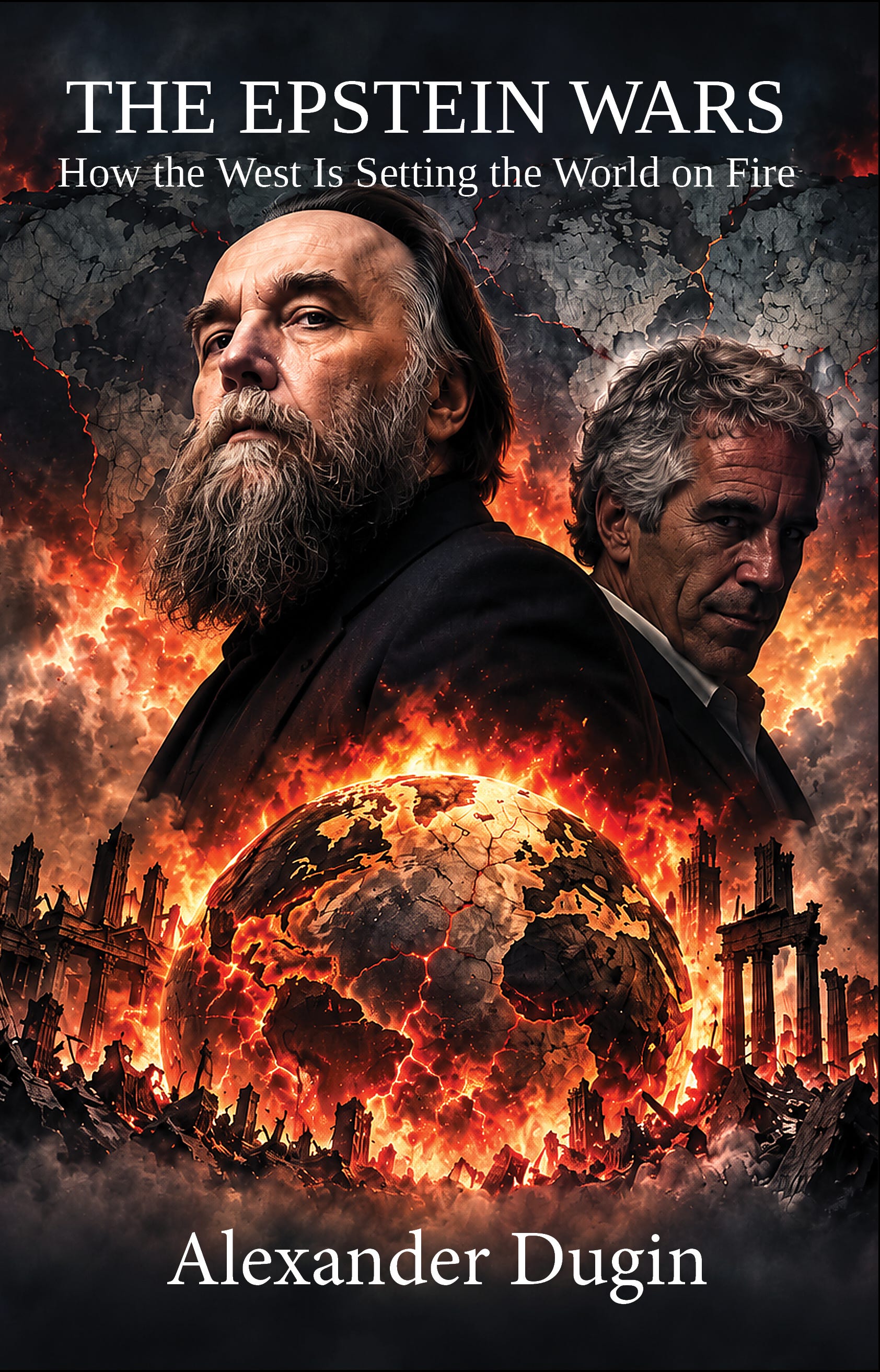
Alexander Dugin — THE EPSTEIN WARS: How the West Is Setting the World on Fire
Get it here.