

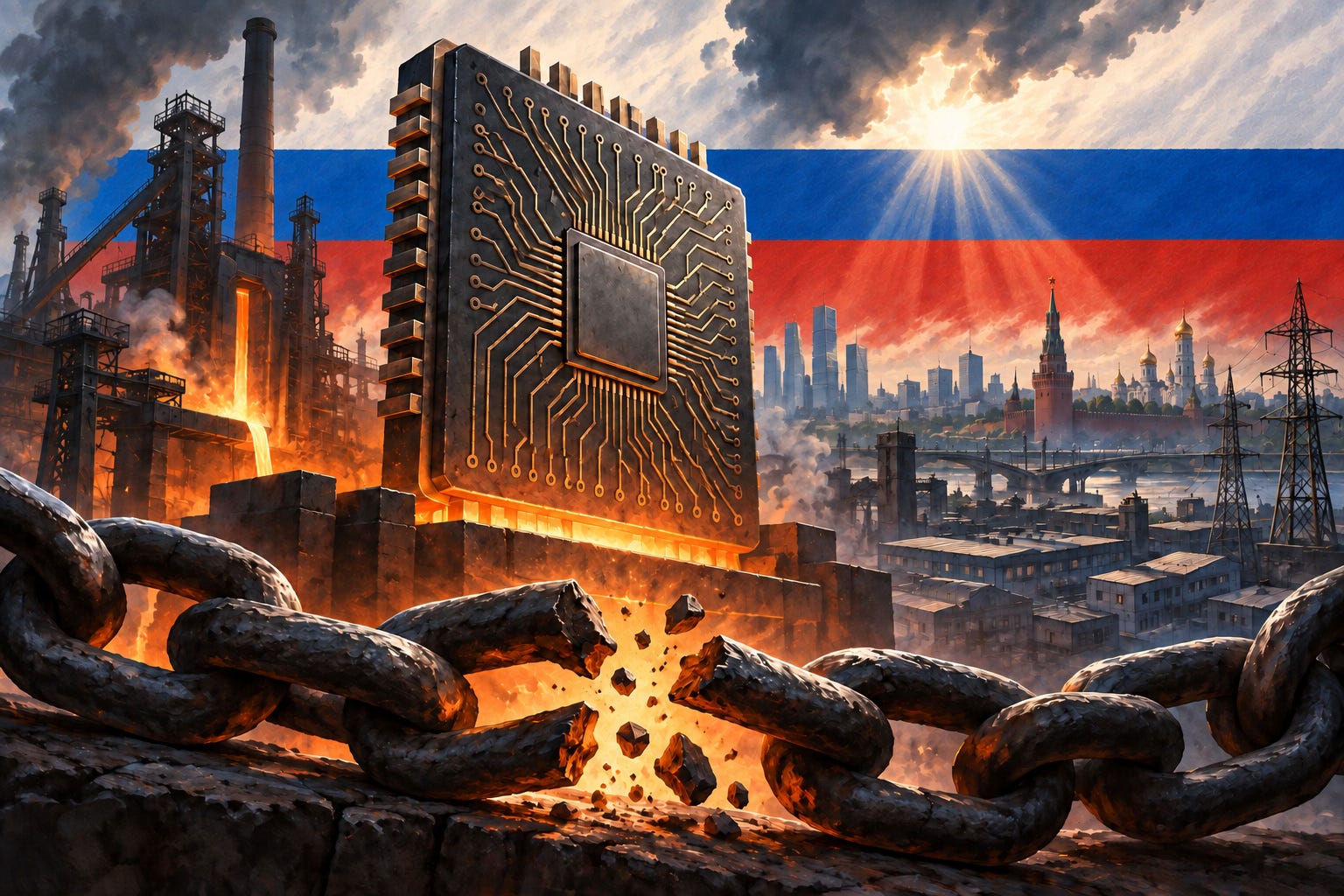
Alexander Dugin warns that Russia must move beyond import substitution and achieve autarky—or risk losing its independence and its future.
Once again, [the Russian political scientist] Chadaev is entirely right about import substitution. From the 1990s and 2000s onward, the liberal-globalists—foreign agents in the economic sphere—persuaded our leadership that joining the international division of labor was advantageous, while autarky meant stagnation and a dead end. Integration into global value chains, they said, was development and modernization; there was no alternative. Anyone who argued otherwise—Glazyev, Katasonov, Delyagin, Khazin, Galushka—was demonized, ridiculed, and pushed to the margins. A taboo still sits on the word autarky itself and on Friedrich List’s doctrine of the “self-sufficiency of large spaces.” That means our economy is set up, from the outset, to reject full economic and technological sovereignty.
After the Special Military Operation began and a flood of sanctions followed, some things changed. The anathema on autarky was never lifted. The new line was simply that we would integrate—without the West. Import substitution became the answer.
It is a short-term measure, and a justified one. We have to fight and win now. We have to fight and win now, and the previous generation of economists had already destroyed the autarkic base needed for that, leaving Russia dependent on global supply chains. The West cut those chains; everyone then rushed East—or back to the same West by circuitous routes.
The liberal economists used a false argument for subversive ends: participation in the world division of labor (in globalization) is development; autarky is stagnation and collapse. Chadaev and the example of China—and not only China—show something else. Treat autarky as a platform for expansion—not as Fichte’s fully closed commercial state (which can also work, as Silvio Gesell and Ezra Pound argued), but as the building of an export base for external markets. The rising civilization-states, and ordinary states too, can readily help. Then autarky is no longer a dead end. It becomes a springboard to real sovereignty and world power.
What we are doing is still tactics. In the 1990s it was the tactic of self-destruction; since the 2000s, the tactic of preserving and hardening sovereignty. Those tactical reserves are spent. They are no longer enough to make Russia great, to win the decisive war, or to hold our place as a pole in the new architecture of world order. We need a strategy: a full strategy of sovereignty. That includes autarky. It means that however unprofitable it looks in the short run to process our own rare earths or to make our own microchips and quantum processors, that is exactly what must be started in a systematic way. Today—not a moment later. And done properly. Here all means are fair. Not merely pounding the table. To wake someone up, you sometimes have to go to extremes.
We need to see clearly what the West is driving at. Capital is dictating the replacement of human beings by AI and robots. Capital’s need for human beings is shrinking fast. Marx grasped something of capitalism’s nihilistic core. Nick Land has a very fine feel for the same thing under present conditions. Capital has a strategy, and it is following its pattern.
If we still have no strategy, we have no chance of surviving. The stock of tactical moves, and any remaining reliance on the legacy of Soviet socialist autarky, are exhausted. Strategy or death.
(Translated from the Russian)
New from Multipolar Press:
Dugin Against the Modern World: Essays on Alexander Dugin and the Multipolar Revolt by Constantin von Hoffmeister

Yes! It is foolish for any Country to be dependent on importations when they can produce their own. Russia is so huge - surely your own Peoples can produce EVERYTHING you need.
Elbrus is in motion. Isn't it?
http://www.mcst.ru/novyj-8yadernyj-mikroprocessor-elbrus-8c