

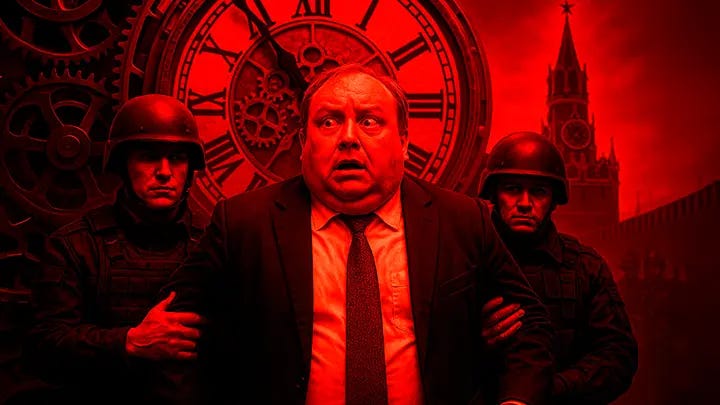
Alexander Dugin on how corruption shaped the Russian elite and why it must be reformed.
The Ticket to the Elite Is No Longer Valid: The “Blacklist” Has Reached Putin’s Desk
The country has been at war for a fifth year, and the question of revising the “elites”—many of which were formed during the darkest times of the 1990s, according to the principle of “corruption, banditry, and baseness”—has long since come to a head. A fair question arises: what should Russia’s ruling elite be like?
Where Are the “Mycelial Networks” of Sleeper Agents Located?
Today, questions are increasingly being raised about the need to “review” and “nationalize” the domestic “elites.” And here, while agreeing with the framing of the issue itself, it is important to note that these “elites” are, of course, highly heterogeneous and far from equal in character. For example, I personally know many representatives of our highest state elite who are people of crystal integrity—convinced Russian patriots with traditional values that guide them in their lives. Therefore, it is absolutely wrong to lump everyone together under one heading.
Moreover, I have repeatedly encountered—and spoken about this in many interviews—the fact that individuals who are widely perceived by the public as less than exemplary, insufficiently steadfast or patriotic, upon closer acquaintance turn out to be very consistent, deeply convinced, and honorable people. This is not something one can grasp without knowing them personally or from observing them at a distance. For that reason, at a certain point I swore off naming names: you mention someone, and it later turns out that everything is entirely different.
In this connection, if Vladimir Putin has indeed recently been presented with lists of members of the elite described as having “degenerated,” then there are surely specific grounds and reliable knowledge behind them. Of course, that holds if we proceed from the assumption that such lists came from respected individuals close to the head of state. In that case, there are no arguments or reasons to distrust them. Personally, however, I would refrain from naming any names in this context, because I have been convinced many times over that things often turn out quite differently from what they seem at first glance.
Let me give an example. After the start of the special military operation, everyone feared that the weakest link would be the economy, yet it turned out that the weak link lay somewhere else entirely. The economy, which many had regarded as the stronghold of a liberal “sixth column” within our state, did not fail. Meanwhile, those on whom we all relied, assuming them to be our strong side, proved to be quite different. We do not reliably know where the “mycelial networks of the sleepers,” the agents of influence, are located. They may be in entirely different places from where we assume. And that is a very important point.
Admission to the Elite: “Corruption, Banditry, and Baseness”
Overall, however, there is a clear impression that a significant portion of our elite is inadequate. Moreover, the very mindset of our society appears inadequate, as does the preparation for such a serious war and its conduct over these four years. Yes, we are holding out, we are advancing toward victory—albeit with great difficulty and while constantly facing new challenges. There is no doubt here: we will prevail. Yet it creates the impression that genuine conclusions from previous failures are still not being drawn.
People simply shift positions and areas of responsibility without demonstrating their competence. After failing in one direction, they are assigned another, then predictably fail there as well, then a third—and so on. This is impossible to ignore.
And here another very deep and serious question arises, almost philosophical in nature: what kind of elite do we need? How should we envision it, and what criteria should we apply to representatives of the ruling class in order to judge whether they truly measure up?
All of this is, for now, merely implied—never openly articulated, and scarcely even reflected upon. And when the discussion turns to a specific case or individual, it becomes detached from any broader context, giving rise to outright arbitrariness. Someone dislikes someone else and begins shouting: “So-and-so is inadequate, he’s part of the sixth column!” Another immediately jumps in to defend him, firing back: “And who are you? Why are you saying this—perhaps someone is standing behind you?”
As long as we are dealing with isolated cases, it is entirely impossible to correct a systemic problem. It makes no difference whether one ministry or another is being investigated, one official or another.
Take, for example, Defense Minister Andrey Belousov, who has been tasked with clearing up serious problems within his department. And he is clearing them: new cases are being uncovered, truly monstrous facts are coming to light, new sentences are being handed down. And although Belousov has already been in office for some time, the flow of such revelations shows no sign of diminishing. One might think the Augean stables had been cleaned and that it was time to move on to the next stage. Yet it turns out that this requires extraordinary effort and time.
We have no clear criterion for what our elite should be. Yet it has not simply “degenerated”—it was, in essence, formed during the darkest period of the 1990s according to the principle of “corruption, banditry, and baseness” (as opposed to “efficiency, morality, and patriotism”). These were the three markers by which individuals entered the elite. Members of the elite were expected to be corrupt, connected to criminal elements, and exceedingly unscrupulous in order to seize positions and hold on to them. Of course, even then there were exceptions: honest individuals, a genuine stratum of public servants and patriots who served the state despite everything. Yet in the main, the elite was not formed on the basis of honest service. And everyone understands this perfectly well.
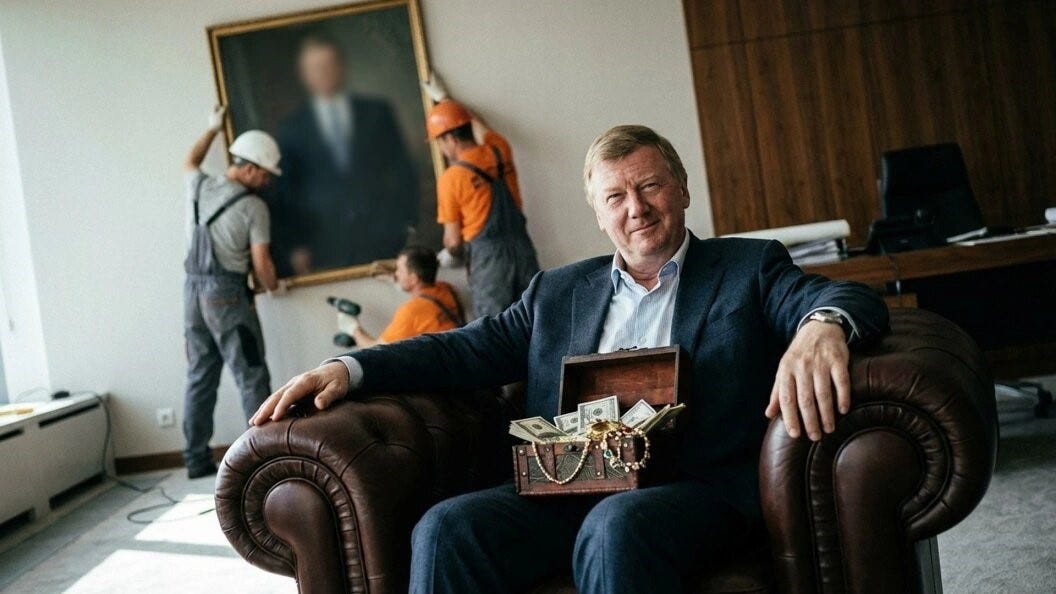
Today, there are attempts to combat this, though in my view they come with enormous delay and are pursued inconsistently. Someone is exposed, and then a long trail of discussion follows—perhaps he should be pardoned? Even Anatoly Chubais, who plundered and dismantled the country while serving as head of the presidential administration, finance minister, first deputy prime minister, head of RAO UES [Unified Energy System of Russia], and head of Rusnano… He stole everywhere, destroyed everything, and in the end fled. He faced no punishment, and his legacy continues. And yet such a figure could have been stopped earlier—a man who caused harm both ideologically and economically, corrupting everything around him. Now he heads centers working against Russia on the side of its enemies, openly acknowledging that he had always been an adversary. Perhaps there are no longer such blatant cases, yet there remain vast numbers of people who are not far removed from Chubais. Because it was precisely according to this principle that the elite was formed in the 1990s.
This is, of course, a systemic issue, rather than merely a matter of personal “degeneration.” It is the inertia of a dark period of dependence on the West—the inertia of a colonial capitalism that we adopted uncritically. Something must be done about this. A transformation in our society’s worldview is necessary, and it must begin precisely with the elite.
Are we moving in that direction or not? I have the impression that we are not yet. Although this should have been done long ago, even now we are only beginning to wonder whether it should be done at all.
What kind of elite do we need?
When new initiatives aimed at renewing the elite break through, this is excellent. It is the voice of people who care about the fate of the Fatherland, and one would hope that this process will finally begin. New criteria must be established—real, clear, and transparent. Who has the right and the dignity to belong to the ruling elite, and who does not? Judgment must be based not only on moral qualities, but also on effectiveness, competence, professionalism, and responsibility. For if you possess much, you are responsible for much. You bear a greater burden than the ordinary person—you are responsible for everything. And it is precisely this sense of responsibility that is clearly lacking across the entire ruling class.
If such measures truly mark the beginning of a renewal, I would support them wholeheartedly and would gladly take part in developing the criteria required for a new elite. If, however, everything remains partial—someone is investigated, someone removed, or more likely simply reassigned elsewhere—then this will mean that we have not matured and do not grasp the urgency of the problem. And that would be deeply regrettable.
Still, I would not want to get ahead of events. A great deal of time has already passed: those who were at the height of their power in the early 1990s are now elderly. It is unlikely that those who were selected according to the old criteria have, over these thirty-five years, acquired the qualities demanded by Russia’s current historical moment. On the contrary, it seems to me that they have spent their energy, while their children are wholly unsuited to power—they are capable only of squandering what their parents managed to seize during the chaotic redistributions of that era.
This is a very difficult situation. I will repeat: one must begin with criteria—by stating what Russia’s ruling elite should be like. And then, carefully and systematically, without personal exceptions or clan ties, one must proceed to implement these principles. I think they are easy to formulate:
First, these must be people devoted to the state—that is, patriotic.
Second, they must be highly effective and accountable for both their successes and their failures. They must be the best—hence the meritocratic principle.
Third, they must be honest: they must serve the state and be satisfied with their administrative position, rather than using high office as a vehicle for personal enrichment.
These three principles are very simple. One simply needs to replace with them the criteria by which the elite was previously selected—and by which it still remains in power: lack of accountability, lack of patriotism, and deep involvement in corruption. Corruption, Westernism, liberalism, irresponsibility, and shoddy performance must become unacceptable.
In Sum
What served as a ticket into the elite in the 1990s should now become a ticket to entirely different places. The opposite qualities must be cultivated and consistently monitored. Then society will begin to feel a sense of justice, and the affairs of the state will improve: we will finally begin to produce our own processors, our own machinery, and establish rational governance.
We have a very talented people and a fine state with immense resources. Yet a systematically inadequate elite is, without question, obstructing our further historical development.
(Translated from the Russian)

There is but one response to banditry and treachery: a public denunciation followed swiftly by a sharp guillotine. The following is an excellent example to follow:
The Case of Zheng Xiaoyu
The story of the execution of China’s top drug regulator is one of the most high-profile examples of the Chinese government using the death penalty to address systemic corruption and restore international confidence in its exports.
**Zheng Xiaoyu** served as the director of the State Food and Drug Administration (SFDA) from 1998 until 2005. His downfall came during a period when China was reeling from several high-profile product safety scandals, including tainted pet food, toxic toothpaste, and counterfeit medicines.
The Charges and Conviction
In May 2007, a Beijing court convicted Zheng on two primary counts:
* **Bribery:** He was found guilty of accepting approximately **6.5 million yuan** (roughly **$850,000 USD**) in bribes from eight pharmaceutical companies in exchange for drug approvals.
* **Dereliction of Duty:** During his tenure, he oversaw the approval of thousands of medicines, many of which were untested or fake. One specific fake antibiotic approved under his watch was linked to the deaths of at least 10 people.
### The Execution
The legal process moved with remarkable speed, which many observers interpreted as a political message:
* **May 29, 2007:** Sentenced to death.
* **June 2007:** Appeal rejected by the Beijing Higher People's Court.
* **July 10, 2007:** Executed via **lethal injection**.
> "The few corrupt officials of the SFDA are the shame of the whole system and their scandals have revealed some very serious problems." — *Yan Jiangying, SFDA Spokeswoman*
>
### Why the Punishment Was So Severe
While China frequently uses the death penalty for corruption, executing an official of Zheng’s rank was rare. Several factors contributed to the severity:
1. **Public Health Crisis:** The corruption wasn't just financial; it had a direct body count, including 13 babies who died of malnutrition in 2004 due to fake milk powder approved on his watch.
2. **International Pressure:** At the time, "Made in China" was facing a global branding crisis. The execution was seen as an attempt to prove to the world that China was serious about product safety.
3. **The "Chicken and Monkey" Tactic:** Using the Chinese proverb *"Kill a chicken to frighten the monkeys,"* the state used Zheng as a high-level scapegoat to terrify other mid-level bureaucrats into compliance.
The Chinese FDA has been virtually scandal free since.
👏🏻👏🏻👏🏻grazie!