

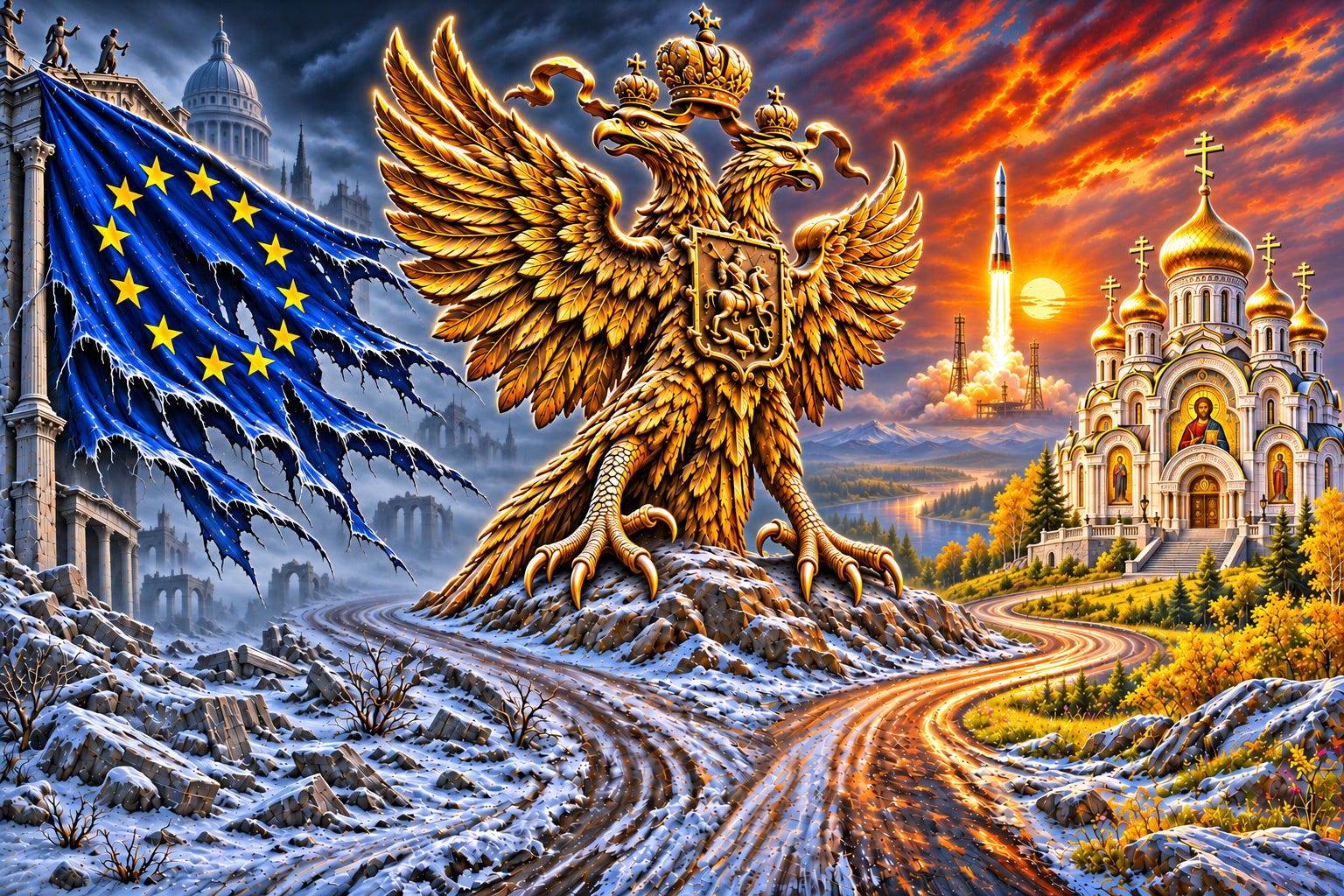
Yannis Andris reveals how Russia’s obsession with European recognition has compromised its sovereignty, security, and historical destiny.
Read part one here.
If one so far thinks that Russia’s European infatuation is mostly a rather obscure subject of scholarly debate with limited ramifications for actual policy, one could not be further from the truth. The Moscow elite’s Europhilia has shaped and even today continues to shape Russian foreign policy preferences and grand strategy in fundamental ways. One may think of a state as an organism. While it has very complex and significant resources to tackle the trials and tribulations of life, it must engage in a careful exercise of resource allocation, deciding how to distribute its finite energies and attention among a limited set of clear priorities that, once set and solidified into habit, are difficult to shift away from and nearly impossible to radically challenge. For a nation like Russia, whose state manifestations through the better part of four centuries—from imperial times to the Soviet experiment to its current ill-defined and de-ideologized form—have set their attention on Europe, which it perceived as the center of global power and a mirror in which it measured its success or failure, to turn away is an existential challenge.
The economy is central to a state’s capacity in peace and in war. Russia’s economy was purposely linked to Europe’s in a bid both to create prosperity and to bolster the concept of indivisible security. This attempt, which began in earnest during Soviet times, was elevated to a prime political objective for President Putin via the now-inoperable Nord Stream and a host of development and investment projects. It was celebrated as a way to tie Russia’s future to Europe’s; it came at tremendous expense and, while it proved lucrative, it also proved to have no structural resilience and, most importantly, failed miserably as a security failsafe. When strategic priorities demanded it, Europe did not hesitate to sever it—literally, with the bombing of the pipeline, whether the hands that blew up Nord Stream were Ukrainian, American, or European. This came as a great surprise to most Russian elites and analysts. It would not have, and Russia would have been better prepared for the long war in which it found itself, if a more balanced approach had been followed in previous years—one that did not focus the entire state’s resources on a Western trajectory. Counterarguments about Europe shooting itself in the foot by cutting access to cheap Russian gas sound hollow when European missiles keep killing Russian civilians and soldiers alike.
This is only one example of the tangible negative results of Moscow’s strategic blindness, incurred by its naive attempts to Westernize and be accepted. From the criminal shock therapy of the 1990s, which ravaged the once mighty—for all its ills—Soviet industry, to entrusting about $230 billion of Russia’s sovereign wealth to European banks over the years—now immobilized if not practically seized—to wasting billions (trillions if counted in rubles) on vanity projects aimed at showcasing a Westernized Russia, such as the Sochi Olympics and the 2018 World Cup—Russian elites erred greatly in allocating the state’s wealth. Instead of maximizing autarky and resilience and pivoting to the East, which was already fast becoming the globe’s industrial powerhouse, Russia doubled down on a European destiny, with fantasies encapsulated in the “From Lisbon to Vladivostok” slogan.
The security ramifications of the Russian state’s misaligned priorities and its obsession with securing a European future were and are more profound. The Russians erroneously believed the “End of History” gospel, thinking that a major war in Europe against European forces was unthinkable in the post-USSR reality. As such, irrespective of the dire, self-inflicted economic malaise of the 1990s and early 2000s, Russia allowed its mighty military to deteriorate into a shadow of its former self. One must acknowledge that President Putin did carry through a modernization plan, mainly after the 2008 Russo-Georgian War, but it was still quite limited in scope and depth, and many promising projects in development, such as the MiG-1.44 fighter aircraft or the T-95 battle tank, were discontinued. Russia did manage to extensively modernize and even gain an asymmetric qualitative advantage over the US with regard to its nuclear arsenal, but when Russia’s own doctrine legitimized its use—when Ukraine attacked Russian strategic assets—President Putin did not respond, with profoundly negative results for Moscow’s strategic deterrence. The tragedy of post-Soviet Russian military contraction was not that Moscow failed to preserve the Soviet military establishment, an economically untenable proposition, but that it repeatedly treated the preservation of strategic capabilities as negotiable in pursuit of an international accommodation that never materialized.
This accommodation, or rather its phantom, involved a new security architecture in Europe—one that took Russian security concerns into account and involved the abandonment of NATO’s Eastern expansion. Apart from expressing its consternation, Moscow did very little until it was too late; it acted only after the Maidan coup, and even then it hesitated to finish the job in Ukraine—a grave mistake of historical proportions. In my view, the Kremlin’s desire not to antagonize the Europeans played a major role in explaining President Putin’s 2014 inaction and allowed Russia to be drawn into the Minsk agreements, which would only have been implemented if the European powers had indeed shared Moscow’s vision of a commonly developed security architecture and had been willing to ignore Washington—a very naive supposition, to put it mildly. This apparent naivety, which does not befit a great country like Russia, can also be partly explained by President Putin’s legalistic mindset and his incomprehensible trust in the force of treaties and gentlemanly agreements. This aspect of President Putin’s personality, while an asset in peacetime, is a fatal flaw in times of war and when the enemy is willing to go down paths you are too afraid to follow.
Apart from the weakening of Russia that its elites’ persistent Europhilia generates, it also acts as a major structural hurdle to Moscow’s professed vision of multipolarity. Russia has spent considerable time advocating a multipolar international order, opposing Western hegemony and promoting the emergence of alternative centers of political, economic, and military power. Yet there is an inherent contradiction in attempting to establish a multipolar international system while continuing to regard integration into the existing Western-centered order as a principal strategic objective. Moscow cannot stand on two boats moving in opposite directions.
A genuine multipolar order requires Russia to accept that its interests may diverge permanently from those of Western Europe, that its economic development cannot depend principally on the restoration of European commercial relationships, and that its security architecture must be constructed around its own strategic requirements. It also requires accepting the consequences of being an independent geopolitical pole rather than a dissatisfied participant seeking a more favorable position within someone else’s order. Echoing Professor Karaganov’s arguments, this does not mean rejecting European trade or diplomacy, or denying that European culture did affect Russia’s. It does mean, however, abandoning the expectation that these relationships or that past should determine Russia’s strategic priorities and future.
Russia’s post-Soviet predicament is not simply the consequence of its failure to secure an equitable place within the European security order but also the consequence of having organized much of its economic, military and diplomatic development around the expectation that such a place could eventually be secured. This expectation, rooted in a much older historical disposition, repeatedly subordinated the development of independent strategic capabilities to the pursuit of external recognition. The emergence of a genuinely multipolar international order therefore requires more than a change of foreign-policy orientation. It requires Russia to overcome the historical and institutional inertia that has made European acceptance an enduring measure of its own success.
Moscow had been treating multipolarity as a hedge and slogan for years. It acted as a warning to the West that if the US and Europe continued to disregard Russia’s security concerns, Russia could accommodate and accelerate the shift toward a non-Western global order. But while that is a sound strategy—recognizing that Russia cannot be the king but can be the kingmaker—it failed because of the Western deep state’s institutional Russophobia, the divergence of priorities between Washington and Moscow, and the fact that at a certain point Russia must choose subjugation or resistance. The SMO—the Ukraine war, and I know this will surprise many—is treated not as an act of resistance but as a mechanism to force a more favorable accommodation of Russian interests by the West. President Putin is honest when he says this is not a war in the sense that Russia is not using the full extent of its arsenal, including strategic nuclear weapons, as it should if this were an existential conflict; it is also a mistake, because the conflict is existential and the enemy has displayed no qualms about escalating. Multipolarity is not a diplomatic slogan or an alternative distribution of international prestige. It is a material condition that must be constructed through the accumulation of independent economic, technological, military, and political capabilities. Accepting that turning away from Europe is a precondition of that is a bitter pill for Russian elites, but if they do not take it, they will face the unpleasant choice of subjugation or total war.
President Putin successfully challenged the assumption that Russia could be incorporated into the Western political order on subordinate terms. Yet his political generation remained, in important respects, a product of the very historical framework that had made such incorporation an aspiration in the first place. Russia needs elites whose conception of national development is not primarily derivative of European institutional models or Western recognition. For what it is worth, today Russia is in many respects a more open society than most European countries, where challenging the dominant narratives leads to effective professional and personal ostracism or worse.
It would be a mistake, however, to exempt the man who broke the spell from the spell itself. President Putin is, in my view, the most consequential Petrine product of all, precisely because his generation inherited the Petrine mould whole. Born in Leningrad, Peter’s granite window on Europe, and formed as a KGB officer in Dresden, he addressed the Bundestag [German parliament] in fluent German in 2001 and declared Russia a friendly European nation; as early as 2000 he was floating Russian membership of NATO; and in 2010 he proposed a harmonious economic community from Lisbon to Vladivostok. These were the reflexes of a man for whom Europe was both the yardstick and the audience. Even the rupture bears the mark. The Munich speech of 2007 and the war of 2022 are the grievances of an insider who feels refused, not of a stranger who never wished to enter. The demands—indivisible security, a seat at the table, respect for red lines—are demands for European recognition, and Minsk was a plea for Europeans to underwrite it, which—the woe might be on them—they never did. In that sense, as the irrevocably refuted lover of Europe, Putin is the one who just might stir Russia away from its Petrine obsession once and for all.
This does not mean, as Professor Karaganov correctly states, a rejection of European education, intellectual exchange, or cultural heritage. Quite the opposite: a genuinely confident civilization should be able to absorb external knowledge without making external validation the measure of its own worth. In the broader multipolar strategic vision, Russia can serve the noble goal of acting as a paradigm of what European societies can aspire to be: independent from US influence, not consumed by divisive and self-destructive suicidal empathy, and not beholden to a neo-colonial, holier-than-thou mindset as a foreign policy prerogative. The paradox is that for Russia to help Europe in such a manner, it must, as Professor Karaganov astutely suggests, first turn away from Europe.

interesting perspective. never even considered the idea of europhilia. guess we'll be hear that term more and more in the future. kudos.
Your analysis stirs me to anguish and sorrow as to the state of ‘societies’. As an American who naively has believed in the brotherhood of man, we and the Europeans have abused this positive vision and it cuts to the quick. Mother Russia likely is our last hope and my prayers are with her.