Yannis Andris draws on Spengler’s concept of pseudomorphosis to explain why Russia must overcome centuries of imposed Westernization, reclaim its distinct civilizational identity, and help create a multipolar world.
Esteemed Professor Karaganov recently published an article arguing that Russia needs to turn away from Europe and abandon the hope that relations between Moscow and European capitals can be restored to any level of cordiality anytime soon. Professor Karaganov does not suggest that Russia should sever all ties and raise the contemporary equivalent of the Iron Curtain (which, in my view, would likely be to the Eurocrats’ liking), but rather that it should establish a working relationship on a pragmatic level, devoid of atavistic sentimentality on Russia’s part—a sentimentality that projects outdated views of what Europe is onto the current unfortunate realities.
In this essay, I will attempt to expand upon Professor Karaganov’s proposal, a proposal I wholeheartedly endorse as a necessary condition for enhancing Russia’s international standing and accelerating the advent of a multipolar world, while grounding it in the philosophy of history and international relations theory.
First, a needed disclaimer of sorts. Today the powers ruling Europe, at both the national and supranational level, are vehemently and existentially—ontologically, even—Russophobic. Hating Russia (and even the normalization of treating Russians as subhuman) is almost institutional in its depth and scope, despite not fully reflecting the attitudes of most European publics. Across the political spectrum, European leaders treat Russia as the ideal boogeyman whose antagonizing acts serve as a rallying cry, a cause célèbre that solidifies European cohesion and helps both to hide the EU’s structural issues and to push for their securitization (per the Copenhagen School) in relation to Russia, as well as for a militaristic Keynesianism as an engine of EU economic growth. Should there be a meaningful shift in the ruling order in the EU—perhaps with the ascent of powers like the AfD in Germany or Marine Le Pen in France, powers willing to restore European-Russian relations to what they were prior to 2014—the policy of decisively turning away from Europe would perhaps not be optimal, even though, as I will attempt to show, it would still align with historical trends and with the need for Russia finally to chart a unique civilizational course.
The main question can be stated as follows: has Russia’s persistent attempt to define its relationship with Europe in European terms become an obstacle to the realization of its own historical and geopolitical potential?
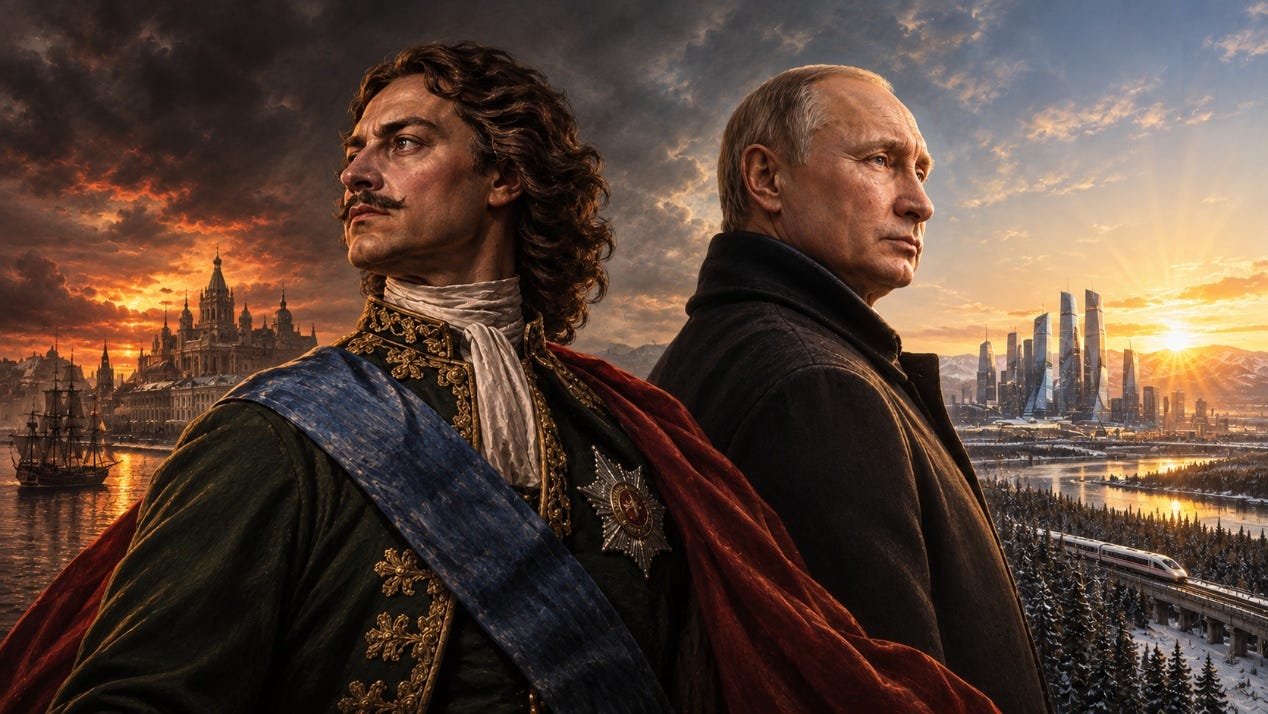
The Petrine paradox is that the very reforms that made Russia a European great power may have distorted its subsequent historical development and obstructed its emergence as a distinct Eurasian civilization. Peter’s reforms simultaneously increased Russia’s military, administrative and industrial capabilities and imposed considerable cultural and institutional costs.
Peter the Great—an epithet that history has, in my view, rather generously bestowed—violently implemented a Westernization reform program upon Russia. Though it undoubtedly increased Russia’s aggregate power and firmly placed it among the main European powers of the day, it simultaneously prevented the organic growth of Russian culture and stifled Russia’s unique civilizational potential. While for the average educated Russian this sounds anathema, it is only because he has learned to interpret the world mostly within a Petrine-imposed lens. This amounts to judging Russia’s success by how European it is—a malady plaguing not only the liberal faction of Russian politics but almost its entire political spectrum. This inferiority complex and need to define one’s country vis-à-vis the West are not unique to Russia but can be found across Eastern Europe and beyond, mainly among elites. But there is still hope for Russia to break free from the Petrine straitjacket and realize its civilizational potential, charting a new course, one in harmony with a multipolar vision of global politics. This hope lies partly in understanding the underlying historical mechanism of Peter’s reforms.
The main mechanism I use to interpret Peter’s violent imposition of Western ideas is Oswald Spengler’s historical pseudomorphosis. Spengler, a philosopher of history, argued in his magnum opus—and a mandatory read—The Decline of the West that nascent cultures can often find themselves caught in the orbit of another, already formed civilization at a higher level of development, and adopt its mannerisms across the entire gamut of cultural expression, be it art, philosophy, technology, or political forms. But a clear distinction is necessary: this adoption, no matter how wide-ranging, never pierces deep enough to alter the fundamental, ontological character of the affected culture. No matter how hard Peter and subsequent leaders—from Catherine the Great to Nicholas II and from Stalin to President Putin—attempted to Westernize Russia, its soul remains intact. This, again, is not unique to Russia; the impossibility of genuine transformation amounts to the fallacy of seeking the alchemist’s stone. It is the source of eternal grievance for Westernizers and Europhiles of all cohorts, and in geopolitical terms, when it manifests as strategy, it is the singular reason for the tragedy of Ukraine today. No matter how much blood is spilled and how many years pass, neither Moscow, Kiev, nor Warsaw—or Belgrade, for that matter—will ever be Western. At “best,” they will be a poor imitation, if not a parody. At the risk of trivializing Spengler’s more nuanced mechanism of pseudomorphosis (go and read The Decline, dear reader!), one can call the attempt to adopt another culture in place of one’s own “geopolitical crossdressing.”
But Spengler is certainly not alone in placing Russia by default outside Europe. Spengler actually argued that Europe’s delimiting line is the Vistula—take that, Poles et al. Many prominent scholars followed this classification, among them the great British historian Arnold J. Toynbee, the Russian philosopher Nikolai Danilevsky, the American scholar and international relations theorist Samuel P. Huntington, and even the American diplomat George F. Kennan.
Toynbee’s classification of Orthodox Christendom as a distinct civilization provides an important complement to Spengler. It establishes that Russia’s historical distinctiveness is not simply a Russian nationalist interpretation. The Orthodox world developed its own religious, institutional, and historical trajectory, fundamentally different from Western Christianity.
Danilevsky’s argument that Russia and Europe belong to different cultural-historical types predates Spengler and provides a useful historical point of comparison. Danilevsky, similarly to Spengler but with certain differences, argued that humanity does not share a single universal path of progress. Instead, history divides into separate, organic “cultural-historical types” (civilizations) that grow, mature, and decline much like biological organisms. Huntington, in his Clash of Civilizations, is useful because he explicitly identifies Russia as the core state of Orthodox civilization, culturally distinct from Western Christendom. His framework also helps explain why the post-Cold War expectation of Russia’s uncomplicated absorption into Western institutions was historically questionable. Huntington also firmly places Ukraine, Belarus, and the Balkans—including Greece, often erroneously identified as the cradle of Western civilization—as non-Western cultures. Finally, Kennan, who was the architect of the containment theory of the USSR, is particularly useful as a Western, non-Russophobic strategic thinker who clearly understood the historical and geopolitical particularities of Russia and warned against treating the post-Soviet moment as an opportunity for an unrestricted expansion of Western institutions.
Thus, far from being an exotic, unconventional position espoused by either Russian nationalists or Russophobes, the notion that Russia is fundamentally, in its soul, alien to Europe and the West (as, ironically, are most of these Russophobes, particularly of the eternally ungrateful Slavic variety) can be established academically. Returning to Spengler, he argued that a precondition for a distinctly Russian civilization to emerge is precisely to break through the Western pseudomorphosis cast. His quote encapsulates this: “Tolstoy is the past, Dostoevsky the Russia to come. [...] Tolstoy’s Christianity was a misunderstanding. He spoke of Christ and he meant Marx. But to Dostoevsky’s Christianity, the next thousand years will belong.”
Here Professor Karaganov’s diagnosis deserves a respectful dissent. He dates Europe’s decline to the early 2000s, when the drafters of the EU’s constitutional treaty declined to mention Christianity, as if a Europe that “changed” had left Russia standing at the altar. But a civilization does not mutate over a preamble, least of all one that French and Dutch voters then rejected. By Spengler’s own periodization, the West passed from Culture into Civilization around 1800: the cathedral gave way to the exchange, faith to rationalism, the knight to the megalopolis. The secular, universalizing, missionary Europe of Brussels (the same one perpetuating the Ukraine war by arming Kiev’s war criminals) is not a corruption of the Western soul but its ripened and decadent form, the same Faustian will to reorder the world that sent Crusaders east and administrators to every colony, now armed with directives instead of galleons. This is why the Russophobia I described is ontological rather than situational. A Europe that merely changed could change back, and the divorce would be a lovers’ quarrel awaiting reconciliation, which is exactly the Europhile’s false hope.
This dynamic can also be understood through the concept of institutional path dependence. Historical choices do not merely shape the circumstances in which subsequent decisions are made; over time, they generate institutions, interests, expectations and habits of thought that make certain trajectories progressively easier to reproduce and alternatives increasingly costly to pursue. Russia’s Westernization, therefore, should not be understood simply as a sequence of discrete reforms or diplomatic orientations, but as a process that gradually embedded a European frame of reference within the outlook of its governing elites and the structures of the state. Even when the strategic environment changed, the assumptions produced by this historical trajectory continued to influence how Moscow perceived its interests, assessed its options and measured its international standing. The result was not an immutable destiny, but a form of institutional and intellectual inertia: a tendency to reproduce an inherited orientation—the path—long after the conditions that had originally sustained it had ceased to exist, a choice whose reversal is tantamount to a radical change of institutions and the elite’s worldview—hence the dependence.
Read Part 2 tomorrow, right here on Multipolar Press!
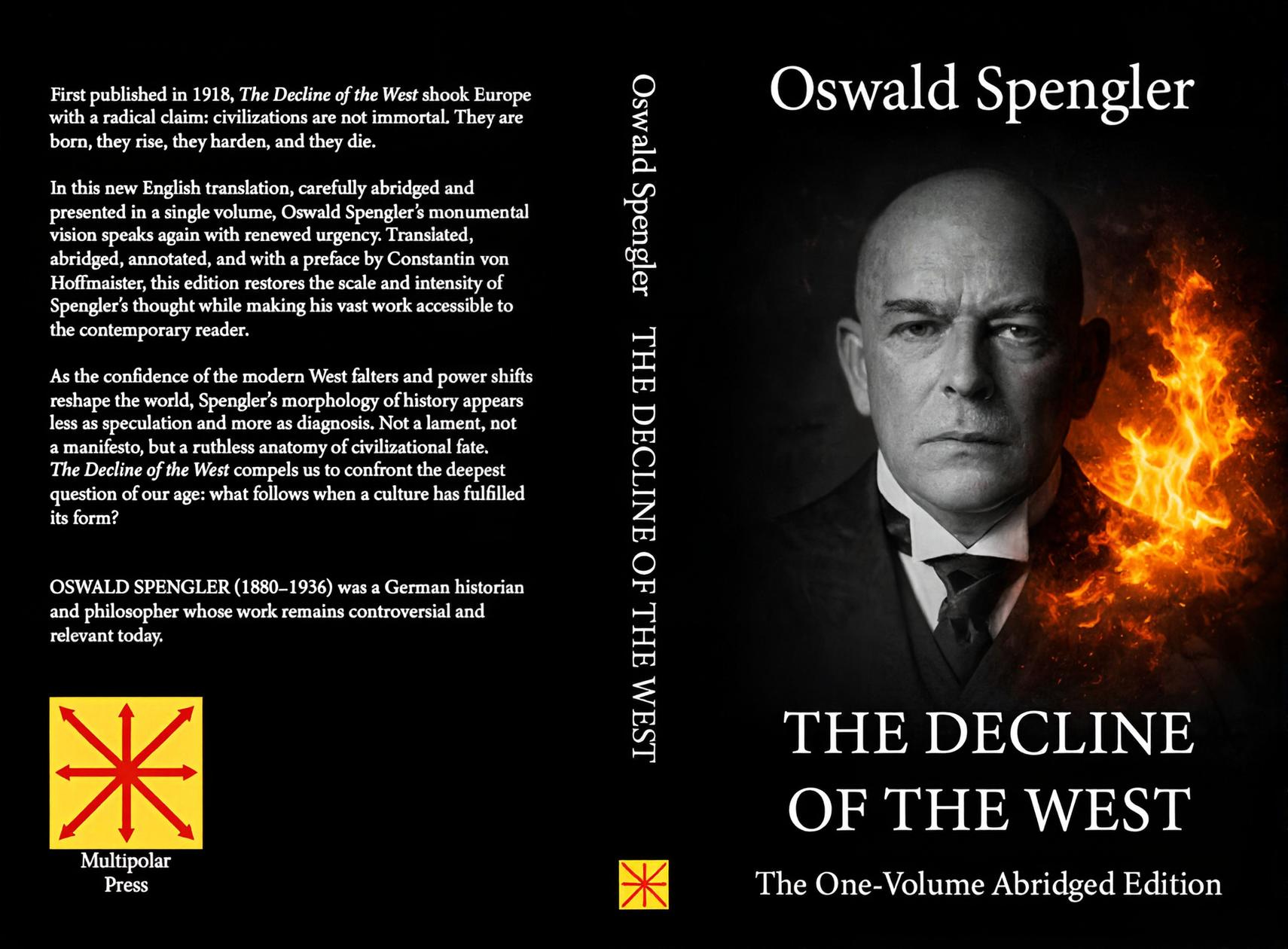
Get Oswald Spengler’s The Decline of the West: The One-Volume Abridged Edition.
Freshly translated, expertly abridged, annotated, and with a preface by Constantin von Hoffmeister, this single-volume edition preserves the full philosophical depth, sweeping morphology of history, and prophetic intensity of Spengler’s masterpiece while making it far more accessible and readable for contemporary audiences without sacrificing its intellectual rigor or visionary power.
Order your copy here.