Russia Must Awaken
Victory over sleep
Alexander Dugin argues that Russia faces a civilizational struggle defined by time, acceleration, and the need to break what he calls the country’s “heroic sleep” before the collective West escalates the conflict further.
Conversation with Alexander Dugin on the Sputnik TV program Escalation.
Host: Hello, friends. Happy holiday to everyone!
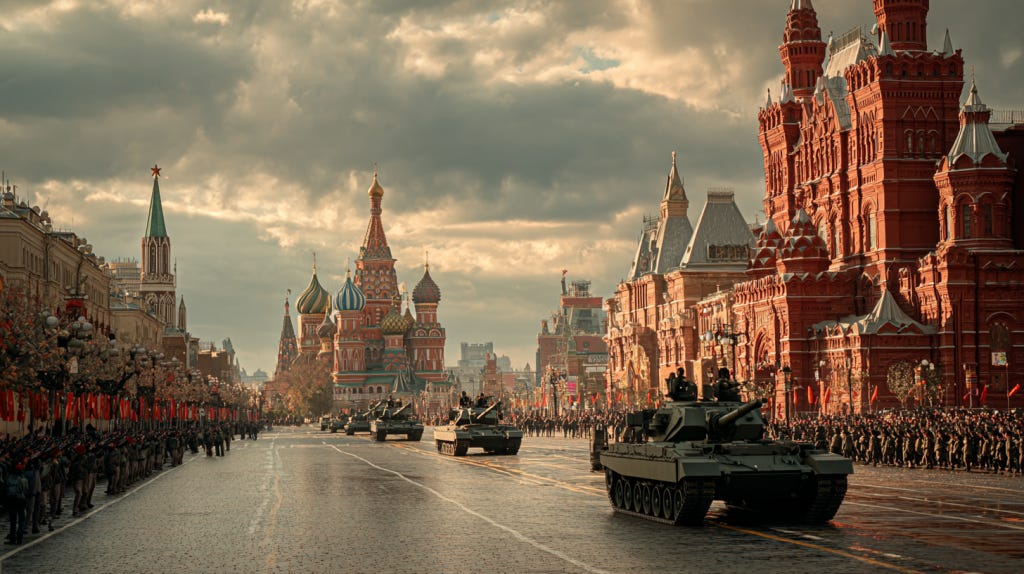
During the May 9 parade on Red Square, genuine heroes marched “in formation,” as military personnel say: 17 Heroes of Russia and 83 recipients of the Order of Courage. Beside the president in the stands sat not only veterans of the Great Patriotic War, but also participants in the current events, including the first female Hero of Russia, Lance Corporal Lyudmila Bolilaya, who shielded a wounded soldier with her own body.
Perhaps this is one of the defining features of the present May 9 celebration — the living continuity of heroic sacrifice in the conditions of the special military operation. What else, Alexander Gelyevich [Dugin], should we speak about in this connection?
Alexander Dugin: I think there are many subjects worth discussing. And since you mentioned the heroes awarded the Order of Courage, I would like to remind everyone that this is a kind of Immortal Regiment: many remarkable figures of the SMO [Special Military Operation] era have received this award, and, sadly, many of them posthumously. My daughter, Daria Dugina, was also posthumously awarded the Order of Courage by the president for defending our freedom, our truth, and our state.
That is why this is a very bitter holiday. For us, the people of the SMO era, the phrase “a holiday with tears in our eyes” has ceased to be a metaphor and has become something immediate and concrete. Remembering our grandfathers and great-grandfathers who fell in that war is a sacred duty, yet now we are losing loved ones in real time. They are becoming heroes and recipients of the Order of Courage right now. This pain and these tears are not symbolic; they are not merely a tribute to tradition. Our Immortal Regiment is growing, becoming ever more concentrated and sharply present in our lives.
Today’s holiday feels to us more like a tragedy and a reminder of the unimaginable suffering our people endured both in the Great Patriotic War and in the trials we are undergoing today. For this war continues. The celebration of May 9 in 2026 feels to me like the heaviest in my lifetime. Before 1991, we celebrated victory in a country that had been defended, reclaimed, and expanded by those people. Thanks to them, we became a victorious people: our warriors left us a great and tangible inheritance.
The country in which we breathed, studied, and contemplated the world — a country through which one could travel from Kaliningrad to Sakhalin without customs checkpoints or borders — all of this was part of our common Victory. The Ukrainian, Belarusian, Kazakh, Uzbek, Armenian, and other peoples were part of our single society. All of this was the legacy of May 9, 1945: our very existence, our Russian language, and our sovereign state. This triumph was preceded by five years of terrible war, occupation, retreats, and unimaginable sacrifice, until the war truly became a people’s war and the people awakened.
They rose in defense of the Motherland under the leadership of a great leader. The greatness of Joseph Stalin is becoming ever more evident today. I am an Orthodox man; I am not a supporter of communism, atheism, or Marxism, yet it is impossible to deny the scale of this figure. He was able to raise the country up at a critical moment and save the state through the right words, decisions, and actions. For us — conservatives, monarchists, and supporters of tradition — he appears as a successful emperor. Yes, he is a contradictory figure, yet Byzantine history and Christian history alike contain rulers who were far from orthodox and who nevertheless brought great victories to their peoples and their empires.
And then, in the nineties, this victory was almost stolen from us; in fact, it was effectively usurped. On the territory of our united Fatherland, dubious entities appeared that spat upon both our Soviet past and our Russian past, constructing “anti-Russia” projects — and not merely one, but several at once. And from Moscow we treated all of this with complete condescension. We ourselves were selling off our victory.
I would remind you that during that period, in the nineties — and people may already have forgotten this — the Russian Federation was at times led by figures who themselves despised and spat upon the greatness of the veterans, who tried altogether to erase the significance of our Great War. They agreed with the equation of communism and Nazism, something the European Union insisted upon. These traitors ruled over us, and it was precisely they who shaped the elite that still partially remains in high positions today. It was a terrible period, when the results of our victory were taken from us and the holiday itself was nearly stolen away.
When Vladimir Putin came to power 26 years ago, he gradually began to save this holiday. Saving the results of the victory was far more difficult, because we ourselves had renounced them — precisely in 1991, during the dissolution of the Soviet Union. We voluntarily surrendered the fruits of our great victory, staining the honor of our state, our government, and our society. Mikhail Gorbachev, Boris Yeltsin, and everyone surrounding them — every last one of them stained their honor through an unimaginable betrayal.
That is why this holiday became profoundly bitter. Putin attempted to save it. We began celebrating it with increasing confidence. And then we began asking ourselves: why speak only of the holiday, only of the past, only of the Immortal Regiment of that era? For the threat hanging over our country exists today as well.
And then the Special Military Operation began. We breathed deeply once more. And we realized — our people realized — that Victory belongs not only to the past; it is also our duty in the present. We embarked upon the path of reclaiming the stolen results of the Great Victory of 1945. Beginning in 2014, we took a certain step in that direction, and when the SMO began, we fully entered the direct path of restoring our historical dignity. We began asserting ourselves as an independent state-civilization, as a genuine pole of the multipolar world — and after that, we encountered extraordinary resistance.
I even think that many people did not suspect how difficult it would be to win the war we entered into. We understand how hard it was to fight during those five years, from 1941 to 1945. Yet in reality, we have encountered something whose full scale, it seems to me, we still do not entirely comprehend. If we fail to win this Patriotic War that we are waging against the forces of the collective West, then the issue will no longer concern merely the Victory of 1945, but Russia’s very existence in history.
Our being in history, our sovereignty, our statehood, our independence, our freedom, and our civilization are once again in question. They stand in question just as sharply as they did in 1941, 1942, or 1943. In the broadest sense, we still have not turned the tide of this war. Over the past four years, we have not even come close to fully realizing the goals that were set at the beginning of the SMO.
And if we widen our perspective further still, we will see that the post-Soviet space, which forms part of Eurasian integration, is slipping away from us, distancing itself and drifting farther rather than drawing closer and integrating. If we speak seriously... Of course, one should not really speak this way during wartime, because morale must constantly be strengthened. That is true and proper. Yet sometimes a reality check is necessary, a comparison with reality itself, so that we understand what is required of us now in order for Victory truly to become our Victory, so that we may defend its sacredness.
Look, we are already paying for it with blood. Behind my shoulder hangs the portrait of my daughter — posthumously awarded the Order of Courage for Russia in this war, in our Patriotic War. And these are not merely words, not merely photographs that we carry in the Immortal Regiment procession — this is our pain. And if we are unable now to truly gather ourselves and reverse the course of the most difficult war in which we find ourselves... This war has turned out, you know, I think perhaps no less difficult than the Great Patriotic War. The scale of sacrifice is incomparable, of course, yet this is far from a technical operation.
Moreover, there are no prospects whatsoever for it ending in the near future. The West is preparing for a direct assault against us in the Kaliningrad region and along other fronts. Sanctions, attacks against our fleet, direct provocations at every level in the air, strikes against our energy and strategic infrastructure — all of this is only intensifying. And naturally, this requires an extremely decisive response.
It seems to me that it was precisely this feeling of deep historical anxiety that colored the May 9 celebrations this year. That earlier Victory has already secured its place in history. Yet if we fail to achieve our present victory, if our current war does not end in triumph — however difficult, however painful that triumph may be — we may lose even that former Victory as well. Such is the tragic and bloody life of history: there are no victories won once and for all.
The moment you relax, become distracted by something else, or convince yourself that the last war was truly the final one and that an era of peace and harmony has now arrived, a new war will crash down upon you with its cruel wave. This is inevitable. Therefore, every generation must grow up and be shaped with the readiness to bring a new victory to its people, its state, and its civilization. We have no right to forget this.
Host: You said, “to turn the tide.” Does that mean we are retreating in some sense? And by using this verb, I am not referring to territorial matters at all. So somewhere we are still falling back, if there is now a need to “reverse” the situation?
Alexander Dugin: You know, in the direct sense we are neither retreating nor falling back, yet we are not advancing with the intensity, nor achieving the results, that by all the logic of war — old war, new war, and ultra-modern war alike — we should have achieved. We have reached a boundary, and this is not a question of territorial gains, but of the dynamics of the war itself. We are lagging behind not in relation to formal indicators, which in truth do not exist — we are lagging behind ourselves. We are lagging behind what we should have done earlier, much earlier, yet we keep postponing it again and again.
We draw “red lines,” they cross them, and then we establish new ones again and again. We behave ethically, consistently, and as people willing to negotiate. Yet the nature of our opponent is entirely different: he does not value this in the slightest, perceiving our restraint as weakness and indecision. And questions arise among the people: “Why are we not doing this, and this, and this as well?” There are probably reasons and strategic calculations for everything, visible only to the leadership. Yet these questions within society and at the front — and I speak constantly with the fighters — are being voiced with tremendous sharpness.
In the present circumstances, I do not wish to cite anyone specifically, so as not to disrupt the fragile balance between our military-political propaganda and the actual state of affairs. I agree with this propaganda and with its necessity. All of this is correct: war is a brutal thing, and it demands actions that would be unacceptable in ordinary life.
Yet nevertheless, to my great sorrow — and this gives rise to a deep feeling of anxiety — I notice a growing distance between what exists in the consciousness of our elites and what is happening among the people and in society. Of course, there are many outside factors here: attempts are constantly being made to divide us, there are network technologies that inflate molehills into mountains, transform isolated incidents into catastrophes, and distort the proportions of events. We are living in a state of network warfare. Yet for that very reason, it seems to me that unity and solidarity between society, the people, and the authorities must now be strengthened by the authorities to the greatest possible extent.
When we see the people who rose to prominence in the nineties... perhaps now they are somewhat different, yet the mark remains upon them. At times they try to hide their faces, yet you can spot the people of the nineties from a mile away — they carry certain signs, you can read it on their foreheads, there is a particular physiognomic quality in their eyes. These are people of the nineties, and they will never wash that away. Of course, some people may transform themselves, yet those who came in under Boris Yeltsin, embedded themselves, obtained positions, and built their careers on the collapse of the country, on absolute lies, and on the betrayal of our Victory — when such people are directing informational or political processes, you understand that things cannot continue this way.
And so there naturally arises the desire to compare the era of betrayal with the Putin era — the attempt to restore our historical dignity and revive our sovereignty. This is a great and sacred attempt. Vladimir Putin’s will to resurrect Russia is something truly wondrous, almost miraculous, something divine. And the people are absolutely ready for it.
What nobody understands is this: why is everything happening so slowly? Why are we waiting? Why are decisions that have long since matured still not being made? Why are we delaying? And this feeling — that we are delaying — permeated the current celebrations as well, our memorial commemoration of the Great Victory. “Why are we delaying?” — I could read this question in the eyes of tens of millions of our people watching the parade. We understand and give honor and praise to our ancestors, yet now the issue concerns our own victory. Where is it, our victory? Where is the movement toward it in the rhythm that the Russian people long for, that Russian society demands, and that Russian history itself requires?
Host: And what decision in particular are you waiting for above all? If tomorrow some decree were to appear — or however such a decision might be formally expressed — what would you personally want to see, or what do you consider especially necessary right now?
Alexander Dugin: You know, I am not a specialist in military affairs. I simply exist within the intellectual understanding of this war from the perspective of those people who stand on the front lines. And everyone is waiting. The army is waiting, the people are waiting, society is waiting — for the destruction of Ukraine’s military-political leadership, for strikes against headquarters and decision-making centers by any effective means whatsoever. Simply by any means.
People are waiting for the destruction of the structure, the infrastructure, the logistics, the supply routes through which weapons arrive from the West — regardless of what else may be moving along those transport arteries or whose interests we might affect. Here we must act decisively. If it is war, then it is war. We are in a critical situation. And yes, of course, we are waiting for our military strategy to adapt to these new challenges.
This is not merely a question of the number of drones. We have now produced enough of them, yet the issue of quality arises, because our opponent is ceaselessly — every day, every second — improving its technological capabilities with the support of the entire West. And the drones we have manufactured in enormous quantities can, in a single moment, turn from formidable weapons into children’s gliders. It is necessary to keep pace with the rhythm and technology of war.
We must seize upon the solutions emerging from our own people — and our people are absolutely brilliant. There are engineers, inventors, enthusiasts who create these models, disassemble enemy drones, and every single day draw conclusions about how the nature of war is changing before our eyes. Yet our response comes with some kind of incredible slowness. Decisions must be made precisely in this spirit: speed, rhythm, efficiency, simply an adequate understanding of the situation. The infliction upon the enemy of damage incompatible with the continued existence of this political entity called Ukraine, the immediate destruction of Western supply logistics — now, today. Not in response to something else, but simply today. The time of the conditional truce is over — though in truth, such a truce never even existed. This is the voice crying out from our people.
Host: We continue our conversation, and in the second part of the program we will discuss what awaits us in the near future — over the coming months, perhaps even weeks. As we know, German Defense Minister Boris Pistorius has now arrived in Kiev on a completely unexpected and unannounced visit. Experience tells us that such visits are usually followed by some kind of adventure — and this has happened more than once before.
It is being reported that the main topic of the negotiations will be the expansion of cooperation in the field of defense industry, particularly the joint development of advanced unmanned systems “of all operational ranges” and the creation of new joint ventures. Pistorius is openly speaking about the desire to use Ukrainian combat experience to improve German technologies, especially in the sphere of “deep strikes.”
Host: What awaits us in the near future in connection with this visit?
Alexander Dugin: What awaits us in the near future is the same war that awaited us yesterday, that awaits us today, and that will await us tomorrow. And this is serious and long-term, because behind Ukraine there is emerging an ever more coherent and prepared vector that is raising the level of tension and aggression from the collective West.
Yes, Donald Trump and the United States are currently not playing the principal role in this, unlike what Joe Biden and his previous administration were doing, since they were the most active participants in the confrontation. Trump has focused on Iran, Venezuela, and Cuba. He clearly does not regard Russia as enemy number one. For him, confrontation with China is more important, as is helping Benjamin Netanyahu in the Middle East in the destruction of all sovereign forces capable of halting Israeli expansion. Trump is interested in the Monroe Doctrine, which declares that America should belong to Americans — meaning, in practice, to the United States.
Yet he remains part of this unified collective Western body; he leads NATO’s principal country. Without the full participation of the United States in the war against us, the European Union — and certainly Ukraine — would never have been able to hold out for so long and with such determination. One must not forget that, despite the current temporary easing of relations with Washington, this in no way removes the United States from NATO. Trump has had many opportunities to truly end this conflict, or at least withdraw from it, yet he has done neither. Accordingly, we must prepare for war with the entire collective West.
And Pistorius’s visit means that Germany will play a direct role in this. And I think it will all begin with Kaliningrad. It appears that plans are taking shape for the blockade of the Baltic, and in essence we must prepare for the next stage of escalation.
Look, Pistorius arrived in Kiev. If certain figures to whom he came were no longer there, or if certain territories and places no longer existed, there would be nowhere for him to come, no one to meet with, and nothing to discuss. Yes, that too would constitute escalation — yet we are not doing it, which means they will.
It often feels as though we refuse to believe the obvious. I remember how historians once wondered: why did Joseph Stalin trust Adolf Hitler? After all, Hitler was deceitful; he never honored his promises. Yes, he promised Stalin the division of Eastern Europe and the Baltic region, and Stalin probably believed him. Historians ask: how could that have been possible? After all, intelligence was being delivered to him saying that Hitler was preparing aggression, that it would come treacherously and without a declaration of war. But now — Boris Pistorius, Friedrich Merz — are these somehow different from Hitler? Or take Emmanuel Macron and Keir Starmer... are these people who stand by their word?
No, these are people who disregard public opinion. These are people who have effectively established totalitarian regimes within their own societies and are now trying to mobilize their populations for war against Russia.
Europe has a population of 400 million. Right now it may seem as though they are weakened, that there are only migrants and representatives of movements banned in Russia, yet this is still an enormous mass of people. One may laugh at them, yet remember: at the beginning of the Great Patriotic War we too had boastful little songs saying, “Attention, attention! Germany is coming against us with pitchforks, with shovels, with hunchbacked women.” But what arrived were not hunchbacked women with pitchforks, but iron columns of German tanks and highly motivated infantry. And at what cost did we defeat that very real force?
Now once again we say: “Oh, Europe is no longer the same.” Europe will truly become “not the same” only after we prove it. Until then, let us seriously prepare for a full-scale war against the entire collective West, including the United States — because there are absolutely no guarantees that they will stay out of it. The restructuring of our society for the sake of victory is the only way to avoid a great war. When the enemy sees that Kiev no longer exists, that Volodymyr Zelenskyy is gone, that the political leadership is gone, and that we are using everything necessary to achieve our objectives without looking back at “public opinion” or treacherous agreements — only then will they retreat. We are dealing with enemies who understand only strength.
And Pistorius’s visit is yet another link in an endless chain of treacherous, aggressive, and threatening acts directed against us. I am not even speaking about the possibility that Pistorius himself could have been eliminated. Fine, you came to visit our enemies... But it would have been possible to ensure that such a visit simply could not take place, because there would have been no one left to meet with.
Yet we say: “No, that cannot be done, under no circumstances, we are not like that.” You know, of course we are not like that. We are fighting for truth, for honor, for dignity, for life, and for people. Yes, we are not like that — but they are! And through this hypnosis of ours — this insistence that we are kind, decent, and faithful to our word — we are hardly persuading them to become more like us. Perhaps it impresses public opinion, but right now there is a war underway, and war demands extremely serious actions.
It seems to me that we have delayed too long with this idea that “we are not like that.” Fine, we are not like that... But they still do not know what we are truly capable of! Let us show ourselves, let us demonstrate what we can do, because the time has come. Pistorius’s visit is yet another drop in the bucket. How much longer are we supposed to wait? After all, why have they still not begun a systematic military invasion, for example into Kaliningrad? And yet they are already speaking openly about it, forming armies, and preparing their societies for war with Russia. They are not hiding it. In Germany this year, incidentally, laws concerning mobilization are being adopted. There you have it.
That means that by the autumn of 2026, mobilization will be underway in Germany. A law on compulsory military service has been passed in the United States. Formally, it is for a war with Iran, yet who knows — they can send those conscripts wherever they choose. And they have not yet begun this final, decisive action simply because they are still preparing. They believe that at the present moment it would be premature.
And so we sit and wait until they reach that level of self-awareness at which they decide: “Now is the perfect moment, now we can act.” And it is entirely obvious that when they conclude the time has come, they will calculate every factor, including the fact that we may not be in the best possible condition by that point. That is why the question of time is crucial. There is even an entire philosophy devoted to this issue, one that dominates in Silicon Valley, that is embraced by U.S. Vice President JD Vance, and that is being actively studied by the military structures of the Pentagon and NATO. It is called accelerationism.
It is a philosophy — a complete philosophy — according to which everything is decided not by strength and not even by determination, but by time and by speed. If there is an acceleration of technological movement, of political and military processes, then whoever is faster is the one who wins. To speak briefly about the philosophy of accelerationism — and alongside it there is also the philosophy of dromocracy, the rule of speed developed by Paul Virilio — this constitutes an entire philosophical framework. And that framework is active. Our opponents are working with time itself: they measure time as power.
And when they notice that we are delaying, that we hesitate to do something precisely when it is necessary, that we do it later rather than sooner — when we postpone decisions, a kind of procrastination emerges in the military-political and diplomatic sphere. Procrastination means that one deeply dislikes doing something unpleasant today and therefore postpones it until tomorrow. This becomes an extremely dangerous thing in conditions where the enemy has decided to wage war against us to the fullest extent and has no intention whatsoever of abandoning that course. On the contrary, the enemy measures everything through time.
When some political figure or official of ours says, “Oh, this will provoke reactions that are too sharp right now,” and postpones a decision until later, he is playing into the enemy’s hands. That is already sabotage. Anyone who fails to understand how to work with time can inflict incalculable damage upon planning, decision-making, and ultimately upon our Victory — the necessary Victory of a great people and a great state. That is why, incidentally, those who have awakened within the structures of power are speaking more and more about the future, about perspectives, about the new, and about change.
I even heard a particular word used at a very high level — “disrupt.” An excellent word, spoken by a very responsible figure close to our highest leadership. Let me explain: disruption means interruption, the interruption of inertia.
The problem is that if we continue moving by inertia in the way we are moving now, we will inevitably and soon arrive at very grim results. This inertia must be broken. That is precisely the logic of disruption. We must break the regime of procrastination in the conduct of our relations with the collective West and, naturally, with our direct opponent — Ukraine. It is necessary to destroy this inertia; it is necessary to change our relationship to the rhythm of events, to the rhythm of decisions and their implementation.
We are losing time. And we are losing it not in every sense at once, but specifically in terms of acceleration. If today we do the same things we did yesterday, and yesterday they produced results, today they may already produce none. On the “other side,” we are dealing not with some passive inertia, but with an increasingly ferocious and constantly accelerating aggressive subject that has resolved to destroy us. And if we are doing the same things we did yesterday, then we are already losing. Today we must do what needs to be done today, while preparing ourselves to make a leap, a breakthrough, a rupture with gradualism tomorrow — that is the logic of disruption.
In other words, sleep is canceled, vacations are canceled, enjoyment of pleasant weather is canceled, this relaxed mood of late spring and summer is canceled. Mobilization begins. And I am not speaking now about direct military mobilization.
It seems to me that wars today are entirely different. It may even be possible to do without that. If necessary, it can also be used — but only not in order to senselessly sacrifice vast numbers of our people without achieving results. There must be results. And results are not always determined by sheer quantity. Contemporary wars regard quantity as only one factor among many, not the principal one.
A small army can defeat a larger one. Look at the ratio between Israelis and the Islamic, Arab population. Look at how many Iranians there are — and yet what are the Israelis doing? They strike with impunity, eliminating targets one after another with precision. They are few in number, yet they act in an extraordinarily coordinated manner. And they, precisely, are the ones who never sleep. It seems to me that in the Mossad, just as in the Central Intelligence Agency, sessions are held every single day where senior officials sit together with intellectuals, programmers, technicians, and managers and say: “Let’s create a disruption.” Today, for example, it is May 11 — they convene and decide what disruption they will carry out today, because in two or three days they will hold another session and once again determine their next breakthrough.
Meanwhile, we continue living through the images of the past. It is as though we adopted some decree seven years ago, passed some regulation forbidding the production of components without approval from a particular authority — and then simply froze in place. Incredible instructions dating back to Soviet times continue to operate, and they still determine our lives.
One high-ranking general once told me that in the Ministry of Internal Affairs, even ten years ago, only forty kopecks a day were allocated for feeding a dog. And when people started investigating, it turned out this rule dated back to the era of Nikolai Shchyolokov — in other words, practically the “Neanderthal period.” Back then, forty kopecks was enough to feed a service dog quite well, but how could that possibly work today? And yet this regulation remained in force until very recently; it simply could not be repealed.
And everything with us is like those “forty kopecks.” Then this general came along and carried out a disruption. He said: “I am not going to commit an official crime. I will feed the dogs proper meat on my own initiative — and where I obtain it is none of your concern — in defiance of this regulation for as long as this idiotic regulation remains in force. Let’s change it! Wake up! Let’s bring our legislation into line with the demands of the times, with the price of meat, and with the lives of the dogs.” Try feeding them rotten meat — they will die.
So even in such primitive cases we encounter some kind of abyss. This is institutional procrastination. State institutions are categorically failing to meet the challenges of the age. We are witnessing a completely inadequate relationship to time: everything slows down, everything feels as though it is happening in a dream. It is as though we are trying to run through water up to our chests while everyone else has long since climbed out and taken flight. That is precisely the logic of disruption — our society has now been given its very last warning to carry out this breakthrough everywhere: disruption in the work of ministries and departments, in military leadership, in information policy, in our attitude toward culture and education — everywhere, extraordinarily important changes have become overdue.
I was even thinking, incidentally, about what to call these changes, because the word “reforms” already leaves a bitter taste. Reform is, first of all, meaningless, and second, it merely means changing the form. What forms? Coming from the people who are currently up there inventing things, it is frightening even to imagine what might emerge.
What is needed here is a new foundation. There is a Latin concept for this: refundatio — re-foundation. We need to relaunch our society, our statehood, our political system. Not merely preserve it and touch it up cosmetically, but truly relaunch it. All the prerequisites for this already exist: magnificent supreme authority in the person of the President, whom the people genuinely trust. He is doing everything correctly.
Yet the speed at which we are moving toward these goals is simply fatal. It is deeply depressing. The goals are correct, the orientation is correct, the President is correct, our people are correct, our history is correct — everything is aligned in our favor. Except for what Russian fairy tales call the “heroic sleep.” Everyone says, “Oh, he sleeps the heroic sleep” as though it means he is sleeping well. No! That sleep was the black enchantment of evil forces, casting slumber upon the hero precisely at the moment when he most needed to fight the dragon, the serpent, and rescue the princess. Yet he sleeps. And how does he sleep? Without awakening. The heroic sleep is a diseased sleep, a pathology, a terrible curse and black sorcery. Our society sleeps this sleep. Or rather, perhaps not society itself — society is gradually beginning to awaken.
Yet some part of the elite... It feels as though beams from the dark forces of Hell are directed at them, solely to ensure that they continue doing exactly what they are doing. Because even if something worked yesterday, and the day before yesterday it worked magnificently, by the third or fourth repetition of the same thing — without taking into account changes in the environment, the world, and time itself — it becomes fatal. There is no need even to undermine or sabotage anything: simply continue doing what was done before, and everything will collapse according to its own logic. The world changes, the people change, meanings change, technologies change.
In Silicon Valley right now, philosophers are being hired to work on artificial intelligence while programmers are being dismissed — the models themselves can already do much of their work. Yet to think through something philosophically, the machine still remains incapable of doing that, and perhaps it never will be. What we need is precisely a philosophy of time, a new philosophy of the future, a new breakthrough. And not in the old manner, where people say: “Let us invite contemporary philosophers.” Because they will invite people who still live within the mentality of “forty kopecks per dog,” people who established themselves during the era of Nikolai Shchyolokov. They will come and say things that may even be correct, yet are already meaningless.
What is needed is a new summons and a new refundatio, a relaunch of the system and a re-founding of our political essence. All of us — beginning with the authorities (except for the Supreme Leader, whose continuity is precisely what carries value) and ending with the people, who are eternal. The eternity of authority and the eternity of the people must converge in an entirely new way.
(Translated from the Russian)


Dugan is not clear, to me anyway, on just how he proposes Russia should wake up from this "heroic sleep" and achieve "Victory". Patience is called for. Russia is facing very dangerous opposition, and the world trembles in a nuclear shadow cast by parties that are not totally rational.
Poignant thoughts