

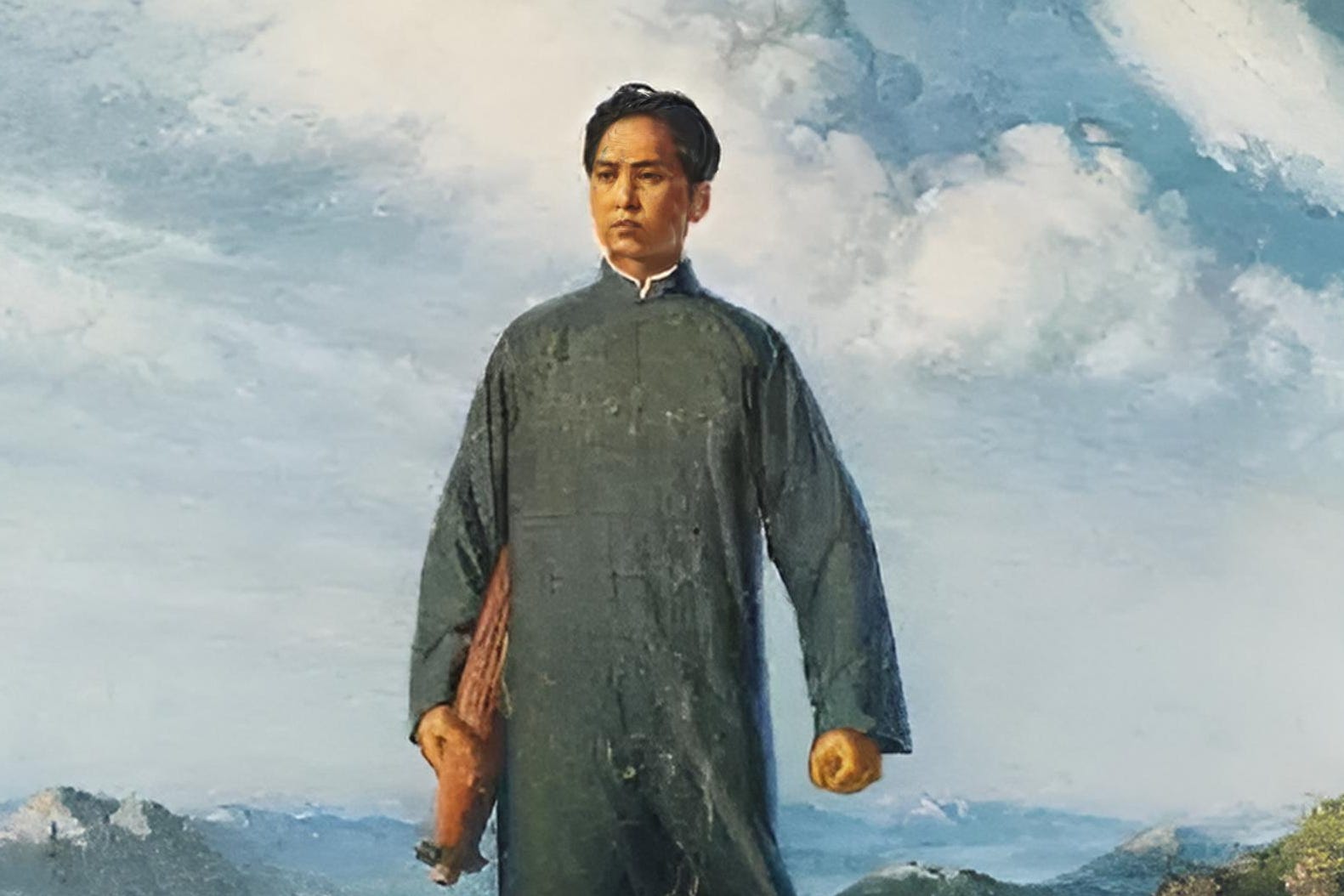
Callum McMichael examines how Mao Zedong’s classical poetry transforms nature, struggle, and history into a vision of human will capable of overcoming inherited limits and reshaping the world.
Mao Zedong’s poems, collected in the Chunqiao Publications edition of December 2024, were written over four decades in classical Chinese meters. The ci forms follow fixed tunes with prescribed line lengths, tonal patterns, and rhymes. The lu shi and chueh chu require regulated structure and, where appropriate, parallel couplets.1 These technical limits hold throughout. The poems treat landscapes, military movement, personal loss, and political change while remaining inside them. Taken as a whole, they present a coherent view of existence in which human will and the physical world stand in permanent tension and mutual transformation. Nature is not a passive scene. It is a force of scale, resistance, and recurrence that must be measured, endured, and in places remade. Historical time moves; earlier ages reach their limits; the present retains the capacity to push beyond those limits. Struggle does not diminish life. Under certain conditions, it intensifies perception and clarifies purpose. The classical forms supply the continuous discipline that allows these relations to be stated with precision.
The earliest poem, “Changsha,” written in 1925 to the tune of Chin Yuan Chun, already sets out the central relation:
Alone I stand in the autumn cold
On the tip of Orange Island,
The Hsiang flowing northward;
I see a thousand hills crimsoned through
By their serried woods deep-dyed,
And a hundred barges vying
Over crystal blue waters.
Eagles cleave the air,
Fish glide in the limpid deep;
Under freezing skies a million creatures contend in freedom.
Brooding over this immensity,
I ask, on this boundless land
Who rules over man’s destiny?I was here with a throng of companions,
Vivid yet those crowded months and years.
Young we were, schoolmates,
At life’s full flowering;
Filled with student enthusiasm
Boldly we cast all restraints aside.
Pointing to our mountains and rivers,
Setting people afire with our words,
We counted the mighty no more than muck.
Remember still
How, venturing midstream, we struck the waters
And waves stayed the speeding boats?
The question about destiny arises from the scale of what is seen. Memory of earlier companions enters in the same register. Human will is asserted inside the natural order rather than outside it. The poem does not claim that will abolishes nature; it places both in one frame and asks which force governs. The act of standing alone in the cold and measuring the scene is itself a form of engagement. The earlier striking of the waters is recalled as a moment when human effort briefly altered the behaviour of the current. The pattern is already clear: observation, measurement, assertion of capacity, and the refusal to treat the given order as final.
“Yellow Crane Tower,” spring 1927, to the tune of Pu Sa Man, records a moment when an older continuity has broken:
Wide, wide flow the nine streams through the land,
Dark, dark threads the line from south to north.
Blurred in the thick haze of the misty rain
Tortoise and snake hold the great river locked.
The yellow crane is gone, who knows whither?
Only this tower remains a haunt for visitors.
I pledge my wine to the surging torrent,
The tide of my heart swells with the waves.
The crane of the old story is absent. The tower remains. The river is first locked by the hills and then released in the final couplet, which links external current to internal motion. The poem notes the disappearance of one order and the persistence of physical force. The pledge of wine is an act of alignment with that force rather than resignation to it. The meter keeps the statement to eight lines and holds the weight evenly. What has vanished is not replaced by complaint; the remaining torrent becomes the measure of the heart.
The poems written after the establishment of the base in the Jinggang Mountains register the early years of organised struggle. “Chingkangshan,” autumn 1928, to the tune of Hsi Chiang Yueh:
Below the hills fly our flags and banners,
Above the hilltops sound our bugles and drums.
The foe encircles us thousands strong,
Steadfastly we stand our ground.
Already our defence is iron-clad,
Now our wills unite like a fortress.
From Huangyangchieh roars the thunder of guns,
Word comes the enemy has fled into the night.
Human organisation is set against superior numbers and holds. The form still determines line length and rhyme. The poem does not celebrate abstract strength; it records the concrete conditions under which wills can unite and a position can be kept. “The Double Ninth,” October 1929, notes that the festival returns each year while men age, that the yellow blooms on the battlefield have a stronger scent, and that the autumn wind exceeds spring in the extent of frosty sky and water. Recurrence belongs to nature. Human life is finite. Yet the sensory world under conditions of struggle is not diminished; in this case it is heightened. The poem registers the difference without moralising.
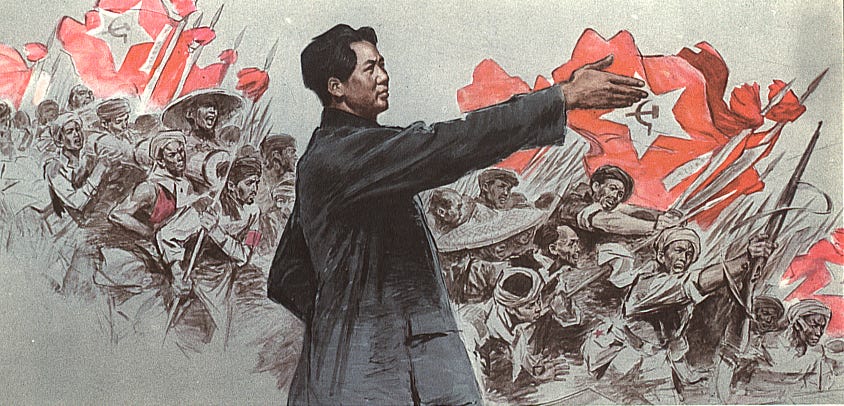
The Long March poems of 1934–1935 reduce prolonged movement and difficult terrain to limited sets of images while intensifying the same relation between will and environment. “Loushan Pass,” February 1935, to the tune of Yi Chin O:
Fierce the west wind,
Wild geese cry under the frosty morning moon.
Under the frosty morning moon
Horses’ hooves clattering,
Bugles sobbing low.
Idle boast the strong pass is a wall of iron,
With firm strides we are crossing its summit.
We are crossing its summit,
The rolling hills sea-blue,
The dying sun blood-red.
The claim that the pass is not impassable is made inside the sequence of observed details. Nature presents the obstacle. Human movement registers it, names the false claim of permanence, and continues. The repetition of the crossing line marks the moment of passage as both physical and decisive.
“The Long March,” a seven-character lu shi from October 1935, states the method under the most extreme conditions:
The Red Army fears not the trials of the March,
Holding light ten thousand crags and torrents.
The Five Ridges wind like gentle ripples
And the majestic Wumeng roll by, globules of clay.
Warm the steep cliffs lapped by the waters of Golden Sand,
Cold the iron chains spanning the Tatu River.
Minshan’s thousand li2 of snow joyously crossed,
The three Armies march on, each face glowing.
Ridges become ripples. Mountains become clay. The chains are cold. The final image is the expression on the faces of the soldiers. The poem reduces the scale of the terrain so that the human passage remains visible. Will does not deny the difficulty; it remeasures the difficulty until the mountains lose their absolute character and the faces retain the capacity for gladness. The reduction is not an illusion. It is an act of valuation performed under pressure. The same period produces “Kunlun,” which addresses the mountain range as a force that has shaped human history across a thousand autumns. Its snow freezes the sky; its summer melt floods the rivers and turns men into fish and turtles. The poem asks who has judged the good and ill it has wrought, then proposes cutting it into three pieces so that the same warmth and cold would prevail across the globe. The mountain is treated as a power that can be spoken to and, in imagination, divided and redistributed. The classical form keeps the address controlled. The will that speaks is not content to admire or suffer the given order; it asserts the right to reshape the conditions of warmth and cold themselves.
“Snow,” February 1936, to the tune of Chin Yuan Chun, brings the same approach to the northern landscape and to historical succession:
North country scene:
A hundred leagues locked in ice,
A thousand leagues of whirling snow.
Both sides of the Great Wall
One single white immensity.
The Yellow River’s swift current
Is stilled from end to end.
The mountains dance like silver snakes
And the highlands charge like wax-hued elephants,
Vying with heaven in stature.
On a fine day, the land,
Clad in white, adorned in red,
Grows more enchanting.
This land so rich in beauty
Has made countless heroes bow in homage.
But alas! Chin Shih-huang and Han Wu-ti
Were lacking in literary grace,
And Tang Tai-tsung and Sung Tai-tsu
Had little poetry in their souls;
And Genghis Khan,
Proud Son of Heaven for a day,
Knew only shooting eagles, bow outstretched.
All are past and gone!
For truly great men
Look to this age alone.
The landscape is described first in ice, snow, and animal motion. Earlier rulers are then measured against a standard that includes literary capacity. Historical succession is affirmed. The past is not denied; it is judged incomplete. The present is placed as the site where a more complete form of greatness remains possible. The form stays classical; the judgement is made inside it. The poem does not claim that the present has already achieved finality. It claims that the measure of greatness has shifted and that the capacity for poetry belongs to that measure.
After 1949, the poems register the establishment of the new state and the early years of construction. “The People’s Liberation Army Captures Nanking,” April 1949, a lu shi:
Over Chungshan swept a storm, headlong,
Our mighty army, a million strong, has crossed the Great River.
The City, a tiger crouching, a dragon curling, outshines its ancient glories;
In heroic triumph heaven and earth have been overturned.
With power and to spare we must pursue the tottering foe
And not ape Hsiang Yu the conqueror seeking idle fame.
Were Nature sentient, she too would pass from youth to age,
But Man’s world is mutable, seas become mulberry fields.
The taking of the city is recorded. The warning against pride follows at once. Nature’s possible aging is set against the mutability of human arrangements. The parallel structure of the lu shi holds the statements in balance. The world is not fixed. Seas can become fields. The will that has crossed the river is reminded that the same force of change that brought victory can also bring decline if it rests. The poem affirms transformation while refusing the luxury of final rest.
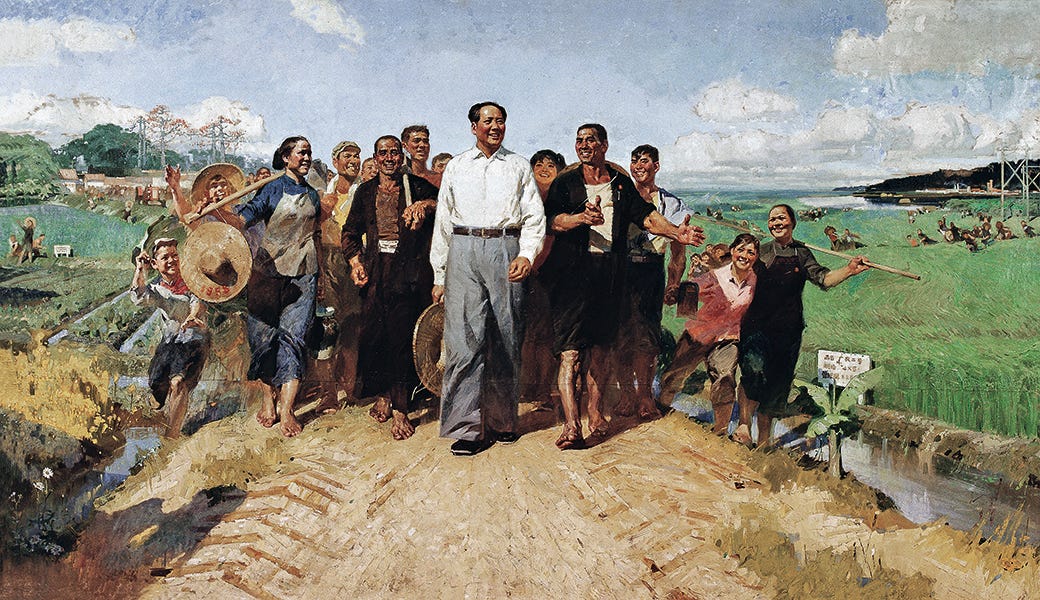
“Swimming,” June 1956, to the tune of Shui Tiao Keh Tou, moves from the physical act of crossing the Yangtze to plans for bridges and dams, then to the imagined response of the mountain goddess. Wind and waves are preferred to idle walking. The ancient saying about the flow of time is answered by the possibility of altering rivers. The poem keeps the physical crossing and the larger projects inside the same formal frame. Human labour is shown reshaping the environment that earlier poems had measured as an obstacle. The goddess, if she remains, will find the world changed. The will that once measured mountains now proposes to rearrange the waters that flow from them.
“Reply to Li Shu-yi,” May 1957, to the tune of Tieh Lien Hua, answers a poem about the deaths of Yang Kaihui and another comrade. The two women are placed in a mythical register and offered a drink. Personal loss is registered without further development. The classical form contains the material in the same way it contains the military and political material. Mortality is acknowledged. It is not allowed to become the final word. Later poems such as “Ode to the Plum Blossom,” “Winter Clouds,” “The Fairy Cave,” and “Reascending Chingkangshan” return to mountains, weather, and the plum that blooms in the cold. The images stay specific. The meters remain unchanged. The plum that flowers under frost is not a symbol of resignation; it is an instance of life continuing under conditions that might have been expected to stop it. “Reascending Chingkangshan” returns to the mountain of the late 1920s and finds the same red flags still present, the same determination intact. The return is not nostalgic. It is a re-measurement of continuity under changed historical conditions. The collection ends with “Two Birds: A Dialogue,” in which a large bird speaks of wide horizons while a small one stays near its bush. The difference in scale and ambition is stated directly. The poem does not argue; it places the two perspectives side by side and leaves the reader to recognise which one accepts the given limits and which one does not.
Across the whole body of work, the central relation remains constant. Nature presents scale, resistance, recurrence, and beauty. Human will measures that scale, endures the resistance, notes the recurrence, and in places alters the conditions. Historical time moves; earlier ages and their rulers reach the limits of their own horizons; the present retains the capacity for further movement. Struggle does not erase sensory life; under certain conditions it heightens it. The classical meters provide the continuous framework that allows these relations to be stated with precision rather than rhetoric. The forms do not decorate the material; they organise it so that the tension between human agency and the physical world remains visible and active. The will that speaks in these poems is not content to contemplate or suffer the given order. It observes, measures, reduces where necessary, and asserts the right to reshape. Joy appears not as the absence of difficulty but as the capacity to keep moving and perceiving while the difficulty remains present.
The Chunqiao Publications edition presents the texts with only a short note on the verse forms. That is sufficient. The translations retain the economy of the originals. A reader can examine the poems by ordinary standards of craft: accuracy of description, control of tone, effectiveness of structure, and the capacity to hold attention across repeated readings. On those standards, the stronger pieces succeed. They show that classical Chinese meters could continue to function under the pressures of twentieth-century Chinese history while articulating a view of existence in which transformation remains possible, measurement remains necessary, and the present age is not required to bow before the limits of the past. That result is visible in the poems themselves.
Editor’s note (EN): The ci is a Chinese lyric form written to established tune patterns; lüshi is an eight-line regulated verse form; and jueju is a shorter, four-line form of regulated verse. Spellings such as lu shi and chueh chu reflect older romanization systems.
EN: Ci is a Chinese lyric form written to established tune patterns; lu shi is an eight-line regulated verse form; and chueh chu is a shorter, four-line form of regulated verse.

Excellent