

Richard Wilson turns memories of growing up among American Indians into an indictment of an empire that consumes the cultures of the conquered and the conquerors alike.
The worst defeat of all is to forget, especially what has crushed you.
— Louis-Ferdinand Céline
Having grown up in rural areas, extreme bucolic areas of the Pacific Northwest, Texas, Illinois, Indiana, Idaho, I grew up around poor people.
Poor white trash mixed in with other poor people, namely Indians.
Not the subcontinent ones, thank you very much. The feather ones. The ones mostly relegated to reservations.
No head bobbing for us.
No.
We had the stares, the non-labial words that seemed to come from the throat and use no lips or teeth.
I’m not one of the liberal mouth-breathers who think all Indians, pre-Columbus, were herbalists with a direct telephone line to the Great Spirit and never practiced war, murder, rape, pillage.
Nor am I one of the opposing camp who sees Indians, all Indians, as perennial underdogs who lost and will continue to lose, ad infinitum.
Who sees all Indians as basically feces people.
Both groups take humanity away from them.
Liberals and conservatives alike love to lump all Indians together into one red-skinned mass of were-tadpoles with no relevance to modern-day post-capitalism, unless it’s as a new OnlyFans category, a supplier of cheap meth, or a night out playing blackjack.
I grew up with many Indians.
They’re as human as any other group.
Some good. Some bad.
Some have been lovers. Some put me in the hospital. Some I’ve put in the hospital.
A few have been some of the best friends I’ve ever had.
Many married into our family, or we into theirs.
Some Indian nations had a martial history. Some a trading history. Others a mere existence.
Just like European peoples.
Like African nations.
Like Asian nations.
I’m not a rarity.
I’m not.
Many of your heroes, and mine, had similar views on the American Indians.
Mussolini, Benjamin Franklin, Lenin, Marx, Baudelaire, D. H. Lawrence, Genet, Tolstoy, Dickens, many more.
More.
Many more.
And probably the strangest group are the US generals who fought them and later became advocates and supporters of the “noble savages.”
General Crook.
General Miles, who was tasked with hunting down Chief Joseph and the Nez Perce.
General Gibbon.
General Oliver Otis Howard.
Men who had fought them and nevertheless came to recognize something in them.
Indians and European Americans, for all the guff we see and hear today, did have moments of recognition, identification with each other, and respect.
The last Confederate general to surrender, long after Lee surrendered?
Stand Watie.
American Indian.
When Lee walked into Appomattox, the man who prepared the formal surrender papers for Grant was Ely Parker, a Seneca.
There is the famous story of Lee seeing Parker’s face and saying something about seeing one real American, to which Parker supposedly replied, “We are all Americans here, sir.”
Maybe the story has acquired a little varnish over the years.
I still like it.
Because there is something in it.
The man surrendering and the man writing the surrender papers were both Americans.
The first American general officer killed in World War II?
General Tinker.
Osage.
He didn’t lead his men from some safe bunker.
He took a plane and disappeared into the Pacific.
To meet an Indian and think he is wise or a warrior simply because he’s Lakota or Blackfeet or Apache is retarded.
It’s like meeting a Scot and thinking he can make whisky, or meeting a German and thinking he can bake strudel, or meeting a Russian who can do the Cossack dance.
Yet some truths are truer than others.
Indians do join the military in large numbers.
Some people have martial traditions.
Others have trading traditions.
Others farming, fishing, scholarship, commerce.
There is nothing strange about this.
What is strange is how frightened we have become of saying it.
The first casualty of globalism, perhaps, was the particular.
Before there was economic globalism, there was religious globalism, political globalism, imperial globalism.
People were told that their gods were wrong, their kings were wrong, their customs were wrong, their language was wrong.
The first casualties were Europeans, hundreds of thousands, maybe millions, killed or forcibly converted. Told the old gods, old ways, were wrong. Imagine a photograph from that time.
They were converted, absorbed, conquered, taxed, displaced.
Being a believer wasn’t insurance that someone would leave you alone.
No.
Then it was a group.
You belong to the wrong group.
Sword thrust.
Flames.
Catapult.
Destruction.
Two thousand years of this.
And so when Europeans came to America, as agents of an expanding empire, an expanding religion and eventually an expanding economic system, their world tour began in earnest.
Some Europeans may have had an ancestral memory of what it meant to have your people conquered, absorbed, converted, renamed.
Some recognized something in what many Indians went through.
There is no honor in what the US government did to many of the Indian nations.
It may be odd for a conservative to say this today.
A hundred years ago it wasn’t rare.
It wasn’t the norm, for sure, but neither was it some impossible contradiction.
And the fact that so many of their young men later joined the military, en masse, is shocking.
Maybe it isn’t.
Maybe they understood something.
Now almost all Indians live on reservations.
The old ways are all but gone.
There are no more noble savages.
No Winnetou. No Crazy Horse or Tecumseh. Just sad balls of cellulite with a casino and a bumper sticker.
The Indians have become like their colonizers.
But interestingly, the colonizers’ descendants have become like Indians on reservations.
Poor, drugged, addled. With no way out except the military or suicide.
All of America is a reservation now.
Gambling, porn, drugs and booze, food fetishists, a nation of waddling cartoonish freaks.
Tecumseh asked: Where today are the Pequot? The Narragansett? The Mohican? The Pokanoket and many other once powerful tribes of our people?
We can also say: where are the Scots-Irish?
The Texans?
The Okies?
The American Germans?
The Irish?
The English?
They’re still here, of course.
But increasingly, only biologically.
The old particular identities have been dissolved into one giant consumer identity.
The last time I was in America, I was in line at Denver airport.
All around me, the whales of cellulite, loud, obnoxious.
I fantasized about Geronimo, Sitting Bull and my own favorite, Captain Jack of the Modoc Nation in northeast California, walking in with rifles, bows and arrows and erasing us.
But perhaps it’d just be like that old commercial from the 1970s.
The Indian in a canoe, paddling, all is Edenic, and then he turns, moves the branches and sees the trash.
One lone tear runs down his cheek.
If they could come back, perhaps they’d just weep.
And our own heroes, Lee, Crook, Miles, Washington, Sergeant York, hell, anyone, even the Creek Nation supporter Davy Crockett, who left his home state of Tennessee to go to Texas and die at the Alamo—maybe they’d do nothing but weep if they saw us now.
We are all Americans, as General Ely Parker said to Lee.
But we are all reservation dogs now.
The America the Indians fought for in 1776, 1812, 1861, 1914, 1952, 1968 is dead and gone.
Almost as gone as the buffalo.
Or the wolf.
Gone the way of the Pequot.
Gone the way of the American South.
Gone the way of the West.
Gone the way of her martial ethnicities and traditions.
Dead and gone. Steamrolled.
Many people in history have contrasted the American Indian with the European system in North America.
One was duplicitous, greedy, swinish.
Another was free, honorable, like the deer or wolf.
I don’t believe either story.
The fighting against the Empire, whether as Vercingetorix, as a nameless Anglo-Saxon pagan, as a Scottish Borderer, as a young man in Tennessee, as my own family in Harlan County, Kentucky, or as an Afghan, an Iraqi, a Viet Cong, a Russian soldier or an Iranian soldier, is not the same history.
But there is a family resemblance.
Like recognizes like. Or should.
You don’t get to come here and tell us what we are.
And that’s why I don’t understand the modern obsession with flattening everything into one universal human category.
One says we’re all interchangeable victims.
Another says we’re all interchangeable members of some enormous “Western civilization.”
Both can make the same mistake.
They forget the particular, the details.
They forget that a people isn’t an abstraction.
And once those things disappear, you can have every museum in the world and still have lost the people.
Oh, we are lost.
This is where, for me, multipolarity becomes something more than a geopolitical slogan.
Real multipolarity, if it means anything, is the rejection of the idea that there must be one universal center at all.
American Indians didn’t corner the market in bravery, in honor, nor did Europeans corner the market in oppression.
But when a people mounts a defense against interlopers in defense of its tradition?
I’m for them.
So too was Gaddafi, who supported the American Indian Movement with money and arms.
That fact makes everyone uncomfortable.
Good.
It should.
I’m proud to be a descendant of men who came from Scotland, England, Ulster, Germany to America.
I’m sure many of my forefathers saw themselves in the Indians who fought against encroachment, theft, forced religion, or just a cultural steamroller.
Not because they were secretly the same people.
They weren’t.
But because they understood something.
The government that lied and double-crossed many of the Indians is also the government that double-crossed Randy Weaver, coal miners in Kentucky, Waco and more. The same government that double-crossed Ukraine.
These aren’t the same histories.
But the instinct is recognizable.
I have always been against the Empire and for the underdog. The rural man, the rustic peckerwood, the bogtrotter, savage.
Always.
The congregated cities, for me, are the enemy. (I have to admit, Moscow is unlike any city I’ve been to. It is still a city.)
Give me the pagan fire, pagan drums over any Bach, Wagner, some rune over any Rembrandt.
We may not eat frybread and dance dances that nobody remembers any longer.
We may not live in lands our ancestors came from.
We, some of us, most of us, don’t speak the languages of our ancestors, eat the same foods, or even know what our ancestors believed.
We have our reservation wherever we are.
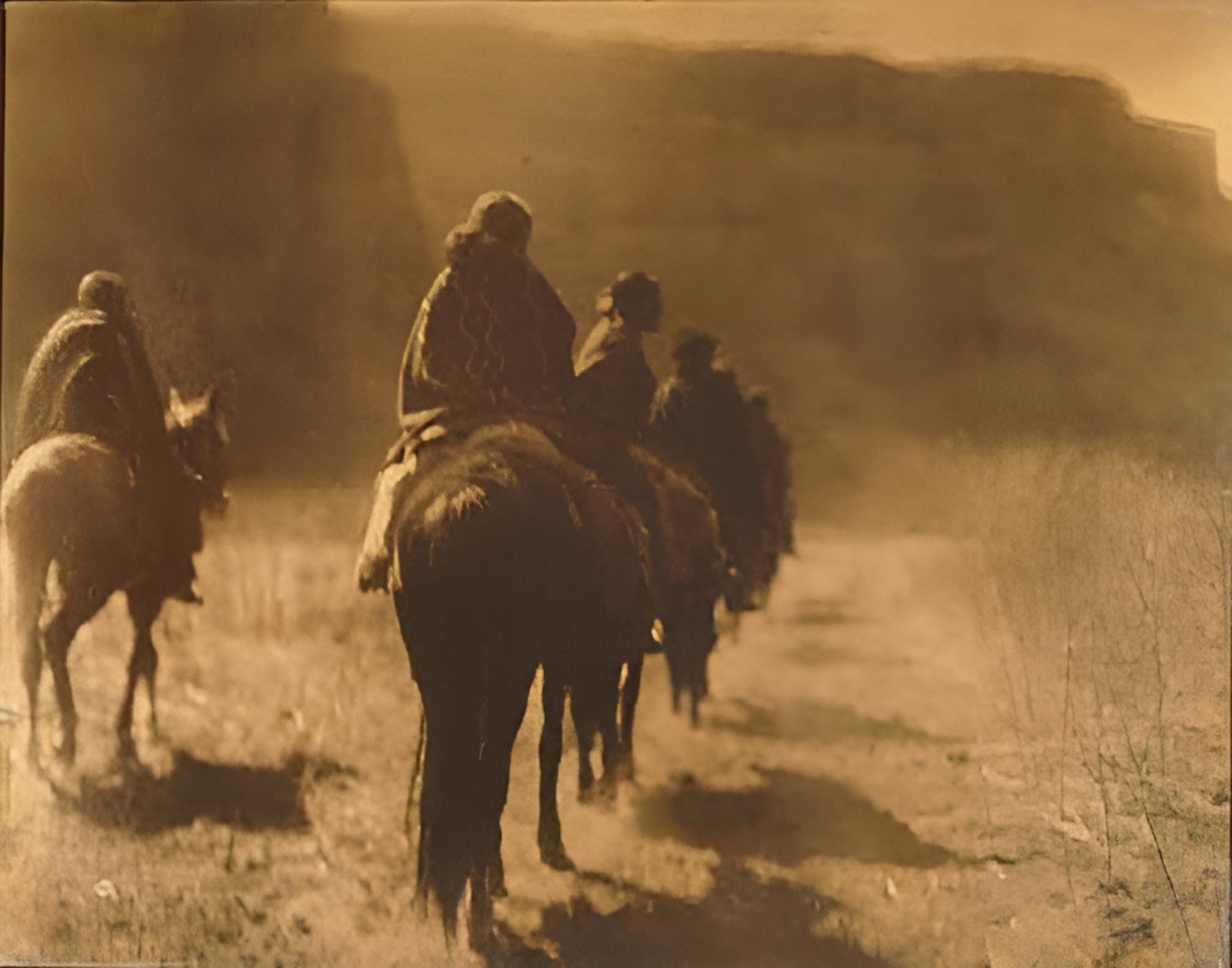
Last century, a Seattle photographer named Edward Curtis travelled tens of thousands of miles taking photographs of American Indians.
He wanted to capture them before they disappeared.
Will we ever have our own photographer?
Will some future Muslim do the same for us?
Or some Chinese?
Some Nigerian?
I doubt it.
I hate to be the Cassandra or the Jeremiah here, but do we have one leader with the gravitas of Sitting Bull?
No.
Chief Joseph?
Crazy Horse?
No.
Not one Lee, Widukind, Andrew de Moray, Rob Roy.
Nothing. Nobody here to save us.
Just a reservation now.
From Alaska to Los Angeles, to New York, London, Glasgow, Berlin, Paris, everywhere.
The first time I saw a man passed out in public was at the XL reservation in Modoc County. Now, this emblem is everywhere. The passed-out drunk or drugged person. The XL reservation is everywhere now.
Oh, there is glitz. We have trillions, they say. We have nukes, others scream. And?
The Lakota had the gold in the Black Hills, the Comanche had the southern plains, the Makah had salmon and the abundance of the sea. Where are they now? Where is the gold, the salmon, the horses on the plains?
It’s all coming to a Netflix series, soon, brother. Soon.
Sit your derrière down, drink your beer, eat your cake, watch yer favorite show, see that Comanche chief? He’s a little too swarthy, ain’t he?
Well, we is Hollywood. We is the entertainment division of Langley.
We can erase any culture we want. And we do. In a myriad of ways.
A red man or white man don’t have to be white or red, he can be black as night, don’t ya know.
There is casino flash and laughter.
There is money.
But Main Street is worlds away from Wall Street.
Main Street is a shuttered street with weeds in the sidewalk, old men shuffling by, the yoga poses of fentanyl and rotgut.
Main Street in the West is Pine Ridge now.
Edward Curtis thought he was photographing a people before they disappeared.
He was.
His photographs are some of the best. Some of the people in them hadn’t worn headdresses or shirts or held rifles or spears in a long time.
Some people remembered, maybe, a time long past.
The eyes of some of his subjects? I see the same look now everywhere.
Maybe we need to ask ourselves the same question.
Who is photographing us?
Who will remember the dying towns?
Who will remember us before we disappear?

Amazing - thank you
Absolutely love this article, I have seen this in my own life and it is an accurate portrayal of the situation! Of course it had to be criticized by someone in a 10x10 cubicle and a Bolshevik education