
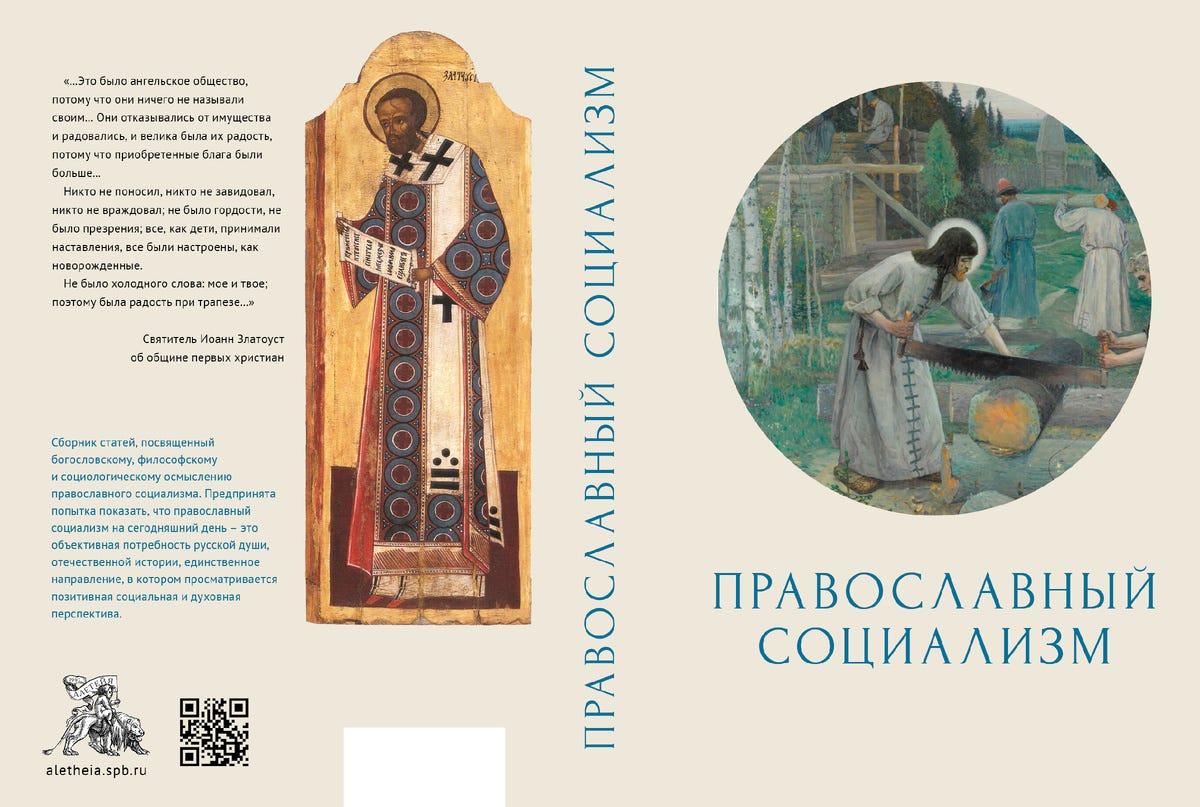
Andrei Kosterin asks whether Orthodoxy and socialism can overcome their historic divide and together offer Russia a path to spiritual and social renewal.
For two thousand years, humanity has had Christ’s commandments, yet it has still not learned how to reconcile them with earthly life—at least at the level of entire societies. Individual spiritual strivers manage it; some communities and monasteries manage it, more or less. But building a stable, functioning, Christ-centered society that lives by the Gospel’s commandments, rather than in glaring contradiction to them, remains beyond our reach.
Without delving into the distant past or considering non-Orthodox versions, Orthodox socialism, as a social program for building a Christ-centered society, emerged in the early twentieth century through the work of the outstanding Russian philosopher and theologian Sergei Bulgakov. Unfortunately, this attempt found little sympathy either in the hearts of Orthodox Christians or in the minds of socialists. Tragically driven to almost opposite poles by the events of 1917, these two camps needed another century to recognize the disastrous consequences of their division.
The religious writings of two thinkers of the 1970s, Felix Vladimirovich Karelin and Gennady Mikhailovich Shimanov, breathed new life into the concept of Orthodox socialism. Through their remarkably perceptive intuition and lives of spiritual endeavor, they discovered and revealed to us that the truth of socialism is possible only with Orthodoxy, while the truth of Orthodoxy can be embodied only as socialism.
During the terrible, truly accursed 1990s, when Russia was hurtling toward the abyss, having forgotten Christ and rejected socialism, the banner of Orthodox socialism was taken up by Karelin’s and Shimanov’s disciples, Nikolai Vladimirovich Somin and Alexander Yevgenyevich Molotkov. Their essays and theoretical writings established a platform and a school of Orthodox socialism that continues to grow and attract new supporters.
Considerable time has passed since the publication of Alexander Molotkov’s collection Russia’s Mission: Orthodoxy and Socialism in the Twenty-First Century (2008) and Nikolai Somin’s Orthodox Socialism as the Russian Idea (2015). New authors have emerged, primarily their students and followers, while social and spiritual conditions in Russia and around the world have changed, calling for fresh consideration within the framework of Orthodox socialism. Moreover, those books, published in small print runs, have long since become bibliographical rarities.
The essay collection Orthodox Socialism, recently published by Aletheia, is an attempt to fill this unfortunate gap in bringing the ideas of Orthodox socialism to a wider audience. Nikolai Somin proposed the collection, and his like-minded colleagues enthusiastically embraced the idea. The authors have known one another well for many years, bound together by both shared ideals and longstanding friendships. The present volume is the fruit of their collaboration: a small symphony in which each contributor’s melody can be heard alongside the common theme. One author works in theology, another addresses sociological questions, and a third writes fiery commentary on pressing social issues. This variety of perspectives makes it possible to offer an overall picture and avoid the one-sidedness inevitable in a work by a single author. Often, two authors perform the same “melody,” as several essays were co-written. At other times, one author takes up and develops another’s “melody,” as in Andrei Kosterin’s essay “Can ‘Russia’s Mission’ Be Accomplished?” Written in defense of Alexander Pasechnik’s film Russia’s Mission, it addresses a film inspired by Alexander Molotkov’s book of the same name.
Let us take a brief look at the collection to give readers some sense of its ideas and authors.
Alexei Bakulin, a writer and journalist for the newspaper Orthodox St. Petersburg, sets the tone by presenting a vivid image of two halves, Orthodoxy and socialism, whose union produces the critical mass needed for an “anti-explosion”: Russia’s rebirth.
If these two acknowledgments are made and backed by some form of agreement, the two halves of the critical mass in the Russian anti-bomb will come together, and an anti-explosion—creative and life-giving—will illuminate the globe. (p. 23)
The synthesis of Orthodoxy and socialism is the collection’s central theme. Every author addresses it in one way or another, emphasizing that the way forward lies in their synergistic union, rather than in setting Orthodoxy against socialism or securing the victory of one over the other. Russia has no more room for bitter ideological battles and internal strife. The time has come to gather stones, and for everyone to come together in a constructive communal assembly.
Protodeacon Vladimir Vasilik, a professor at St. Petersburg State University and a historian specializing in Byzantium, draws on the writings of Symeon the New Theologian to show what the Orthodox Church’s attitude toward wealth and property should be:
Without mounting political opposition to state and social institutions, St. Symeon the New Theologian assesses them spiritually and morally from a monastic—that is, a genuinely Christian—perspective. He castigates human pride, mercilessness, acquisitiveness, and greed. … Ultimately, he regards private property as a creation of the devil and one of the causes of corruption in the Church, through which, in his view, some bishops lose the grace bestowed upon them. All these ideas are profoundly relevant in our wicked, self-serving, and deceitful age. (p. 62)
The Orthodox essayist and carpenter—what a wonderful combination!—Sergei Karelin, son of Felix Vladimirovich, carries on his father’s noble work. After examining the arguments of Christian socialism’s opponents in detail, Sergei concludes:
Christianity is less a teaching about the Kingdom of Heaven, which in many respects remains beyond our earthly understanding, than a teaching about how to attain that Kingdom. Once we understand this, we will see that ‘Christian socialism’ is an essential part of Christianity, rather than a substitute for it. (p. 138)
Discussing the concept of Orthodox socialism with Alexei Bakulin, Andrei Kosterin, an essayist from Vladimir, reaches the following conclusion:
Orthodox socialism is the Liturgy carried out into the world beyond the walls of the Church. If a person’s principal task is salvation, all deeds and thoughts must be subordinated to that task. Society must help each person in his individual effort to attain salvation, rather than hinder him. Indeed, in Christian sociology, the very concept of personhood is transformed: it expands from the individual into a conciliar whole, a symphonic person. Ideally, all of Russia should become such a whole, a single symphonic person. (pp. 214–215)
Vyacheslav Makartsev, an essayist from Nizhny Novgorod, closely examines the approach to property in the newborn Church, the apostolic community:
We see that in the newborn Church, which was one Body with Christ and whose Head was Christ, everything was held in common. … And this was achieved in the newborn Church by transferring one’s possessions into common ownership, rather than by renouncing or rejecting property. (p. 240)
On this basis, he asks a reasonable question: when and why did the Russian Orthodox Church depart from this original high standard?
Developing his ideas further, the engineer and philosopher Alexander Molotkov explicitly identifies synthesis as an urgent task of the utmost importance:
Orthodoxy and socialism are now inherent in Russian history, and the task of national self-understanding is to give this inner unity a present-day expression in the form of a new social and political synthesis. This is precisely the optimistic approach to the philosophy of history that vindicates our own history instead of rejecting it, thereby opening up truly authentic horizons for the future. (p. 258)
The filmmaker Alexander Pasechnik, adopting a sharply polemical tone to drive his point home, likewise sees a synthesis of Reds and Whites as the only way forward:
But first, everyone who sincerely loves Russia and wishes it well must put an end to the endless, pointless squabbling. The so-called Red–White shit-flinging serves only our rulers and Western intelligence services, because it prevents us from uniting. Yet only by uniting do we have a chance of winning. (pp. 347–348)
Nikolai Somin, who holds a bachelor’s degree in theology and a Candidate of Sciences degree in physics and mathematics, and works as a mathematician and programmer, draws attention to the substantive resemblance between Orthodox anthropology and Orthodox sociology. From this resemblance, he reaches a profound and original conclusion. Just as the human body should not be an “autonomous subject,” like an animal, but should submit to the Holy Spirit, and just as the human being is the image and likeness of God, so human society should submit to and bring itself into conformity with the Kingdom of God. Somin calls this correspondence “likeness to the Kingdom”:
Likeness to the Kingdom … has the same fundamental significance in Orthodox sociology as the proposition of humanity’s likeness to God—‘the human being is the image and likeness of God’—has in Orthodox anthropology. The principle of likeness to the Kingdom resolves the question of good and evil in social relations: God Himself desires that people live together with their possessions held in common. (p. 353)
Galina Chudinova, a writer and member of an Old Believer community, closes the collection with an appeal to the people’s intuition and feeling, without which it is impossible to find the right path or achieve victory in the Special Military Operation:
There is only one way out: for the people to see the truth, free themselves from the colonial yoke imposed on us by enemies at home and abroad, and make a gradual, peaceful transition to a new socialism. Orthodox for Russians, and rooted in the people for all of Russia’s indigenous inhabitants. The purpose of every person’s and every people’s life is the happiness of salvation: salvation from one’s own sins, the salvation of family and loved ones, and the deliverance of one’s homeland from its enemies. (pp. 480–481)
The authors are far from imagining that their book has said the last word on Orthodox socialism. On the contrary, the conversation has only just begun, and our modest volume invites readers to join us in developing a Russian ideology for the good of Russia.
A good half of the essays in the collection previously appeared on Russkaya Narodnaya Liniya [Russian People’s Line], which generously made its platform available for the discussion of Orthodox socialist ideas during the years when liberal ideology held sway. The authors express their deep gratitude to its editorial staff, and personally to Anatoly Stepanov, for this opportunity and for many years of cooperation. We are also sincerely grateful to our opponents: our arguments were born and refined in heated debates with them, making them unwitting co-authors of our book. It is difficult to overstate the contribution of the editor, Diana Pikkieva, to the book’s publication. Without her energy, enthusiasm, and tireless attention, its preparation might have dragged on for years—or never reached publication at all.
The essay collection Orthodox Socialism is available from:
The publisher, Aletheia.
The Falanster bookshop.
The URSS bookshop.
The Tsiolkovsky bookshop.
The digital library LitRes.
Authors: Andrei Kosterin, Diana Pikkieva
(Translated from the Russian)
Bear one another’s burdens, and so fulfill the law of Christ. - Galatians 6:2
The above verse seems pretty obvious to me. Modern, Western "Christians" would most likely say this only applies to emotional and spiritual burdens so as to avoid taking concrete measures to insure that everyone's needs are met. Typical Capitalist/Protestant cop-out.
The Pilgrims that landed in Massachusetts tried that very thing, "...all things held in common" and failed miserably. That idea is only good in a monastery but not in society in general.
The USSR failed on that--couldn't support itself. China too; it moved from collectivism to now private property albeit government controlled making it a fascist state.
The very early church should NOT be held as an example for the nascent church for it was still Jewish and Jewish racial proclivities directed the church, i.e. the messianic utopian idea of communism and then cultural communism in Gal. 3:28. It took awhile for The Church to break free of its Jewish milieu and discover itself as a Doric Greek religion with a Roman flavor.
Socialism is gnosticism; utopianism, which is “immanentizing the eschaton”, is gnosticism.