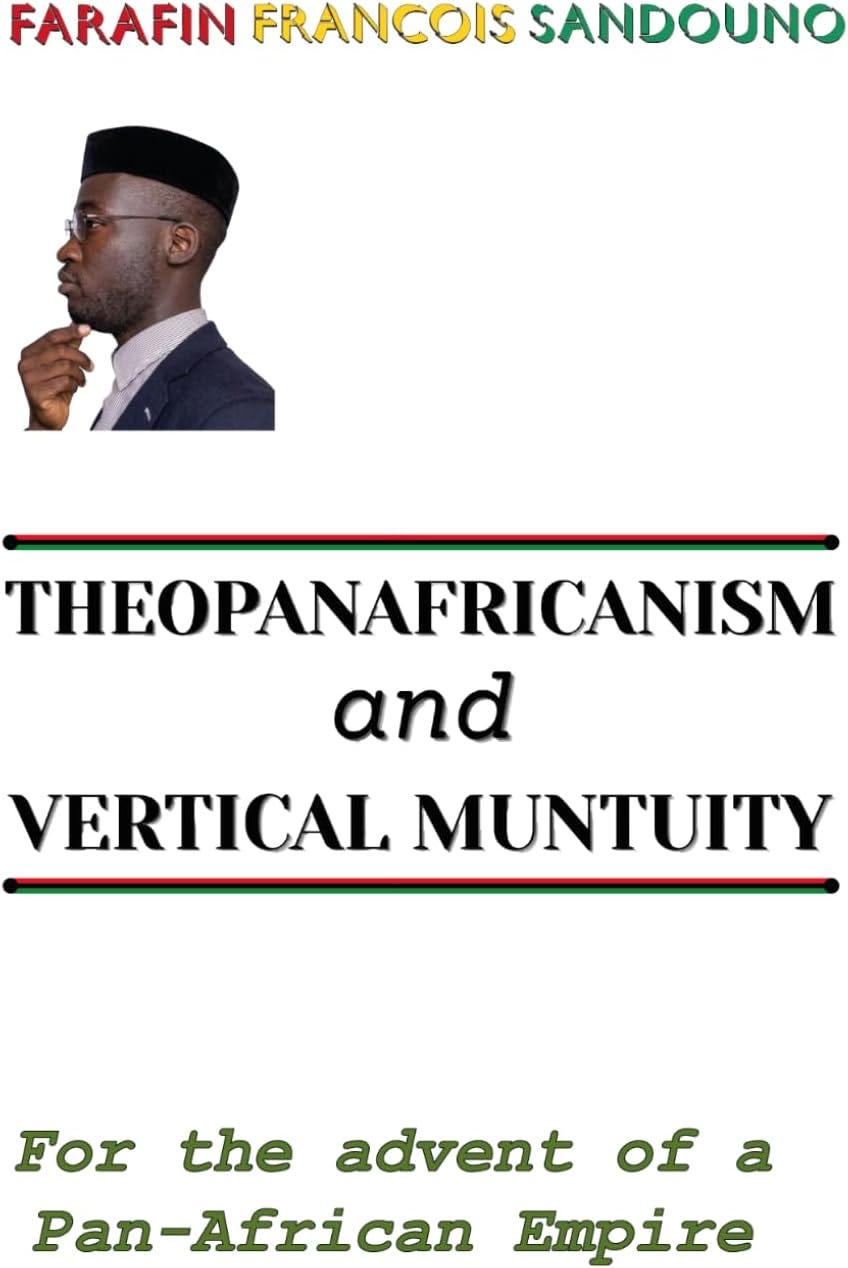
Farafin Francois Sandouno envisions the rise of a sovereign Pan-African empire, uniting ancient kingship, sacred authority, and warrior power into a new order capable of reclaiming Africa’s destiny and establishing it as an independent pole in a multipolar world.
Thinking about African sovereignty in the 21st century means critically questioning the limits of the modern and colonial nation-state. Before the establishment of artificial African borders and state structures inherited from colonization, the African continent was characterized by the presence of empires, kingdoms, city-states, confederations, and other forms of political organization. In numerous contexts, royal authority, the warrior function, and sacerdotal authority did not necessarily constitute separate spheres, but rather participated in an integrated conception of political and cosmological order. It is from this perspective that it becomes possible to examine the relationship between power, war, the sacred, and sovereignty in the African tradition.
I. Spiritual Authority and Temporal Power
Twentieth-century perennialist thought developed, in various forms, a reflection on the relationship between Tradition and modernity, also dwelling on the distinction between two fundamental modes of traditional existence: Contemplation and Action. This distinction allows for a specific reading of the relationship between the sacerdotal function and the royal-warrior function. The former guards the principle, wisdom, and transcendent dimension; the latter translates the superior order into the realm of political action, protection, and governance of the community. There have been thinkers who defended a traditional conception in which sacerdotal power occupied a superior position, just as others emphasized the heroic action embodied by warrior and royal power. This dichotomy was particularly evident in European history through the conflict between the Empire and the Papacy, of which Guelfism and Ghibellinism represent historical expressions.
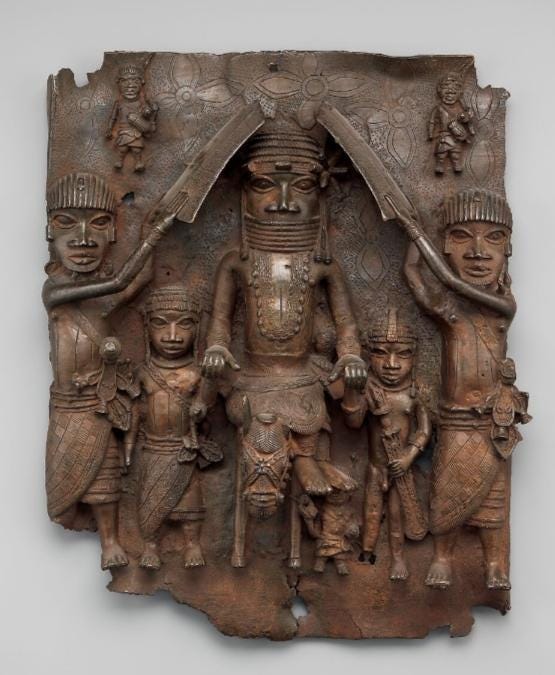
However, this model was much more nuanced in Africa. Africa was acquainted with these realities without necessarily opposing them. In numerous traditional societies, the various functions of authority tended rather to integrate and mutually complement one another. The Chief or Sovereign could hold temporal power while simultaneously being invested with a sacred or ritual function. Operating around him were sacerdotal authorities tasked with safeguarding and animating ancestral cults, while a warrior component ensured the protection of the community and contributed to the preservation of political order. Therefore, this was not necessarily an antagonistic separation between priesthood and royalty, nor between contemplation and action, but rather a potential complementarity of functions within the same order.
It is precisely this complementarity of castes that deserves to be re-examined, as I have explained in my book Theopanafricanism and Vertical Muntuity: For the Advent of a Pan-African Empire. Not to emulate a form of backward-looking nostalgia, but to contribute to the formulation of an African conception of sovereignty suited to the 21st century.
II. From African Castocracy to Democracy and Coups d’État
A question therefore imposes itself in the analysis of contemporary Africa: what caused the emergence of recent military coups d’état on the political scene?
According to the Institute for Security Studies, over the past six years the continent has experienced 11 successful military coups d’état across nine countries: Mali, Guinea, Chad, Sudan, Burkina Faso, Niger, Gabon, Madagascar, and Guinea-Bissau. Circumstances and motivations differ considerably from one country to another. A portion of contemporary literature has linked these events to security crises, deteriorating governance, constitutional manipulations, electoral disputes, and a growing anti-colonial sentiment. From my theopanafricanist perspective, however, the problem can be posed at a deeper level. Modern liberal democracy presupposes a specific conception of political authority: power derives from the electorate, is exercised through representative institutions, and finds its legitimacy in procedure.
Traditional African societies, by contrast, were founded in many cases on different conceptions of legitimacy, in which royalty, lineage, spiritual authority, initiation, seniority, and the warrior function could all contribute to the constitution of the political order. This does not mean that traditional Africa lacked forms of participation, deliberation, or oversight of power. The Charter of Kurukan Fuga, proclaimed according to tradition in the 13th century, constitutes a significant example of African normative elaboration preceding the modern republican state.
However, contemporary Africa currently lacks ideological singularity. The fracture between the structures of the modern state and historical forms of African legitimacy therefore poses a question that cannot be ignored. It is in this context that some coups d’état present themselves as a rupture with a political order perceived as incapable of guaranteeing security, sovereignty, or the national interest. In some recent cases, military takeovers have been accompanied by demonstrations of popular support or jubilation. Nonetheless, they represent a transitional phase toward an inaugural African model.
III. Toward an Operational “Theopanafricanism”
Africa must reconnect with itself and rediscover its own models, its civilization, its Tradition, its culture, its spirituality, its laws, and its codes.
Pan-Africanism should therefore not be limited to the economic or material dimension. It must transition toward what I have doctrinally defined as operational “Theopanafricanism,” in which the dimension of the Sacred is once again placed in relation with geopolitics and geostrategy. The fundamental issue becomes that of sovereignty—a sovereignty that is not only economic, technological, and military, but also cultural and spiritual.
In this perspective, traditional African politics must not simply be idolized in its historical form. It must be restored and adapted to the demands of the 21st century through a contemporary form of sovereignty capable of integrating traditional memory, political authority, and a multi-vector geostrategic vision. This is what I define as “tradi-operational castocracy.”
Within this perspective, the question of restoring traditional African monarchies also arises—thought anew and readapted to contemporary conditions—as an African geopolitical and civilizational project, coupled with the rediscovery of endogenous sacrality. In this interpretation, the project of an African Imperial Pole represents a perspective of political, cultural, and strategic integration through which Africa could aspire to greater autonomy and international projection capacity.
Farafin Francois Sandouno is a perennialist, political theorist, Italian-Guinean writer, founder of Theopanafricanism and Vertical Muntuity, geopolitical lecturer, and an international member of the think tank Sovereignty.
Order Farafin Francois Sandouno’s Theopanafricanism and Vertical Muntuity: For the Advent of a Pan-African Empire here.