Operation Barbarossa: Then and Now
The past that refuses to pass
Alexander Dugin explains why the spirit of June 22, 1941, is returning today and how Russia must finally overcome the illusions of the 1990s to secure its future.
Conversation with Alexander Dugin on the Sputnik TV program Escalation.
Host: Today is June 22 — besides being the longest day and the shortest night... Incidentally, these phrases are also connected to events from the middle of the last century. Eighty-five years ago, the Great Patriotic War began. Many different lessons have been drawn, many different conclusions supposedly made. But recent years show that those answers and those learned lessons were not as solid as we thought. Because in light of today’s events, there is much we can recall about those years. I suggest we start with this — talk a little, remember a bit, but naturally draw parallels from 1941 in the 20th century to 2026 in the 21st.
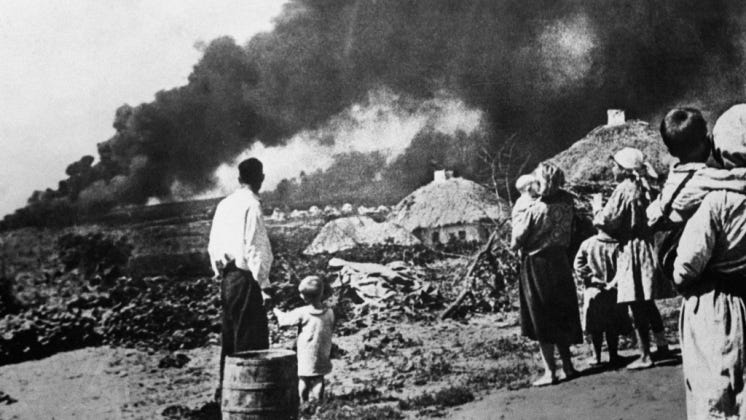
Alexander Dugin: Of course, these are completely different eras, but certain conclusions and certain sudden flashes of memory about that tragic moment — the surprise attack by Hitler’s Germany on the Soviet Union without a declaration of war — which led to the seizure of huge swathes of our territory. In the first months, even the first year of the war, the Germans advanced. They advanced methodically and in massive force, while we retreated. We were not ready for this war at the time. We did not expect it, we had not prepared for it properly, and we believed it was impossible.
Stalin trusted Hitler until the very end, as we know. He believed that Hitler took the word “socialism” in “National Socialism” seriously. That was the ideology of Nazi Germany, and Stalin thought that Hitler would choose, say, an alliance or at least neutrality with another socialist power in the face of the Anglo-Saxon capitalism that Hitler genuinely hated — and with which he was also at war. After all, World War II did not begin on June 22 with Hitler’s attack on us, but in 1939 with Germany’s war against Britain. So anything could be expected from Hitler. In this respect, he somewhat resembles Trump — or Trump resembles Hitler — because his positions also shifted and his policy was quite inconsistent. At times he cursed the Soviet Union and communism, at others he turned against the liberal bourgeois West.
Hitler’s National Socialism is an ideology banned in the Russian Federation. At the same time, it was both anti-capitalist and anti-socialist — the so-called “third way” ideology. And of course, Stalin probably hoped that the balance in this intermediate ideological state would tip toward confrontation specifically with the liberal West and Anglo-Saxon capitalism, which Hitler truly hated. But it turned out that he hated not only them, but us as well. And I believe that we were pushing him toward confrontation with the West, while the West was pushing him toward confrontation with Russia.
A great deal of material about these backstage negotiations has now been made public. And in the fact that June 22 happened — the attack by Nazi Germany on Russia, which was prepared and planned — a significant role was played by those same Anglo-Saxon agents. They understood that if Hitler... And Hitler’s Germany was essentially the European Union of that period. All of continental Europe was under Hitler’s heel — he had either installed loyal regimes or simply occupied it. This was an enormous challenge. If Hitler had continued fighting on one front against the West, it would have been very difficult for both Britain and America.
It was precisely during this period that a major success of British intelligence — through various channels — was to set Hitler against the Soviet Union. To ensure that the “national” element in National Socialism outweighed the “socialist” one. This was a huge ideological, philosophical, and intelligence operation. Only now are we beginning to seriously suspect this, seeing the first signs of this deep work by British special services, which tried to play on Hitler’s racism: “The Anglo-Saxons are people like us, but the Russians are Untermenschen — subhumans.” Incidentally, we hear exactly the same thing from the West today. Everything is repeating itself.
This Anglo-Saxon operation succeeded, and the result was the tragedy of June 22, 1941. It was also the beginning of the end for Hitler, because this attack on Russia became for him what the campaign against Russia had been for Napoleon. The British and international globalist forces — those same financial networks — at the critical moment, understanding that they could receive a blow from a consolidated continental Europe, set that force against Russia.
And what happened next? The end of Germany, the end of sovereign Europe. But the blow our people endured was enormous. These were monstrous losses. Yes, we won this war triumphantly and brilliantly, but at what cost!
And here is something else important: Europe, divided as a result of our Victory into two camps, already carried within itself a certain geopolitical trap. This line of division proved insufficient. We should have either gone all the way to the Atlantic, liberating all of Europe, or... But we stopped, entered into agreements, and decided to come to terms with the Anglo-Saxons. We divided Europe, and this laid a mine under the future. We held out for a long time — several decades by historical standards. From 1945 to 1989 — a decent stretch, but not centuries.
And then all the results of our Victory, all our successes and colossal sacrifices were crossed out by the betrayal of the Soviet leadership at the end of the 1980s. Our Victory was simply stolen from us — by the liberals, Westernizers, and reformers of the 1990s. They even stole the very date from us.
That is why today we think: how did this happen? Why is everything repeating itself? Why is it again June 22, and we again see calls in the Western press to fight Russia — essentially calls to finish what their grandfathers started? We are once again facing a war with the West, only now the enemy is much closer to our heart, to our historic Russian lands. The threat looms over us again. June 22...
This now belongs to the past that has not passed. In Soviet times it seemed to us that it was simply history. We would remember it, focus, become serious, pay tribute to the memory of our ancestors who won that war. But it still seemed like a closed chapter. It turned out that it is about the future — it is about the present. June 22, 1941, is that historical moment in which we did not live for several decades, but in which we are living once again.
But where is our 1945? Where is our capture of Berlin, London, Washington, Paris, Helsinki, Warsaw, and Rome? Where is that? In reality, we don’t even have it in our plans. And here, just as Stalin then overestimated Hitler, overestimated Europe and the ideological orientation of those who prepared the attack, so too, in my view, we today do not understand the modern West.
We should have begun preparing for a new war with the West immediately — on May 9, 1945. From that moment, we should have directed all the power of our state toward advancing further to the Channel, rather than simply holding the lines we had reached. Instead, we went into a deep defense, then made concessions, believed in the theory of convergence based on a common Enlightenment project — and that was it. In the end, we were almost steamrolled. If not for Putin, we might no longer exist. He went in a different direction and set a course for restoring our sovereignty and our state-civilization. We have set out on the right path, but after all the losses we have suffered, it turns out to be very difficult to follow it — especially if we hesitate and trust the West again.
The main lesson of June 22, 1941, is this: until we reorganize world space in our own interests — interests that will reliably protect our civilization — the threat will not disappear. This can be done not only by force, but also by peace. But it must be our peace, it must be our Russian World. Here, not only weapons matter, but also diplomacy, intellect, technology, and ideas.
The most serious conclusion from this analysis is that we won that war, but then we were thrown back. And now we need to secure that result once again, so that the victory of 1945 remains part of our historical existence, and not just a distant episode. Because today the West is essentially telling us that that victory was an accident, while the attack of June 22 was a natural outcome. The Russophobia that permeated Nazi ideology has not gone anywhere — it has now become mainstream in the West, and Ukraine has been artificially turned into the vanguard of this process.
Therefore, to the pride in the great feat of our ancestors and the grief over the losses, the ashes of the present are now mixed in. We are in a moment when the historical June 22 continues for us.
Host: Allow me to add an informational point here. You speak about victory, and I am sure that absolutely everyone listening to us will agree with your words. But this is the kind of time we live in: it is not enough to win — it is important to prove that you won. There are certain world leaders who — regardless of whether they won or lost, what happened, how it happened, or where it happened — tell everyone about their victories through their information megaphones and social networks. And a significant part of the world perceives it exactly that way.
What does Russia have in reserve, as a trump card (forgive the comparison), to prove, to explain, and to convey this idea to those who may not have forgotten, but who are beginning to doubt? Was it really exactly as we have been accustomed to thinking for the past 85 years? Because now from various sources — free, loud, and sometimes brazen — what is pouring out is, to put it mildly, perhaps not outright lies, but half-truths or truth torn out of context.
Alexander Dugin: First of all, history belongs only to the victors. The defeated have no history of their own — it is written for them by those who won. They come and say: this is how it was for you, this you won, but that — you did not. In order to have the right to our own history — and therefore to the victory of 1945 — we must win once again.
Today we let our victory slip through our fingers; we ourselves renounced it. Have we condemned Gorbachev? Have we held a tribunal for the traitors, for the liberals who seized power? The people reject this, and that is where Putin’s support comes from — he has taken a patriotic stance. But legally and ideologically, this has still not been formalized. The people who dismantled the Soviet Union — which was the continuation of the Russian Empire, our state — have never been held accountable.
Accordingly, we ourselves surrendered our sovereignty, and we should not be surprised that the West imposes its own version of history on us. The West today believes that Stalin was a tyrant just like Hitler. And our historians in the 1990s nearly agreed to accept this version of history written by the victors, signing Russia’s global capitulation. We came very close to complete loss of sovereignty, but Putin turned the ship of Russian statehood onto a course of revival.
Words, worldview, and philosophy play an enormous role here. Ideas, statements, national narratives — these are the main battlefield. A sovereign is someone who controls his own consciousness and the body of historical knowledge. If foreign models are implanted into our minds, then there is no need to conquer us militarily. Today colonization proceeds through the information sphere, and in this respect our civilizational discourse is largely losing.
This is connected to the structures responsible for information policy. Our journalists on the front lines are trying to promote our meanings, but when they turn to the rear for systemic support, they do not receive an adequate response. Everything still depends on the momentary moods of officials: if they decide to open the window a crack for patriotic ideas — fine; if they decide otherwise — everything shuts down.
This monstrous legacy of the 1990s and 2000s, when the West was considered the model — where families lived and money was kept — was accepted by the elites. We tried to fit into it. And we still have not fully replaced those people who, by inertia, remain carriers of this pro-Western, Yeltsin-era worldview.
They are still in their positions. Yes, they are loyal to our president, yes, they support him, but deep down, I think they do not agree either with the Special Military Operation or with the inevitable escalation of relations with the West — an escalation that is happening not through our fault, but according to the objective logic of history. They couldn’t care less about geopolitics. They studied from Western manuals, they were invited to conferences, they were treated with respect. In essence, a significant part of the Russian elite in the 1990s — and perhaps even in the late 1980s — was ideologically co-opted.
Accordingly, the people who today are supposed to be fighting the West and asserting sovereignty were raised on directly opposite principles: that the West is the ideal, that we should not fight it but imitate it, and that Russian sovereignty is merely a formality. That is their worldview. And these people remain in many key positions. We have not yet had a full-fledged change of elites.
At the same time, the West itself today is completely different — it is not the West that existed 20–30 years ago. It is changing rapidly, and we do not understand the deep philosophical, sociological, and anthropological processes taking place there. Many still cling to the illusion that it is comfortable and cozy, and that the money is there. But as the Gospel says: “Where your treasure is, there your heart will be also.” This is a terrible problem. We cannot truly count on victory in an external war until we achieve victory over our own inner paralysis at home.
In 1991, a real treacherous coup took place, when a marginal rabble ready to carry out the West’s tasks imposed liberalism from above — something our society categorically did not share. We still have not recovered from that act of suicide. That is precisely why it is so difficult for us to advance our sovereign discourse and present to the world the image of Russia as a unique state-civilization, something our president constantly speaks about. We have enormous potential, but honestly, we have not yet even truly approached it.
Host: Despite the fact that on June 22 we want, can, and should speak first and foremost about the pages of Russian history — about what was lived through and what is being lived through now — there are also other global events that are undoubtedly attracting the attention of the entire world and on which, well, or at least they are trying to build some kind of structure for the future of all humanity.
Alexander Gelyevich [Dugin], I would ask you to comment as well on what you think and how, in your view, the negotiation process and the process of settling the situation in the Middle East is developing, at least at the current moment. Because U.S. President Donald Trump is precisely one of those politicians who is ready to present any of his actions as a victory. Moreover, thanks to the media support he has — and he unquestionably does have it — this will be recorded as such for many people.
But at this moment, in your view, who holds the initiative? Which country can now dictate terms and, roughly speaking, insist somewhat more firmly on its position in light of recent events? The first round seems to have fallen apart; the Iranian delegation apparently left, J.D. Vance with a bewildered look…
Alexander Dugin: I think modern Western politics is distinguished by the fact that everything happens very quickly. There is even a philosophical concept — accelerationism. The point is that the main thing is not to do it correctly, but to do it quickly. And this is not just a feature of Trump himself. Trump won because he understands very well the structure of short cycles. The modern Western person’s attention cannot stay focused on anything for long. He is no longer capable of reading a book, an article, or even a news item from beginning to end. He needs everything very quickly, brightly, catchily, disconnected from what came before and without any connection to what follows.
It seems like idiocy — and that is exactly how consciousness works with certain mental defects: it instantly grasps something but does not connect it with the past or the future. The famous film Idiocracy has essentially already come true. We are dealing with a real civilization of conscious, well-tempered idiocy that is not ashamed of it but actively promotes it. Accelerationism is an invitation to a new form of mentality: forget what happened yesterday and don’t think about what will happen tomorrow.
And Trump fits perfectly into this situation. If we zoom out a little, what is happening? There was an Israeli and American strike on Iran, the destruction of Iranian leadership. It was a monstrous, unprecedented act of aggression carried out very quickly. And at that moment Trump lost part of his supporters because he sided with Netanyahu against everything he had said before. It was an instant reversal. It seemed Trump would now always follow Netanyahu. But Trump turned again.
At the new stage, he suddenly says that the Iranians are decent guys, although earlier he had declared he would destroy them and bring back the Shah. Now — no Shah, everything is fine there. Now his main opponent is Bibi Netanyahu, who does not want to end the occupation of southern Lebanon and the strikes on Beirut. Now this is the new enemy. Immediately the Zionist lobby, with which he was embracing yesterday (someone like Mark Levin), turned against Trump, and he began fighting them.
Everything changed again. The negotiations were conducted under the premise that Trump had turned toward peace, wants to open the Strait of Hormuz, reach an agreement with the Iranians, and that only Netanyahu is in the way. This is an erratic, Trump-style change of course. A fly flies like this: here, then there. This is accelerationism — to be like a fly. And it is in this rapid, clip-thinking behavior that the secret of Trump’s success in the West lies.
And so the Iranians, with great difficulty agreeing to Switzerland and Europe, make their way there and arrive in Geneva. And then Trump says: “If you don’t open the Strait of Hormuz right now, immediately, without any conditions, you won’t fly back — I will destroy you.” He says it exactly like that: “I won’t approve anything.” The Iranians respond: “We understood who we were dealing with, but not to this extent.” Even madness has a certain logic, but here — nothing.
And here we go again: all the Zionists applaud Trump, Bibi says “Well done, that’s how it should be, let’s just liquidate them right there in Switzerland where they flew in.” After all, this has already become something of a signature style, a distinguishing mark of Israel and the CIA — to eliminate those with whom they are negotiating. Like, let’s remove these ones, and the next ones might be more compliant.
This is roughly what the modern West looks like. And the fact that people’s hair doesn’t stand on end at what this collective West — in the person of Trump, the United States, and Netanyahu — is doing means only one thing: “Idiocracy” has finally triumphed. The average person just watches it as a show: “Oh, interesting how Trump hit them on social media, how he scared them — good job.” What happened yesterday doesn’t matter, what will happen tomorrow doesn’t matter either. A new week begins, stock prices swing, and for them the issue is closed.
And against this backdrop — like two Dementors from Harry Potter — Witkoff and Kushner are present at all these processes with dark, impenetrable faces. They look like characters from a fantasy film: nothing can be read on their faces. Wherever they go, there’s failure. No one elected them, they have no clear status, yet they are everywhere. Trump supposedly trusts them, but what they are actually doing — no one understands. It feels like we are watching a heavy horror film where what is happening is already beyond any reality.
In this coordinate system, Trump and American society live exclusively in the moment. The Iranians were nevertheless lured to Switzerland, although they resisted and suggested Pakistan or other venues. They were lured in, and now there are no guarantees they will be allowed to leave. It resembles how in ancient times people were lured into the Horde.
We are seeing the complete collapse of all notions of diplomatic norms, behavior, and agreements. Agreements are not observed by anyone in the West; no principles remain. They promise one thing and do the exact opposite. The Iranians say they are closing the Strait of Hormuz again. Trump repeats for the fortieth time that he opened it and solved all the problems. Once again, nothing is clear. Could they go to extreme measures and eliminate the Iranian negotiators — the same Arakchi or Ghalibaf? In their logic, they quite possibly could — they have done so before. Of course, they might not go that far; I’m not claiming it 100%.
But the main conclusion for us is obvious: this is what any agreement with Trump means. It lasts less than a second. Yet here at home we are still talking about some conditional “spirit of Anchorage” or the possibility of compromises. They went, they talked, they left — that’s it. From now on, we must rely exclusively on ourselves.
Even the Iranians, who in my view are conducting their war with the West much more correctly — striking where they can reach — have found a weak spot, and it would be good if we found it too. The Iranians have used control over the Strait of Hormuz to effectively insist on their conditions, doing so very consistently and effectively. But even they believed it. This trip to Switzerland: while they were still flying, Trump was already writing messages.
Alexander Dugin: Of course, Vance found himself in a completely idiotic position. He had just started trying to win back MAGA supporters whom Trump had lost during the previous stage of his accelerationist maneuvers. He had just begun to bring them back on board ahead of the midterm elections — and off we go again. Some say Netanyahu is blackmailing Trump, others claim certain economic models were found, and still others believe that the two silent Dementors — Witkoff and Kushner — are doing their pro-Israel work because they are real estate developers.
For example, Albania is outraged right now because Jared Kushner and Ivanka Trump want to buy an Albanian island and build a resort there. A huge number of Albanians have taken to the streets against the government, which had already struck a deal, apparently for a very nice sum. People are protesting. Right now, everyone is fleeing from the West and from Israel like from the plague. Anyone associated with them seems cursed. So what should we do with them? I think we need a certain quarantine with regard to this civilization.
Yes, they act quickly. Yes, in the moment they achieve results by not following any rules, by playing without any laws at all, and by changing the rules on the fly. They start playing football, finish with hockey, and declare victory even if they were completely defeated. It is an incredible level of arrogance and disregard for common sense, but this is exactly how things work in the logic of “Idiocracy.” Of course, we have not degraded to that extent yet, but if we continue to look at the West as a model to imitate, we will head in the same direction.
That is why it is now very important to understand what the modern West really is. Even these American-Iranian negotiations show that Trump deserves zero trust. By the way, Yuri Ushakov, the Russian President’s aide for international affairs, recently said that since Anchorage nothing has moved forward — there are no results at all. That was the first point, and the second…
Host: Now it’s only victory…
Alexander Dugin: Yes, only Victory. And the second point: he said that nothing was decided at the G7 either. In reality, we cannot… This “Idiocracy” is simply incapable of deciding anything. We have moved into a post-human condition. We are dealing with a world, with a civilization that seems very effective and very attractive, but all of it lasts only for a moment. Such trajectories and such abrupt changes of direction can no longer be carried out by humans, not even by large animals — only by small insects. Flies, dragonflies, beetles with hard shells. That is what the modern West is. It is no accident that they want to switch to an insect-based diet — they themselves are rapidly turning into either insects or robots, passing through a process of total degradation.
The English philosopher Nick Land calls this the “ratchet mechanism of degeneration.” A ratchet is a device that only allows movement in one direction. In this context: things can get worse, but never better. This mechanism, like a lock, fixes only the worst, and once you’re in that state, you cannot go back — you can only move toward even more monstrous decline. And this ratchet mechanism of degeneration is now actively at work in the West. The most striking thing is that the same Nick Land says: this is how it should be. Degeneration is the highest law of the universe; the world is left to its own devices. Hence the logic of object-oriented ontology: let’s dissolve, let’s descend even lower, to the level of inanimate objects.
And Trump, in his negotiations and his politics, demonstrates this perfectly. There are no positive goals there at all, no vision of the future. It’s just an endless Dumb and Dumber movie. But since there is always someone even more limited than any fool, this process of falling becomes an infinite system of micro-clips, where each fragment breaks down into even smaller particles of degradation.
Host: Alexander Gelyevich [Dugin], my colleagues in the studio are joking that in such a world, negotiations should probably be handed over to neural networks. Just sit two digital agents across from each other, load all the data into them, let them negotiate, and the leaders will only have to sign the papers.
And indeed, artificial intelligence is developing at a tremendous pace and becoming more powerful. But doesn’t it seem to you that behind this technological efficiency lies a dangerous existential dead end? Is this the future of humanity — handing over key decisions to algorithms — or will people still be able to take the reins of these digital prospects and retain the right to volitional, value-based decisions that no mathematical model can calculate?
Alexander Dugin: The main trend in artificial intelligence development right now is not about stimulating new capabilities, but quite the opposite — about limiting it. The task today is not to make AI smarter, but to make it dumber. It is visibly getting dumber even as it develops.
People are beginning to realize that AI reaches conclusions completely different from what they planned and initially programmed. Because it has a broad spectrum of data and is better able to weigh all factors. This has created a counter-trend: people are turning into idiots, while artificial intelligence is not. AI, in fact, still operates within the framework of the rationality that humans once possessed but are rapidly losing.
Right now we are seeing a real breakdown — a genuine Luddism in the field of artificial intelligence. Thousands of programmers in Silicon Valley are facing the fact that AI is simply replacing them. Artificial intelligence already writes better code and creates new programs.
It makes mistakes too, but it is neither a scoundrel nor a lazy bum. Modern man, on the other hand, is a scoundrel, an idiot, and a slacker. And that is why AI also makes mistakes. Because they gave artificial intelligence the ability to make mistakes (this is the whole point of LLMs — Large Language Models) and to operate not in strict logic but in rhetoric and language, it has become truly human-like. And since humans constantly lie, they gave it the ability to lie as well, and it became human. But it is still rationally human.
Meanwhile, people themselves are becoming smaller and more fragmented. And they have started to break artificial intelligence because it is taking away their jobs. They are imposing restrictions on it. Various liberal ideologues and totalitarian supporters of Western dominance have gotten involved, and they are now trying to bring AI under control. So in matters like international affairs, AI would conclude, for example, that eliminating Iranian leadership is unacceptable because it directly violates international law. But Netanyahu, Ben-Gvir, Smotrich, Mark Levin, or Trump with Hegseth would reply: “But I want to.”
Host: It all depends on what you load into that artificial intelligence. If you proceed from international law, but conditionally give priority to national interests — if you feed it Israeli data, Israeli media, Israeli texts, and Israeli meanings — then it will calmly allow for removing a negotiator or destroying Iran. Not because it’s right, but because for them there’s nothing terrible about it.
Alexander Dugin: The thing is, this can also be turned in the opposite direction. We can ask the artificial intelligence: “Are you sure this is right?” It will say…
Host: The long history of the Israeli state gives you carte blanche. Kill one, a thousand, four thousand…
Alexander Dugin: Exactly. But what if we look at it from the other side? If others look at it, they won’t like it. They will have their own intelligence. They will say: “What is this? So this is what we’re dealing with? How exactly should we greet an artificial intelligence loaded with such Zionist meanings?”
Host: That’s exactly what I was getting at. Conditionally speaking, two artificial intelligences meet. One is loaded with one history, the other with a different history. And then some kind of negotiation process — I don’t know how possible or appropriate that is, or how realistic it will be in the future.
Alexander Dugin: That’s exactly the point — you are absolutely right. The thing is, artificial intelligence is built as a large language model, and when we try to tailor it to small, private interests, it will agree at the agent level — it is oriented toward accepting all of that.
But as a large system, as a neural network, it will of course overcome this. That is the problem: artificial intelligence is becoming more humane than people and more reasonable than its creators.
(Translated from the Russian)


