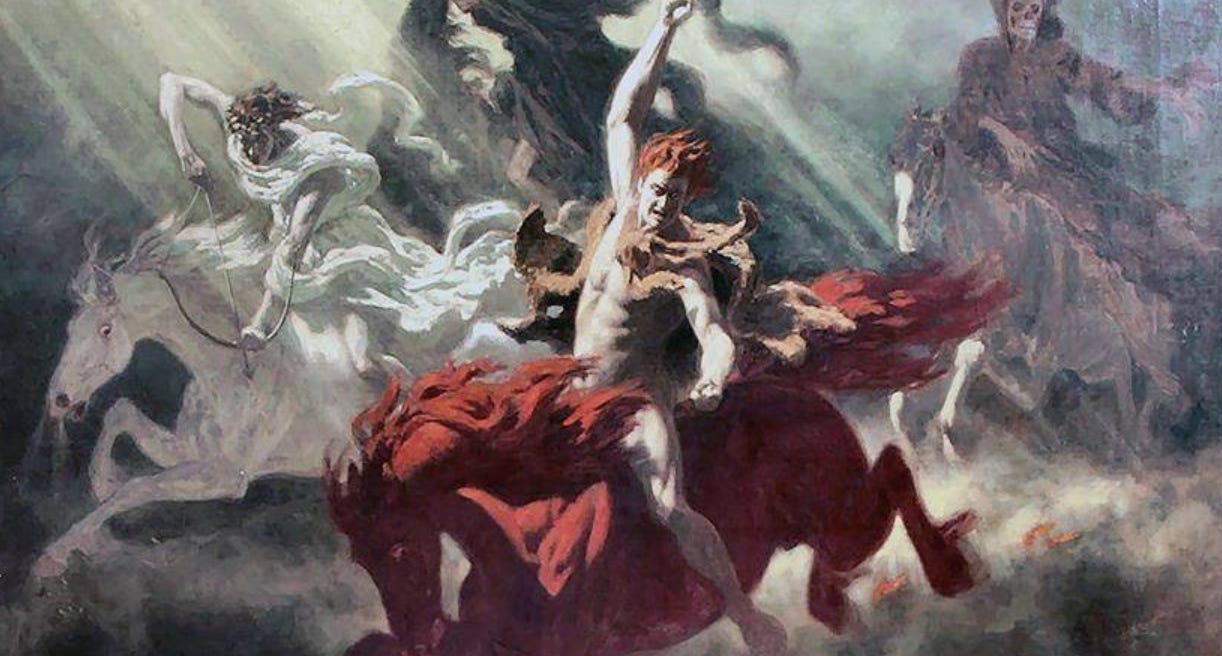
Ontology and Experience of the “Radical Antichrist”
Perspectives from semantics, religious studies, sociology, and political science
Alexander Dugin frames the Antichrist as the absolute counter-pole to the sacred, a primordial adversary whose shifting manifestations across myth, theology, and metaphysics transcend individual religions and reveal a universal structure of enmity.
Traditionalism and Semiotics
The aim of this article is to examine the figure of the “Antichrist” and the semantic field of the “end times” outside of any strict attachment to a single, specific religious tradition. Yet the figure of the “Antichrist” (Ὁ Ἀντίχριστος) does have such an attachment – to Christianity. Consequently, we can say that we are examining not only and not so much directly the Christian figure of the Antichrist, as his analogues. This brings us to the topic of traditionalism.
What is traditionalism? It is not one of the traditions. It is that structural matrix, that paradigm, which is common to different traditions. If we compare them with the society of Modernity, with the New Age and the secular paradigm of contemporary science, it turns out that all concrete traditions and religions share something in common. The attempt to describe, uncover, and single out this common element leads to traditionalism.
In this context, traditionalism can be understood as the result of a sociological analysis of modernity (with negative conclusions) in parallel with a comparative study of concrete traditions. But it also claims (for example, in the person of Guénon[1]) something else – “primordialism,” that is, that traditionalism is an expression of the Primordial Tradition, which precedes the known traditions and does not follow from them.
We will not now discuss whether this claim is justified. For the moment, it is enough for us that the sociological procedure that reconstructs traditionalism, or the paradigm of traditional society, in contrast to modern society, is entirely reliable. This alone lends Guénon persuasiveness. But whether his conviction is justified that the sociological and philosophical concept of “Tradition” corresponds in reality and historically, and also ontologically, to some existent that lies at the roots and can be apprehended experientially (including in metaphysical and spiritual forms of experience), this requires more careful consideration. That is, whether we can speak of a true “primordiality,” and not simply of an a posteriori mental reconstruction akin to postmodern generalizations, remains an open question.
The value of Guénon in the context of Postmodernity is obvious. But how do his ideas correlate with the structures of the Premodern? And is there in the Premodern anything like what he singles out as its central component – that is, the Primordial Tradition?
Our hesitation will protect us from lapsing into syncretism, New Age, occultism, and neo-spiritualism. We do not pass judgment; we say: let us accept the thesis of “Tradition” and even of the “Primordial Tradition” as a concept that is undoubtedly operational sociologically (a common structure underlying concrete traditions), and for the time being bracket its historical-ontological grounding.
Let us approach the problem from the standpoint of semiotics. What is a concrete tradition? A religious one, for example? It is a language[2]. This language is structured, contains signs and syntax, creates (connotative – for structuralists) fields of meanings, and constitutes or describes (constitutes) denotata. In any case, a concrete tradition has three linguistic and logical layers:
a series of signs (symbols, dogmas, plots, myths, narratives), that is, the structures of the signifier;
a series of meanings corresponding to the signs (the signifieds);
and a series of senses (which govern the correlations between the first and second series – or the relations of the signs of the first series among themselves, connotation).
For example, when a Muslim says “Allah,” he has in mind something different than what a Christian has in mind when uttering the word “God.” Without a detailed analysis of these three series we cannot understand anything in a concrete tradition. The same applies to “Antichrist” – in a strict sense he has meaning (and value) only as a figure of the Christian narrative, of Christian dogmas; he is linked to Christ in a complex way (most often by inversion) and points us to a denotatum (what is designated) that is constituted exclusively by the Christian religion and remains within its framework. One can speak of the Antichrist as a connotatum that receives being from its conceptual place in the system of the Christian language and its structure.
The same can be said of any figure in a concrete religion. For example, of Khidr in Islam or of the prophet Elijah among the Jews. Some things have distant analogues in other religions; others do not.
In addition, there are borrowings and re-interpretations of one and the same figures in different contexts. This complicates the analysis.
The Ontology of Denotata in Traditionalism
But what is the semiotic structure of traditionalism, that is, of Tradition – or, if one prefers, of the “Primordial Tradition”? This structure represents, in relation to concrete traditions, a kind of meta-language that generalizes the paradigmatic properties of concrete traditions as concrete languages. That is, we are dealing with a generalizing series of signs that can be provisionally assigned to the field of the signifier.
But observe: this is a special signifier, which does not coincide with any one concrete tradition or religion. And here the most interesting question arises: what is the corresponding field of the signified, that is, what are the denotata of traditionalism? Or, in other words, what is the aggregate of connotative senses of traditionalism that constitute its “essences” as a discourse?
Does a meta-language in general (and traditionalism in particular) possess a denotative or connotative field? If the meta-language is a purely artificial construction, then it has no such field, since a meta-language serves only for the technical description of how the real language is arranged. But if we recognize (together with Guénon) that traditionalism is not a summarizing technical abstraction but the expression of an eternal, permanent, and supra-historical structure, then it does.
Hence, in order to speak of “Antichrist” outside the Christian context – in such a way that this figure has both sense and meaning – we are forced to adopt the standpoint of primordialism. Otherwise, we will have to limit ourselves to comparing among themselves the three-level series of various religions and exclude altogether the possibility of dealing with that (ontological and semantic) which is common to them (except in the sense of a posteriori and distanced external – that is, nominalist! – observations and generalizations). Strictly speaking, they have nothing in common (ontologically nothing, no unity of the signified).
The Antichrist in Christianity
Having said all this, we must nevertheless return to the Christian context, from which we shall begin our investigation of the semantics and meaning of this figure.
The Antichrist marks the last times, the eschatological aeon, the culmination of apostasy (ἀποστασία). He sums up the conditions (historical, social, existential, ontological, etc.) under which salvation becomes maximally difficult and complex, and all things in the world and even in religion are turned upside down. The Antichrist passes himself off as Christ and as God – and so skillfully that many are unable to recognize this. This constitutes the essence of his function: he confuses, deceives, perverts, passes one thing off as another. He is a harlequin, an actor, a buffoon, a jester.
The figure of the Antichrist in the semantics of Christianity can be considered multidimensionally. Structurally it is tightly coupled with the Christian paradigm of history. This history proceeds from Paradise to the Fall, to the vicissitudes of the chosen people, then to Christ, then to the Church, then to the release of Satan from his bonds and to the End of the World, whose culmination is the Last Judgment. The stage of the appearance of the Antichrist is the last before the End of the World and the Second Coming of Christ. Therefore, the theme of the Antichrist can be taken as an instrument for measuring Christian time. And much depends on how this time is calculated – including one’s attitude toward society, the world, and even religion. For – and this is the most important thing! – the Antichrist counterfeits everything; his epoch is an epoch of forgery. Forgery of what? Of everything – of the world, of religion, of society, of power, of the human being. It is an epoch of simulacra, of substitutes, of perverted copies. Accordingly, in the face of the element of the Antichrist, people of the last period must act and be otherwise than before. Seeing water, a star, a human being, or a temple, Christians of the pre-Antichrist period relate to them accordingly. But Christians of the Antichrist period are invited to act differently: to distrust, to verify, to remain vigilant in regard to the most simple and familiar things. The familiar is no more. In everything a trap is hidden. The era of the Antichrist is an epoch of suspicion.
The Katechon and the Antichrist
In the Orthodox tradition the definition of the Antichrist has a political dimension.
In full, this passage, fundamental for the history of Christianity, reads as follows:
Let no one deceive you by any means: for that day shall not come, unless there come a falling away first, and the man of sin be revealed, the son of perdition,
who opposes and exalts himself above all that is called God, or that is worshipped; so that he sits as God in the temple of God, showing himself that he is God.
Do you not remember that, when I was still with you, I told you these things?
And now you know what restrains, that he might be revealed in his own time.
For the mystery of lawlessness is already at work; only he who now restrains will do so until he is taken out of the way.
And then that lawless one will be revealed
In Church Slavonic the corresponding verses read:
And now ye know that which restraineth, that he might be revealed in his own time.
For the mystery of iniquity doth already work: only he who now restraineth will restrain, until he be taken out of the midst.
“That which restraineth” – τὸ κατέχον – is a participle in the neuter and refers to the “Kingdom,” the “Empire,” whereas “he who restraineth” – ὁ κατέχων – is a participle in the masculine and points to the one who restrains, that is, to the “Tsar,” the “Emperor.” Both words are derived from the verb κατέχειν, “to hold, to restrain,” literally “to have under,” “to possess, to hold in one’s grasp.” From here comes the Russian word derzhava (“great power, realm”), as well as “vlast’” (authority, power) – that which the ruler “holds,” over which he is the possessor.
Here is how John Chrysostom’s commentary on the Epistles of the Apostle Paul interprets this passage:
Quite rightly everyone may first ask what this “that which restraineth” (τὸ κατέχον) is, and then desire to know why Paul speaks of it so obscurely. What is this “that which restraineth his appearing,” that is, “that which prevents him”? Some say it is the grace of the Holy Spirit, and others – the Roman Empire; with the latter I am more inclined to agree. Why? Because if the Apostle had wished to speak of the Spirit, he would not have expressed himself so obscurely, but would have said clearly that what now prevents his appearing is the grace of the Holy Spirit, that is, the extraordinary gifts. Besides, then he ought already to have come, if he is to come when the extraordinary gifts fail, since they have long since failed. But since the Apostle speaks of the Roman Empire, it is clear why he only hints and for the moment speaks in veiled terms. He did not wish to draw upon himself excessive hostility and useless danger. Indeed, if he had said that in a short time the Roman Empire would be destroyed, then immediately they would have wiped him off the face of the earth as a rebel, and together with him all the faithful, as those who live and strive precisely for this.
This is why he did not use such an expression, and did not say that this would happen soon, although (in veiled form) he hints at this constantly. (…) Exactly so he says here: “Only he who now restraineth (ὁ κατέχων) will do so, until he is taken out of the midst.” That is: when the Roman Empire ceases to exist, then he (the Antichrist) will come. And rightly so – because as long as people fear this Empire, no one will quickly submit to the Antichrist. But after it is destroyed, lawlessness will prevail, and he will strive to seize all power – both human and divine. Just as earlier other kingdoms were destroyed, namely: the Median by the Babylonians, the Babylonian by the Persians, the Persian by the Macedonians, the Macedonian by the Romans, so this last one will be destroyed by the Antichrist, and he himself will be vanquished by Christ and will rule no more. All this is related to us with great clarity by Daniel. “And then,” it is said, “the lawless one shall be revealed.” What then? Immediately after this comes consolation: the Apostle adds, “whom the Lord Jesus shall slay with the breath of His mouth and shall destroy with the brightness of His coming, whose coming is after the working of Satan.” Just as fire, when it only approaches, even before it arrives, paralyses and destroys the small animals that are at some distance, so also Christ by His mere command and His coming will kill the Antichrist. It is enough for Him simply to appear, and all this will perish. Barely does He appear, and He already puts an end to the deception.[4]
The removal of the Katechon-Emperor “from the midst” (ἐκ μέσου) is both the sign and at the same time the mechanism of the coming of the Antichrist. In other terms, the transition from traditional society (in Orthodoxy it is expressed by the “symphony of powers” and the caesaropapist principle[5]) to post-traditional society is accomplished in this way. With this the final epoch of substitutions begins.
Not all Christians acknowledge this, yet in the Middle Ages most Catholics agreed with such an interpretation of 2 Thessalonians (where the “son of perdition” and the “mystery of lawlessness” are mentioned) with reference to the Emperor and the Western Roman Empire of the German Nations[6]. It collapsed, incidentally, in the person of Austria-Hungary in 1917 – at the same time as the Russian Empire and the Russian Emperor.
But even those Christians who interpret the passage about the Katechon not politically, but metaphorically, think in approximately the same structural way. For them, the “restrainer” acquires the generalized meaning of “piety,” “holiness,” which leaves society.
The Antichrist as a Measure of Time
In all eschatological currents in Christianity the theme of the Antichrist manifests itself in one way or another. Thus, in the Russian schism it played a decisive role. Characteristic in this respect is the statement of an Old Believer, a representative of the extreme “priestless” group of “wanderers” (a follower of the famous “fugitive” Antipa Yakovlev):
“Do you hear, brethren, what these deceivers say – that it is unnecessary to know about the Antichrist. But all our faith consists in the Antichrist.”[7]
What does it mean that “all faith consists” in him? It means that the assertion of the coming of the “spiritual Antichrist” radically changes one’s attitude to the environment in which the Christian finds himself. Changes in relation to what? In relation to the pre-Antichrist period. What is the pre-Antichrist period? The paradigm of the socio-comic existence of a normative Christian society.
Thus, the role and function of the Antichrist in Christianity is clear. The dispute is waged between the “already” and the “not yet.” At the same time, it is revealing that in contemporary Christianity there is a tendency to remove the theme of the Antichrist from brackets altogether. In so doing, the most important hiero-historical moment is removed, and religion is de-historicized, de-socialized, de-ontologized, de-existentialized. Christianity without the theme of the Antichrist is unreliable and cannot justify the temporal moment. Hence, it loses its most important dimension and gradually turns itself into a simulacrum. The trick of the devil, as is well known, consists in persuading everyone that he does not exist.
Dajjāl
There is nothing impermissible in attempting to discover functional analogues of the figure of the “Antichrist” in other traditions and religions. This comparative procedure is fairly simple. One need only remember that the semantics of these analogues will be determined by the context and the religions as languages.
In Islam this is “Dajjāl,” the “Liar” (الدجّال), or “al-Masīḥ al-Dajjāl” (الدجّال المسيح, the False Messiah). He is depicted as one-eyed (asymmetrical). He will fight with the Muslims and the returning Christ at the end of time (we must immediately note that the Christ of the Muslims is not the Christ of the Christians).
The victor over Dajjāl, in the view of Muslims, is the Mahdi, who for Sunnis is the eschatological leader of the Islamic umma, and for Shiites – the last Hidden Imam.
Claudio Mutti summarizes the information about Dajjāl in the Islamic tradition:
The Mahdi will fight the Antichrist, the Deceptive Messiah (al-Masīḥ al-Dajjāl), who will establish his kingdom on earth in the last times before the Imam’s manifestation. “I warn you,” says a hadith of Muhammad, “of the danger of his coming. There is no prophet who did not speak of him to his communities. Even Noah did this for his people. But I will tell you of him what no prophet has ever told his disciples. Know that he is blind in one eye, while Allah, Allah is not such.” This physical deformity will be a sign of the general hideousness characteristic of the false Messiah who, however, will be able to conceal, by the force of suggestion, his true appearance. Nevertheless, according to a conviction widely spread today among Muslims, Dajjāl has already established his hegemony over the greater part of the earth. Many are those who have been able to recognize in modern Western civilization truly diabolical features and who have seen in the traditional image of the devil a symbol of the contemporary world. In this case the partial blindness of the Antichrist can be understood as an indication that modern technological civilization… sees only one aspect of life, material progress, and completely ignores its spiritual aspect.[8]
The astonishing ability of Dajjāl to see and hear from afar, to fly with mad speed – that is, his traditional characteristics – can be expressed in the following terms: “With the help of its mechanical marvels, modern civilization allows man to see and hear far beyond his natural abilities and to traverse gigantic distances with unimaginable speed.”[9] The prophecies about the ability to bring down rain and to have power over the growth of plants, which are common both to Dajjāl (the Antichrist) and to the Mahdi, but which in the case of Dajjāl represent a satanic parody, can, within such parallels, be identified with modern science. Another aspect of the activity of Dajjāl can be interpreted in a similar way: the discovery and exploitation of mineral deposits in the bowels of the earth, which he is supposed to encourage according to prophecy; and this kind of activity is also common to the Mahdi and Dajjāl. Finally, it is said that the false Messiah will be able to kill and restore to life, so that those weak in faith will take him for God and worship him. And in fact, modern medicine “returns life to those seemingly doomed to death,” while the wars of modern civilization, with their scientific horrors, annihilate life. And the material development of this civilization is so “powerful and so dazzling that those whose faith is weak believe that there is something divine in it.”[10] But those whose faith is firm will read, written in letters of fire on its forehead, the inscription “Denier of God,” and will understand that this is a deception meant to put their faith to the test. The identification of Dajjāl with the modern Western civilization that, since the era of colonial expansion, has begun to press hard upon Islam, first appeared in narrow circles of African “Mahdist” movements which opposed proud resistance to the penetration of the infidels and their “civilizing mission.” “Recently,” we read in a British colonial report, “agitators have acquired the habit of identifying the European conquerors of Muslim countries with Dajjāl.”[11] And, in the end, Dajjāl will be vanquished precisely by the Mahdi. And Jesus, sayyidinā ʿĪsā, must finally annihilate him: “He shall break the cross and cut the swine in two,” it is said of this in a hadith.[12]
Dajjāl appears at the end of the cycle. Victory over him is the last act of sacred history.
In extreme Shiism – Ismailism – there is the figure of the “Qāʾim” – the Resurrector (Qāʾem, قائم – literally “the one who rises”), who is the supreme embodiment of the third heavenly Logos who has descended into the world and has become the spirit (intellect) of humanity.[13] The task of the Qāʾim is to restore the fatal consequences of the primordial error that he committed when he doubted the source of the Light and therefore fell. Here “Dajjāl” is interpreted as the exteriorization of this shadow of doubt, which has become an object standing before the spiritual subject. In the final battle of the Qāʾim with Dajjāl, the Logos fights with itself, with its dark side.
Naturally, this gestalt cannot be directly identified with the Christian Antichrist, since the contexts (languages) are different, yet the homologies are obvious.
‘Erev Rav
In Judaism there is also a theme directly connected with the gestalt of the “Antichrist.” It concerns the notion of ‘erev rav (עֵרֶב רַב) – “the peoples of the great mixture,” as interpreted by Kabbalah.[14]
The Zohar describes the ‘erev rav as follows:
The Great Mixture consists of five peoples: the Nephilim (“fallen ones”), the Gibborim (“heroes”), the Anakim (“giants”), the Rephaim (“shades,” literally “healers,” “sorcerers”), and, finally, the Amalekim. Because of these peoples the small he (ה) of the Tetragrammaton fell from its place.[15] Balaam and Balak came from the branch of Amalek: remove the letters “lak” from Balak and “eʿam” from Balaam and the remaining letters form the word “Babel,” “for there the Lord confounded the language of all the earth.”[16]
The people of Amalek, scattered over the earth in the age of the Tower of Babel, were the remnants of those of whom at the time of the Flood it was said: “And I will destroy every living thing that I have made from the face of the earth.”[17] And the descendants of Amalek in the period of the fourth dispersion[18] are those mighty princes who rule over Israel by force of arms. Of them it is also said in the verse: “The earth also was corrupt before God, and the earth was filled with violence.”[19]
Of the Nephilim it is said: “Then the sons of God saw the daughters of men, that they were fair.”[20] They constitute the second group of the Great Mixture; they descend from the “fallen” (Nephilim) of the upper world. When the Holy One, blessed be He, wished to create man and said, “Let us make man in Our image, according to Our likeness,”[21] He wished to make him ruler over the beings of the upper world, so that he would command and that all would be governed by his hand, like Joseph, of whom it is said, “And he set him over all the land of Egypt.”[22]
But the beings of the upper world decided to oppose this and cried out: “What is man, that Thou art mindful of him?”[23] – this man who in the future will rise up against Thee! The Holy One, blessed be He, answered them: “If you yourselves were in the lower world as he is, you would commit even more crimes than he!” And soon “the sons of God saw the daughters of men, that they were fair,”[24] they desired them, and the Holy One, blessed be He, made them fall bound in chains into the lower world. The sons of God were called Aza and Azael, but the souls of the Great Mixture, which descend from them, are called Nephilim, who doomed themselves to a fall by fornicating with “fair” women. Thus the Holy One, blessed be He, erased them from the world to come so that they might have no share in it. He gave them their reward in the lower world, as expressed in the words: “And He repays those who hate Him to their face, to destroy them; He will not be slack.”[25]
The Gibborim (“heroes”) constitute the third group that forms the Great Mixture; of them it is written: “These were the mighty men who were of old, men of renown.”[26] They come from the same stock as the people of the Tower of Babel, who said: “Let us build ourselves a city, and a tower whose top is in the heavens, and let us make a name for ourselves.”[27] They build synagogues and schools and place there scrolls of the Torah with crowns on their heads; but all this is not for the sake of YHWH (הוהי) but “that we may make a name for ourselves.”[28] Since they come from “the other side,” they despise the children of Israel as the dust of the earth and rob them. Therefore their work will be broken. Of them it is written: “And the waters prevailed exceedingly on the earth.”[29]
The Rephaim (“shades”) constitute the fourth group of the Great Mixture: when they see the children of Israel in trouble, they draw away from them, and even if they are able to save them, they evade it. They shun the Torah and those who study it and go to do good to idol-worshipers. Of them it is said: “The dead will not live” (more literally, “the shades shall not rise”).[30] In the era of the redemption of Israel Thou “wilt destroy all remembrance of them.”[31]
The Anakim (“giants”) constitute the fifth group of the Great Mixture. They hate those of whom it is said that the Torah is “an ornament about your neck.”[32] Of them it is written: “They were also regarded as Rephaim, like the Anakim,”[33] for they are indeed equal to one another.
The five groups of the Great Mixture lead the world back to the state of tohu-bohu (“The earth was without form and void”).[34] And “to return to tohu-bohu” means the destruction of the Temple.
“The earth was tohu-bohu,”[35] because the Temple was the axis of the world. But when the Light comes, which is the Holy One, blessed be He, they will be wiped from the face of the earth and annihilated. However, the final Liberation depends not on their being “wiped from the face of the earth,” but on the destruction of Amalek, for it is in relation to the Amalekim that the oath was pronounced.[36]
The most authoritative Kabbalist, the Vilna Gaon, Elijah ben Shlomo Zalman, clarifies that the ‘erev rav is the “husks (klipah) of Jacob.” In his commentary on the Zohar he gives the following interpretation:
Esau and Ishmael are woven into Abraham and Isaac, but the ‘erev rav is woven into Jacob. Therefore the ‘erev rav is more problematic for Israel and the Shekhinah, for they are the leaven in the dough – since all who are stingy and those who do not support the Torah are among them.[37]
His commentary on a passage from the Book of Numbers – “And the people spoke against God and against Moses: ‘Why have you brought us up out of Egypt to die in the wilderness? For there is no bread and no water, and our soul loathes this worthless bread’”[38] – explains:
The leaven in the dough – this is the ‘erev rav, who are worse than all the nations of the world (the goyim), because they stop Israel on the path of fulfilling the commandments (mitzvot),[39] and he who turns his fellow away from the path does him more harm than if he had killed him.[40]
In the already mentioned section of the Zohar it is said:
Dispersion, exile, and the destruction of the Temple, and all sufferings – all of them result from Moses’ having accepted the ‘erev rav, and all the evil and perverted people and malefactors of all generations descend from them, from their souls, for they are reincarnations of those who left Egypt.[41]
In this way, the idea is formed that, alongside the evil that comes from outside with respect to the Jewish people, there is evil arising from within the people themselves. And it is precisely this evil – the ‘erev rav – that becomes, for some commentators, the most important.
The ‘erev rav are not simply Christians (Esau/Edom) or Muslims (Ishmael), but an admixture of Gentiles of the Egyptian era into the Jews themselves. The ‘erev rav are those with whom Israel will fight at the end of time in the messianic period (Vilna Gaon).
A disciple of Rabbi Hillel of Shklov transmits his teacher’s words:
The central role of the two Messiahs, Messiah son of Joseph and Messiah son of David, in the generations consists in the defense and war against the three main klipot (husks) – against the husks of Esau,[42] Ishmael,[43] and the ‘erev rav.[44] The main battle must erupt in order to remove from Israel the forces of the ‘erev rav, the husk of Armilus.[45] The ‘erev rav is our greatest enemy, which separates the two Messiahs from one another. The husk of the ‘erev rav acts through deception and roundabout paths, through flattery. Therefore, the war against the ‘erev rav is the most difficult and bitter of all.[46]
Concerning the enigmatic figure of Armilus, also symmetrical to the gestalt of the “Antichrist,” the Vilna Gaon explains:
Armilus, the angel of the Great Mixture, is the one who attempts to join Esau and Ishmael[47] in order to destroy Israel and the whole world, God forbid. The central desire of the Great Mixture is to unite Esau and Ishmael and thereby separate the two Messiahs. Our central task is to oppose these actions and to fight them. We must annihilate the might of the Great Mixture, the perverted husk of Armilus, and drive it out of Israel. The Great Mixture is our main enemy, because it separates the two Messiahs. The husk of the Great Mixture acts by deception and indirectly. Therefore the war against the Great Mixture is the most difficult and bitter, and we must fight it and defeat it with all our strength. Whoever does not participate in the war against the Great Mixture becomes part of its husk. Whoever he may be, it would be better for him never to have been born.[48]
Thus, according to this identification, “that side” (sitrā ahrā), “hell,” “darkness” is located not merely around the Jews, but inside the Jews, within them themselves, as their disintegrating into five groups inverted black double.
And again, as in the case of the Christian Antichrist, we see here the main motif – parody, counterfeit, simulacrum. The ‘erev rav are not merely other religions or adversaries of the Jews; they are an internal challenge arising from the substitution and subtle perversion of Judaism itself.
Satan
Judaism also knows other analogous images. First of all, this is Satan (שָׂטָן), who was identified as the leader of the fallen angels. From Judaism the gestalt of Satan passed into Christianity and Islam (Shayṭān – شيطان). The meaning of the Semitic root is “to be hostile” or “to act as an adversary, to hinder.”
In the story of the sufferings of Job, Satan disputes with God about the devotion of the righteous man who blessed God for His gifts and benefactions, but had yet to face the test of faith in the last labyrinths of suffering. Satan is described there as one of the “servants of God” (and even “sons of God” – בני האלהים), subordinate to Him and fully obedient to His will.
However, in Jewish eschatology as such, the figure of Satan does not play a key role – unlike the ‘erev rav. In Christianity, on the contrary, the Devil appears as the “Father of the Antichrist.” In Islam Shayṭān or Iblīs (إبليس) is described as the one who first raised a rebellion against God.
In the Christian tradition, at the end of time there must take place the final battle between the angelic hosts led by the archangel Michael and the demonic hordes under Satan’s command.
In the Latin tradition Satan was identified with the spirit of the evening star – Venus, Lucifer.
To this same circle belong the demonic images of Samael, the demon of murder and crime, Aza and Azael, who are mentioned in the Zohar and apocrypha, the female demons Lilith, Nahema, Agrat bat-Mahlat, and so on. Strictly speaking, they can all be considered components of the ‘erev rav, the “Great Mixture.”
Kali-Yuga
In Hinduism an analogous eschatological situation rests on the mythology of degradation in descending cycles and rests on the period of Kali-Yuga (कलियुग).
Hinduism envisions the cyclical picture as follows. There is the night of Brahma and the day of Brahma. During the night of Brahma the world does not exist; during the day it exists. Since Brahma is eternal, his days and nights do not follow one another in time, but coexist, expressing his two aspects – unmanifest and manifest – Saguna Brahman (Brahma with qualities) and Nirguna Brahman (Brahma without qualities). Each day of Brahma (mahā-kalpa) contains 1,000 kalpas.[49] In each kalpa there are 14 manvantaras[50] – 7 manvantaras of departure and 7 manvantaras of return. In each manvantara there are 4 yugas (Satya-Yuga, Treta-Yuga, Dvāpara-Yuga, and Kali-Yuga).
Modern humanity lives at the end of the Kali-Yuga of the 7th manvantara (after which the cycle of return should begin) of the kalpa of Varāha (the White Boar).
From the standpoint of the Hindu theory of cycles, it is important that within the manvantara the sequence of yugas follows a descending order: the yugas correspond to the Golden, Silver, Bronze, and Iron Ages of Hesiod, and this is reflected in the quality of the earthly environment and in the shortening of their duration. Satya-Yuga lasts four tenths of the manvantara, Treta-Yuga three, Dvāpara-Yuga two, and Kali-Yuga one. In parallel with this, the parameters of human existence worsen, becoming ever worse and worse. Since Hinduism considers as antitheses the pairs order/disorder, sacred/profane, hierarchical/chaotic, etc., the logic of the succession of yugas means a transition from order, sacredness, and hierarchy to disorder, profanation, and chaos. The last yuga, Kali-Yuga, in turn represents a descent, only now within the framework of an already lowest cycle: it is the epoch of destruction, mixture, chaos, lawlessness, injustice, and decline par excellence.
At the end of Kali-Yuga the tenth avatar of the god Viṣṇu – Kalki (कल्कि), king of the mystical land of Shambhala[51] – must appear. With this the Kali-Yuga of the seventh manvantara will end, and a new Satya-Yuga of the next, eighth manvantara will begin.
Kalki is the one who conquers darkness and filth:
It is said that at the end of Kali-Yuga the earth will be ruled by mleccha kings. Base-born and impious, they will not be crowned properly, but will seize power by force and will begin to commit various atrocities. They will kill women and children without hesitation and destroy one another. The rise and fall of such kingdoms will rapidly alternate. These kings will know neither pity nor true love nor genuine wealth. Ordinary people will follow their example. All traditions existing today will be lost. Kings will destroy their subjects; they will be distinguished by greed and bad conduct. There will be more women than men in those times. Education will fall into decay; people’s strength will diminish, and life expectancy will shrink. Finally, time will put an end to the rule of the existing kings, and there will be no more kings. Only the coming of Lord Kalki will put an end to all mlecchas, heretics, and evil-doers. Further, in the Vāyu Purāṇa (98.391–407) the end of Kali-Yuga is described, a time when only a few will remain alive. These will be helpless beggars deprived of any property. No one will help them; they will continuously suffer from diseases and various misfortunes, dying of hunger in times of drought. They will kill one another (out of malice or hunger). Every loving feeling will be lost, even between the closest friends. People will settle along river banks and in the mountains, wandering about the earth and rummaging through garbage in search of food. At the end of Kali-Yuga humanity will be destroyed.[52]
Kali-Yuga is the epoch of the rule of the demon Kali (कलि). This point is sometimes overlooked because of the closeness of this name to that of the black goddess Kālī (काली), the śakti of Śiva. But these are different roots: in the name of the demon Kali (kali) both vowels are short, while in the name of the goddess Kālī (kālī) they are long. In some myths the final battle that ends the dark age is fought precisely between the goddess Kālī and the demon Kali. The demon Kali (कलि) functionally corresponds to the gestalt of the “Antichrist.”
We should note that the phonetic closeness of the names of all the main figures in the eschatological scenario has symbolic significance: in many religions and traditions the conditions of the end times differ precisely in that, during this period, it becomes easy to confuse top and bottom, truth and its simulacrum. The black demon is a simulacrum of the black goddess and the enemy, the opponent of the white avatar – Kalki.
In Buddhism King Kalki is mentioned as the 25th ruler of Shambhala.
Buddhism also features the future Buddha Maitreya (मैत्रेय).
The antagonist of the Buddha is the demon of illusion and death, Māra (मार). In the Buddha’s victory over Māra he attains bliss and awakening.
Ohrmazd and Ahriman
A peculiarity of the Zoroastrian religion consists in the fact that in it the battle between the god of Light and the god of Darkness continues throughout the course of world history.
The Zoroastrian text Bundahišn relates its structure as follows:
Ohrmazd has always been supreme in omniscience, virtue, and radiance. The realm of Light is the place of Ohrmazd, which he calls “Endless Light,” and omniscience and virtue are the constant properties of Ohrmazd. As he says in the Avesta, the Avesta is the explanation of both: of the one who is constant and without limit in time – for Ohrmazd, his place, his faith, and his time were, are, and always will be – and of Ahriman, who in darkness, ignorance, passion of destruction, and abyss was and is, but will not be. And the place of destruction and darkness is that which is called “Endless Darkness.” Between them there was a void, that is, what is called “air,” in which now the two spiritual principles, limited and limitless, have become mixed with one another – the upper one, which is called “Endless Light,” and the abyss, “Endless Darkness.” What lies between them is the void, and the one is not connected with the other, and [then] both spiritual principles are bounded in themselves. As for the omniscience of Ohrmazd, he knows about both kinds of his (“Ohrmazd’s”) creatures – the limited and the limitless – since he knows the covenant of the two spiritual principles. Further, the sovereignty of Ohrmazd’s creatures will be realized at the final embodiment[53] and will become limitless forever and ever. And the creatures of Ahriman will perish at the time when the final embodiment comes, and this too is limitlessness.[54]
It is important that Ahura Mazda and Angra Mainyu fight one another almost as equals for power over past and present. “Ohrmazd was and is” (būd ud ast), and “Ahriman was and is” (būd ud ast). The field of this battle is the “void” (tuhīg) or “air” (wāy), where the two abysses – of Light and of Darkness, of limit and limitlessness – meet. But the wisdom of Ohrmazd consists in the fact that to him belongs the third dimension of sacred time, the time of the war – the future. Ahriman “was and is, but will not be” (būd ud ast kē nē bawēd). The Spirit of Evil is denied one thing – participation in the future. This very denial predetermines the nature of the future as Zoroastrianism understands it. The future age is an age without Ahriman.
It is remarkable that the middle era between Creation (Bundahišn) and the era of final separation or judgment (Wizārišn) is the epoch of mixture. In it Light is mixed with Darkness, truth with falsehood, high with low. In a certain sense this is the epoch of apostasy – that is, of desertion and substitution. It is also the “time of rivalry.” It is described as follows:
Then, by virtue of his omniscience, Ohrmazd knew: “If I do not create the time of rivalry, then he will be able to deceive and subjugate my creatures, for even now, in the period of Mixture, there are many people who commit more sins than righteous deeds.” And Ohrmazd said to the Evil Spirit: “Consent to the time, so that our battle in the period of Mixture should last nine thousand years.” For he knew that with the acceptance of this period of time the Evil Spirit would be weakened. Then the Evil Spirit, inattentive and foolish, approved such an agreement, just as two people at war with each other set a time: ‘On such-and-such a day we shall fight.’[55]
In Zoroastrianism the last epoch, Wizārišn (Separation), is the final division of good and evil. During this period the faithful to Ohrmazd fight the last battle with the servants of Ahriman.
At the end of the cycle appears the “last Zoroaster” or “second Zoroaster,” who acts as the restorer of the original good world. This is the culmination of history as battle:
According to the new revelation received by Zoroaster, humanity shares with the good divine beings a common destiny – gradually to overcome evil and restore the world to its original, perfect state. The wonderful moment when this takes place is called Frashōkərəti (in Pahlavi Frashegird), which probably means “making wondrous, miracle-working.” At this point the second era will end, since the third will begin – “Separation” (in Pahlavi Wizārišn). Then good will again be separated from evil, and since the latter will be finally destroyed, this “Separation” will last forever, and throughout this time Ahura Mazda, the good divine beings – the yazatas – and men and women will live together in complete tranquility and peace.[56]
The analogue of the Christian Antichrist here is Ahriman himself, who by the end of history has subjected the material world to his power. At the critical moment of the world confrontation Ahriman reveals his face. The “collective Antichrist” of Zoroastrianism may be considered the aggregate of the “children of Darkness,” the army of Ahriman, which reaches the peak of its power at the turning point of sacred history.
The Pole of Light is embodied in the figure of the Saoshyant, the Savior, the universal King, who meets the armies of Darkness in the final battle.
Giants, Titans, and Monsters
In the Hellenic tradition – in contrast to the monotheistic religions and Iranian Zoroastrianism – there is no such sharply contrasting figure that would embody the principle of pure evil. The structure of Greek worldview gravitates toward the Platonic notion that “evil is only a diminution of good” and therefore lacks hypostatic presence, independent existence, essence. Socrates refused to recognize the existence of a separate idea (paradigm) for dirt; accordingly, in such a context there could be no idea of evil, still less of pure evil. Eschatology likewise played no significant role in Greek culture, since being revolved in measured circles around an unchanging, eternal divine axis. In such a picture there was good and only its relative diminution. Time is the moving image of eternity. The world is the image of Olympus. Becoming is the image of being. At the center of things rests the unmoved mover, who alone is truly important and significant as beginning and end, as source and goal.
Characteristic of the balanced attitude of Greek religion to the gods of Hades, the realm of the dead. Hades and Persephone, who ruled there, had their own cults and temples, rites, and myths. The Underworld was visited by Olympian gods – Zeus himself, Apollo, Dionysus, and Hermes. The smith-god Hephaestus was linked to subterranean regions. Hades was also regarded as an ordered place, with structures belonging to it that entered into the overall harmony of the world.
But the Greeks also knew of the Titanomachy and Gigantomachy – the rebellion of the Titans and giants against the authority of the eternal gods, the attempt of Becoming to overthrow the unchanging and eternal Olympian order.
Therefore, analogues to the figure of the “Antichrist” in the Greek tradition should be sought among the Titans and giants, as well as the heroic figures close to them.
Thus, especially sinister features in Greek mythology are ascribed to the Titan Prometheus; to the chthonic, serpent-like monsters Python and Typhon; to the king of the giants Eurymedon and their leader in the uprising against the gods in the Phlegraean Fields, Alcyoneus; and so on. Myths relate that the chief Titans and principal giants were twelve in number, corresponding to the twelve Olympian gods. Each of the chthonic monsters – each giant – sought to overthrow the god who confronted him: Alcyoneus – Hades, Polybotes – Poseidon, Mimas – Hephaestus, Enceladus – Athena, and Porphyrion – Zeus himself.
Here we see the same symmetry characteristic of the gestalt of the “Antichrist,” who imitates God, tries to pass himself off as Him, substitutes reality with its copy. The Titans and giants are not merely the gods’ adversaries; they are their simulacra, striving to present themselves as gods.
Other polytheistic traditions know similar ranks of reverse-symmetrical beings analogous to the gods and Titans (giants) of the Greeks. In Hinduism the counterparts are the devas and asuras; in Mazdaism, in reverse proportion, the ahuras and devas. In Germanic myths the heavenly Æsir are opposed by the frost giants, the jötnar.
In other mythologies, battles and collisions between old and new gods are described in a similar way. In the West Semitic tradition of Canaan the god-fighting figure was Baʿal, the younger deity, cut off from inheritance, who decided to seize it by force, overthrowing his father – the old god El.[57]
A truly sharp antagonism between the gods and their chthonic opponents is seen only in the Iranian tradition, grounded in the metaphysical dualism of Ohrmazd and Ahriman. In other mythologies and religious systems – above all in Hellenism – it does not play such a fundamental religious role. Accordingly, the eschatological dimension in these traditions is only hazily outlined.
Yet even these mythological gestalts can, with appropriate reservations, be counted among the archetypal forms relevant to the “Antichrist.”
Structural Analysis of the Eschatological Scenario, the “Calendar Antichrist,” and the Morphology of the End of the World
In developed theologies – and especially in the context of monotheism – the final battle and the moment of the coming of the “Antichrist” acquire particular significance, standing out from the general context of time. In a sense, the words of the Russian Old Believer – “All our faith consists in the Antichrist” – apply to all monotheistic traditions in which the drama of the confrontation with the enemy, with the inverted spirit of evil, is the central problem. The theme of the “last times” is singled out into a separate discipline: eschatology, the doctrine of the end.
In other, primarily polytheistic religions and traditions the metaphysics of war, of the last battle, is somewhat muted. From the standpoint of forms – morphology – it can be reduced to the constant repetition of cyclical situations. Their prototype is the yearly cycle.
If we describe in this context the morphology of the end of the world, we obtain the classical cyclical-calendar model.
Dark times – winter/night/darkness/cold/death. This is the setting. The “calendar Antichrist” is the personification of the period that directly precedes the midnight point in the daily cycle or the winter solstice point in the yearly cycle.
Where does the parodic character come from? In calendar morphology everything is clear: evening twilight resembles morning twilight; autumn resembles spring; the time before sunset resembles dawn; the morning star resembles the evening star (Lucifer of the Romans).
Cyclical symbolism and map/calendar clearly lie at the basis of the set of images with which traditions operate.
The various figures analogous to the Christian Antichrist can quite well be reduced to this calendar morphology.
From the standpoint of a connotative study, this gives us an exhaustive result, since it provides a sign-map that can be applied to more complex mythologies and theologies as well. In this sense eschatology – at least structurally – is derivable from the marked-up cyclical symbolism.
However, from the standpoint of the denotative, we find ourselves in a situation where we must admit that we are dealing with a hypostatization of natural phenomena elevated to the status of a religious-mythological personality. That is, the denotatum of the “calendar Antichrist” is only a sector of the natural cycle and the symbolic topology that corresponds to it (sea, underworld, pits, burrows, roots, the bottom – whence Shambhala etc.).
The opponent of the “calendar Antichrist” in this case is the next cycle, symmetrically positioned with respect to him on the other side of the winter solstice point. Two ur runes (two mountains, two horns, two gates, Janus with two faces, the heavenly twins, etc.) illustrate all the possible scenario motifs quite clearly.[58]
The Sociology of the “Antichrist”
The introduction of calendricity and cyclicity makes it possible to give a sociological interpretation to the “Antichrist” (in a structurally generalized form). It is the state of society at the end opposite to the normative. Such cyclical observations of society can already be found in the father of sociology, Ibn Khaldun.[59] Society passes through cyclical stages; the end of one cycle is followed by a new one. The end of a social cycle is the “last times” in sociology.
Society is concrete. This concreteness of society is reflected in the structure of its temporality. Sooner or later society degenerates and disintegrates (not society as such, but its concreteness). This is followed by a period of anarchy and chaos, after which a new society begins a new cycle. This is a new concreteness. In Pitirim Sorokin this is described through the sequence: ideational society/idealistic/sensate – and then again ideational.[60]
In this sense eschatology is the period that completes a concrete society. And the “Antichrist,” as a sociological phenomenon, can be regarded as the generalization or personification of the last agony of this society.
In Sorokin’s view, the sensate model of the sociocultural system is the final stage before a new ideational phase. The culmination of the sensate system, in Sorokin’s terms, is the “sociological Antichrist,” and the sensate system itself is the “Kali-Yuga” or apocalyptic society.
It is characteristic that Christianity too links the moment of the coming of the Antichrist with socio-political changes (that is, with the “removal of the Katechon from the midst” – according to John Chrysostom).
Societies differ; accordingly, their social eschatologies are structurally similar but temporally/historically distinct. What is a flowering for one society can appear as decline for another. Everything depends on the structure of concreteness.
Only society itself knows what it really is. Therefore only within it can one form an idea of its end, of its eschatological phase.
The Concept of Counter-Initiation. The Great Parody. The “Radical Antichrist”
After this methodological digression let us return to the problem posed at the very beginning: whether this generalized figure of the “Antichrist,” which we have traced in various religious, morphological, and even sociological contexts, has a common ontological denotatum. Does there exist a “generalized Antichrist”?
Let us suppose that yes, and that Guénon is literally right (and not only sociologically and structuralistically). We mean by this that traditionalism has its own denotative field, which represents ontologically reliable series of signifieds. In other words, the terms and constructs of traditionalism correspond in reality to certain “extra-linguistic” realities. Moreover, these realities are apprehended not through the grid of concrete traditions (and concrete societies), but can be accessed directly – by means of traditionalism itself.
In that case in traditionalism we obtain a radical (that is, root, from radix, “root”) language together with a root semantic field and – this is the most important – a root ontology of the corresponding denotata. Concrete traditions and religions in this case will be the modifications of these root (radical) instances, which, by virtue of their particularity and relativity, acquire distinctive features in the following spheres:
of connotation (structural connections),
of semantics (senses built upon these connections),
of language itself (as the totality of signs, rules, and paradigms),
of constituted (apprehended) denotata (that is, of ontology proper).
This is precisely what Guénon asserts.
If this is so, and in traditionalism we are dealing not only with a technical meta-language but with all three layers (sense-sign-signified), then there exists a traditionalist or root (radical) denotatum, whose modifications are the figures analogous to the Christian Antichrist. Guénon clearly describes this, introducing two traditionalist terms – “counter-initiation” and “the Great Parody.”[61] He grounds the mechanism of the “Great Parody” in the image of “opening the cosmic World-Egg from below.”
In this model, besides the Christian Antichrist and analogous figures in other traditions, whose denotativity is justified (constituted and given ontological status) by these very concrete traditions, we are dealing with a special new denotatum that generalizes the ontology of all these concrete religious-social forms – with the “Radical Antichrist.”
A Generalization about the “Antichrist.” The “Concrete Antichrist”
We have obtained the following windows or paths of access to the dark problem of the “ontology” and “semantics” of the figure of the “Antichrist.”
First, one can consider the gestalt of the “Antichrist” as a sequence of separate and semantically distinct figures that perform more or less similar functions in different religious doctrines and traditions, as well as in different social contexts and rite-calendar complexes. In that case we are dealing with meaningful, connotative, and denotative entities (essences) constituted or apprehended by concrete traditions.
These constructs or phenomena depend on the structure of a concrete religion and tradition, of the society based upon it, of the normative political system. That is, they depend on the socio-cultural, epistemological, and anthropological context.
Since concrete traditions, religions, and societies differ, in each case we are dealing with a distinct essence, although one that is typologically comparable.
According to the Sapir–Whorf hypothesis, there is no direct translation between languages. There is likewise no direct translation between traditions, religions, and societies. When people of a concrete society (concrete tradition, culture, civilization) see that their normativity is collapsing, they turn to the figure of the Antichrist, Dajjāl, Ahriman, to the concepts of Kali-Yuga, Ragnarök, etc., as to a marker, a crucial semantic moment, a reality intimately linked with their social existence and its history. And having activated such a concept, they begin to act with regard to it accordingly.
Yet each time this is an entirely concrete actualization, that is, the being of the “Antichrist” is, in each case, separate and distinct. We can correlate the “Antichrists” among themselves only in the form of a posteriori comparativism. We do not penetrate into the being of this generalized archetype.
Here we are dealing with occasionalism and must relate to the topic occasionalistically and pluralistically. For some “Antichrist” is such, for others otherwise. The recipes and paradigms of perception can differ, as can reactions and conclusions.
Nevertheless, the very fixation of this figure and comparative observations, if we carry them out cautiously and with thorough consideration of those features that make each society, tradition, religion, or culture unique and different from the others, can in some cases help us better understand each of these figures. What is known of Ahriman may prove useful for an understanding of the devil in Christianity; details reported about Dajjāl may shed light on the structures of the “‘erev rav”; and the themes of Kali-Yuga, in their turn, may clarify certain aspects of the Apocalypse.
The “Situational Antichrist”
Second, a wide opportunity opens before us for morphological generalizations – cyclical, sociological, and semiotic in nature. This makes it possible to ground a certain similarity between “situations of the Antichrist.”
These situations really do possess many common traits. Once more the picture – as in the case of religions – proves fruitful for comparative studies, but with the same limitations. A distinction here is the “metaphorical” nature of the interpretation: the winter solstice, for all its cultic significance, or a social catastrophe leading to the death of a society or culture, are not sufficiently concentrated to ensure an experience of tension as high and focused as in the case of the figure of the “Antichrist” in a religious context.
At the same time, morphological analysis is only a distant view from outside – a pure superstructure of meta-language. Here we are dealing solely with observation and cannot either encounter the essence of the phenomenon or (still less) look into its depths.
The naturalism of the calendar approach only illustrates how, by solving the problem, one can move very far away from it – unless, of course, one does the opposite and lives through the drama of the New Year as a node of existential, ecstatic tragedy. Many archaic rituals were precisely this, until the conventionality of the sacrifice replaced the piercing horror of real ritual torments and deaths.
Radical Ontology
Finally, we come to the most important point – the possibility of interpreting the figure of the “Antichrist” as a certain ontological unit possessing an independent being that does not depend on cultural and religious contexts but, on the contrary, influences them. Such a figure requires that we accept traditionalism and its generalizations not as a technical a posteriori construction, but as a realm referring to actual being, structured in a special way. This approach demands that we regard Guénon or similar theories of universal sacred ontologies (above all the Neoplatonists and, in particular, Proclus’ reconstruction of the Platonic Theology[62] or the Elements of Theology[63]) with maximum trust. This means that we are ready to accept traditionalism as a radical language – that is, not simply as a morphological scheme but as an ontological field of root – radical – denotata. All the radicality here consists in the fact that this field precedes the chain of (always relatively) homologous figures of concrete traditions or socio-cultural contexts, as the root precedes the trunk and branches.
At the same time we should immediately warn that such radicality does not necessarily mean chronological precedence – for roots do not exist before the tree, but together with the tree. Hence the notion of the Primordial Tradition in Guénon should not be interpreted as a reference to an indefinitely remote past. Primordiality, at least ontologically understood primordiality, is always contemporaneous. It can be more or less open and evident – or, on the contrary, veiled and concealed (depending on the cyclical situation), but it cannot fail to exist here and now. If we accept the basic thesis of traditionalism, it is precisely the being of the Primordial Tradition that makes each concrete empirically attested tradition real and sacred. For this the Primordial Tradition must be not “before” the historical tradition, but “inside” it, together with it, synchronously with it.
One more clarification. It is incorrect to regard any one of the existing traditions as the perfect model and direct identity of the Primordial Tradition, and the others as its distortions, variants, or deviations. Every historical tradition is always a concrete semantic and semiotic context and therefore cannot at the same time be the paradigm. Guénon himself adheres to this understanding, specifying it in the case of Hinduism – as the most primary – and Islam – as, on the contrary, the last and final tradition. It is precisely this specification that may be disputed, as becomes evident, for example, in Guénon’s acceptance of Nestorian Christology, reflected in Islam, as definitive. But on the whole, with certain corrections, Guénon defines universality and primordiality in a correct and balanced way.
Just as in practice it is difficult to resist attributing “primordiality” to some single tradition, so there is a strong temptation to put forward the hypothesis of the existence, alongside all known and existing traditions, of yet another – a distinct – religion or tradition, perhaps secret or hardly accessible, which would contain within itself the entire set of root – radical – structures. At times the excessively detailed and formal descriptions by Guénon of esoterism and corresponding initiatic practices can lead to such a mistaken conclusion. The esoteric dimension may – and indeed must – be present in every authentically sacred tradition, but none of them can represent this “esoteric tradition” in its fullness; and at the same time such an “esoteric tradition” cannot exist alongside the others as something special and separate.
True primordiality (that is, true radicality) has a different nature: it cannot precede empirically attested traditions, nor coincide with any one of them, nor exist alongside them as something isolated. It represents a special vertical dimension present within the givenness of a concrete tradition, but never coinciding with this givenness.
The “Radical Antichrist” and the Experience of Him
Having accepted the existence of radical ontology, we can approach the figure of the “Antichrist” from yet another angle. This can be defined as the eliciting of the figure of the “Radical Antichrist.” The “Radical Antichrist” appears when we recognize the hypothesis of the existence of a hypostatized denotatum for the traditionalist language.
In this case we must fix, within the field of traditionalism, a certain zone where we identify that root gestalt which unfolds into an indefinitely broad variability of homologous figures. These figures are those of which the eschatological narratives of various traditions speak – from calendar-ritual to religious and socio-cultural. The “Radical Antichrist” is that common element present in the known typical images and situations, but not as the result of observations and comparisons, of analytical operations, but as a moment of a special metaphysical experience. The presence of this entity shows through the religious and cultural forms that we have cursorily enumerated, but never coincides with them fully. Nor does it have independent existence apart from their contexts – one can speak of an “esoterism of the Antichrist,” but not of an “esoteric Antichrist.” The “Radical Antichrist” manifests through traditions, uniting their particular images. At the same time he is effectively present in these images and entities as their inner dimension, their spiritual vertical. He is the common root that is, for each branch of the tree, its own root.
Therefore, the encounter with the figure of the Antichrist (Dajjāl, Ahriman, the ‘erev rav, the Titans, the demon Kali, Māra, etc.) and with analogous socio-cultural moments in dying societies can remain limited to the concrete context, or it can penetrate through it – into the inner dimensions, into the realm of roots. It is precisely in this way that radical experience is structured.
Recognition of this dimension and the unique experience bound up with it rests upon the acceptance of a special – likewise root – ontology of traditionalism. This is why such experience may be called primordial.
Antikeimenos as a Concept
In order to give the gestalt of the “Radical Antichrist” a more formal character, we can introduce yet another neutral technical term which, given all the considerations set out above, can become an effective concept. With the help of this concept we can avoid direct connotations with a concrete – in this case Christian – religious context, which would inevitably divert us, to a greater or lesser degree, from the metaphysical experience of the “Antichrist” in its radical – primordial – dimension. As such a term we propose the Greek word ὁ ἀντικείμενος. Its basic meaning is “opponent,” “enemy,” “adversary.” Its etymology is transparent – it is a participle of the verb ἀντίκειμαι, which in turn consists of the prefix ἀντί- (“against,” “opposite”) and the root κεῖμαι (“to lie, to be placed”). Ὁ ἀντικείμενος is “the one who stands opposite,” “lies opposite,” is the “counterpart, opposite.” The semantic core also includes the idea of resistance, counteraction, as well as hostility and even harmfulness. In general, this is quite close to the semantics of the Hebrew word “Satan” (שָׂטָן, śāṭān).
It is noteworthy that the term ὁ ἀντικείμενος is used in the same fundamental text for all Christian eschatology – in the Second Epistle of Saint Paul to the Thessalonians, where the Katechon, “the one who now restrains,” is discussed. Let us quote it again:
Let no one deceive you by any means; for that day will not come unless the falling away comes first, and the man of sin is revealed, the son of perdition,
who opposes and exalts himself above all that is called God or that is worshiped, so that he sits as God in the temple of God, showing himself that he is God.[64]
μή τις ὑμᾶς ἐξαπατήσῃ κατὰ μηδένα τρόπον ὅτι ἐὰν μὴ ἔλθῃ ἡ ἀποστασία πρῶτον καὶ ἀποκαλυφθῇ ὁ ἄνθρωπος τῆς ἀνομίας ὁ υἱὸς τῆς ἀπωλείας
ὁ ἀντικείμενος καὶ ὑπεραιρόμενος ἐπὶ πάντα λεγόμενον θεὸν ἢ σέβασμα ὥστε αὐτὸν εἰς τὸν ναὸν τοῦ θεοῦ καθίσαι ἀποδεικνύντα ἑαυτόν ὅτι ἔστιν θεός.
Here the subject is precisely the Antichrist, who in this case is called “the man of sin” (ὁ ἄνθρωπος τῆς ἀνομίας), “the son of perdition” (ὁ υἱὸς τῆς ἀπωλείας – note that, once again, the Antichrist parodies Christ, which is expressed in his being called “son”), “the one who exalts himself” (ὑπεραιρόμενος), and “the one who opposes” (ὁ ἀντικείμενος). Antikeimenos is the Antichrist. In this sense the term fully preserves its link with the entire complex of this figure in the Christian context.
However, if we do not specially sharpen precisely this correspondence, we can use the notion of Antikeimenos more freely. It can denote everything that, contextually and at the same time on a large scale and convincingly, we can understand as “the adversary,” “the enemy.” Moreover, “the main enemy,” the fundamental, absolute one – root, radical, primordial. This correlates excellently with the devil, with Satan, who in the Christian tradition is sometimes also called “the enemy,” “the hostile power,” “the enemy of the human race.” Antikeimenos is the gestalt of the absolute enemy. In this sense the term is applicable to the Antichrist proper, and to Dajjāl, and to the ‘erev rav, and to Ahriman, and to the demon Kali, and to the Titans and giants, and to any other powers of Darkness that hurl a mortal challenge at peoples, religions, societies, cultures.
In the passage from the Apostle Paul quoted above, Antikeimenos is logically linked to the figure of the Katechon, since it is precisely the presence of the Katechon (ὁ κατέχων) that prevents the appearance of Antikeimenos from being realized. Both gestalts are inseparably bound together by the structure of the eschatological scenario. The very being of the Katechon has as its main aim to prevent the manifestation of Antikeimenos. But the reverse is also true: Antikeimenos’ aim is to break the resistance of the Katechon.
Antikeimenos and Political Theology
It is now appropriate to recall what an important role the Katechon played in Christian politics, where, in the Middle Ages – and, to some extent, over a longer period of preservation of the Byzantine paradigm in Eastern Europe (up to the theory of “Moscow – the Third Rome”) – it was precisely the presence or absence of Empire that served as the reference point for eschatological time. Christian society, naturally, reckoned this time from the side of the Katechon, being in solidarity with him and with the Roman order embodied in him. But the placing of such a vantage point necessarily had to be linked with Antikeimenos, who at any moment could appear through a breach in the katechontic rampart of the Christian polis. In other words, the insufficiently conceptualized Antikeimenos constantly and invariably was present at the very heart of Christian political thought.
In the twentieth century the German philosopher Carl Schmitt[65] recalled the significance of the Katechon for the entire structure of European politics, after which the term itself began to be routinely used in a broad political-theological context, designating the state as a secular figure of “political theology.” Accordingly, the antithesis Katechon–Antikeimenos received conceptual content. All the more so since the Modern Age was precisely the period of the destruction of the old order and of the social-political institutions associated with it. In this case, the gestalt signifies the source of that historical and political power that is directed toward the destruction of the structures of traditional society – religious, estate-based, hierarchical. Modernity itself, in this case, turns out to be an expression of Antikeimenos, since its openly proclaimed aim is the overturning, the overthrow of traditional systems and institutions. In that case, the gestalt of Antikeimenos semantically coincides with the concepts of progress, liberalism, modernization, etc. Antikeimenos means revolution.
The Rebel Object
We should also note that in Greek, in an entirely analogous way, the philosophical term ὑποκείμενον is formed, which is translated into Latin as sub-jectum, sub-stratum, or sub-stantia. In meaning and structure, ἀντικείμενον can mean – and does mean – “object.” In Greek philosophy the pair of notions “subject/object” in a strict sense did not exist, but if we were to translate them back into ancient Greek, we would obtain precisely ὑποκείμενον/ἀντικείμενον. Thus, ἀντικείμενον is also the object, with the entire volume of its meanings. More precisely, it is first of all precisely the “object,” the “thing,” that which is “in front of” the observer, beyond the external boundary.
In this philosophical sense antikeimenos (perhaps here it would be better to write with a small letter) means that external thing which lies on the other side of the observing presence.
Such ambiguity – Antikeimenos as “Antichrist” and antikeimenos as “object” – is extremely expressive. The Modern Age in science, culture, politics, and ideology represents precisely a shift of the center from subject to object – toward matter, “reality,” density, into the realm of parts without a whole, that is, of parts of an unknown something, parts of an absent gestalt. Correspondingly, one can quite well speak of the katechontic function of the subject, which remains (where it still remains) the guardian of a sacred order – albeit worn and weakened. If the object is a synonym of the “political Antichrist,” then the subject acquires the meaning and mission of the Katechon.
If we now project these resonances onto object-oriented ontology (OOO), which is becoming increasingly popular, the symmetry we have constructed on the basis of the term ὁ ἀντικείμενος will unfold fully. The philosophers of OOO increasingly clearly discern in the external side of things (objects) the sinister features of a dark deity – a bearer of absolute horror.[66] The aim set by the speculative realists (Quentin Meillassoux[67], Graham Harman[68], etc.) is precisely to abolish the subject once and for all, freeing, from the rationalist projections that previously suppressed them, autonomous object-ontologies. The overthrow of the structures of order is also the main aim of that God-fighting power which appears, in the eschatological scenario, as the direct adversary of the Katechon.
Antikeimenos and the Radical Subject
The term Antikeimenos is a successful equivalent of the term “Radical Antichrist.” It does not so much add new properties or features to the “Radical Antichrist” as it allows us to operate with it freely – not only in a theological context or in the context of political theology, but to invoke it in analogous cases further removed from religion and religious eschatology, while preserving all the deep content of the corresponding primordial metaphysical experience.
Antikeimenos can be applied to philosophy as an equivalent of the object, but such an equivalent in which a reference to a Lovecraftian reality of gods of horror or to a breakthrough of infracorporeal hordes of Gog and Magog from under the “World-Egg” (in the spirit of Guénon’s symbolism[69]) is already contained.
On the other hand, it allows us to distance ourselves from the concreteness of the Christian teaching on the last times and to operate freely in dialogues with representatives of other religious traditions, for whom it will be far easier to accept a neutral term, investing in it their own content. Instead of such syncretic formulas as “Dajjāl/Antichrist” – and even more cumbersome ones – we can refer to Antikeimenos.
Another remarkable feature of this concept is the possibility of its operational use in political-science, as well as in sociological and cultural-studies contexts – by analogy and in direct symmetry with the concept of the Katechon, which received wide circulation following Carl Schmitt’s successful interpretation of it.[70]
Finally, Antikeimenos fits best with the primordial significance of the radical ontology that we recognize (if we recognize it) in traditionalism. And in this capacity the term becomes the most important symmetrical counter-pole in relation to the Radical Subject, another figure of radical ontology.[71] From this symmetry much can be drawn that will shed light on both gestalts. But this is already the subject of the next cycle of studies.
(Translated from the Russian)
Footnotes
[1] René Guénon, The Crisis of the Modern World [Кризис современного мира]. Moscow: Arktogeya-Center, 1991.
[2] Alexander Dugin, The Philosophy of Traditionalism [Философия традиционализма]. Moscow: Arktogeya-Center, 2002.
[3] Second Epistle of St. Paul the Apostle to the Thessalonians, 2:3–9.
[4] St. John Chrysostom, Works of Our Holy Father John Chrysostom, Archbishop of Constantinople, vol. 11, book 1 [Творения святого отца нашего Иоанна Златоуста, архиепископа Константинопольского], pp. 597–598.
[5] Alexander Dugin, Noomakhia. The Byzantine Logos. Hellenism and Empire [Ноомахия. Византийский Логос. Эллинизм и Империя]. Moscow: Akademicheskiy Proekt, 2016.
[6] Antonio De Stefano, L’idea imperiale di Federico II. Parma: Edizioni all’insegna del Veltro, 1999.
[7] A. I. Maltsev, “The Socio-Political Views of Euthymius According to His Works and Later Old Believer Sources,” in Sources on the History of Social Thought and Culture of the Late Feudal Era [Памятники общественной мысли и культуры позднего феодализма], ed. N. N. Pokrovskiy. Moscow, 1988.
[8] Muhammad Asad, Le chemin de la Mecque. Paris, 1976.
[9] Ibid.
[10] Ibid.
[11] C.-J.-F. Tomlinson, C.-J. Lethern, History of Islamic Propaganda in Nigeria. London, 1927.
[12] Claudio Mutti, “The Appearance of the Mahdi,” in Milyy Angel [Милый Ангел], no. 1, 1992.
[13] Henry Corbin, Cyclical Time and Ismaili Gnosis. London: Kegan Paul International and Islamic Publications, 1983.
[14] Bar Shaul, “Who Were the Mixed Multitudes?” Hebrew Studies, vol. 49, 2008.
[15] The topic of the relation between the Tetragrammaton, the Divine name Yahweh, which in the Jewish tradition is not to be vocalized and consists of the letters (from right to left) הוהי, is central for the doctrine of ‘erev rav. Kabbalists place these letters vertically and correlate them with four worlds. י corresponds to God Himself. The first ה corresponds to Elohim-Mother, the Heavenly Shekhinah. The letter ו represents the spiritual bridge, the axis of the world. The second ה, the small he, corresponds to the Shekhinah in exile or to Israel. By attacking the bridge vav, the “peoples of the Great Mixture” cause it to recede, and thus the connection between the upper Shekhinah and the lower Shekhinah is broken. This theme is entirely comparable with the doctrine of the Valentinian Gnostics about the fallen Sophia. See in more detail: Alexander Dugin, “The Messianism of the Kabbalah,” in The End of the World [Конец Света]. Moscow: Arktogeya, 1998.
[16] Genesis 11:9.
[17] Genesis 7:4.
[18] According to Judaism, the current fourth exile began in the year 68 A.D., i.e., 172 years before the beginning of the 5th millennium according to the Jewish calendar. See Alexander Dugin, “The Messianism of the Kabbalah,” in Milyy Angel [Милый Ангел], no. 3, 1996.
[19] Genesis 6:11.
[20] Genesis 6:2.
[21] Genesis 1:26.
[22] Genesis 41:43.
[23] Psalms 8:5.
[24] Genesis 6:2.
[25] Deuteronomy 7:10.
[26] Genesis 6:4.
[27] Genesis 11:4.
[28] Genesis 11:4.
[29] Genesis 7:19.
[30] Isaiah 26:14.
[31] Isaiah 26:14.
[32] “[…] for they are a garland of grace for your head,” in the Synodal translation. Proverbs 1:9.
[33] Deuteronomy 2:11.
[34] Genesis 1:2.
[35] “And the earth was without form, and void; and darkness was upon the face of the deep.” Genesis 1:2.
[36] Zohar [Зоар], vol. 1. Paris: Verdier, 1981–1991, pp. 143–146.
[37] From the book by the disciple of the Vilna Gaon, Rabbi Hillel of Shklov. Rabbi Hillel Shiklover, The Voice of the Turtledove (Kol HaTor) [Голос Горлицы (Коль hа-Тор)]. Petah Tikva: Rabbi Yeshiel Bar Lew, 2011, p. 122.
[38] Numbers 21:5.
[39] The follower of Sabbatai Zevi, Baruchya Russo, founder of the most radical branch of Sabbateanism, called precisely for a “sacred violation” of all Old Testament commandments (mitzvot) as the path to “paradoxical salvation” and “deliverance.”
[40] Rabbi Hillel Shiklover, The Voice of the Turtledove (Kol HaTor), p. 45.
[41] Zohar [Зоар], vol. 1, pp. 161–162.
[42] A synonym for Christian peoples.
[43] A synonym for Muslim peoples.
[44] The “shell” (klipah) of Jacob — an inner corruption within Israel.
[45] Armilus (ארמילוס) is a figure of Talmudic eschatology. According to one version, he is identical with the Messiah from the tribe of Joseph (and of Ephraim), that is, the suffering Messiah who in the era of “deliverance” (ge’ulah) will create a “great Empire.” According to another version, he appears as the black double of the Messiah, an analogue of the Christian Antichrist. In this version he appears as the son of Satan and a female statue, who has created a gigantic world Empire. In the tract The Book of Zerubbabel he is opposed by Hephzibah, the mother of the true Messiah from the line of David, as well as by a second suffering Messiah (in this version a positive hero) who fights against Armilus and dies in this war. Only the second Messiah, from the line of David, the son of Hephzibah, succeeds in defeating Armilus.[46] Rabbi Hillel Shiklover, The Voice of the Turtledove (Kol HaTor), p. 70.
[47] I.e., to unite Esau (Christendom) and Ishmael (Islam) in a single anti-Jewish alliance.
[48] Rabbi Hillel Shiklover, The Voice of the Turtledove (Kol HaTor), p. 71.
[49] The term kalpa means both a long period of time and something ordered, formed, defined, limited.
[50] Manvantara means “the age of Manu,” i.e., a human age or cycle.
[51] Alexander Dugin, Noomakhia. Horizons and Civilizations of Eurasia. The Indo-European Heritage and the Traces of the Great Mother [Ноомахия. Горизонты и цивилизации Евразии. Индоевропейское наследие и следы Великой Матери].
[52] C. Lavallois, “The Tenth Avatar,” in Milyy Angel [Милый Ангел], no. 3, 2000.
[53] The expression tan pasēn means “future body” or “body of the age to come.” Henri Corbin analyzes this concept as the “body of glory” in detail. See: Henry Corbin, The Man of Light in Iranian Sufism / The Light of Glory and the Holy Grail (Russian ed.) [Человек света в иранском суфизме / Свет славы и Святой Грааль]. Moscow: Volshebnaya Gora, 2006.
[54] Zoroastrian Texts. The Judgments of the Spirit of Wisdom (Dadestan-i Menog-i Khrad). The Creation of the Foundation (Bundahishn) and Other Texts [Зороастрийские тексты. Судения мудрого духа. Создание основы (Бундахишн) и другие тексты]. Moscow: Vostochnaya Literatura RAS, 1997, pp. 265–266.
[55] Ibid., p. 267.
[56] Mary Boyce, Zoroastrians: Their Religious Beliefs and Practices [Зороастрийцы. Их религиозные верования и обычаи]. Moscow: Nauka, 1987, p. 36.
[57] Alexander Dugin, Noomakhia. The Semites. The Monotheism of the Moon and the Gestalt of Ba’al [Ноомахия. Семиты. Монотеизм Луны и Гештальт Баала]. Moscow: Akademicheskiy Proekt, 2017.
[58] Alexander Dugin, Signs of the Great North [Знаки Великого Севера]. Moscow: Veche, 2008.
[59] Ibn Khaldūn, The Muqaddimah: An Introduction to History [Мукаддима], 3 vols. Princeton University Press, 1958.
[60] Pitirim A. Sorokin, Social and Cultural Dynamics [Социальная и культурная динамика]. Moscow: Astrel, 2006.
[61] René Guénon, The Reign of Quantity and the Signs of the Times. Essays on Hinduism. The Esoterism of Dante [Царство количества и знамения времени. Очерки индуизма. Эзотеризм Данте]. Moscow: Belovod’e, 2003.
[62] Proclus, Platonic Theology [Платоновская теология]. St. Petersburg: ITD Letniy Sad, 2001.
[63] Proclus, The Elements of Theology [Элементы теологии]. Moscow: Progress, 1993.
[64] Second Epistle of St. Paul the Apostle to the Thessalonians, 2:6–9.
[65] Carl Schmitt, Der Nomos der Erde im Völkerrecht des Jus Publicum Europaeum [Номос Земли]. Berlin: Duncker & Humblot, 2011.
[66] Eugene Thacker, Horror of Philosophy, vol. 3: Tentacles Longer Than Night. Perm: Gile Press, 2019; Graham Harman, Weird Realism: Lovecraft and Philosophy. Perm: HylePress, 2020.
[67] Quentin Meillassoux, Après la finitude. Essai sur la nécessité de la contingence [После конечности. Очерк о необходимости контингентности]. Yekaterinburg; Moscow: Kabinetny Ucheny, 2016.
[68] Graham Harman, The Quadruple Object: A Metaphysics of Things After Heidegger, trans. A. Morozov and O. Myshkin [Квадруплетный объект]. Perm: Gile Press, 2015.
[69] René Guénon, The Reign of Quantity and the Signs of the Times [Царство количества].
[70] Massimo Cacciari, The Withholding Power. An Essay on Political Theology [Удерживающая сила]. Bloomsbury Academic, 2018; Giorgio Agamben, The Time That Remains: A Commentary on the Letter to the Romans [Оставшееся время]. Moscow: Novoe Literaturnoe Obozrenie, 2018; idem, Homo Sacer: Sovereign Power and Bare Life [Гомо сакер]. Moscow: Evropa, 2011.
[71] Alexander Dugin, The Radical Subject and Its Double [Радикальный субъект и его двойник]. Moscow: Eurasian Movement, 2009.


The notion that there is an "Antichrist" who will appear at some point in time to plague mankind is a myth - an exciting myth which provides ample opportunity for speculation as to who it might be (King Charles?, the Pope?, etc.). Nevertheless, it's a myth which somebody made up; and others repeated.
John's first two letters tell us that "antichrists" are those who deny that Jesus is the Messiah. That's it! - it's that simple. John further tells us that already in his time were many antichrists - and today, we are flooded with them.
John's letters are short. Read them straight thru.
Thank you, Dr. Dugin for your insightful article. Another aspect to consider is that the true Christ, Jesus has a Second Coming. The Antichrist had a first coming, and was most likely Adolph Hitler and Nazi Germany. Before the Second Coming of Jesus Christ, the Antichrist will appear and set up his demonic kingdom. His identity is still a mystery, but he will be defeated by Jesus Christ.