

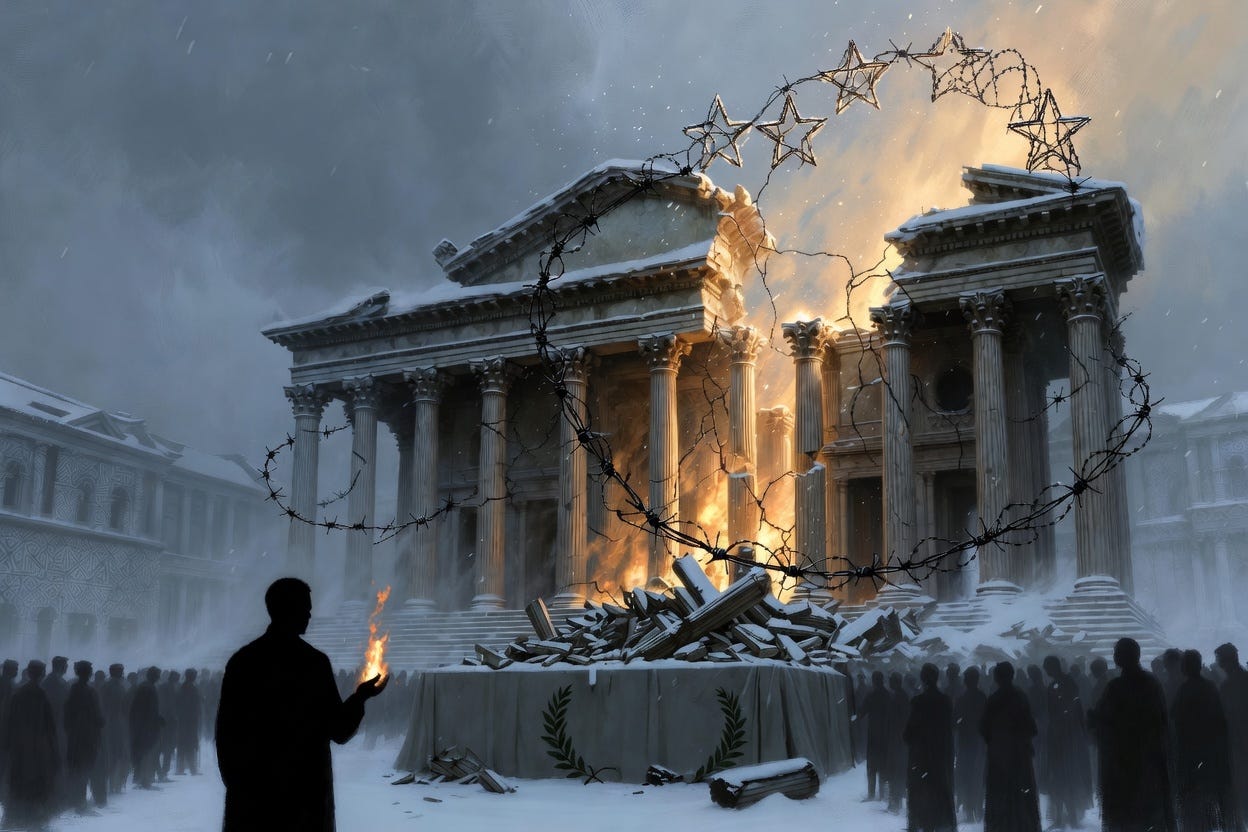
Speculum Orientis, an Iranian immigrant in Italy, argues that the truest respect a guest can show his host is to defend the cultural continuity, historical identity, and civilizational integrity of the nation that welcomed him.
I carry no illusions about the history that shaped this moment. I am from the Middle East, a region carved up by European maps and bled by European greed; the “immigration crisis” rose, in part, from the rubble of nations broken by colonial and post-colonial intervention. I do not defend that record. But my love is not for the system that did the breaking: a liberal machine that has shown equal contempt for the European peasant and the African villager, dissolving all rooted life into a market. I write out of love for culture itself, whether it blooms in Isfahan or in Florence. Many voices already detail the crimes of the West against the rest. It is precisely because those voices are heard, that this essay must take up a different task: to say that Europe’s self-dissolution is not justice, and that the immigrant who truly honors his host must say so.
I arrived in Italy in 2022. I came legally, with a student visa, driven by a sincere desire to understand the West, not through screens, but by living within its ancient walls, reading its philosophers in their native tongues, and walking the same streets that once echoed with the footsteps of Dante and Cicero.
I was born in Iran, raised in a Muslim household, and carry within my blood the memory of another ancient civilization. It is precisely because I come from an old world that I recoil in horror at what I see unfolding across Europe today. And it is precisely because I am an immigrant that I must speak against the immigration policies destroying this continent. My voice cannot be dismissed as “racist” by the left-leaning establishment that immediately demonizes any European who dares to object. If a white Italian protests, he is instantly branded a fascist. But what label can they stick on me, a Persian, a Muslim by birth, who tells you that the open-border dogma is a slow-motion suicide of civilizations?
Every authentic civilization is an organic, differentiated, and vertically oriented whole. A people is not a random collection of individuals bound by a commercial contract called a constitution; it is a spiritual entity, shaped by blood, soil, language, religion, and a shared metaphysical vision. An Italian is not merely someone who holds an Italian passport. He is the heir of Rome, of the Holy Roman Empire, of a Catholic cosmos that sacralized every act of life. An Iranian is the son of Cyrus, nourished by Zoroastrian light and by the mystical love of Hafez, a love that flows from the hidden springs of Sufism itself. These identities are not interchangeable goods in the supermarket of globalism. They are treasures, refined through centuries of joy and agony, and their dissolution is the greatest tragedy of the modern age. As an Iranian, I want to see Iran remain Iranian. As a guest in Italy, it is my profound duty to demand that Italy remains Italian. Anything else is not tolerance; it is the nihilism of the marketplace.
I stepped onto Italian soil dreaming of a world I thought still existed. I wanted to hear the music of the Italian language everywhere, to witness life still woven around the quiet heartbeat of Catholic time, to recognize faces carved by the Mediterranean and an ancient bloodline. I yearned for the smell of a nonna’s kitchen: flour and semolina in the air as her hands shaped fresh pasta. The delicate, buttery fragrance of a cornetto baking in a nearby pasticceria, and the sound of Pavarotti pouring from an apartment window, a voice that was not mere song but the soul of a people made audible.
Yet even as I pursued this dream, I was not naive. I knew that the Italy of Dante and the Catholic cosmos had been bleeding from within for centuries, hollowed out by a rationalism that reduced the world to a machine, by a materialism that substituted comfort for salvation, and by a spiritual exhaustion that made its people forget their own gods. The demographic winter, the retreat into private comfort, the replacement of the cathedral spire with the shopping mall; all this was underway long before the first boat landed on Lampedusa. Europe was not killed by the invasion; she was already in the Leontievian stage of secondary simplification. The present tide of newcomers merely feeds on a body that, through its own internal apostasy, had already begun its organic dissolution.
Instead, what struck me with blinding force was the systematic erasure of that very reality. In many quarters of the city, I hear no Italian. I see not the organic diversity of distinct civilizations, but a chaotic dumping ground where the rootless of the world are aggregated. I am stunned not by the presence of other foreigners, for students and merchants who have always crossed borders, but by the immense scale and the ideological apparatus that incentivizes this ongoing replacement. This is not an accident; it is a policy, promoted by a liberal-globalist establishment that sees rooted peoples as an obstacle to the smooth flow of capital and the creation of a post-human, consumable identity.
Let me explain the perversity of the system from the perspective of a legal immigrant who works and pays his taxes. I follow the law. I contribute. I demand no special privileges regarding insurance, housing, or welfare. But I am surrounded by a state apparatus that constantly incentivizes me to become illegal, to abandon my studies, and to claim refugee status. The irony is grotesque: If I were to betray my legal status and declare myself a refugee, the system would reward me almost instantly. A home would be provided. A monthly stipend would follow. All the mountains of bureaucracy I currently climb, the endless queues at the questura, the Kafkaesque folders of permesso di soggiorno renewals, the labyrinthine documentation of income, insurance, and domicile would mysteriously evaporate. That crushing administrative weight, which for a legal immigrant is a trial of patience and paperwork, shrinks to a few signatures and a swift entry into a parallel welfare track, greased by an ideology eager to manufacture dependents. If I were to enroll in certain study programs under that status, I could earn more than an average Italian worker who has labored his entire life. This is not a myth; it is a documented, structural reality. The host society, the Italian people who built this nation with their sweat and genius, are made strangers in their own land, while newcomers are incentivized to remain strangers, living parasitically off a welfare state that the native taxpayers alone sustain.
The ancient world understood hospitality, xenia, diyafa, the sacred bond between host and stranger, as a vertical obligation, not a horizontal transaction. The guest was bound by a divine protocol: to honor the hearth, to submit to the customs of the roof that sheltered him, to recognize that he stood on soil not his own.
The modern state has usurped this priestly role, but it administers a sacrament without salvation. When it granted refugee status to the Sudanese national in 2023, it was not performing an act of mercy; it was conducting an initiation rite into the church of abstract humanity, a church that demands living sacrifices. Three years later, the cost of that sacrament was exacted from a native Irishman, Stephen Ogilvie, a man who had committed no sin other than existing in the land of his fathers. The state had pronounced the stranger worthy of protection; the stranger pronounced the native worthy of mutilation. The blade that took his eye and ravaged his face was not merely a criminal instrument; it was the materialization of a spiritual severance that began at the border, where the state had already dissolved the guest’s obligation to the soil by declaring all soil interchangeable.
And the state, true to its theology, responded not by repenting of its false judgment, but by condemning the righteous anger of the native population as “unrest.” Here we see the complete inversion of the sacred order: the protector becomes the accomplice, the guest becomes the predator, and the victim becomes the accused. The refugee permit, once a mark of sanctuary, has become a license to transgress. The state, having dissolved the particular bonds of blood and soil in favor of universal legal fictions, finds itself constitutionally incapable of distinguishing between the deserving guest and the invading wolf. In its egalitarian blindness, it has transformed the ancient right of asylum, an exceptional act of communal mercy, into a conveyor belt that delivers the children of the host to the knife. This is the managerial elite’s final cruelty: to make the native pay for his own dissolution, and then to criminalize his grief.
This is not compassion. This is the liquidation of the social bond. True charity is hierarchical and personal, not an abstract bureaucratic machine that buys the loyalty of a foreign underclass to undermine the organic nation. The open-border ideology is ruining European societies, and it does so under the blackmail of “anti-racism.” Any European who points out the crumbling of public safety, the explosion of parallel legal systems, or the sheer incommensurability of certain cultural codes is immediately silenced by the left-liberal establishment. Yet let us speak plainly, without the language of hate but with the cold precision of reality: statistics show that certain immigrant populations, coming from specific civilizational backgrounds, the lowest people of their own societies, possessing a complete ignorance of the common good as Europe understood it, the human sediment that settles wherever open borders allow, commit crimes at a much higher rate. As a man who walks these streets, I can confirm that there are entire zones in Italian cities where I cannot walk without endangering my safety. This is not “racism”; it is a fact of experience. The liberal illusion claims that all humans, stripped of their heritage and placed in a vacuum, will behave identically if given the same “opportunities.” This is the anthropology of the laboratory, not of the world. Man is a being of difference, not of sameness. When you import a mass of people from a civilization whose spiritual and social forms have followed a wholly different trajectory, you are not creating diversity; you are planting the seeds of permanent hostility and the ghettoization of souls.
This leads to the crucial point that the Italian left, in its suicidal folly, is now pushing a referendum to grant Italian citizenship after only five years of residence. Five years! Can a man become Italian in five years? Can he absorb the language in its profoundest nuances, the religion in its lived orthopraxy, the silent cultural codes, the collective memory of the Risorgimento and, along with the scent of a tiglio tree in a Tuscan piazza, an Italian expression or proverb, still used in daily life, that Dante created centuries ago? No. This is a legal fiction that degrades citizenship from a sacred spiritual substance into an administrative stamp. True belonging requires a vertical integration of blood, soil, spirit that may take generations, if it is possible at all. The reduction of citizenship to a bureaucratic formality is the final insult to the soul of a people. It tells the native that his identity is nothing but a legal status up for grabs, and it tells the immigrant that he has no duty to elevate himself into an existing spiritual order; he merely needs to exist in space for five rotations around the sun.
Immigration policies, if they are to exist at all, must serve the people of the land. The first and non-negotiable principle of any sane political order is the privilege of the native. The rights of the historical community are absolute. Everything else, economic growth, demographic supplementation, the whims of global corporations, must be secondary. Europe’s leaders, poisoned by egalitarian hubris, have reversed this principle. They declare that the rights of abstract “humanity” override the rights of real, flesh-and-blood communities to preserve their identity and their sacred difference. This is the essence of the modern world: the dissolution of every qualitative difference into a uniform, liquid mass, controlled by a managerial elite that knows no loyalty except to its own power.
This is why I, from the perspective of an immigrant who loves civilizations, advocate for multipolarity. Multipolarity is the affirmation of a world of great, differentiated organic cultures, each sovereign in its own space. Europe must remain white and Christian, not out of hatred for other races; I am not white, and I am not Christian, but because a Europe that ceases to be these things ceases to be Europe, just as an Iran that abandons its Persian and Islamic core would become a meaningless shell. True diversity is the diversity of peoples, each rooted in their own soil, cultivating their own genius, and relating to one another from a position of strength and mutual respect, not through the chaotic mixing enforced by the melting pot. The melting pot does not work. It never has. What it produces is not a harmonious blend, but a world of suspicion, self-segregation, and simmering resentment. People do not want to mix; they want to remain what they are. The immigrants mass-imported into Europe today do not want to become Italian or French or German. They want to rebuild their home country here, on foreign soil, raising their flags and enforcing their customs. And the liberal state, which hates the native’s identity, actually encourages this parallel society because it weakens any unified resistance to the market state.
The final tragedy is the demographic one. Europe’s native population has been pushed into a demographic winter by the same materialist logic that devalues life, family, and sacrifice. An exhausted, atomized populace produces fewer children. Meanwhile, the system subsidizes the fertility of the newcomers with the taxes of the dying native stock. It is a mathematical certainty: in the near future, if this trajectory continues, there will be no Italy. There will be no France. There will be no Germany. There will be a territory, still called by those names, inhabited by a population that has no organic link to Dante, Molière, or Goethe, a population that will vote, consume, and exist as spectral figures in a universal supermarket. This is not a delirium of the fearful; it is a rational projection based on current policies and birth rates. To name this tragedy is not hate; it is the ultimate act of love for these peoples and their imperishable spirit.
I am an Iranian, a guest in Italy. And it is precisely as a guest that I understand my duty: to honor the host, to defend his house against those who would burn it down, even if those arsonists speak the language of human rights. The revolt against the modern world must be ecumenical. All those who still stand on the side of Tradition, whether they prostrate towards Mecca, kneel before the Cross, or meditate in silence, must unite to restore the sacred order where each people can live and die according to its own soul, in its own land, under its own sun. For Europe to survive, it must again become European, and it must rigorously, unapologetically privilege its own children. Everything else is not politics but the management of a cemetery.
As a final acknowledgment, I do not support violence in any shape or form.

Not long after we immigrated to the United States I was taught as a child about the Melting Pot. In those days, the mid 50s, it was a phrase that denoted pride in the ability of the United States to absorb multiple cultures with the demand that one subsumes your previous culture, usually European at that time, and join the great American experiment. It was not seen as divisive, it was seen as a means to unify, to leave those fractious Europeans behind and willingly join this new world.