

Interview with Acting First Secretary of the Central Committee for Komsomol of the Communist Party of Armenia
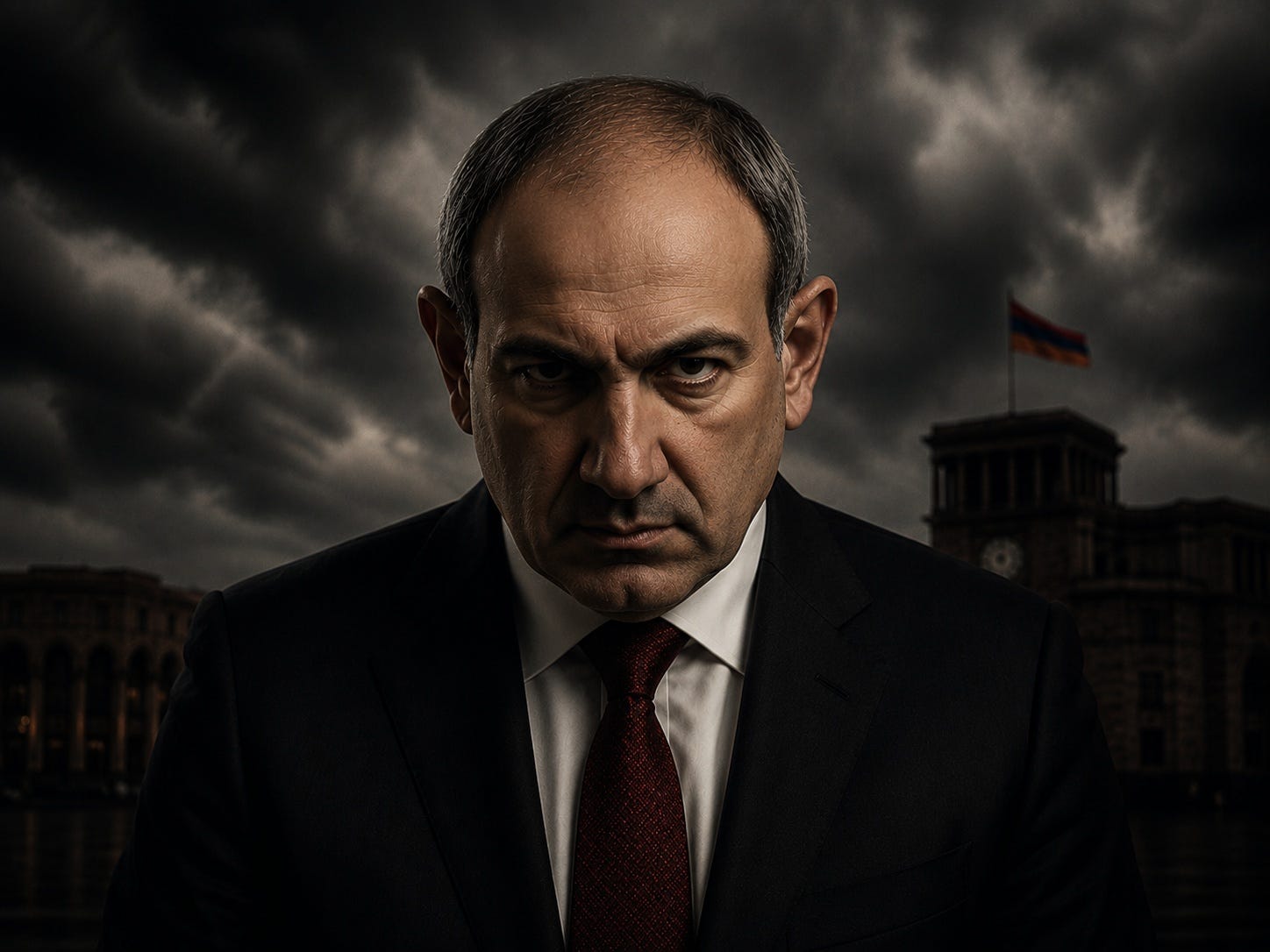
Sebastian Reed speaks with a representative of the communist movement in Armenia, amid a critical geopolitical point where the government of Nikol Pashinyan is pivoting away from Russia and closer to the European Union. As Pashinyan claims victory in the June 2026 election, the future of Armenia looks doomed to repeat past scenarios which took place in Ukraine, Moldova and Georgia.
It’s 2 a.m. Yerevan time right now. To answer the last question... I’m sitting on the couch at home. My wife and son are sleeping in the next room. And I swear, I’m scared. Scared for a future my brain can even contemplate. Scared not just for my family, but for the entire country, and for all the people I know and love. Scared for my people, who have already suffered so much in their lifetime. I’m terrified of what could happen to my people again. Just 115 years later. Two days left until the elections. Tomorrow morning, the day of silence begins. And the day after tomorrow, no matter what my people do, no matter how they vote, the future seems bleak to me at best…
To begin, could you introduce yourself, tell us about your background, career, and the experiences that shaped your political worldview? How would you define your current political position, and do you associate yourself with any party, movement, or ideological tradition in Armenia or abroad?
Hello. I’ll answer each question separately. I’m the Acting First Secretary of the Central Committee of Komsomol and a member of the Communist Party of Armenia. I first joined the party four years ago and became a member a year ago. Before joining the party, I already had a certain knowledge of Marxism and a clearly defined ideological vector. However, my path was arduous. I’ve been interested in politics and history since I was 9 or 10 years old. And, of course, first and foremost, the history of my country and its people. It’s a very long history, spanning approximately 3,000 years. Studying such a long period of history, even from a nationalist perspective—the only one we had—certain patterns emerge that can’t be explained by anything other than dialectical materialism. Thanks to a blogger, Dmitry Puchkov, I learned about the ideological basis of communism. Historians of communist views often visited him at the time.
So, from then on, I began studying Marxism and the history of communist movements around the world in more detail. I was 15 or 16 years old at the time. And so here I am, 26. Ten years have passed, and my confidence has left no doubt, and my knowledge has deepened. There have been some ups and downs along the way. At times, I leaned toward nationalism, sometimes toward cosmopolitanism, but ultimately, I cast aside all these adolescent vacillations and chose the path that led me to the party.
The Komsomol line is orthodox Marxism. However, we allow room within the organization for alternative interpretations. This gives us the opportunity to work with diverse population groups and ideological leanings around the world. We are not afraid to listen to other interpretations of the goals of the communist movement, and we are not afraid to express our own interpretations. Under these circumstances, this is the best and most pragmatic approach.
How do you assess Nikol Pashinyan’s leadership in the current political climate? To what extent does he retain public legitimacy, and is his proposed turn toward the West perceived by ordinary Armenians as a pragmatic necessity, a risky gamble, or a betrayal of traditional alliances?
So, firstly, in the Third Republic of Armenia, no government has ever shone with legitimacy except the first, and then only for a very short period of two or three years, until the people recovered from the nationalist frenzy. Secondly, Pashinyan has always been someone who knows how to garner political capital. His entire career has been populism in the worst sense of the word. In my observations, any decision he makes is based on two factors. The first is how popular the decision is currently, and the second is how much potential it can generate for hype. And the decision regarding Russian-Armenian relations is no exception. He doesn’t care about the economic or long-term consequences for the country. He only cares about the political capital he can extract from the situation and the potential for further promotion. The fact that the Armenian economy will collapse after abandoning cooperation with Russia within the Eurasian Economic Union doesn’t interest him one bit. What matters is his popularity and the marketing techniques his team employs.
And what about the people? He’s accustomed to being pushed around and unable to do anything. The people are afraid. And not without reason. The level of political repression in our country is off the charts. Constant jailings of opposition figures, persecution, unreasonable and unproven accusations, and so on.
It’s even reached the point of persecuting the relatives of opposition-minded citizens. For example, a member of our party received a call from home. His mother was crying and begging him to cease his political activities. She worked in a ministry and received a clear demand: either force her son to give up his activities or lose his job.
Another example. An Armenian-language communist blogger from Argentina was forced to delete all his video content from the “Commune” channel. His relatives in Armenia were threatened with dismissal, and their children were even threatened with expulsion from school.
If this isn’t a classic dictatorship, what is? So the people will be neither for nor against it. He’s simply accustomed to being bullied and held under the strictest oppression for 40 years. And resistance breeds even greater oppression and greater problems. After all, there’s no one to wage a fight without ending up in the same boat. The entire opposition is the same dictators of the past or those who imagine themselves as such in the future. And at the same time, they’re the same populists talking about freedom and independence.
This brings to mind the words of a certain Ukrainian rapper:
<< Words of freedom in snake tongues.>> This is our reality.
When we talk about a “pivot to the West,” what does this mean in practice: in terms of policy, security guarantees, economic integration, and democratic reforms? And most importantly, has the West demonstrated a willingness to provide Armenia with real material support, or is this rapprochement still largely symbolic
To answer this question, I must return to the previous one. Armenia’s entire economy depends on trade with Russia by more than 40 percent. A sudden abandonment of this would be catastrophic. So I don’t think the government is counting on that. I think they were hoping for a gradual rejection of everything related to Russia and a transition to complete dependence on Europe. However, this approach ignores the fact that Russia is also an active participant in foreign policy and involves treating Russia as a large, immovable rock. You can move away from it, but the rock won’t go anywhere, and when the sun gets too hot, you can return and relax in its shade. I’m willing to bet that our government officials haven’t even considered Russia’s role as a subject. But Russia is not a rock. And it won’t stand idly by as its adversaries encroach on its sphere of influence. Russia has launched a plan to exert economic pressure. Armenian goods have been restricted from entering the Russian market, to the point of being completely unavailable. Products made in Armenia have been banned from accessing Russian marketplaces like Ozon and Wildberries.
This is just the beginning. After Pashinyan’s victory, Russia is preparing to raise gas prices, which will be an absolute disaster for Armenia. How will the government get out of this? They won’t. The bourgeoisie that seized power will simply sell everything on time and flee into the sunset to the French Riviera, London, or wherever. And we’ll be left with empty pockets, freezing in the mountains in winter without gas. That’s what will happen to our country under the “Civil Contract” party.
On the other hand, some describe Pashinyan as soft or even friendly toward Turkey, sometimes claiming he downplays the tragedy of the Armenian Genocide. What, in your opinion, is Pashinyan’s and modern Armenia’s attitude toward Turkey and the 1915-1923 genocide?
You’re absolutely right to call it a Turkish puppet. And of course, our party as a whole, shares this view. There are many reasons for this. From the interesting pasts of various government officials, to the occasional Turkish foundation, university, and politician connection, to the fact that Pashinyan and his cronies do everything they can to avoid disturbing Turkey and Azerbaijan. It’s reached the point of political jargon and ceremonial peculiarities. For example, the word Artsakh is forbidden. And the director of the Institute for the Study of the Armenian Genocide was fired from her job for daring to give Jaydee Vance a book containing the word Artsakh. This is appalling. Even a caricature. Armenia is essentially a dictatorship on the level of Batista-era Cuba and Bokassa-era Central African Republic, and the ruling party pretends to have created, as its representatives say, a “bastion of democracy.”
The only difference between the two aforementioned dictatorships and Pashinyan’s regime is that in Armenia, they don’t kill yet; they imprison. But I think the worst is yet to come, and dark times await us.
And naturally, everything we see, from the political strategies used by his party in Armenia to the talk of peace with the transfer of Armenian territories to Azerbaijan, clearly and unambiguously hints at their connection to, or even complete subordination to, Turkish and Azerbaijani structures.
There’s often a gap between official political rhetoric and the actual mood of society. How do ordinary Armenians perceive Nikol Pashinyan today? Is their support or opposition to him driven more by ideology, economic conditions, or the emotional consequences of military defeat?
In fact, it’s a bit of everything. Each of the aforementioned components has its place in the opposition. But the most important component is ambitious bourgeois clans. They are united by common financial interests and also have great potential to become a center of capital concentration in Armenia. Today, the Karabakh clan, which allies with Kocharyan from the opposition, is in the ascendancy, while from the government, the Sukiasyan brothers, who have vast resources and various assets throughout the country, from banks to manufacturing. There are also several less stable clans, or even hypothetical clans, that are formed temporarily to achieve a specific political-economic goal. Each clan has a party or parties that serve its interests. Some of them are headed by well-known business oligarchs.
This is the main source of the opposition’s formation. It is the money of the bourgeois clans. Accordingly, the opposition is little different from the ruling Sukiasyan clan and other oligarchs who have joined the government.
And the people? They have a choice. Who exactly will rob and profit from the people more than anyone else?
However, with Pashinyan as a variable, things are no longer so simple. Pashinyan’s policies could lead to the destruction of the country and lead to catastrophe. And, of course, the authorities are trying in every way to contrast themselves with the former government and contrast themselves with it, reminding us why the people rose up and overthrew the government in 2018. Meanwhile, the opposition talks about past victories in 1994, about Artsakh’s enormous foreign debt, the lack of visible social change, and so on.
And no one can break this vicious circle. The people are simply tired. All the money is in the hands of the oligarchs and their tame parties. Any new blood in politics is either bought with money most could never imagine, or the new political force is initially determined to find a cozy place for itself under the wing of the capitalists and bask there.
The Communist Party, however, has no sources of funding because it doesn’t sell itself to anyone. This is precisely why it doesn’t fit into the generally accepted understanding of politics among the Armenian public.
It’s also important to note the Russia-Europe discourse. This is one of the most important aspects of political agitation. Accusations of mutual espionage are the norm in our politics. These accusations are primarily made by the authorities, accusing them of spying for Russia. In the event of counter-accusations, opposition members risk imprisonment. This is precisely why the opposition speaks less about espionage. Our political arena has become a cheapened theater. And this is very disappointing.
How has the regional balance of power changed since the start of the US-Israeli war against Iran? Has this situation pushed Armenia toward closer cooperation with its Western partners or, on the contrary, increased its caution, given its geographic and defense limitation
To understand how our government thinks, one thing must be understood. It doesn’t act out of considerations of national security. It doesn’t act out of considerations of its own security, for those needs have already been met. It doesn’t act out of considerations of even the country’s existence. It acts out of purely petty-bourgeois considerations of how to make more money. And, of course, being pro-Turkish at their core and pro-Western in their agenda, our government and its representatives don’t bother at all with thoughts of regional policy and security. On February 28, when the attacks on Iran began, our country launched its prime minister’s election campaign. When more than 100 children died in a bombing at a school in Minab in a neighboring country, the Armenian prime minister was busy eating corn on camera as part of his campaign. The connection between eating corn and the election campaign may be unclear to the reader. However, his political strategists have quite skillfully found a method of psychologically influencing the population. Corn is considered an inexpensive food in Armenia. By doing so, the prime minister wanted to demonstrate once again that he is flesh and blood of the people, unlike all his electoral competitors. So our government cares about regional security, the balance of power, foreign policy, or even domestic politics only to the extent that it affects their wallets. Even if it affects their political reputation. Even then, their own wallets are more important to them, since they need a reputation not for great achievements, but only to fill their wallets.
However, regarding our party’s position on the Iranian issue, we unequivocally support the people of Iran and their sovereignty, despite everything that has happened to the communists in Iran since the 1970s. And despite the brutal confrontation between communists and Islamists in Iran. However, as has already been said, our government is absolutely unconcerned about this. During the entire war between the US and Israel on one side and Iran on the other, there was only one telephone conversation between the Iranian and Armenian Foreign Ministers, in which the Armenian Foreign Minister offered to send humanitarian aid to Iran. No one else discussed anything with Iran.
And, based on the above, we can essentially conclude: our government has absolutely no position on the Iran issue.
Given the upcoming elections, are there any authoritative political figures or movements today that could pose serious competition to Nikol Pashinyan? If so, how do they differ from the current leadership—ideologically or strategically?
Yes, there are certainly parties capable of challenging Nikol Pashinyan. A total of 18 parties are participating in the elections. There were 19, and one filed a withdrawal request. Of these 18 parties, in my opinion, only 6-7 have a chance of entering parliament. And of these, 4 are guaranteed to enter. The first is the ruling party itself, the Civil Contract. According to all polls, it has a lead, but not an absolute one. The second is the Strong Armenia party, created before these elections by Samvel Karapetyan, a Russian oligarch of Armenian descent. Samvel Karapetyan has a total net worth of approximately $5 billion.
Next is the Armenia bloc. The Armenia bloc consists of several parties, the main one, the largest of which, is Tashnaktsutyun. The Tashnaks are known for their historically anti-communist leanings and are nationalists, but they position themselves as socialists and are members of the Socialist International, which I consider one of the greatest injustices. The list of this bloc of parties is headed by Robert Kocharyan, the second president of Armenia. He served as president from 1997 to 2008. At that time, Armenia was a presidential republic until the constitutional reform of 2016, when the country was declared a parliamentary republic. In 2008, Robert Kocharyan handed over power to his fellow party member, Serzh Sargsyan, with whom he now has a very poor relationship, despite the fact that Serzh was his comrade-in-arms. He, like Robert Kocharyan, was a participant in the First Karabakh War. In fact, he was the first president of the Nagorno-Karabakh Republic from 1992 to 1996. Many people will vote for him, but whether it will be enough for the bloc of parties to enter parliament is a question. For a bloc of parties to enter parliament, at least 7% of the vote is needed, while for a party to enter parliament, 4% is needed. Personally, I believe Robert Kocharyan will receive approximately 10-12% of the vote. The next candidate who might garner enough support to enter parliament is Arman Tatoyan and his Wings of Unity party. Arman Tatoyan was the former Deputy Minister of Justice of Armenia in the 1990s and also a human rights defender in Armenia. He has a fairly good reputation among certain circles, especially intellectuals and young people interested in politics. But whether that’s enough, I don’t know. The next party that will garner enough votes to enter parliament is Gagik Tsarukyan and his Prosperous Armenia party. Unlike Samvel Karapetyan, Gagik Tsarukyan is a purely Armenian oligarch who conducted all his activities in our country and made his money from Armenian workers and their exploitation. Essentially, he’s a feudal kinglet who has turned his small homeland, the city of Abovyan, into his personal fiefdom. And, essentially, he can run this city however he wants. Which is disgusting. However, he enjoys widespread support among the poor and is very religious, which also adds to his support among religious Armenians.
He also enjoys widespread support among athletes, as he has headed the Armenian Olympic Committee for a long time, right up to the present day. He is known as a great philanthropist. He has helped sick children, athletes who lacked sufficient funds to continue their careers, and so on. He has a very ambitious project to build a statue of Jesus Christ. This statue is intended to be larger than the one in Rio de Janeiro. Construction is currently underway. Essentially, it is a project to build a huge shopping mall around this statue. Other political parties, in my opinion, have little or no chance of entering parliament. For example, the pro-European “In the Name of the Republic – Defenders of Democracy” Party of Arman Babajanyan is essentially not an independent political force. They are literally hired hands of the French embassy, as well as the embassy of the European Union. For the sake of correctness, I should note that this is my personal opinion. So, as you can see from the above, there are very few worthy political forces in our country. Specifically, there are none at all among the most well-known and popular ones.
How would you assess the current state of political pluralism in Armenia? Can opposition figures operate freely and competitively, or are there legitimate concerns about political pressure, legal prosecution, or informal restrictions? In this context, do you see any similarities or significant differences between Armenia and countries like Ukraine or Moldova in their approach to opposition groups perceived as pro-Russian?
This is a very funny question. Our government is trying to create the image of a very peace-loving, democratic (in the bourgeois sense, of course), and modern government. However, in reality, quite harsh political repression is taking place within the country. A huge number of opposition figures are in prison, while not a single government official is behind bars. The opposition in our country, especially the pro-Russian opposition, which constitutes the bulk of political forces in the country, is persecuted. As I noted above, the mayor of Kyumri, Vartan Ghukasyan, is in prison because of his opposition statements. Several mayors of other cities are in prison because of their affiliation with the opposition party. Representatives of the highest clergy are in prison because of their conflict with the ruling party. Anyone who in any way could pose a threat to the continuation of power and to Nikol Pashinyan personally as prime minister will be imprisoned. Even the leaders of opposition parties are in prison. Popular opposition podcast hosts, who have garnered hundreds of thousands of views, are also in prison—a significant number for Armenia. The authorities are trying to find any possible formal pretext to lock up opposition figures. It could be anything: a careless remark that could be classified as slander. A drunken brawl in a bar ten years ago, or even if a current opposition figure had connections to the administration during the previous government. A simple miscalculation turns into rampant corruption. I won’t deny, of course, that corruption has existed and continues to exist in Armenian society. Moreover, its rate hasn’t slowed down, but rather increased. But what’s interesting is that only those corrupt officials who are unfavorable to the authorities are being imprisoned.
From this, I conclude that they are being imprisoned not for corruption, but for opposition political statements. Overall, it’s normal. You can register a political party within the law, with absolutely any ideology, absolutely anywhere, and with any number of people. But only as long as you don’t hinder the government’s efforts to reproduce itself. As for Ukraine or Moldova, Ukraine is certainly far from us. People weren’t imprisoned there, they were killed. As for Moldova, we’re openly discussing the concept of a “Moldovan scenario.” And it’s believed that the Moldovan scenario will be implemented in the upcoming elections. That is, several days before the elections, some political parties will likely be banned on formal, legal grounds. Essentially, today the entire state security apparatus serves not the people, but the Civil Contract party and its interests. It has been transformed into a vast repressive mechanism, the essence of which is to suppress protests, seek out and isolate opposition figures who have a voice in society, while at the same time formally maintaining the appearance of being a highly civilized, democratic Western country. All of this, of course, is in quotation marks.
In your opinion, how did the collapse of the Soviet Union impact Armenia politically, economically, and culturally? What long-term structural changes—both positive and negative—still shape Armenian society?
This is another topic on which one could write a vast, multi-volume treatise. But I will try to be as concise and brief as possible. The collapse of the Soviet Union effectively began in its active phase with the outbreak of the Karabakh conflict in 1988. Thanks to this conflict, the domestic politics of Armenia and Azerbaijan changed so much that even a hint of internationalism became a betrayal in the eyes of society. People who had gone to school, college, and the army together, who had grown up in the same village, were now forced to hate each other. And if they did not succumb to this mass psychosis, they were considered outcasts within their own national communities. Most of these people were forced to simply move to Russia, where the traditions of internationalism still partially survived. Not to mention mixed Armenian-Azerbaijani marriages. And the children of these marriages. To sum up, this was not a national catastrophe, but an international catastrophe. All peoples involved in this conflict suffered. And everyone was forced to choose a side. There were even isolated cases where Armenians fought for Azerbaijanis, and Azerbaijanis for Armenians. But the fate of these people was usually very tragic. People of mixed descent, of whom there were many in Karabakh, were forced to choose one side of the family. It was effectively ethnic cleansing based on national identity on both sides. Only rarely among the field commanders of that war were there people uninfluenced by radical nationalism. On the Armenian side, such a person was Monte Melkonian. He died from a shell from an infantry fighting vehicle in 1993, during the war. His ideas, unfortunately, never gained widespread acceptance in Armenian society, despite his status as a national hero of Armenia, which was awarded posthumously. The result was mutual interethnic hatred between Armenians and Azerbaijanis, the complete destruction of the concept of friendship between peoples.
And anyone who dared to mention it would be considered a traitor. Personally, I often encountered the argument that it was impossible to be friends with the murderers of one’s relatives. After 2020, this hatred only intensified. So, the collapse of the Soviet Union resulted in the complete degradation of public life and a contraction of the economy by more than 50-70 percent. For comparison, Soviet Armenia had an economy comparable to that of Spain. The absolute and complete degradation of cultural life also befell Armenian society. Due to the destruction of Soviet institutions and state sponsorship of all cultural sites and events, there was simply no one left to finance culture. As a result, only bourgeois culture began to develop—that is, culture that could be sold. And sold profitably. And at that time, only nationalism could be sold profitably. For the vast majority of society was infected with this disease. Thus, the fall of the USSR resulted in nationalists taking control of the state. And this continued in Armenia until 2018, when the nationalists were replaced by liberals. More specifically, liberal globalists. Led, of course, by Nikolai Pashinyan. The country’s entire economic structure was also reforged for capitalism. As a result, a country with enormous industrial potential began producing only what benefited the global financial elites, including those of Russia, France, and America. For example, the only heavy industrial facility remaining in Armenia from the Soviet era is the Zangezur Copper and Molybdenum Plant. It produces enormous quantities of molybdenum, which is sold to Russia, China, Europe, and many other countries around the world. Armenia accounts for 10% of the country’s northeastern copper and molybdenum deposits. There was another similar copper and molybdenum plant, which was comparable in production volume. However, it was destroyed. Its final destruction occurred in the 1920s. Overall, all Armenia gained economically from the collapse of the USSR was famine, poverty, and a lack of fuel until the late 1990s. It also suffered political and economic isolation from both the west and the east. The entire eastern border became a front line, as did Armenia’s southwestern border with the Nakhichevan Autonomous Region. Turkey, meanwhile, became a supremely unfriendly country, having always supported culturally related Azerbaijan in the Armenian-Azerbaijani conflict. A positive change. I can only note one thing. It was a rise in national consciousness, and only for a short time. Specifically, only for the first half of the 1990s. Then, as Marx wrote, the bourgeois system of society transformed everything into lucre, erasing all the chivalrous prejudices of the old society.
To what extent do elements of the Soviet-era political culture (such as centralized power, clientelism, or a power-state mentality) still influence decision-making in Armenia? Are they weakening or merely adapting under the new elites?
The Soviet legacy is actually typical for almost all CIS countries. However, each country used it in its own way. Armenia decided to slowly but surely move away from these traditions over time, initially in favor of nationalist rhetoric and an attempt to reforge Soviet governance systems to suit nationalism, removing anything that didn’t fit.
Then, the corrupted remains of this system fell under the steamroller of the liberal globalist system created by Pashinyan, who is a supporter of the idea of a self-regulating market. This means there’s no need to do anything. The market will regulate itself. So, unfortunately, little remains of the Soviet legacy in Armenia today.
Following Armenia’s loss of control over Nagorno-Karabakh in 2023/2024, how would you characterize the current state of Armenia’s relations with Russia? Did this moment mark a decisive break, a strategic reassessment, or merely a temporary strain within a historically close alliance?
What happened in 2023 is largely the fault of the Armenian state. The fact is that the Russian peacekeeping contingent was obligated, according to the October 7 agreement, to protect the population of Nagorno-Karabakh and prevent any threat to their lives, as well as to ensure the right of the Armenian population of Nagorno-Karabakh to live in their historical homeland, that is, Nagorno-Karabakh. Almost none of this was fully implemented. And despite the fact that the agreement was concluded for five years, the peacekeepers remained there for only three. They only had enough strength to evacuate the population to special regions, from where they were then evacuated to Armenia, a total of approximately 120,000 people.
The Russian peacekeeping contingent even suffered several casualties during the evacuation process. And in most cases, these were soldiers and officers who were protecting the Armenian population from the Azerbaijani army by their own choice. Honor and praise to these people.
However, as you understand, the result was the ethnic cleansing of the Nagorno-Karabakh Republic, its destruction and abolition. A huge number of civilian casualties, deliberate attacks on civilian targets by the Azerbaijani army, which were not met with systematic resistance from Russian peacekeepers. And this is a fact. The Armenian people have a right to be outraged by this, in my humble opinion. However, as I have already said, the lion’s share of the blame for the loss of Nagorno-Karabakh lies with the Armenian government, which, firstly, withdrew the Armenian army from Nagorno-Karabakh, in accordance with the documents signed on October 7. Secondly, Nikol Pashinyan signed a document in Prague removing any claims Armenia had against Azerbaijan. From that moment on, Armenia effectively renounced its role as patron of Nagorno-Karabakh and its Armenian population, delegating all this to Russia. Russia, for its part, perceived this as assistance to the Republic of Armenia, its ally. While Armenia has ceased to be interested in the fate of Nagorno-Karabakh, Russia has deemed it pointless to independently pursue its own interests in Nagorno-Karabakh while its main forces are engaged in a special military operation on Ukrainian territory. Nikol Pashinyan, with his pro-European Civil Contract party, is exploiting the justified discontent of the Armenian people to advance his own political interests. All his talk of diversification actually implies one thing: making Armenia dependent not on Russian capital, but on European capital. For Armenia, this could be an absolute disaster. I’ve already described why.
Given Armenia’s tense relations with Russia following the events in Nagorno-Karabakh, is Armenia truly capable of pursuing an independent foreign policy, or will it inevitably be forced to trade one sphere of influence for another?
I believe I’ve already answered this question. However, I’ll repeat it. Armenia is a country that has been in economic and political isolation for decades. Armenia has no fossil fuels of its own and no political structure capable of withstanding long-term isolation, like North Korea’s. Armenia lacks a powerful army capable of defending itself, defending its homeland, or even... from its neighbors. Our western neighbor is Turkey, with its 350,000-strong army. Our army, at best, has 80,000 soldiers. In reality, it’s even fewer. Our country lacks modern technology in the military, economic, or any other sphere, and is generally quite technologically backward. It lacks extensive manufacturing capabilities, as all production facilities... or almost all of them were destroyed between 1991 and the 2010s. Armenia is a country that cannot effectively function independently without skillful diplomacy and serious societal changes. Only then will our country be able to claim sovereignty.
How has the loss of Nagorno-Karabakh changed Armenian national identity and political consciousness? Does it foster a desire for reform and realism, or, conversely, does it fuel revanchism and distrust of both allies and adversaries?
Well, the short answer is a bit of everything. A better illustration might be the list of parliamentary parties, or rather, those participating in the current elections. There are pro-Russian parties there, which believe that the turn toward Europe led to the loss of Nagorno-Karabakh. There are pro-Western parties, which consider Pashinyan a traitor for not having done enough to end Russian influence in Armenia. There are nationalist, reformist, and all sorts of other parties. But there are simply no leftist parties there. Communists, especially not. Thus, the loss of Nagorno-Karabakh has had different impacts on different segments of society. And the result has been the formation of various politically motivated circles, which strive for different goals and appeal to different audiences. But, as I already said, among these various forces, not a single communist one.
Based on both personal experience and political analysis, how would you describe how ordinary Armenians perceive Azerbaijanis—and vice versa? To what extent are these views shaped by historical memory, state narratives, and the recent conflict over Nagorno-Karabakh? Do you see real room for reconciliation at the societal level, or are disagreements becoming more entrenched?
In short, Azerbaijan suffered from Weimar syndrome for decades. That is, a crushing defeat, an insult to the nation, and so on. The ruling faction in Azerbaijan took advantage of this and fueled public hatred against Armenians. And against any Armenian. Almost the same thing happened in Armenia. However, the narrative was somewhat deeper. The fact is that in Armenia, we rarely pronounce the word “Azerbaijani.” To us, they are the same Turks who live west of the Araks.
They share almost the same language, the same culture, and even proclaim the concept of “two states, one people.” In fact, this is one possible starting point for a pan-Turanian project.
As a result, the hatred of Turks, which stems from the Armenian genocide in the Ottoman Empire in 1915, is very easily transferred to Azerbaijanis, which is also a variation of Weimar syndrome. Following the war with Azerbaijan in 2020 and the destruction of Karabakh in 2023, two parallel tendencies have become dominant in Armenian society. One is the tendency of fear. Fear of war as a horrific, inhumane phenomenon, and the understanding that everything, absolutely everything, must be done to prevent war from breaking out. This includes making any compromises, and sometimes even unilateral concessions. The second tendency is revenge. The desire for revenge, the desire to kill perceived enemies in the same way they killed relatives, friends, or acquaintances. The vengeful spirit also has strong potential for development in Armenia. So far, the pacifists are winning. However, everything could change. Both tendencies, if left unchecked, are capable of destroying the very concept of the Armenian people. This also poses an existential threat.
In conclusion, what future do you envision for Armenia under current conditions, and what future would you prefer—is it different from what you expect? (Include a final summary or concluding statement.)
It’s 2 a.m. Yerevan time right now. To answer the last question... I’m sitting on the couch at home. My wife and son are sleeping in the next room. And I swear, I’m scared. Scared for a future my brain can even contemplate. Scared not just for my family, but for the entire country, and for all the people I know and love. Scared for my people, who have already suffered so much in their lifetime. I’m terrified of what could happen to my people again. Just 115 years later. Two days left until the elections. Tomorrow morning, the day of silence begins. And the day after tomorrow, no matter what my people do, no matter how they vote, the future seems bleak to me at best. And what would I like to see? I think my membership in the Communist Party and the fact that I’ve been involved in the communist movement for years answer that question. Long live the revolution!
