
Santander Wallaby explores one of the twentieth century’s decisive geopolitical confrontations and its lasting consequences for world politics.
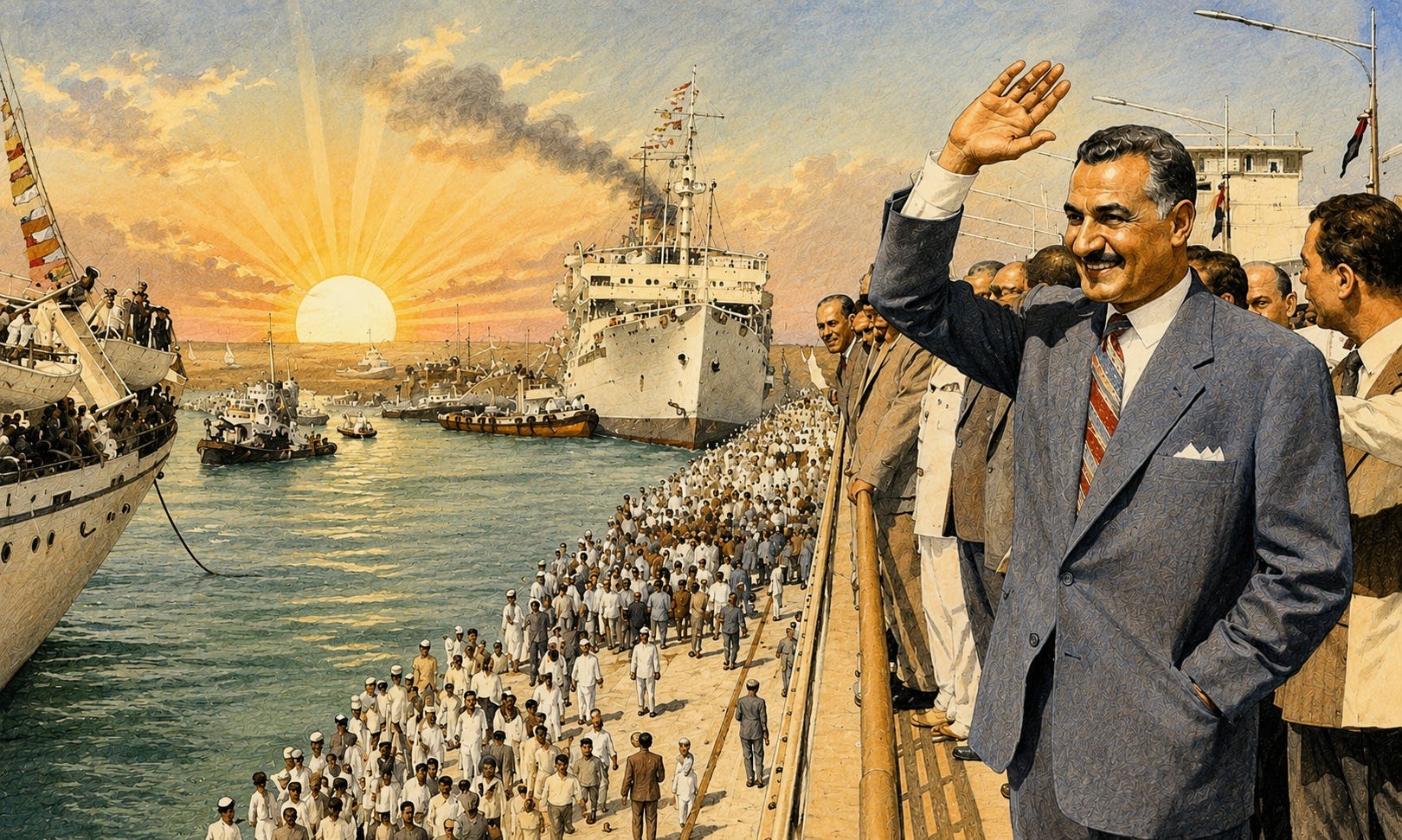
On 26 July 1956, Egyptian President Gamal Abdel Nasser stood before a vast crowd in Alexandria and declared that the Suez Canal would no longer remain under foreign control. His opening words, “Lift your head, my brother, for the days of oppression belong to the past and the canal stands under our control,” captured more than the mood of a single nation. They expressed the conviction that political sovereignty means little without control over the strategic arteries that sustain a state. Speaking for three hours before tens of thousands gathered in Liberation Square, while millions more listened by radio across Egypt and the wider Arab world, Nasser transformed a practical economic decision into a declaration of civilizational independence. Four years earlier, he had helped overthrow King Farouk in the Free Officers’ Revolution, ending a monarchy closely tied to foreign influence. Now he sought to complete that revolution by reclaiming one of the world’s most important maritime passages. Genuine sovereignty cannot exist where decisive economic and strategic assets remain subordinate to outside powers. The nationalization of the Suez Canal therefore embodied the transition from formal independence to actual independence, from political symbolism to effective control over national destiny.
The announcement itself demonstrated remarkable preparation and discipline. Nasser carefully delayed the decisive moment until every practical measure had already been set in motion. Throughout his speech, he repeatedly mentioned the name of Ferdinand de Lesseps, the French engineer associated with the canal’s construction in the nineteenth century. To the audience, it appeared to be a historical reference, yet it served as the agreed signal for Egyptian forces waiting across the country. In Cairo, Port Said, Ismailia, and Suez, military units immediately occupied the offices of the Compagnie universelle du canal maritime de Suez, the company through which British and French interests exercised effective control over the waterway. Only after these operations had succeeded did Nasser publicly reveal that the canal had become Egyptian property. The crowd erupted in celebration. The decision was already irreversible. Historical turning points require decisive political will rather than endless procedural debates. Power belongs to those prepared to act at the critical moment, securing facts before opponents have time to respond. Nasser’s operation illustrated precisely this principle. Sovereignty was established through action, transforming the balance of power before diplomatic protests could alter the outcome.
What transformed a single national decision into a global geopolitical earthquake?
