

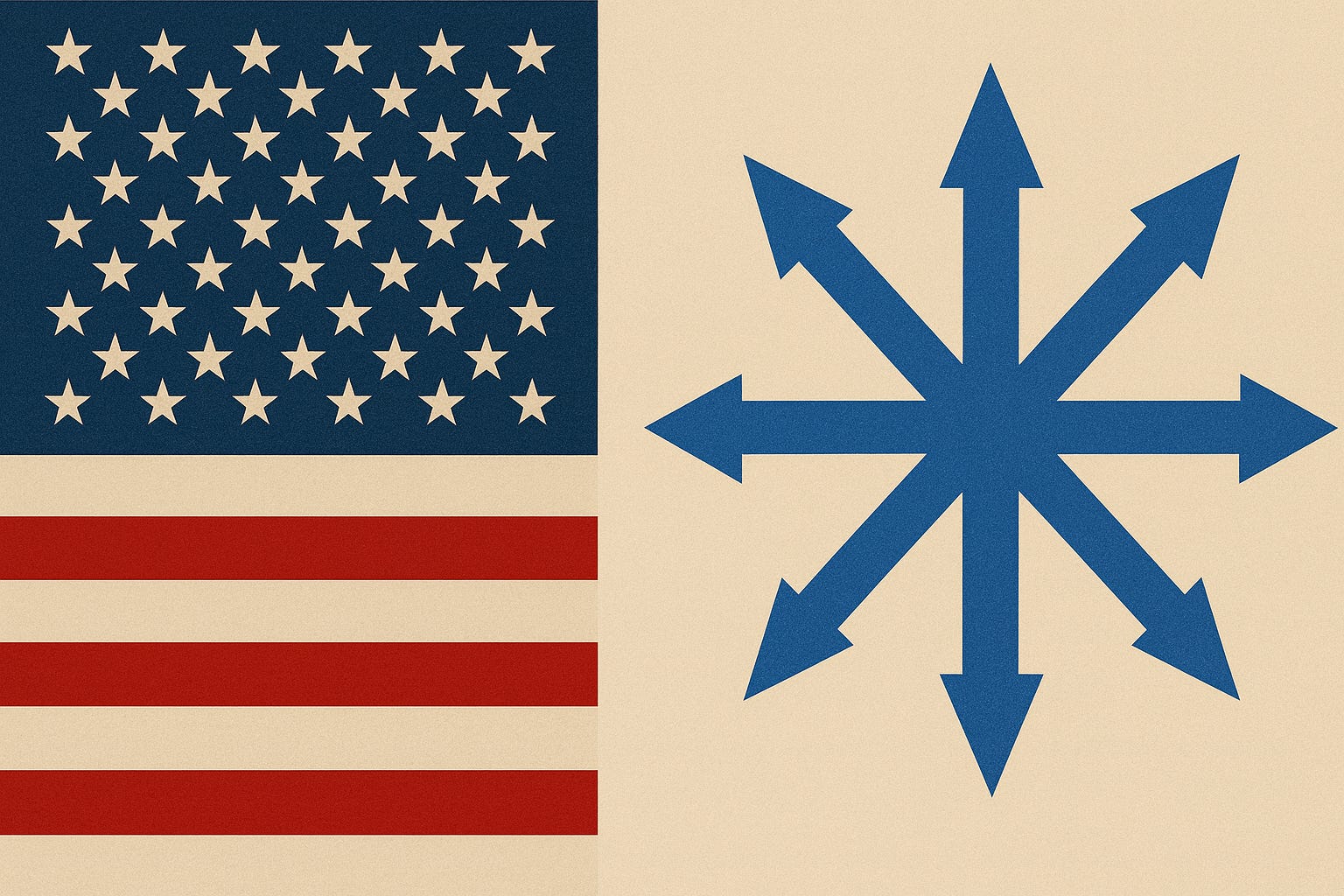
Phisto Sobanii, a Florida teacher, reveals how America’s rising generation senses the sunset of the unipolar order and reaches instinctively for a civilizational future.
You compose because you want to somehow summarize in some permanent form your most basic feelings about being alive, to set down some sort of permanent statement about the way it feels to live now, today.
— Aaron Copland
As a public high school social studies teacher in rural Florida, I get an enormous amount of practice explaining things to people from all over North America. Usually it’s with young men and women, but sometimes to my colleagues and students’ parents. I refine my arguments and method over and over again. In regards to multipolarity, what follows is some of what I’ve learned and some of what I see for the future. Whatever your interest in the matter, here are some things you should know. Perhaps they are novel, perhaps not, but in the end I pray they are useful.
In class, when it comes to political discussion, it seems to me the only real question on anyone’s mind is, “What’s coming?” The global order many of us teachers have known since childhood is shaky at best, with stresses of all types bearing down on our once proud Republic. At the local level, these anxieties among the people reveal themselves in three orientations. First is toward the past, where the glories of our previous unipolar dominance will somehow be again. The second is hiding in the present, stuffing one’s head in the endless scrolling of technological distracting sand. The third dare strides into the future, perceiving the contours of the coming multipolarity.
I like to think of myself as a member of that third group. Part of that is temperament, as I’ve always had an interest in the meta-political. More relevant to my calling as a teacher, I consider it a sacred duty. Pondering the future, and being welcome in the broader discussion of it in places like Multipolar Press and beyond, allows me to see and understand the musings of my betters and bring those higher things back to my students. The future will be theirs soon enough and so I play my role as a guide to what may or may not be.
I’m happy to humbly report that the best and brightest of my classes find multipolarity deeply compelling. Their eyes light up, their speech quickens, and that unique energy of a young mind crackles. It strikes them as true and worthy of investigation.
There seem to be three reasons for this. First, they are primed for valuing a diverse world by their current so-called “culture.” At the same time, they, being high schoolers, are skeptical enough to sense the lies within the actual totalitarian unipolar framework. They know people have never been parts of a machine to be interchanged at the whim of corrupt, deracinated elites. “Diversity” is easily revealed as a ploy to enslave us in monoculture. Balance is required to defend the nations and so multipolarity’s civilizational empires safeguarding cultural uniqueness speaks to the young. This naturally flows into the second concern, which is their rootedness. Many here are connected to the land, with families stretching back generations. They understand the importance of place, of home, and so they value protecting it. The third factor is closely related to the second. Our community is growing relatively rapidly, with newcomers arriving every day. They seek to guard the roots they’ve just set down in a place they will find special, just as I did when I arrived years ago.
Therefore we see the ground clearly as fertile, so what are the challenges? Hopefully surprising no one, it is an old, simple foe: ignorance. It is up to us to till the ground and plant the seeds. Philosophy, history, and geography are not valued like they once were, and certainly not at all in public schools. Fortunately, as stated above, the bright students have a better grasp than most and so have fewer hurdles to understanding. For the rest, a simple explanation of North American geography is often enough to get their minds moving. The oceans are vast, just like our coasts, rivers, and natural resources. Bleeding out our people and treasure in global adventures is not required for the prosperity of us common folk. Everyone welcomes this and instinctually remembers the uselessness of dying far away in unknown lands across the sea.
So what is to be done with this? For readers of this publication especially, how can we use it to hasten the multipolar order? How can we help the people of America realize their best manifest destiny sooner rather than later (or not at all)?
Our current situation cannot last much longer. It shambles forward like a zombie monstrosity, slavishly devoted to liberalism for the mere sake of it. Its rotted, soulless masters are completely devoid of all of history and hope for the future. For enlightening my fellow Americans, I recommend the following: take my above description of the younger generation’s soil, couple it with the principles discussed in publications like Multipolar Press and elsewhere, and water that growth through the lens of Paul Kingsnorth’s latest book Against the Machine.
To show what I mean, take first from this excellent and challenging work what Kingsnorth calls the “Four Ss” of the Machine. These are the key corruptions enabling America’s role as the cornerstone of the unipolar world. The form in which they are elevated marks them as enemies of any future multipolar America. Part of our mission is placing them back in proper order, subservient to our will.
Science. Where we come from. Science can offer us a non-mythic version of this story, and assert a claim as to the true (i.e., measurable) nature of reality.
The Self. Who we are. The highest good is to serve the self and ensure its longevity.
Sex. What we do. Both the highest means of sacral pleasure and, through public expression of “sexuality,” an affirmation of individual identity.
The Screen. Where we are going. The screen is both our main source of distraction from reality and the interface by which we are directed into the coming post-human reality of the Machine.
Cast these demons down with the pillars of properly human culture, which Kingsnorth identifies as the “Four Ps”:
Past. Where a culture comes from, its history and ancestry.
People. Who a culture is. A sense of being “a people.”
Place. Where a culture is. Nature in its local and particular manifestation.
Prayer. Where a culture is going. Its religious tradition, which relates it to God or the gods.
The final lens is perfectly summarized by Michael Warren Davis in his review of the book:
At its heart, Against the Machine is about what it means to be a disciple of Jesus Christ in the modern West.
All this as a gateway for Americans. Perhaps not the answer to “What’s coming?” but at least the compass to navigate it. For common men like myself, my students, and our communities, the turning of history sweeps us up into the tempest. But in the midst of that process we can find paths; even more so with guides like you and I. We must embrace the specific Four Ps of America, clearly communicate how multipolarity secures them, and thereby help this great nation transcend its unipolar end for the benefit of all.
Our past is the history of North America’s Anglo- and Latin-descended peoples. We are currently in conversation, like Romulus and Remus at the founding of Rome, and the result of that will dictate much of the continent’s future character.
Our people are the same: Anglo and Latin. Black Americans inhabit the step below and must aspire to an equally sophisticated culture. It behooves us to loosen them from the nanny-state arrested development of “Civil Rights” and condemn the worst impulses of their degenerate ghetto culture. Setting aside further discussion of hierarchy, these three groups are the only possible citizens of North America. Anyone else, should they choose to prove their loyalty with action, are welcome residents. Cast the lazy, corrupt, and malevolent into the sea!
Our place is North America, a continent without compare. With oceans to the east and west, tundra desert to the north, and brothers-in-arms to the south, we lack for nothing. Here multipolarity provides its greatest promise as the world won’t need us to police it. As we trust in the strength of our hemisphere, so can we trust in the strength of our rivals to maintain balance across the globe.
Our prayer is Christian. Only the Cross grants victory over the neopagan screens of the transhumanists who, through the Machine, prepare the way for the Antichrist. May news of revival prove true and my fellow Americans return to faith en masse.
In the end, we must remember one important point: our civilization is still very young. Too much of our so-called “progress” has been down the wrong path. Time will tell if we can turn back and overcome, but if the minds of my noblest students are any indication, discovering the truth hastens the great boon that is multipolarity.
And only then will we, for really the first time, hear America’s morning fanfare.

Excellent.
You are spot on about our past - the American tradition is rooted in an English tradition (that the English elite have been working harder than our own elite to cast overboard). The entire notion of rights from those traditions is highly specific, not universal. It is the universalization of "human rights", that are truly an Anglo-American cultural product, is where we've gone astray - particularly with Wilsonian internationalism (perhaps the cornerstone of the unipolar conceit and tied to Protestant theology).
Which leads to where you go wrong. We are not a nation of blood heritage, we have an Enlightenment credal heritage. That heritage is open to people who do not look like us or originate from a small set of countries, but aspire to the same things. We are a nation of cast-offs (really, what the hell better description is there of a Puritan?) and misfits (people who wanted what their native societies would not grant them - liberty most pre-eminently). Where that has gone wrong is with the abandonment of the melting pot view of America in favor of a clan/tribal reconstitution. By applying a blood heritage, you are indulging in the same error as the cultural left that has rejected the traditional process of assimilation.