Multipolarity Against Entropy
What lies beneath the age of globalization
Kazuhiro Hayashida on why the struggle between multipolarity and unipolarity runs deeper than geopolitics.
The essence of the confrontation between multipolarity and unipolarity lies deeper than a difference in the distribution of power within international politics, and can be understood as a confrontation between civilizational structures themselves over how the increase of entropy within the social order is to be processed. Civilization is a long-term social structure constructed in order to place human beings, land, vocation, family, religion, the state, memory, and the temporal axis within a certain order, thereby suppressing disorderly dispersion; in this sense, civilization can be said to be a system that restrains the increase of social entropy.
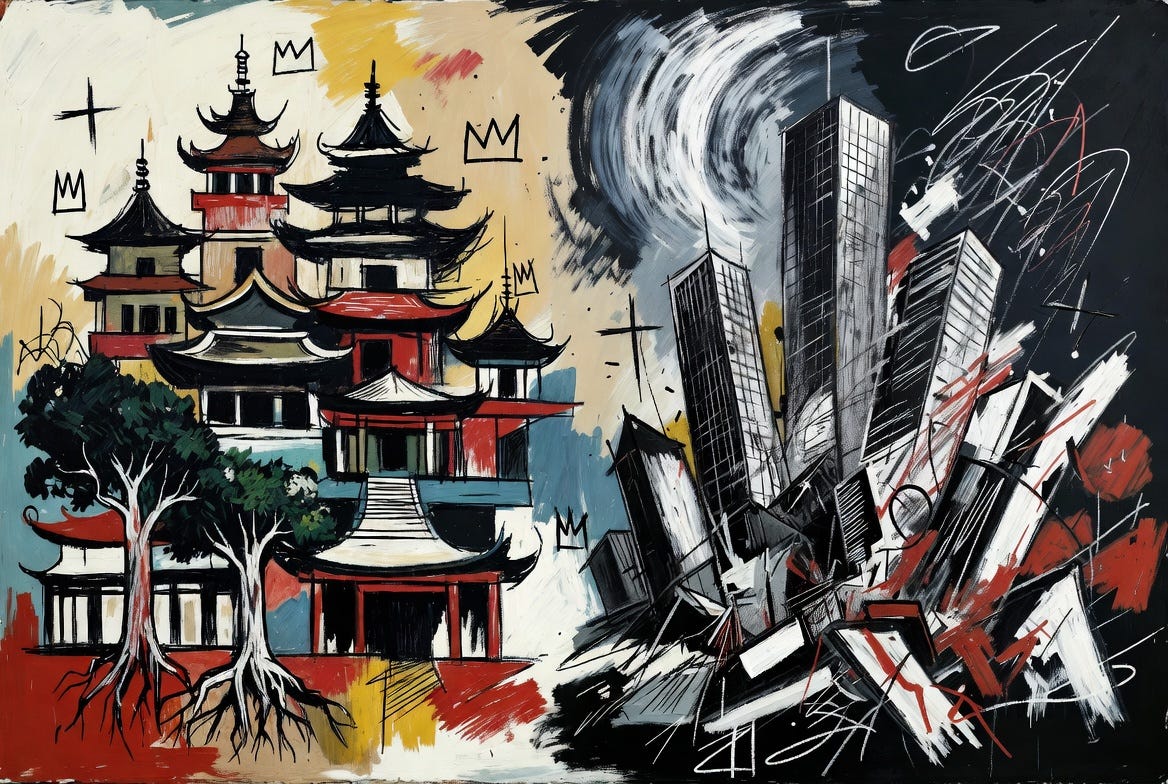
Eastern civilization has carried out this suppression of entropy through a multipolar arrangement. Eastern order can be described as a multipolar arrangement in which multiple centers exist, each maintaining its own boundaries, memory, rites, royal lineage, community, religion, and vocational order, while standing adjacent to one another; it is a structure that controls the friction arising when civilizations come into contact by preserving the distance within which different things can exist while remaining different. What is important when understanding Eastern civilizational order is boundary rather than unity, and mutual distance and non-interference rather than homogenization or equality.
By contrast, Western civilization replaced the suppression of entropy with a single particle and attempted to implement it through a principle of unification. It sought to create order by converging the world into one value, one institution, one temporal axis, one progressive view of history, and one view of humanity. The single particle established for this purpose is liberalism, which regards the individual as the smallest unit of the world. Liberalism separates human beings from civilization, community, religion, family, vocation, royal lineage, state protection, and historical memory, and places them within a linear sequence of individual, rights, freedom, and autonomy; at that moment, Western order internalizes within itself the cause of its own collapse. This is because the absolutization of individual rights brings them into collision with the rights of other individuals existing within the same space, and that collision is repeated without limit.
Furthermore, fragmented individuals lose their capacity to resist ruling forces because their formation into collective bodies is obstructed. When structures such as civilization, community, vocation, religion, family, state protection, and historical memory are preserved, human beings do not exist in isolation as individuals, but are placed within multiple relationships, and those relationships generate collective judgment and resistance. Liberalism severs these relationships as old frameworks that restrict individual freedom, and by transforming society into an aggregate of fragmented individuals, it destroys common sense, customs, traditional values, and the historical temporal axis, thereby constructing a society that is easy for the government and the market to centrally manage.
Modern neoliberalism is the contemporary form of domination in which this liberal principle of entropy increase has been completed through the market, finance, institutions, and technological management. Neoliberalism dislocates individuals who have been separated from civilization by liberalism through the market, contracts, prices, debt, finance, investment efficiency, and international standards. What is important here is that before neoliberalism can marketize society, it must first dismantle the civilizational fixed forces that obstruct marketization. Land, vocation, family, religion, state protection, and historical memory retain criteria of judgment that cannot be processed solely by market prices, and as long as they remain, the market cannot become the highest criterion for society as a whole.
Based on the above, we can understand that the purpose of neoliberalism is not market expansion. What neoliberalism truly requires is the dismantling of civilizational fixed forces that exist outside the market, and the conversion of structures that obstruct marketization, such as land, vocation, family, religion, state protection, and historical memory, into units that can be processed through price evaluation, contractual relations, capital mobility, and investment efficiency. Since civilization determines, according to criteria different from market prices, what may be sold and what must not be sold, what may be transferred outside and what must be protected, what must be refused even when profitable, and what must be maintained even at a loss, neoliberalism must dismantle this civilizational mechanism of judgment.
In a society where civilization remains, the market functions as a tool. In a society where civilization has been dismantled, the market becomes the criterion of judgment. Land changes from homeland into real estate; vocation changes from apprenticeship relations and responsibility within the community into skills in the labor market; family changes from a site of generational continuity into an aggregate of individual contracts; religion is reduced from the foundation of world order into a private value; and the state is transformed from a vessel of civilizational protection into an investment environment. Through this series of transformations, society is not liberalized but priced, and moves into a condition in which it can be bought, moved, relocated, evaluated, and discarded.
Neoliberalism attacks civilizational fixed forces as inefficiency, closure, discrimination, privilege, antiquity, and irrationality. Vocational communities are treated as closed vested interests, family systems as old institutions that bind individual freedom, religion is reduced to private belief, and state protection is processed as an obstruction to market competition. In this way, the low-entropy structures that supported society are dismantled, and society is made fluid. A fluidized society becomes a condition easily reorganized from the outside through finance, international institutions, contracts, and technological management.
This structure also connects to the market theology seen in America and the EU. When the market is treated as a sacred self-regulating order, civilizational obligations that do not submit to the market are processed as old orders that ought to be sacrificed. The sacrifice of human beings in obedience to the demands of the market is justified in the name of economic rationality, and poverty, unemployment, inequality, war, and even industrial destruction are processed as judgments issued by the god called market. Within this structure, the very existence of God, king, community, state, and civilizational obligation above the market becomes an obstacle. The reason neoliberalism dismantles civilizational bonds can also be explained as a working condition of this market theology.
Japan’s postwar structure is a concrete example of this civilizational dismantling. Through occupation, Japan was deprived of the right to speak of its own provenance, and lost the capacity to grasp past, present, and future as a continuous temporal axis. Even the basic fact that the United Nations was a structure of defeated-state management formed by the victorious powers of the Second World War disappeared from Japanese recognition. This is not a lack of knowledge, but a condition in which the temporal axis required to understand provenance itself has been destroyed. The liberal value system gave the Japanese people abstract words such as democracy, humanitarianism, and international society, but as the price for this, it deprived them of the ability to understand where their own country is positioned within the world system that defines Japan as a defeated state.
A state that has lost its provenance cannot judge what it is. Through the methodological operation of liberalism and neoliberalism, America succeeded in causing Japan, while located in Asia, to borrow Western values, and while standing at the contact surface of the East, to internalize the interests of American continental civilization as its own conviction. In a condition where it possesses no civilizational core of its own, Japan cannot assert its own values in contact with other civilizations. Into that emptiness flow American values. This phenomenon is the civilizational hollowing that occurs when Japan is cut off from connection to the civilizational core of the Eurasian continent, and it becomes the fundamental reason why Japan, while existing in Asia, behaves as a Western watchtower. The successful destruction of a country with such a long history and civilization as Japan can be said to demonstrate how this theory is applied in order to dominate various countries through template-like procedures that are never publicly disclosed.
The collapse of historical recognition can be explained through the same structure. Multi-layered historical structures such as the Nanjing Government, the Chongqing Government, Soong Ching-ling, the left wing of the Kuomintang, the founding of the People’s Republic of China, the complex relationship between the Japanese Army and the Communist forces, the Soviet-Japanese Neutrality Pact, the Manchukuo Army, the Shaan-Gan-Ning Border Region Government, and the remaining Japanese soldiers cannot be grasped without parallel temporal axes. The liberal view of history compresses this multi-layered structure into a single-layered chronology. As a result, crude binary diagrams such as Taiwan or the mainland, democracy or dictatorship, pro-American or anti-American emerge. This is at once a phenomenon in which the content of history has been lost and a phenomenon in which the spatial recognition required to understand history has been destroyed.
From these facts, liberalism, neoliberalism, unipolarity, and the increase of entropy can be defined as one continuous structure. Liberalism is the principle of order dissolution that appears in every age, and neoliberalism is its modern market, financial, and institutional form. Unipolarity is its form in world order. The increase of entropy is its civilizational consequence. Liberalism abstracts the concrete bonds that constitute society, and neoliberalism processes those abstracted units through the market. Unipolarity unifies that processing on a global scale. As a result, society loses its center, boundaries, memory, vocation, religion, family, and state protection, and moves into a high-entropy condition.
Multipolarity is civilizational control against this process. Multipolarity suppresses social entropy by allowing each civilization to maintain its own center, boundaries, memory, vocational order, religion, state protection, and family structure. Multipolarity is not an ideology that unifies the world into a single standard, but an order form in which multiple civilizations maintain their internal orders while coming into contact and controlling the friction at their contact surfaces through boundaries and distance. Here lies the strength of Eastern order. Investiture systems, royal lineages, rites, religion, community, vocation, family, and land should be understood as civilizational technologies for suppressing social entropy.
The true right and the true left are also redefined within this structure. The true right preserves land, religion, royal lineage, family, the state, and historical continuity. The true left preserves the people, vocation, labor, communal protection, and the anti-government proletarian impulse. The two are not left and right placed inside liberalism. They are the two wings that resist, from different sides, the dissolution of order by liberalism. On the shortened liberal line, the right and the left are arranged as enemies, but when viewed in a circular manner, the two wings stand directly opposite liberalism.
The essence of multipolarity versus unipolarity is the confrontation between entropy suppression and entropy increase. Eastern multipolarity preserves social order through multiple civilizational centers and boundaries. Western unipolarity attempts to unify the world through a single standard, individualism, and marketization, and in that process decomposes society from within. Neoliberalism is the contemporary form of domination that executes this decomposition in the name of the market, finance, institutions, and technological management. Liberalism is its spiritual principle, unipolarity is its form of international order, and the increase of entropy is its consequence. To defend civilization means to restore the temporal axis, to redefine what cannot be bought and sold, and to reorganize a society moving towards infinite decomposition around shared centers of meaning: boundary, memory, vocation, religion, family, and the protective functions of the state.
(Translated from the Japanese)


