

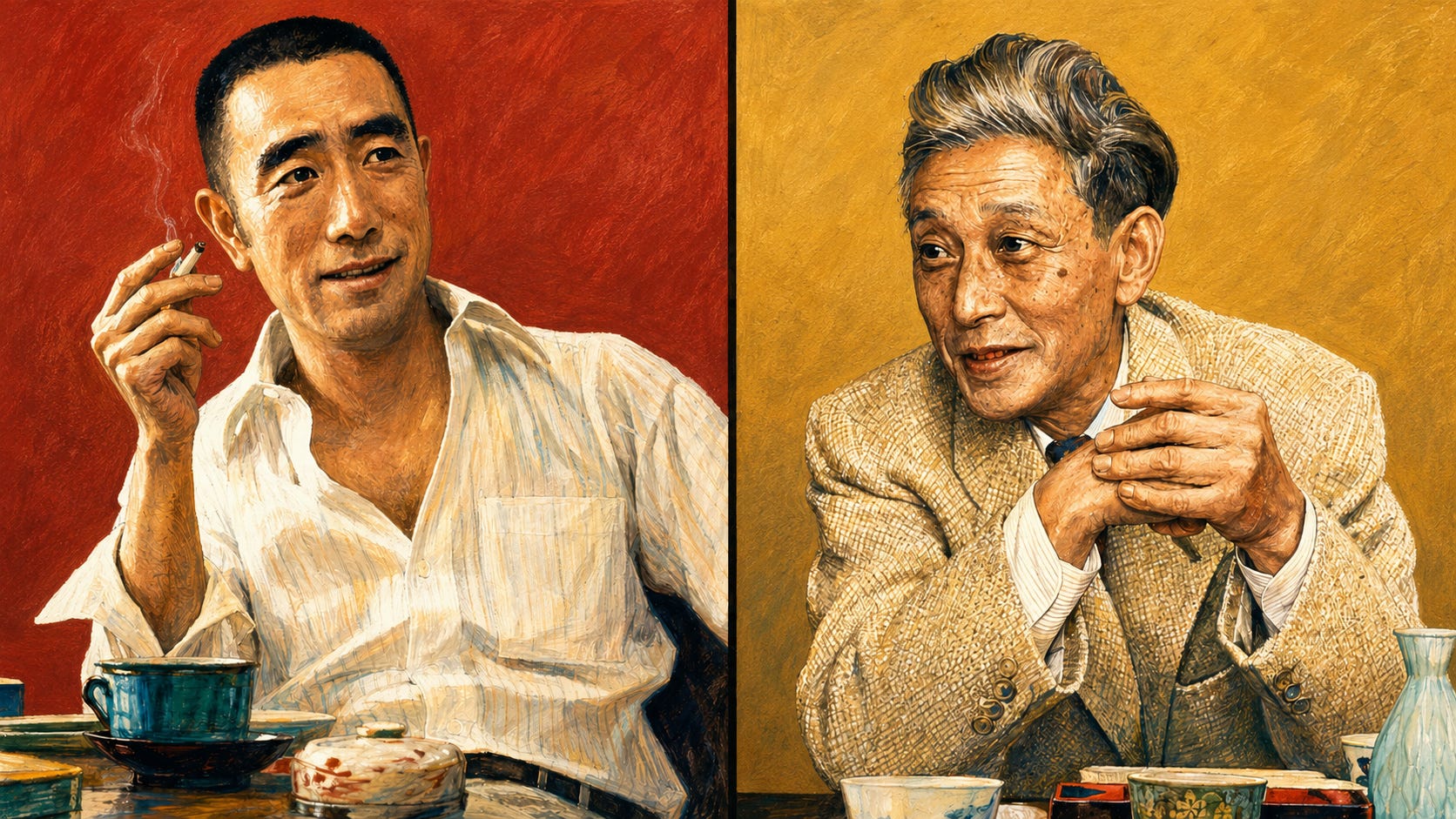
Chōkōdō Shujin enters the charged 1957 encounter between Yukio Mishima and Hideo Kobayashi, where beauty becomes a terrifying force of form, sacrifice, and resistance to the modern world.
When one contemplates the idea of pure beauty, it reveals itself not as mere aesthetic, but as something far more profound, something that is almost terrifying in its intensity. Beauty reigns as a force binding the fleeting to the eternal; beauty is the golden gleam of a temple caught in the dying light of the sun, of magnificent flames consuming a structure that has stood unviolated for centuries. Beauty insists upon its own existence, even as it wounds the beholder. Beauty is inseparable from pain. As Mishima writes in The Temple of the Golden Pavilion, “Beauty—yes, beauty is like a decayed tooth. It rubs against one’s tongue, it hangs there, hurting one, insisting on its own existence.” This same terror, this same insistence, permeates the 1957 dialogue between Hideo Kobayashi and Yukio Mishima, which I have translated as “The Form of Beauty.” The exchange, while nonchalant, is laden with the gravity of true criticism. The dialogue focuses largely on Mishima’s novel, in which beauty is a destructive presence that “attacks, overpowers, robs, and finally destroys.”
Kobayashi, the elder, opens the conversation with his typical “common sense” manner. “I read it and, well, what I felt when I read it was that it was more of a lyric poem than a novel. In other words, if you want to make it into a novel, you have to write about what happens after the burning. There are no real interpersonal relationships, no social relationships.” Here, the form itself becomes the absolute; the reconstruction of the burned Kinkaku-ji temple only sharpens the wound that beauty has created. Mishima describes the rebuilt pavilion with what one could interpret as quiet menace: “It’s shiny gold. And when the setting sun hits it, it feels like it’s shining right on your skin.” Kobayashi, a proponent of intensity over ornament, remarks that even Cézanne avoided the word “beauty,” preferring instead “intense,” or “strength,” as the word itself had grown too soft, too accommodating to the modern eye.
Yet the dialogue does not linger on such casual commentary. Kobayashi warns his younger interlocutor, quite directly, “If there is anything to fear in you, it is your talent… Your talent is so excessive that it becomes a kind of magic.” And Mishima’s protagonist, in the novel that inspires this discussion, confronts the final, far more sinister implication: “When people concentrate on the idea of beauty, they are, without realizing it, confronted with the darkest thoughts that exist in this world.”
This aesthetic of beauty as a force that wounds, overpowers, and leads towards annihilation finds perhaps its deepest resonance in the earlier writings of Ryūnosuke Akutagawa. In his final writings, and even in the very manner of his death, Akutagawa revealed beauty not as consolation, but as the threshold to the abyss. Beauty is inseparable from the shadow of death, a perfection so absolute that it dissolves the self. Kobayashi, who had long been ambivalent regarding Akutagawa’s legacy, and Mishima, who inherited that lineage of beautiful young death, meet here across the years in unspoken recognition. True beauty is never merely decorative; it is a discipline that demands everything, even the burning of the golden temple, even the bitter silence that follows.
The conversation between these two titans of Japanese literature emerges as far more than literary gossip when seen from such a vantage point. It is a reaffirmation that form alone endures as the absolute amidst the vulgarities of the postwar age. In this interview, one sees beauty restored to its rightful place. Beauty is hierarchical, intuitive, sacred, the last bulwark against a world that would strive to reduce all reverence to trite sentiment.
The Critic as Custodian of Classical Beauty
Born in 1902, Hideo Kobayashi entered into a world already torn between the old order and the new.
He came of age amidst the rapid, almost violent transformations of Meiji and Taishō Japan, a period rife with contradictions. Kobayashi entered the French literature department of Tokyo Imperial University and graduated in 1926; even so, his true formation came not from his studies, but from an intuitive fusion, a duality, as it were. The intense symbolism of Baudelaire and Rimbaud stood on one side, while the ancient, unyielding purity of Japanese classical texts stood on the other. This double inheritance forged in him a critic who never bowed to the abstract, the fashionable. Beauty, for Kobayashi, was never a concept to be dissected by reason; it was a lived intensity, a form that revealed itself only to the disciplined eye capable of surrendering to its terror and its order.
Kobayashi began his career as a writer of fiction; stylistically, his earlier works are reminiscent of Akutagawa or Takeo Arishima. As these pieces earned him little acclaim, driven by financial need, he soon turned to literary criticism. By the early 1930s, he had already become the central figure of modern Japanese criticism. In 1935, he serialized his Life of Dostoevsky, a work that depicted the Russian master as a mirror for Japan’s own spiritual homelessness. Regarding this, he wrote, “History represents on a grand scale the bitterness and regret of humanity.” He would later deepen this historical sense in his essay on Cézanne, claiming that “[h]istory is a strange thing. Time passes irrevocably, and because of this, we can only try to recapture the past based on the present.”
The same year saw Kobayashi launch his famous attack on the shishōsetsu, that is, the confessional I-novel that was so fashionable at the time. He lambasted the self-indulgent softness inherent in the genre, calling instead for a criticism rooted in form, in the absolute demands of the work, itself. These early writings foreshadowed his later turn away from the anxieties of modernity towards the classics. He especially focused on doomed artists and poets who had paid the ultimate price for their vision. He wrote of van Gogh, “Soon the song of madness had taken hold of him and never let go of him for the rest of his life.” And of Akutagawa he observed, “He wandered, chasing the shadow of grace, chasing the shadow of destiny.” On Baudelaire he was similarly unflinching, “He is the captive of life, but death is not his possession either.” In Critic, Disqualified, Kobayashi set down the iron law of true perception: “Through art one can understand life, but one can never understand art through life.”
After the war, that turn became decisive. While many intellectuals rushed to embrace the democratic freedoms imposed from outside, Kobayashi stood in opposition to this “leveling” tide. He refused the false, easy optimism of reconstruction, sensing that true renewal could come only through a return to the intuitive consciousness of ancient Japan. In the ruined landscape of postwar Japan, he saw art as defiance, even as few were aware of this. As he later wrote, “Although everyone wants to have an understanding of art as a form of culture, there is no awareness that the world of art actually exists as a major force of resistance against modern culture.” His essays on Mozart, van Gogh, and the classical tradition culminated in the labor of decades: the monumental Motoori Norinaga, completed and published in 1977, his final and perhaps most ambitious work. There, he recovered the eighteenth-century scholar’s “way to things” (mono ni yuku michi). This was a path of pure, unmediated perception, rejecting all intellectual overlay and restoring beauty to its rightful place as the immediate, almost divine encounter with reality.
In that same spirit, Kobayashi upheld form as the last absolute. This was not the rigid formalism of the academy; it was the living, intuitive discipline that alone could bind the transient to the eternal. He saw clearly how the novel itself had become the enemy of form. “The world of novels has always been a world that destroys form, a world dominated by that kind of perceptual power. Modern man has become accustomed to a world that is in tune with the method of science, which denies form.” Beauty, in his vision, was never democratic; it was never intended for the masses. Beauty demanded hierarchy, reverence, and the courage to face its darkness. The word “beauty” itself had grown treacherous: “The word beauty is a strange word; the more aestheticians start using it, the more those who are passionate about the work of beauty dislike it.” He warned that even the purest intuition of form could be compromised. “It is better to criticize an object than to intuitively perceive its form, better to say it is true than to say it is beautiful.”
It was this elder Kobayashi, already in his mid-fifties, who sat down in 1957 with the young Mishima. In the dialogue, he appears exactly as one would expect. Here, Kobayashi is no longer the critic; he is the arbiter elegantiarum transmitting an unbroken tradition of aesthetic order to a younger generation poised on the edge of both greatness and catastrophe. In his life and in that conversation, one sees the same truth that he spent a lifetime defending: that beauty, when truly apprehended in its form, is the last remaining path to spiritual wholeness in an age that has forgotten its own home.
The Artist as Warrior of Aesthetics
Yukio Mishima was born Kimitake Hiraoka during the twilight years of Taishō Japan. He was raised in a strict traditionalist household dominated by a grandmother who instilled in him both aristocratic refinement and a morbid sensitivity to the darker edge of beauty. Much to his father’s chagrin, the pale, skinny boy who would become Mishima discovered literature early, first through the tales of the Heian court, then through the Romantics and the Japanese classics. These works shaped his lifelong devotion to form. By the age of nineteen, he had already published stories under his nom de plume—or perhaps nom de guerre. Then, in 1949, at twenty-four, Confessions of a Mask brought him to the forefront of the literary scene. There, he laid bare the tension that would define the whole of his existence: the veneer of polite civilization versus the true, violent self beneath. “What people regarded as a pose on my part,” he wrote, “was actually an expression of my need to assert my true nature, and that it was precisely what people regarded as my true self which was a masquerade.”
Yet Mishima was never content to remain a mere confessional novelist. His aesthetic deepened into a finely articulated philosophy of disciplined beauty, rejecting the spinelessness of postwar democracy. In The Temple of the Golden Pavilion—the very novel at the heart of the 1957 dialogue—he gave form to beauty’s tyranny. “To see human beings in agony, to see them covered in blood and to hear their death groans, makes people humble. It makes their spirits delicate, bright, peaceful. It’s never at such times that we become cruel or bloodthirsty. No, it’s on a beautiful spring afternoon like this that people suddenly become cruel... Every possible nightmare in the world, every possible nightmare in history, has come into being like this.” And in the novel, he had already diagnosed the poison that lay at the core of beauty: “Indeed, of all the kinds of decay in this world, decadent purity is the most malignant.”
By the 1960s, Mishima had fused his art with the warrior ideal. Sun and Steel became his manifesto of the body as a sculptural form. He trained rigorously, became a bodybuilder, and practiced kendō. He subsequently founded the Tatenokai, a private militia of university students sworn to defend the Emperor and the ancestral spirit of Japan. In his 1968 lecture at Waseda University, Mishima confessed the evolution that had carried him beyond mere aestheticism: “In the beginning, I was an art supremacist. I believed that all I had to do was defend the castle of art. But that isn’t sufficient for a man to maintain his spirit.” Beauty, for him, was never passive contemplation; it was a commanding existence. “Beauty is a crippling existence as well,” he wrote. “They must serve their own beauty for the rest of their lives. Everything but beauty must be sacrificed.” And in The Way of the Samurai, he distilled its martial essence: “Beauty is not beauty for the sake of being loved. It is a beauty of strength, for the sake of appearances and to avoid losing face.”
“The way of the Samurai is death,” Mishima wrote in the same piece. This fusion of aesthetic absolutism and samurai rigor reached its sacrificial climax on November 25, 1970. On that fateful day, Mishima and four members of the Tatenokai seized the Ichigaya Self-Defense Force base, harangued the troops on the shame of the postwar constitution, and then, in perfect ritual form, he performed seppuku. The act was not suicide in the modern sense. It was the final, flawless expression of his aesthetic: beauty attained through heroic death, form preserved in the single, glorious moment of annihilation. As he had written in Voices of the Heroic Dead, “How will our love at the risk of death be fulfilled? How intense will be our joy in death and how full of joy will our hearts be if, at that moment, a voice of great purity comes down to us and says only: ‘Die.’”
It was this Mishima, already in his early thirties, his vision sharpened and his body forged by sun and steel, who sat across from the elder Kobayashi in 1957. In the dialogue, one senses the younger man’s deference to the critic who had first taught the absolute value of form, even as Mishima’s own words already carried the prophetic fire of the warrior-aesthete he would become. Kobayashi saw the danger and the glory in that excessive talent that Mishima embodied. Together, they affirmed what both knew: that true beauty stood as the last aristocratic bulwark against an age that had traded form for comfort, order for equality. In Mishima’s life and, especially, in his death, the heroic ideal found its most brilliant and most tragic fulfillment.
The Form of Beauty
The conversation between Kobayashi and Mishima moves in intuitive leaps rather than systematic argument. It begins with the rebuilt Golden Pavilion and subsequently drifts into the deeper themes of lyricism, talent, form, and the resistance of true art against the postwar age. There is no agenda, only revelation. One could say that beauty is not discussed; rather, it is confronted.
Kobayashi, having just finished reading Mishima’s novel, perceives it at once as possessing the concentrated intensity of lyric poetry, rather than the extended architecture of conventional fiction. Mishima concurs at once that no drama is established. The work remains locked within the isolated subjectivity of its protagonist. Its lyrical passages arise precisely because the narrative refuses to venture beyond the burning of the temple into any realm of social entanglement. The real-life reconstruction of the pavilion itself only heightens the wound; the haste and expense of its restoration, the vague rumors surrounding the original arson, and the discomfort of young visitors in Kyoto all surface in passing, underscoring how a once-sacred site has been reduced to a spectacle while the novel restores its ancient power.
The discussion turns naturally to the word “beauty” and the discomfort it now provokes among those who truly serve it. Kobayashi observes how even the greatest painters avoided the term, preferring harsher, more truthful language. The dialogue circles around the necessity of invention. A novelist must create everything from within, never compromising with external substance or realism. In the end, Kobayashi insists, what such an artist is truly pursuing is form—form as the absolute value.
The critique of the modern age emerges without bitterness yet with unyielding clarity. The novel as a genre has always tended to dissolve form, aligning itself with the scientific outlook that denies it. Painting once rose in rebellion on behalf of form, while prose has largely surrendered. Language itself has grown conventional and lifeless. Impressionism, realism, the whole apparatus of modernity—all have conspired to erode the absolute. On all of these points, Mishima and Kobayashi are in agreement, and the tone is at times pessimistic. Yet the conversation never descends into despair. It remains a living transmission between two generations, between the custodian of classical intuition and the younger warrior already preparing to carry that intuition into the realm of action. Kobayashi transmits the tradition; Mishima receives it. Beauty is form—absolute, hierarchical, terrifying—and in an age that has forgotten its own home, it remains the last resistance, the last path to spiritual wholeness. To gaze upon true beauty is to risk the self; anything less is mere sentiment, the modern evasion.
Of course, such a vision invites the modern charge of elitism. Detractors will say that Kobayashi and Mishima speak only for the few, that their hierarchical reverence for beauty excludes the masses. Neither man would deny the charge; there is little doubt that either man would welcome it. Precisely because beauty demands discipline, mastery, and the courage to face its darker intensities, it cannot be democratized without being destroyed. Mass culture offers comfort, sentiment, and spectacle; true aesthetics offers terror and transcendence. The “elitism” that is embodied by these men is nothing less than the necessary guardianship against aesthetic degradation. In defending the aristocratic order of form, they defend the soul of Japan itself. The golden pavilion may burn, the body may be offered on the blade, but the form remains.
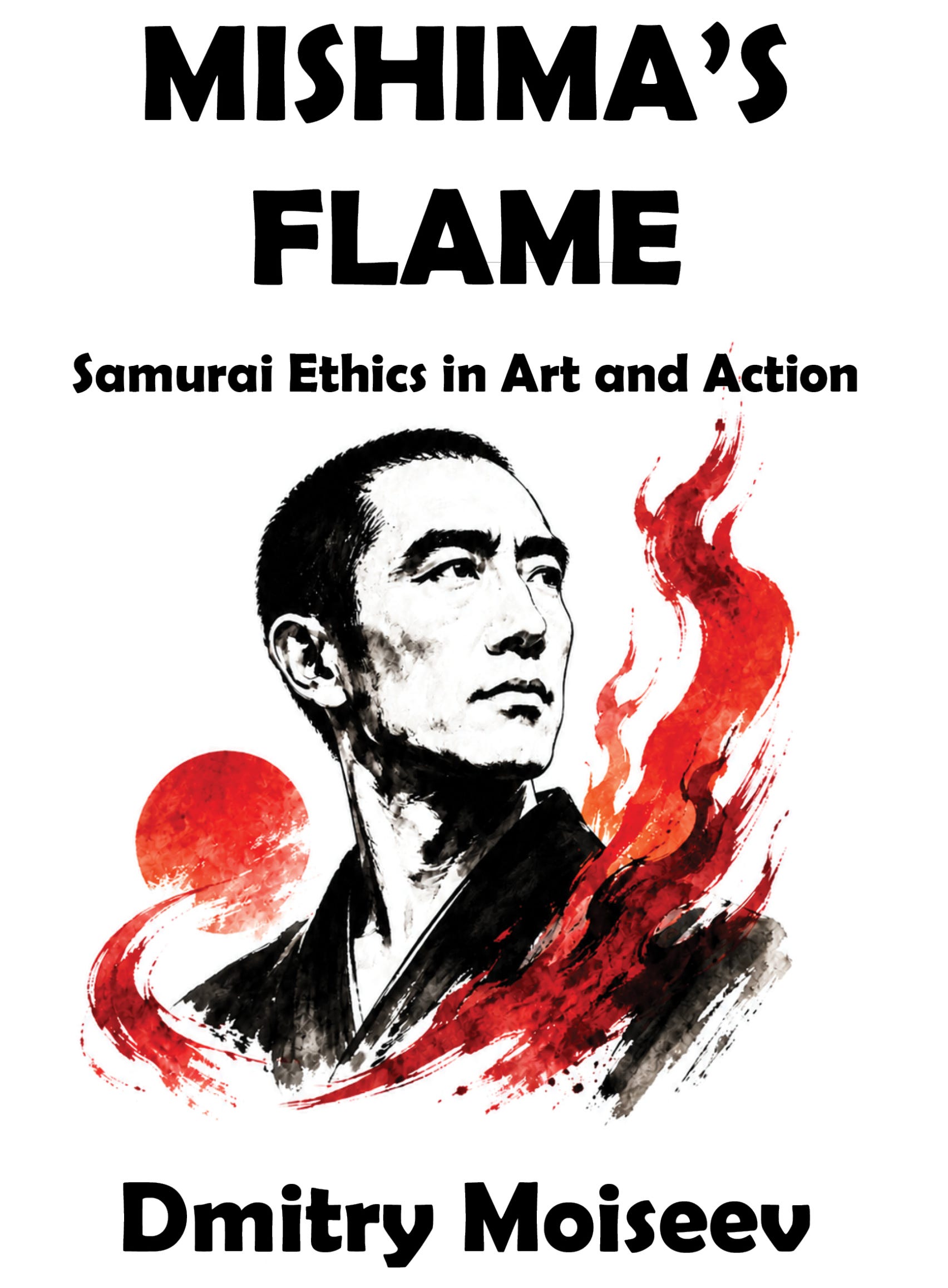
Order MISHIMA’S FLAME: Samurai Ethics in Art and Action, with an afterword by the author of this essay, from Multipolar Press here.

Great Article. Excellent Quality.
Outstanding article. Thank you.