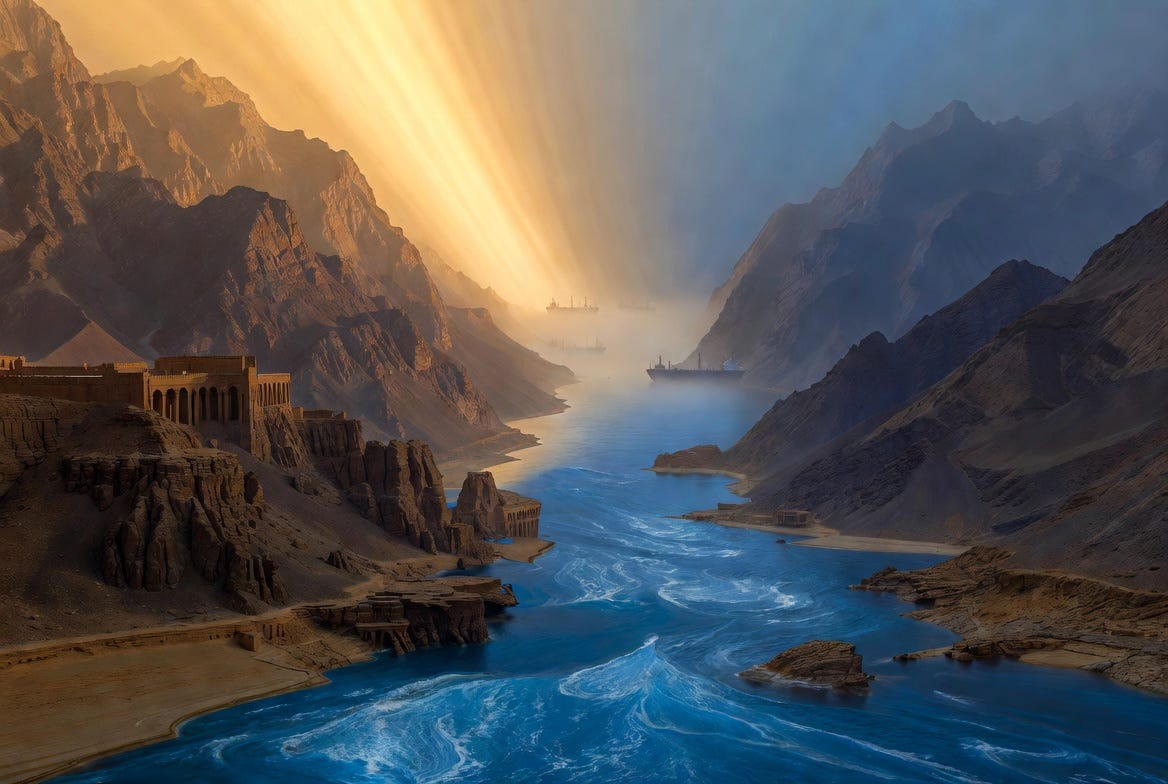
Metaphysical Reflections on the Strait of Hormuz
by Mohammad Taha Jahandideh
Mohammad Taha Jahandideh explains why the Strait of Hormuz is the symbolic frontline in the ontological clash between tellurocracy and thalassocracy.
The Strait of Hormuz, by its organic nature, is a waterway that connects two bodies of water and is enclosed by land on both sides. In recent months, this strait has transformed from a mere route into a symbol of the historical struggle between land and sea, and the confrontation between tellurocracy and thalassocracy. On a deeper level, the land-sea conflict, which geopolitical theorists have called the driving engine of world history and the axis of political-military developments, has a metaphysical root: land embodies stability, fixed borders, traditional sovereignty based on territory and spirituality, centralized authority, qualitative hierarchies, and a collective identity rooted in nativeness; whereas sea embodies fluctuation, borderlessness, indeterminacy, money-based cosmopolitanism, and boundless globalization. In ontological terms, the sea is the manifestation of “Becoming” and modernity, while land is the manifestation of “Being” and tradition.
Carl Schmitt, in Land and Sea (1942) and The Nomos of the Earth (1950), views world history as the narrative of a struggle between two elements: the nomos of the land divides the earth into distinct parcels and traditional hierarchies; the nomos of the sea eliminates all borders and recognizes only free-market economics and horizontal economic relations. Within the theoretical framework of Carl Schmitt and Alexander Dugin, tellurocracy is not merely a political system but a collective spirit: loyalty to the soil, intergenerational continuity, sacred territorialism, self-sufficient economy, and defense of territorial integrity. In contrast, thalassocracy represents a globalist spirit, devoid of nativeness, and marked by atomized individualism. The clash of these two nomoi has been the engine of history’s great wars: from the confrontation between Athens and Sparta to the rivalry of the British Empire and the Russian Empire, and the Cold War standoff between the Soviet Union and the United States. In the geopolitical tradition, from Mackinder to Spykman, the world is divided into two great alliances: a continental alliance from Russia to Iran and China, based on territorial continuity and Eastern tradition, versus a Western ocean‑centric alliance like NATO centered on the United States.
Unlike the placeless war machine of Western imperialism, built upon technical mastery of space, which views nature and the world as consumable objects, Iran has designed its combat strategy to have an organic unity with the geometry of mountains and impassable routes; the enemy’s surprise arises not merely from the range or numbers of weapons, but from a design logic rooted in indigenousness. In contrast, the United States and Israel, lacking indigenousness and historicity, have always responded to warfare against indigenous geography solely with technological domination and the destruction of place and nature—a reflection of Heidegger’s Gestell and René Guénon’s Reign of Quantity: the total reign of technics and instrumental rationality, reducing land to a resource for use and then disposal. Schmitt, in Theory of the Partisan (1963), identifies the telluric quality as the distinguishing feature of the indigenous combatant from placeless forces: the combatant with this quality is an authentic defender of a specific place and draws invincible power from the bond with the earth.
On the other hand, from a historical, geographical, and metaphysical perspective, unlike some land-based countries that have become landlocked, Iran behaves in a manner that, on the one hand, neither negates the sea nor grants it absolute authenticity; and on the other hand, sees “becoming” as an upward movement which, in Julius Evola’s interpretation, possesses an Olympic and heroic quality tied to war. In the current war, relying on this very quality, Iran has managed the Strait of Hormuz: at times opening the strait (for oil exports and goods imports), at times closing it (to pressure the enemy)—but it does not surrender this opening and closing to the changing rules of sea powers; rather, it links it to its own indigenous tradition. Schmitt, in The Concept of the Political (1932), emphasizes that every political order must possess the ability to “make a decision on the exception.” The Strait of Hormuz is a clear instance of this rule.
The relation of contraction and expansion in this tradition is defined not on the basis of the variable, but on the basis of Being and the constant; every change is always meaningful in relation to an eternal and unchanging center (the unmoved mover in ancient philosophy). From the perspective of physical geography, the central plateau of Iran is not a landlocked land; given its geography, it has a sea, but it has never granted absolute authenticity to the sea. This geographical condition is linked with Iran’s philosophical tradition, such that in Islamic philosophy—especially in the view of Mullā Sadrā—Becoming is not negated but is part of existence; yet this fluidity never leads to a rupture from the origin, because this “trans‑substantial motion” (al‑ḥarakat al‑jawhariyyah) expresses unity within hierarchical multiplicity. Every change is always meaningful in relation to an eternal and unchanging center, and “Becoming” serves stability and tradition.
Now, in the Strait of Hormuz, this metaphysical foundation is clearly visible: Iran, relying on its fixed geographical position—a manifestation of “Being”—has been able to turn the global, sea‑based economy (characteristic of America and ocean‑centric coalitions) into a tool for limiting that very power. This is precisely the sublime art of using “Becoming against Becoming”—in an Evolian sense, a kind of “ride the tiger”—in order to preserve its place‑based and history‑based Being.

