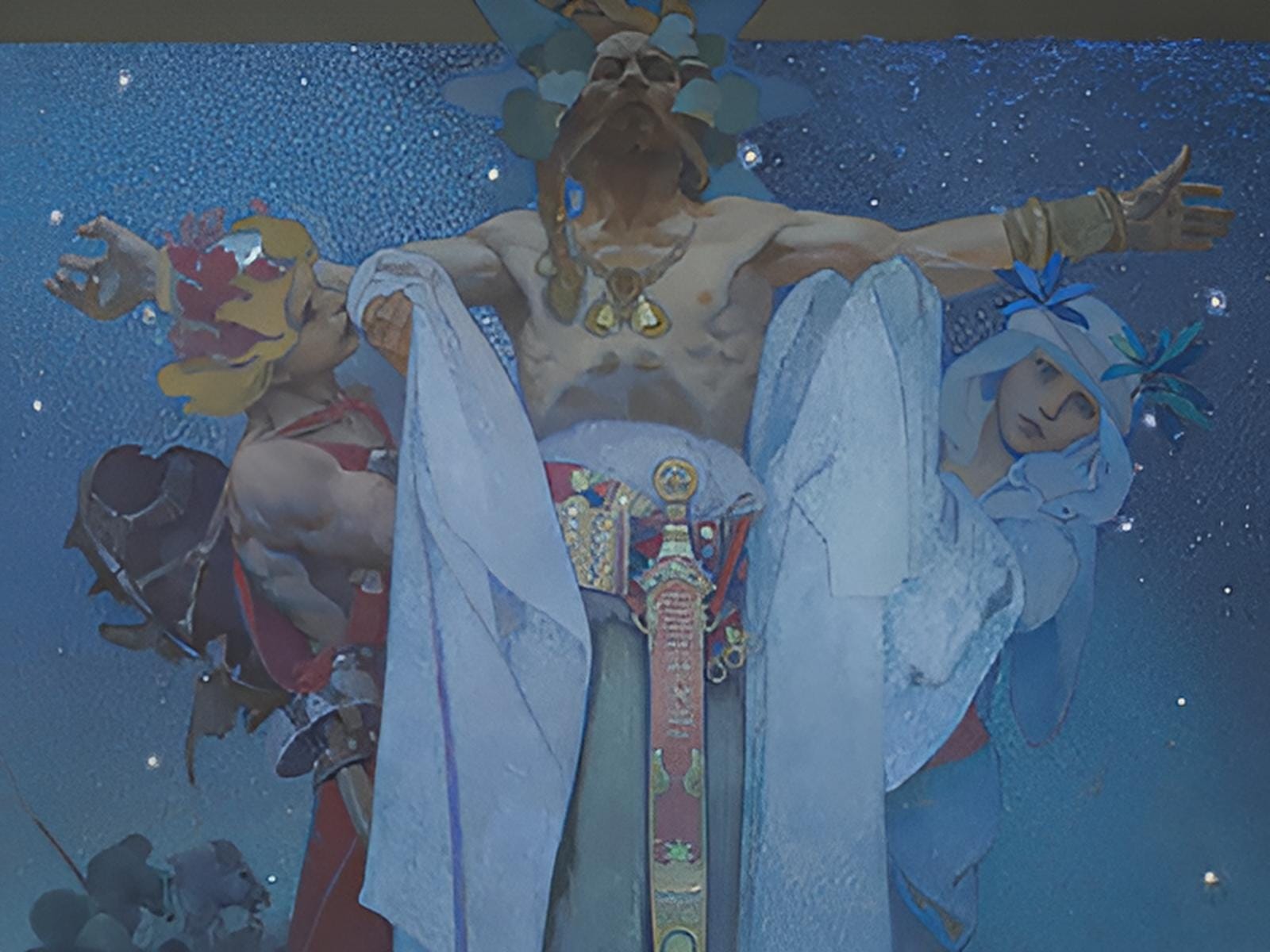
Matryoshka Civilization: The Different Faces of Russia
Will Russia be the new culture bearer?
Naif Al Bidh explores the different faces of Russia through presenting the notion of Matryoshka civilization—the unbounded polychotomy of the Russian idea and culture. The polychotomy inherent to Russia allows it to transform its teloi across world history, producing different ideological molds within every phase of its historical development. The series begins with an exploration of the metaphysics of geographical horizons of different cultures and its relevance to Russia’s history.
Introduction
Each time the forces of history open a new breach, the resulting surge of energy brings new lands and new seas into the field of human awareness, and the spaces of historical existence change accordingly. New criteria emerge, together with new dimensions of political and historical activity, new sciences, and new social systems. Nations are born or reborn.
— Carl Schmitt (Land and Sea, 1954)
A New Russian People
Oswald Spengler once argued that a “new Russian people” is in the process of becoming as it is eventually confronted by a frightful destiny which forces it into “inner resistance,” ultimately leading to the bloom of its higher culture. This new Russia, to Spengler, will be characterized by a passionate religiosity in a way Western Europeans have never been. Once this religious force is directed towards a specific goal, “it possesses an immense expansive potential” that is unique to this culture alone. Such spirit, if triggered, will awaken new cultural types that would lead “new crusades and legendary conquests.” To Spengler, the intersection of world history is exhausted by older petrified cultures, unborn cultures, deformed ones, and decaying societies—it is no longer fertile enough to give birth to such new religious yearnings. Thus, this new Russia is to be resisted on all fronts by all cultures, knowingly, or unknowingly. The notion of the “different faces of Russia” is not a new one, Spengler once described Russia as a culture with many faces, hence the title of his most important essay on Russia, namely, “The Two Faces of Russia” (1922). To Spengler, Russian culture was suffering from a Western cultural pseudomorphosis, which has essentially distorted its actual form. The result is the emergence of multiple Russian cultural forms within a short period of time, the pre-cultural semi-nomadic Russia, the Orthodox traditionalist Russia during the reign of Tsar Ivan Grozny, the culturally distorted Petrinist Russia following Peter the Great’s Westernizing reforms, and the Bolshevik Russia as a continuation of the distorted era. Of the many different faces of Russia, Spengler believed that the southern-oriented Orthodox Russia, which had once pointed towards Constantinople and Jerusalem, was the most authentic form:
Byzantium is and remains the sublime gateway to future Russian policy, while, on the other side, Central Asia is no longer a conquered area but part of the sacred earth of the Russian people.
— Oswald Spengler, “The Two Faces of Russia,” 1922
Yet, even then, he could not help but feel as though there was something else beneath this Orthodox-veneered Russia, another Russia, that still “slumbers” and has yet to give birth to an “unborn new religion” of a young culture that has just recently made its debut in world history. This is a point that Berdyaev had also touched upon when exploring the Russian cultural soul, which he believed was afflicted by a severe polarity as a result of belonging neither to the East, nor West, but a unique East-West. The eternal dialectic clash between East and West, to many Slavophiles and Russian thinkers, could be resolved in the emergence of a Russian higher culture. The concept of the Third Rome is intrinsically connected to this East-West synthesis, yet Berdyaev lost hope in such notions after realizing that the Third Rome had materialized in an inverted fashion thanks to the rise of Bolshevism. Instead of the Third Rome, the Western distortion of Russian culture had led to the emergence of the “Third International.” Nevertheless, the extreme polarity in Russia to Berdyaev was something known to most Russians, who, despite acknowledging their Orthodox connection—the Apollonian principle, implicitly knew of the elemental paganism innate to the Russian soul—the Dionysian principle. What came to be known as “double belief” in Russia, that is, the coexistence of Christian and pagan elements in a syncretic manner, is a perfect expression of this polarity and contradiction afflicting Russia.
Today, however, we are gifted with a unique vantage point when looking at Russia’s historical development. Despite losing the Cold War, Russia was given spatial and temporal room to reconnect to its primordial roots. In hindsight, we realize that the post-Cold War order did not end history, as Fukuyama had once argued. Rather, it had paused history and pushed the whole world into a brief phase of amnesic slumber—a historical purgatory, all induced by the unipolar order of Pax Americana. What I call the “pause of history” and the historical limbo was generally expressed in the trends that dominated cinema in the 1990s, where all protagonists seemed to be stuck in a perpetual socioeconomic loop, which was essentially an accurate reflection of the zeitgeist. Yet, beyond the West, the pause of history clearly functioned as a prelude or a literal commercial break prior to the emergence of the multipolar reality Huntington envisioned in The Clash of Civilizations. The unconscious ideas that dominate our conscious realities seem to manifest themselves powerfully during such brief phases of historical limbo. It is thus not a coincidence that Fukuyama, Huntington, and Dugin all produced works that express their philosophies of history at this specific time. Fukuyama’s linear development of history and its culmination in liberal democratic regimes, Huntington’s multipolar future where civilizations produce a multiplicity of teloi, and Dugin’s multipolar adaptation of Huntington but from a Russian perspective. Our concern in this specific series, is not only to reveal such possible futures in Russia, and the implications of such futures on its neighboring cultures, but to explore the history of the different faces of Russia and their implications on Russia’s future.
The Metaphysics of Geographical Horizons
It is thus essential that we briefly touch upon the metaphysical implications of geography in this introduction to the series. Spengler and the Slavophiles all argued that the East-West dichotomy is of a deeper metaphysical relevance to the development of cultures across time, since these geographic realities move beyond the Euro-, or Western-, centric geographic conceptions such as the notion of a continent of Europe. Concerning this, Spengler said:
‘East’ and ‘West’ are notions that contain real history, whereas ‘Europe’ is an empty sound.
Spengler presented this argument in order to make a clear distinction between the West and Russia, which to him, although their fates are linked to one another, were separate cultures. This to Spengler was clearly expressed in Russian culture through instinctively dividing Europe and “Mother Russia.” Moreover, to Spengler every culture possesses a unique geographical horizon that is metaphysically embedded and essentially determines that culture’s spatial manifestation. Although the West, with its thirst for boundless space, has already extended the geographical horizons of the Earth without any limit, all high cultures that complete their stages of development without interruption manifest their own unique geographic horizons. There are also cases where exhausted cultures, or arrested civilizations, as Arnold Toynbee called them, were dominated by extreme geographic limits and ecological conditions to a degree that they experienced a state of extreme cultural atrophy. That being said, these cultures still experienced a unique geographic horizon in space and time, think of the Polynesian and Austronesian experiences across the Pacific and Indian Oceans—a culture that was solely oceanic in origin. Yet, their pure oceanic foundations, without ground and land, had paradoxically led to the exhaustion of their creative energies. Toynbee described the Polynesians as an arrested civilization that could not fully manifest its morphological development due to the ecological extremities of oceanic existence.
Carl Schmitt once described the sea as a purely fluid space that lacks the solid and ordered character of the land. Unlike the West, which had balanced its oceanic power with its land-based cultural origins, the purely oceanic cultures were naturally exhausted before achieving their full morphological development. To Toynbee, this was also the case with nomads who are likewise subsumed by the extreme desert terrain, and the Inuit, or Eskimo, in the Arctic regions, whereby a culture is forced to confront natural forces as opposed to cultural ones and thus is not able to move beyond the pre-cultural stage that is a pre-requisite to the high cultural stage. Through Schmitt’s spatial theory, we can distinguish two different forms of cultural atrophy: the first is lost through oceanic or sea fluidity, and the other is stuck within telluric, or land-bound, rigidity. Though we can also expand on Schmitt’s ideas further here and assert that deserts function as a hidden third element here, beyond the restrictive land-sea dichotomy presented by Schmitt. We can also perhaps add the Arctic and other extreme regions as unique ecological zones in their own right, all exhibiting their own respective characteristics.
Exploring the intersection between geography, ecology, climate, and culture is crucial to understanding why higher cultural realities emerge within the temperate “Goldilocks zone” that allow cultures to transcend beyond the liminal state—between nature and culture—that some cultures find themselves in. Be that as it may, all cultures, whether higher, lower, or pre-cultural, manifest their own unique geographic horizons, despite their inability to transcend nature. The Inuit and Sami peoples are one of the few peoples in world history to develop a unique geographic horizon that is circumpolar. The Berber Tuareg of the Sahara Desert, or “blue men,” express their soul through their nomadic existence, effectively traversing the Sahara and transcending the international borders of several modern nation-states. Building on Hegel’s philosophy of history, primarily his emphasis on the geographical basis of world history, and Spengler’s emphasis of the ecological origins of all cultures, I have come to the realization of the profound reality of most nomadic pre-cultural nations, namely, their eternal liminal state—between nature and history (culture). This liminal state between nature and history, while viewed as a defect by Hegel in his Lectures on the Philosophy of History, is actually a double-edged sword to these specific nomadic nations (Turkic nations, Tuareg, and pre-Islamic Arabia). While the harsh ecological reality does not allow these specific cultures to express their spirits properly, their liminal states allow them to traverse, and embed, themselves into the ontology of other higher cultures. Take for instance the Turkic, or Turanian, nomadic spirit, which I believe is directly tied to the symbol of the Shangrak associated with original Tengrist beliefs of Turanian nations and is found across the national symbolism of many Turkic republics and nation-states. This symbol, which represents the roof the Turanian archetypal object, the yurt (equivalent to the eskimo’s igloo), could perhaps be described as the prime symbol driving this specific nation—which denotes both an innate sense of expansiveness and mobility. Although this culture is cursed with an extreme ecological reality, making it difficult to express its soul through the higher cultural stages (hence why the portable yurt plays a crucial role in this culture as the only possible form of cultural expression), it is blessed with a nomadic mobility and expansiveness that allows its nations to invade and embed themselves at the civilizational level. In history, this came in the form of the Turanian nomadic invasions of, and absorptions into, several higher cultures such as China, India, the Islamic world, the West, and Russia. Thus, we can argue that every culture is imbued with a distinct sense of connection to the land and geography, which in turn leads to a unique geographical horizon. The ecological and geographical origins of a specific culture also set the geographical bounds, or limits, of that specific culture. Eurasian steppe nomads, for instance, are more expansive when compared to island-based cultures, though even in oceanic island-based cultures (Polynesians, etc.), we witness a different form of expansiveness. Another odd phenomenon worth mentioning about island cultures is their ability to retain different cultural forms that come into interaction with them, and the passage of historical time eventually leads to their hybridization of different, and usually contradicting, cultures. This is seen clearly in the fusion of Islamic, Indic, African and Gothic elements in Zanzibar, as well as the fascinating case of Sicily, where the Greco-Roman, Islamic, and Western worlds meet, leading to one of the most beautiful forms of cultural syncretism in world history. In effect, islands may be the only cases where Spengler’s notion of cultural pseudomorphosis, which he viewed as a tragic matter, is almost a necessity due to the natural geographical isolation of islands.
But why does this all matter to us when discussing the case of Russian culture? Primarily because the task of dissecting a culture’s soul is in itself a very serious matter, let alone the task of attempting to predict the trajectory of a culture, and claim that a specific culture possesses multiple faces due to an innate bipolarity afflicting its soul. Of course, this is not an original claim. Berdyaev, Leontiev, Spengler, Dugin, and many other thinkers have already explored this odd phenomenon existent in Russia. In fact, many Russians have acknowledged this, but cannot simply explain it. This is unsurprising since this phenomenon is a complex one. My claim here is that when tracing Russia’s bipolarity, one finds its expression in its unique interaction with its neighboring cultures and spatial disorientation. Russia’s innate bipolarity leads to a sense of spatial and geographical disorientation, which is problematic to its morphological development since it led to its adoption, and invitation, of false/alien cultural forms, yet the adoption of these forms seems to be paradoxically necessary for its destiny as a culture. In simple terms, Russia’s unique vantage point in world history, as a late comer to the stage of history (and I do not mean this in the derogatory and anti-Russian sense as seen in the works of Isaiah Berlin, but in a Spenglerian, Herderian, and Hegelian sense as seen in their philosophies of history), and geographical location at the threshold between the East and West, made it forcibly interact with a diverse array of cultures in all different cardinal directions. This geospatial challenge facing Russia across its historical development expressed itself in the different directions it took across world history, orienting itself north towards the nordic and Arctic regions within its initial stages of growth, then southwards towards Byzantium and Constantinople when attempting to centralize its politico-religious form, and then willingly looking west towards Europe when faced with uncertainty, and finally, it oriented itself towards the east for a brief yet significant period during the early 20th century.
Some of these orientations have occurred simultaneously, or rather, they overlapped during specific periods. For instance, when Russia began to orient itself eastward, which occurred at the state level with the Russo-Japanese War of 1905 (which is a clear and uncalculated historical incident, and not destiny in the Spenglerian sense of the term), it was still concurrently facing the West as exemplified by the absorption of Western political and economic forms with the Bolshevik Revolution. This is, again, a reflection of the paradoxical reality of the Russian soul, which to Berdyaev and Spengler suffered from profound internal contradictions. Berdyaev had touched upon this specific point when discussing the Russian tragedy as a land caught between the West and East and is thus forced to contend with the dialectic clash between the East and West as global civilizational poles, rather than its own unique national contradictions. To Solovyev, although this challenge of resolving the East-West dialectic is a tragic one, its resolution could lead to a universal theocracy, the true organic form of universalism that replaces the flawed Western liberal form of universalism. Solovyev also ironically warned Europe of a future fragmented period where external forces could effectively destroy it and argued that only a reconciliation of the churches (a union or alliance between Europe and Russia) could save Europe from such a predicament.
Russia as a Civilizational Katechon
Russia has a potential future, and vision, that could replace the destructive futuristic post-human vision emanating from the West, allowing for the continuation of the “human” within world-history. Thus, Russia could potentially function as a world-historical katechon—a restraining force against the Antichrist, and the forces that attempt to accelerate the world towards the apocalypse. Yet, Spengler, Leontiev, and Berdyaev all argue that this possibility is contingent upon Russia’s own emancipation from Western cultural hegemony, one that is not only distorting Russia’s own forms and stunting its proper development, but has also spread the anti-cultural forces of modernity into the Russian plane, slowly exhausting its creative possibilities. When discussing the paths of Russia and the catastrophic implications of Russia’s failure to grow, Leontiev paints a very gloomy picture of the future. On one hand, China and India are awakened from a “thousand-year-old sleep,” and are now active players in universal history once more. To Leontiev, the petrified form of these Asiatic giants, and their subsequent return into history, is not necessarily a positive development if Russia does not participate in universal history. China is seen as a “ferociously state-assertive giant,” India as a “profoundly mystical monster,” and the West as a “perpetually growing hydra of communist revolt,” one that is dying, and thus, is contagious. Russia is situated between them all, in a state of “drunkenness and lack of character.” The Russian to Leontiev lacks belief and mental fear that are necessary ingredients in integrating the culture as a whole into universal history. Rather, he imitates the European, possesses “imitative ideals,” all of which are alarming developments to Leontiev, for the implications of Russia’s failure to wake up are of universal historical significance. To Leontiev, Russia will inevitably find itself at a crossroads in the future where it decides to either dispense its own unique universal mission through evolving into a higher culture, standing between the two Asiatic giants—India and China—and the West, or to fail to accomplish such a feat. On the implications of the latter, Leontiev said:
To end history, having destroyed mankind; by spreading universal equality and by diffusing universal freedom to make human life on the globe altogether impossible! For, in that case, there would be no more new wild tribes, no more drowsy cultural worlds on earth.
Leontiev believed that the continuity of human culture as a whole required the birth of a new culture that took the ideas and truths of older cultures and reproduced them in newer and more stable forms. From his own vantage point, the logical end of world-history pointed towards Russia as the next possible culture that could achieve this world-historical mission. That said, like Spengler after him, he was worried that Russia may have become too corrupted to achieve this. To Leontiev, most societies emerge as a result of impersonal forces that transcend the individual, and in many societies these forces are “inevitable, irreversible, really immortal.” In a sort of Hegelian fashion, he believed that specific forces clash with one another across history and thus lead to different combinations of these forces depending on the time and place. The elements of the culture remain, but they just “reappear in different combinations of forces and of preponderance.” However, unlike Hegel, Leontiev did not see a clear logic in history and all of these dialectic clashes, and argued that some combination of forces are favorable and healthy, while others are unfavorable. On this, Leontiev said:
Thus the form which is the most deeply differentiated and contains the most groups—the form which is at the same time sufficiently concentrated in something general and higher—is the most stable and spiritually productive one; whereas the mixed equalized, nonconcentrated form is the most unstable and spiritually barren.
Like all pessimists, Leontiev’s pessimism grew worse as he aged, infiltrating his own philosophy of history later in his life. This is a similar trait that Spengler also possessed. While both were at one point optimistic of a future Russian culture beyond the West, their growing pessimism led them both to question such a possibility. Leontiev eventually argued that the Russians, almost without noticing, will transform from a “God-fearing people” to a “God-fighting people.” Due to the extreme polarity of the Russian soul, such a reality was possible to him. This would eventually, and unexpectedly, lead to “some one hundred years from now—from the depths of our state, at first classless, then churchless or having only a weak church—to that same Antichrist of whom Bishop Theophanus and other spiritual writers have spoken.” Likewise, although Spengler once predicted a future high culture emerging “between the Vistula and Amur,” he eventually argued that the rate at which Western modernity has transformed and deformed the Earth, the planet has been made incapable of giving birth to a new culture. The next logical step is a cosmic cataclysm—the apocalypse.
One cannot help but ask whether the healthy indicators that Spengler argued Russia once possessed are still existent today? Does Russia still possess a naïve religiosity like all young cultures? Or does rationalism dominate the Russian mind? Are Russians still attached to their countryside, their ecological origin, and source of their unique “Russian” ideas and truths? Or have they severed their connection with nature as the West has done? Are the Russian women still the same “women of race” Spengler spoke of? Or have they deformed into “Ibsen women” and are slowly, and unknowingly, dismantling the family unit? Many, including myself, cannot help but feel that Russia’s cultural immune system could be compromised beyond repair in order to rid itself of the Western cultural pseudomorphosis, unless a truly cataclysmic event enforces a rupture with the West. More importantly for us in this series, however, is if Russia does miraculously cure itself from the corrosive force of modernity, which of the many faces of Russia will materialize and guide it towards its world-historical destiny?


