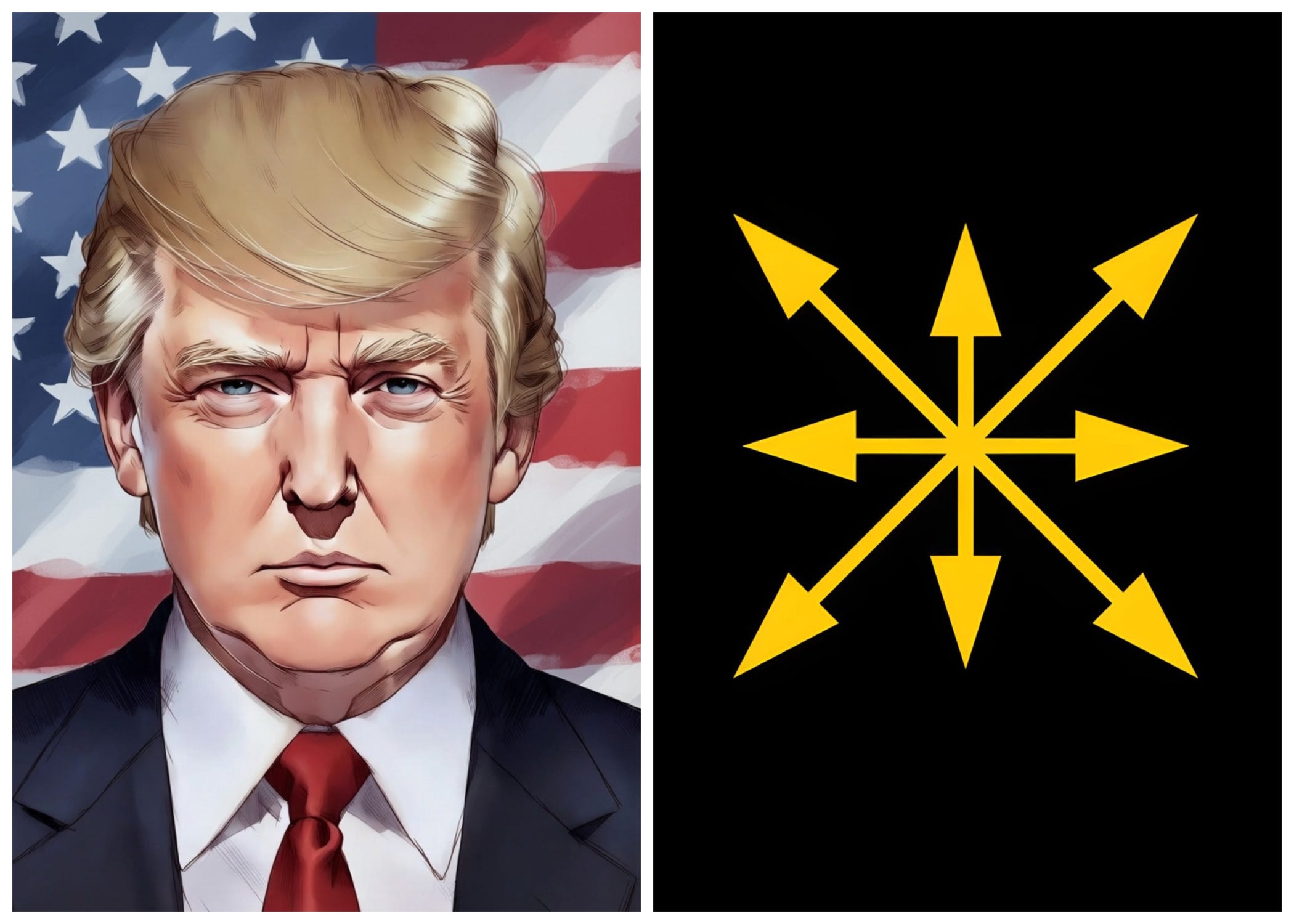
MAGA and Eurasianism
War, sovereignty, and Eurasia in a multipolar age
Alexander Dugin on terrorism, victory, and the Eurasian path towards a multipolar world.
Conversation with Alexander Dugin on the Sputnik TV program Escalation.
Host: I’d like to begin with grim, deeply sad news: in Moscow, Lieutenant General Fanil Sarvarov was killed in a bomb explosion. At the moment, we do not know who carried this out. There are only suspicions that Ukrainian special services were involved, but those suspicions are rather obvious. How do you think we should respond? After all, this is neither the first, nor the second, nor even the third such act. It seems they will continue as the conflict develops.
Alexander Dugin: First of all, I would like to express my most sincere condolences. My family joins me in this. I lost my daughter in a terrorist bombing carried out by Ukrainian terrorists. This is a terrorist regime. Every terrorist act has both a symbolic goal and a concrete one—that is, the elimination of an element deemed dangerous to the enemy within our society or our state, and at the same time a symbolic message.
At first, they delivered symbolic strikes against thought itself—against the brightest, most talented people in our country, against the youth. That was monstrous; it was the first wave, at the initial stage. Then they shifted their focus more towards our military. Unfortunately, from time to time they succeed.
We have just marked Chekist Day, the Day of Security Service Employees, and in reality no one knows how many terrorist attacks are prevented. But if one looks even slightly beneath the surface, it is an enormous number. Our security services are working; they protect our citizens. They investigate, hot on the trail, the attacks that do succeed. But the lion’s share of terrorist acts are thwarted, though this is not talked about. They prevent mass casualties on a huge scale.
In our country, there operates a very extensive network of enemy sabotage and reconnaissance groups, relying on the intelligence infrastructure of Western services—primarily British and European. (Before Trump, the CIA played a very active role in this.) In addition, there is a vast fifth column. At first, it acted openly and brazenly, opposing the war, signing letters against the Special Military Operation, but later it quieted down. The tactics of the terrorists of the Ukrainian regime itself also changed. All these networks began targeting the military more—especially those on whom much depends in conducting and planning operations, in concrete operational activity. They reoriented themselves. We no longer see attacks on public figures after the first wave, but attacks on military personnel have, on the contrary, increased.
I think that, given the symbolic significance of such actions, it is worth recalling the Soviet period: our special services were then extraordinarily sensitive to such operations—during the Cold War, during confrontation, and especially during the war with Nazi Germany. For every such action there followed several systemic responses, if you will, proportional ones. If they managed to eliminate one of our key figures, we responded by eliminating one of theirs. Of course, it is difficult to speak of this directly: human life is priceless. But at least a distant parity in such targeted eliminations of individual figures on enemy territory must exist. Something like that.
This would cool their ardor, because right now it creates the impression that they are methodically, point by point, and alas successfully eliminating our people—one after another—like General Sarvarov, an extraordinarily important figure in our military leadership and in operational planning. That is, once again a blow to the brain, to our military consciousness, to planning itself.
Perhaps this will become the argument that finally forces… It is completely obvious: the people demand a tougher approach both to the internal enemy and to the external one. The entire nation is crying out for justice. People who are losing loved ones—our society as a whole—need at least some symmetry, at least symbolic.
This is where we began our conversation. Terrorism, like war—especially in our time—has a very pronounced symbolic character. Accordingly, our society expects the demand for justice—even during combat operations, during war—to be satisfied. And our leadership, it seems to me, is now choosing the principle of humanity.
If we respond—of course people want that. They want a proportional response. They want these terrible situations to stop happening to us. But at the same time there is a peace track underway. Everyone is discussing how Kirill Dmitriev just traveled to the United States, to Miami, where he spoke with Witkoff and Kushner. It seems that something is approaching, that some breakthroughs are being outlined—although some say they are real breakthroughs, others that it was merely constructive dialogue. We are not given full information.
But if we respond harshly to this provocation, if we remove someone from the top leadership or influential figures in Ukraine—this would in fact become a victory for them. We ourselves would hand them levers of pressure. They would calmly throw this into the media, into European outlets, which would blare about how dangerous, frightening, and aggressive the Russians are, how they attack. And no one would even learn about the first horrific killing—the one from which it all began.
Host: But that’s exactly what we do—and they still portray us as monsters. “So what then—should we just raise our paws and wait while our generals, our children, are destroyed one after another?”
Every time there is such an argument: now it’s the peace track, before that it was humanity, then something else. And we act accordingly. And this causes the deepest pain and sorrow in our society. As if we don’t care about society, don’t care about the sense of justice, don’t care about our pain, about the fact that this is unbearable. And for what? To make peace again with these killers, who will break it on the very first day? There will be no peace—it’s obvious. There will be no real peace track.
We are right to participate in negotiations, but what exactly are we negotiating about?
Alexander Dugin: We would have said immediately: we are going or we are not going. In Anchorage, that was said. Trump understands this perfectly well, but as it turned out, he cannot control things even in his own household. That’s it.
I think the topic of the peace track is exhausted. I do not think anything will come of it. Nothing will come of these peace negotiations—one can calmly forget about them. But in order not to appear overly impulsive, we continue these meaningless negotiations.
We stated our demands—accept them, though we ourselves are not particularly satisfied with them. These are not victorious conditions. Explaining this to the people will be very difficult. And if you do not accept them—then do not accept them. That’s it.
Trump understands all this perfectly. Zelensky will indeed find ways to sabotage things, and we will sit there losing our generals, our children.
Therefore, I understand this logic—someone in the leadership thinks this way. I believe it is bad logic, and they are thinking poorly: it will lead to nothing good. Because in our history there is one single argument—for the country, for the state, for the people. That is Victory. We win—the enemy loses. We strengthen our position—our opponents weaken theirs. That’s it.
And at the same time, this is exactly what the people want. The people thirst for this. And the authorities want this as well. But the idea of peace, a ceasefire, of refraining from retaliatory strikes, of special concessions to a cruel, absolutely cynical, deceitful enemy—with the current regime in Ukraine there is only one thing that can be done: it must be destroyed—is absolutely unacceptable to us.
To liberate this territory from the Nazi regime, from that power—that is the goal of the special military operation. That means we must defeat this regime, so that it ceases to exist in the form in which it exists now.
Will the Americans ensure this for us? Can we agree on this with Trump? No, we cannot. We never will. That is, we can only come to an agreement with our own people and deliver a crushing blow. That is the only thing left to us, because all other arguments and all other forms have been exhausted.
It is desirable, of course, not to slide into nuclear war. But in fact, under that refrain—under that song—one can lose everything very easily.
We have already seen how this happens: under the idea of “anything but war,” a state collapses. That happened precisely at the end of the 1980s and in the 1990s. We have repeatedly gone down this negotiation track, this peace track, this ceasefire track. And every time we did, it ended in yet another catastrophe. And every time we resolutely and firmly defended our national interests, it led to salvation.
I think the current moment is exactly such a turning point. We are too soft. And this runs counter not only to our interests as a state and as a great power, but also to the sense of justice in society. We need Victory.
The people understand that a high price must be paid for this victory—but we are paying it. We have already paid it—how much blood of our people has been shed! And on the other side, however monstrous they may be, they are, in a sense, our monsters as well. And we are forced to participate for so long in this fratricidal war imposed on us by the West. And if we do not win it, there will be no forgiveness for us.
Host: But if we abandon the peace track now—everything loses meaning, no negotiations will lead anywhere.
And if we continue, deaths and bloodshed will only increase; it will continue in any case. Because we understand: no matter how much we engage in bravado, no matter how much we say Ukraine has few people and little weaponry—it has enough to resist, and resistance inevitably entails casualties.
So it seems we must choose how to act. What do you mean by this destruction—strikes on Bankova Street, or the systematic liberation of territories?
Alexander Dugin: That should be decided by our military leadership—how exactly. I mean victory, not a ceasefire. Either we have victory, or we do not. That’s it.
By what method? We began by saying that the enemy uses terrorist attacks on our territory to eliminate genuinely symbolic figures—extremely painful for all of us morally, ethically, and structurally, operationally. The enemy succeeds. We do not carry out symmetrical actions. I believe they probably should not be publicized. Because I do not believe our security services are so helpless as to be unable to respond symmetrically. I simply cannot believe that. I think this is a matter of political decision-making.
The ceasefire under whose aegis we want to demonstrate our compliance is absolutely not what our country expects or deserves. This is blood; this is the devaluation of the sacrifice of all our victims, all our people who fought so that the goals of the special military operation would be achieved—not so that a ceasefire could be concluded and the conflict or war paused temporarily, only for the enemy to grow stronger during that time, as happened in 2014. There is no doubt: a ceasefire would simply postpone the denouement of this war and give the enemy time to prepare.
We are advancing now—slowly, imperfectly, not as fast as we would like, but advancing nonetheless. We are winning. We are withstanding sanctions and pressure. We are genuinely defending our sovereignty. And that is how we must continue—until an anti-Russia disappears from our immediate vicinity. That has been the requirement from the very beginning of the special military operation.
We cannot guarantee the absence of a Nazi regime in Kyiv unless we politically control this territory. We cannot guarantee the demilitarization of this state unless it is under our direct military control. This is basic arithmetic.
We began this special military operation in order to defeat the enemy. He may surrender, he may capitulate—and then we will negotiate with him—or he may be defeated. There is no other way out.
They are now trying to suggest to us some other way out. This “other way,” which would be neither victory nor defeat, would simply postpone for a certain time the realization of the tasks that were set at the beginning of the special military operation. We could not begin such an operation only to later suspend it without achieving its goals. That is an absolute contradiction.
Therefore, of course, we must speak with the Americans. Vance, the vice president, just said a remarkable phrase while speaking at Turning Point, organized by Charlie Kirk (now his wife, Erika Kirk, oversees it). He said that America should help its mothers and fathers, not pay money to Ukraine. But in reality, this is not because we behave well or make concessions—it depends on how well we fight and what successes we achieve.
Because if we demonstrate weakness, if we do not respond to such direct, cruel, and cynical challenges—or respond insufficiently—then respect for us, or if you like, a healthy fear of us on the other side will simply disappear. And respect and fear, unfortunately, are inseparably linked in today’s politics.
But failing to respond to a blow—this impresses no one. It is perceived as weakness—by our direct enemy and even by those forces that would like to meet us halfway. Strong are considered those who are strong—yes, sometimes harsh. But in any case, we are described that way regardless. We are not cruel—yet we are described as cruel. We are soft—yet we are described as hard. We are in fact the most humane, the most democratic—and still, despite this, we are portrayed as beasts, barbarians, murderers, and sadists.
No matter what we do—even if we stand on our heads—Western propaganda, lying to the core, depicts Russia in whatever way suits it.
Therefore, in the end, we do not care how we are described or what we are thought to be. Only one thing matters: strength, victory, courage, decisiveness, and seeing through to the end the goals set in this most serious war.
Host: I suggest that we now talk about the EAEU [Eurasian Economic Union]. We are discussing the geopolitical and international situation in any case, and it is important for us to understand what place the EAEU occupies in this multipolar world—or perhaps not yet fully multipolar, but clearly moving in that direction.
Alexander Dugin: The defining feature of a multipolar world—I have devoted an entire series of textbooks to this topic, I teach a course on the theory of the multipolar world, and I have been working on it for many years—is perfectly clear: a pole of the multipolar world is something more than just a nation-state. What becomes a pole is what today is called a civilization-state.
This is not a single nation-state, but most often a number of nation-states belonging to the same civilization, the same system of values, the same large geopolitical space, and the same transport, financial, industrial, economic system—a common structure, if you will.
In our case—the Russian, the Russian civilization-state—the EAEU, the Eurasian Economic Union, is precisely that pole, because within multipolarity we can become sovereign only together. Let us imagine that the countries around us, which were once part of the Russian Empire and the Soviet Union—that is, part of this civilizational matrix, various modules within a single historical, geopolitical, civilizational system—do not become part of this Eurasian pole of the multipolar world. Then they will become part of some other pole. And that’s it.
Those other states that currently occupy a neutral position towards us face a harsh choice. Either they become part of, for example, the Chinese great space—the Chinese pole, which is a viable option for some Central Asian countries—or part of the Western pole, as we see in the case of Ukraine and Moldova. One can choose the Islamic world—for example, in the Turkish-oriented case of Azerbaijan, or other models, including the Wahhabi tendencies banned in the Russian Federation that envision the creation of an Islamic state banned in the Russian Federation.
But in any case, simply preserving national sovereignty without joining one of the poles of the multipolar world is impossible. Such entities become failed states—collapsed states or territories subject to fragmentation, which is what we see now. There will be endless wars there, endless rebalancing: one external pole will strengthen its influence, another will retreat. But there will be endless war.
The post-Soviet space is a territory of endless war until a decision is made to integrate into one pole or another. And the correct choice is to integrate precisely into our Eurasian economic community, into the EAEU. These are the necessary—and I would say sufficient—conditions for forming a pole of the multipolar world.
Hence an important conclusion: Russia must adopt a Eurasian worldview, a Eurasian ideology that justifies the brotherhood of peoples within a single geopolitical construction, where attention is paid to the traditional identities of each of these countries, but everything is assembled around Russia, around the Russian people, around the historical mission that our people and our state have carried for centuries. We are the unifiers of this Eurasian space. And only we can perform this function at the next stage. Therefore, Eurasianism is absolutely necessary as, if you like, the operating system for the entire EAEU.
For a long time we did not do this—we balanced between striving to integrate into the West and the idea of “Russia as a fortress,” that is, Russia as merely a nation-state.
Both are absolutely impossible. The West is merely a tactical civilization that, incidentally, does not want us. It wants us not to exist. That is today’s global anti-Russia. That is clear. But we also cannot be a nation-state. That is too little for us. It is not a pole; it is an intermediate zone, which is also doomed to become a territory of confrontation between real, fully integrated poles.
Therefore, for us Russians and for all other entities and peoples of the post-Soviet space, there is only one way out: Eurasianism. The creation of a supranational, extremely powerful, solid pole, united strategically, economically, in resources, technologically, in transport—by a common worldview, traditional values, a shared historical past, and a future project. That is Eurasianism.
At present, the EAEU is merely a continuation of the CIS [Commonwealth of Independent States], a continuation of shallow integration, superficial checks and balances—essentially the same divorce office that the CIS was. But it should be something entirely different. The EAEU lacks a Eurasian ideology. Without ideology, there is no goal.
We cannot explain why Kazakhs, Azerbaijanis, Armenians, Georgians—why they should be part of our civilization-state, our common civilization-state, and why their national identity is a very short-lived, fragile construction. We must explain this to them. We must begin with words. With ideas. With a serious, well-founded, philosophical approach to integrating the post-Soviet space. With explanations of what a multipolar world is, what a civilization-state is, what traditional values are, what geopolitics is, what a great space is.
We do not hear these things. We hear only: “it’s profitable.” Trade-level interaction can be had with any partner; that does not require integration into a single territory. Anyone can negotiate that way.
This idea that business and trade decide everything was imposed on us by the West, and it is completely false—rules the West itself does not follow when it is inconvenient. Therefore, we must discard everything that economists, globalists, and liberals taught us, and truly reorganize the post-Soviet space into a pole of the multipolar world—sovereign and independent both from our adversaries in the West and from our allies and partners in the East. It must be independent from both West and East. That is the meaning of Eurasia.
Eurasia is another continent, if you like—another universe, another cosmos alongside Western humanity and alongside Eastern civilizations, which are now friendly and promising to us. We are turning to the East, but it is important not to dissolve into the East, to preserve our unique identity. All of this is Eurasianism; all of this is written into the philosophy of Eurasian integration. And this is where it must begin.
The EAEU is ineffective precisely because it lacks an idea; it contains only technical, pragmatic solutions that do not work. And through this pragmatic approach to the post-Soviet space, we are in practice losing our allies—those who not long ago seemed quite reliable. We are losing them in one direction. Yes, there are some improvements here and there, but in reality negative trends in interaction with the post-Soviet space far outweigh the positive examples. There are positives, but they are overshadowed by extremely negative ones.
Host: In that case, when will this center be defined, and when will it be clear that we are becoming this pole—after the conflict in Ukraine ends—and what poles will appear? How many will there be in the world?
Alexander Dugin: Two different major topics. First, of course, after victory in Ukraine. Before victory, frankly, even our partners in the CIS will not take us seriously. Integration happens with the strong. That is precisely why I am very skeptical—even alarmed—by all actions towards a ceasefire, unless they lead to the U.S. and Trump exiting the war. That would be an excellent outcome, the best possible one.
But if we speak of a real ceasefire, that means postponing indefinitely the integration of the post-Soviet space as well. No country in the post-Soviet space will truly want to unite with a country that reaches a ceasefire not entirely on its own terms.
After victory, Russia will immediately change. It will become completely different. Today, only strength is recognized. If our pole is strong, it is attractive. Our troops marching in a victory parade in Kyiv—there is Eurasian integration. But while our troops are not marching victoriously down Khreshchatyk, integration becomes problematic. We depend on the goodwill of those who are unsure whether integration with us is worthwhile.
So the question is simply becoming a real pole. For that, we must win in Ukraine; we must overcome ourselves and begin rapid development, mobilize our economy and society. We must wake up. We are moving in that direction—that is good—but it is not enough. We must, of course, put forward a Eurasian ideology, a Eurasian worldview.
Now—how many poles will there be? This is also a topic I work on extensively and continuously refine within multipolar theory. It is obvious that there are already four poles: the West—the collective West; and us—Russia, China, and India. Four civilization-states.
In addition, there is divergence within the West itself: a split that allows us to say the West itself has divided into two increasingly divergent poles—Western Europe and the United States.
At the same time, a pole of the Islamic world is forming—with great difficulty. It does not yet demonstrate sufficient will towards integration, unity, or strategic partnership. There are many disagreements, which others exploit. If the Islamic world does not unite into something coherent, it will be an object, not a subject, of the multipolar world—a frontier where the balance of relations between other poles will be played out.
Africa stands on the threshold of integration. Burkina Faso, Mali, and Niger already understand that individually they cannot survive. They have challenged Western globalism and stand for pan-African integration. Africa will unite and also become a pole.
Another pole should be Latin America, which the United States is preparing to attack under the corollary to the Monroe Doctrine—something Trump openly speaks about and which is laid out in the newly published U.S. national security strategy. The Western Hemisphere must be under direct U.S. control and hegemony—this is written there. Accordingly, if Latin American countries want to be sovereign, they must unite, because individually they cannot resist the United States. Unite all, or at least the major countries, and create another pole.
Finally, there is the so-called C5 project, recently discussed in the U.S. I call it the “order of great powers.” In principle, besides the U.S., Russia, China, and India, it includes Japan. Japan is indeed an independent civilization, but I believe it lacks the prerequisites to be a true pole—it remains a satellite, a client state of the U.S. since 1945. If Japan were made great again—Japanese rather than colonial, colonized by the U.S.—then one could speak of it becoming a pole of attraction for Buddhist civilization, as Samuel Huntington wrote in his famous article and later book The Clash of Civilizations, where he foresaw the emergence of a multipolar world based on civilizations.
Today in the West—out of hostility by the U.S. and the Trump administration towards globalists and the European Union—there is an increasingly evident desire to replace Europe with Japan, to shift attention to the Pacific zone, essentially to forget Europe. Thus another configuration of the multipolar world is emerging.
There is a fundamental difference here. We want an honest, just multipolar world—for everyone, for those who are already poles and for those still on the path to becoming one. We want a multipolar world that is fair, humane, and inclusive. Each civilization has its own traditional values; each defends them; and together we build a global space of polyphony and dialogue.
The Americans, by contrast, are cynical and pragmatic. They do not care about Africa or Latin America. They think strictly in terms of power.
Host: By the way, speaking of Latin America—specifically Venezuela. Will the U.S. start a war with Venezuela or not?
Alexander Dugin: They very well might. Trump has shown that despite condemning all forms of intervention and aspiring to the Nobel Peace Prize, he constantly either threatens intervention or supports actions such as Israel’s genocide in Gaza and invasions of neighboring states. Moreover, the Trump administration carried out strikes on nuclear facilities. Trump has shown that he can start a war. If he threatens one, he may well carry it out—or he may not. He is very unpredictable.
Let me remind you: during his first term, he also moved a naval flotilla towards North Korea, attempting to pressure Kim Jong Un. Then he met with him and said what a great president he was, how they became friends and resolved everything. With Trump, anything is possible—war or no war.
What is especially interesting is that blockades of Venezuela have already occurred—seizure of tankers, strikes on boats. Trump claims they are drug traffickers, but this must be proven; evidence must be presented.
In any case, this unites Latin American countries that until recently were bitter enemies. There was no greater enemy for Venezuela than Colombia, nor for Colombia than Venezuela. Now Colombia, Venezuela, and even Mexico face the threat of direct U.S. military intervention, and they are forced to seek common ground.
Thus Trump’s aggression—whether it turns into war or remains suspended—promotes Latin American integration and creates conditions for the formation of a sovereign pole. This process is extremely important. Hugo Chávez understood this perfectly, as did General Perón and Getúlio Vargas. On both the right and the left in Latin America there has long existed the idea of Patria Grande, the Great Homeland, going back to Bolívar: the peoples of Latin America must unite and build a true civilization-state.
Trump indirectly—though this is precisely what he least wants—facilitates this through his aggressive policies. Not out of good intentions, but through pressure.
He may well attempt a campaign against Venezuela, but a quick victory there is unlikely; it would be prolonged and potentially fatal. He understands that too.
Host: Finally, what about the Epstein files—how might they affect Trump himself and his position within the administration? Will there be additional pressure?
Alexander Dugin: As we can see, this issue has now been taken over by his opponents. Initially, it was a Republican agenda item. When they came to power, they promised to publish the Epstein files. Then suddenly Trump changed his position—said there were no files, that it was all fabrication, fake.
Immediately, his opponents—liberals and Democrats—seized the issue and said: you must be in those files yourself, which is why you are covering it up. And they began trying to prove it.
This is a very dark, filthy story. At the center of the American establishment there existed a real oasis of pedophiles, outright satanists—organ trafficking, monstrous abuse, violence against minors. All of this was first concealed by Democrats and is now being concealed by Republicans. The picture is extremely unpleasant and repulsive. It says a great deal about the Western world that still claims to be a model for all humanity.
The depth of depravity reached by American elites with these Epstein files—how everything is turned inside out—is simply monstrous.
(Translated from the Russian)


