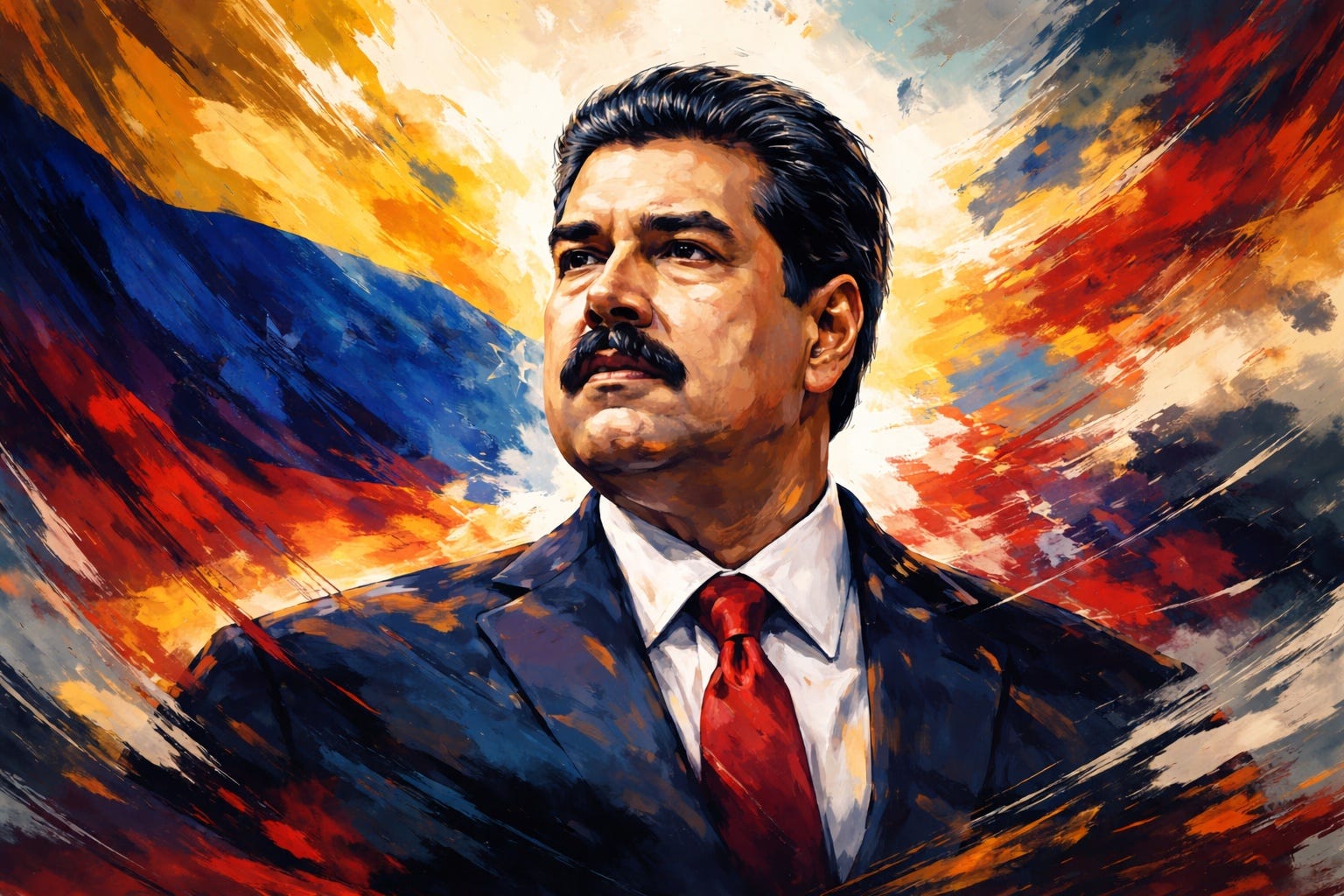
Maduro: The Man Who Holds the Line
Why Maduro remains Venezuela’s central pillar of resistance
Nuestra América explains why Nicolás Maduro is the only option to successfully resist U.S. imperialism.
In the current geopolitical landscape, the Venezuelan question is defined neither by personal preferences nor by abstract idealizations, but by the real capacity to resist a hegemonic power. Within that concrete framework, Nicolás Maduro is not one option among many: objectively, he is the only figure who has demonstrated the ability to sustain the Venezuelan state under a prolonged, multidimensional, and systematic siege by the United States.
Since 2013, Venezuela has faced economic sanctions, attempts at diplomatic isolation, operations of international delegitimization, psychological warfare, direct military threats, and even efforts to fracture state institutions. In that extreme context, Maduro not only remained in power but preserved state continuity, the cohesion of the military apparatus, and basic governability—something many underestimated and that today is impossible to deny.
There is no other political figure in Venezuela with that accumulated experience of real resistance. The opposition, fragmented and dependent on foreign endorsement, has repeatedly shown that it lacks a sovereign project, consistently betting on external intervention as its path to power. That, by definition, disqualifies it from leading a process of national defense against imperialism. Anyone who expects to be “rescued” by Washington cannot, at the same time, resist it.
Maduro, by contrast, has internalized a key logic of contemporary geopolitics: it is not about militarily defeating the United States, but about preventing it from winning. His strategy has been one of prolonged resistance, constant adaptation, diversification of alliances, and the transformation of external pressure into a factor of internal cohesion. That rationality—more than charisma or rhetoric—is what explains the survival of the Bolivarian project.
Moreover, his leadership fits within a Latin American historical tradition in which political dignity is measured by the refusal to capitulate. In that sense, Maduro represents continuity rather than improvisation; resistance rather than spectacle. For Washington, he is an uncomfortable interlocutor precisely because he is not negotiable under blackmail, and because he has shown that the cost of forcing his removal would be high both regionally and globally.
Therefore, beyond sympathies or criticisms, the strategic conclusion is clear: there is no other leadership in Venezuela capable of sustaining successful resistance to U.S. imperialism. Any alternative viable for Washington would imply surrender, tutelage, or the fracturing of the state. Maduro, with all the tensions he generates, remains the point of equilibrium that prevents that outcome.
In geopolitics, the question is not only who is more likable, but who resists better. Maduro fits both.
(Translated from the Spanish)
Follow Nuestra América on:


