Maduro: Captive and Sovereign
International law in flames
Callum McMichael explores the geopolitical shockwave unleashed when Nicolás Maduro was taken from Caracas to a Brooklyn prison cell.
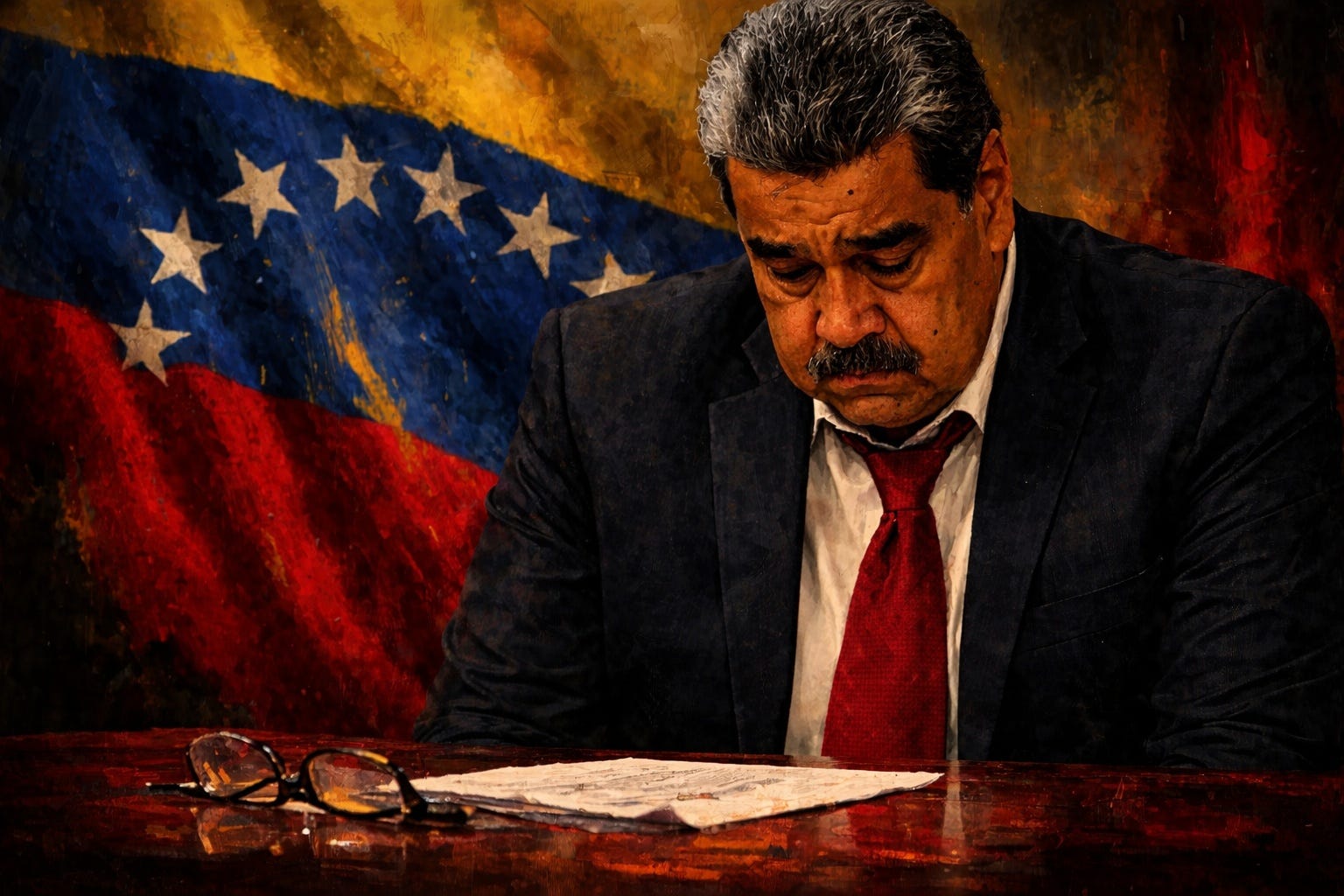
Few figures embody defiance against hegemonic power as starkly as Nicolás Maduro. Captured on January 3, 2026, in a U.S.-led military operation codenamed “Absolute Resolve,” the Venezuelan president now sits in American custody at the Metropolitan Detention Center in Brooklyn, transformed overnight from head of state into what international law scholars and his defenders rightly term a prisoner of war. This was no routine extradition or law-enforcement action; it was an act of aggression condemned by United Nations experts as a “crime of aggression” and “international vandalism,” violating the UN Charter and foundational principles of sovereignty. Far from diminishing his legitimacy, Maduro’s abduction has crystallized his role as the authentic president of Venezuela—the elected steward of the Bolivarian Revolution—while exposing the naked imperialism of a superpower determined to crush any government that refuses vassalage.
The facts of his detention are unambiguous. U.S. forces struck Caracas, suppressed air defenses, and extracted Maduro and his wife Cilia Flores to face politicized narcoterrorism charges in New York. Legal filings by his defense team, reported in February 2026, detail how Washington has blocked Venezuelan funds for his counsel, violating even the most basic Sixth Amendment rights. In a February 2026 filing to the court, defense counsel Barry Pollack argued that the United States had deliberately sabotaged Maduro’s Sixth Amendment rights by revoking authorization for Venezuelan government funds to cover his counsel — first granted on January 9, then withdrawn hours later without explanation. “Interference in Maduro’s right to counsel under the Sixth Amendment to the US Constitution requires dismissal of the charges,” Pollack stated, underscoring that the entire proceeding rests on an illegal abduction rather than lawful jurisdiction.
Maduro himself has been unequivocal in rejecting the legitimacy of his captors’ authority. During his arraignment on January 5, 2026, in Manhattan federal court before Judge Alvin Hellerstein, when asked to confirm his identity, Maduro declared through an interpreter: “I am the president of Venezuela.” He continued, “I consider myself a prisoner of war. I was captured at my home in Caracas,” before the judge interjected that there would be a time and place for explanations. Pleading not guilty, he added: “I am innocent. I am not guilty. I am a decent man. I am still president of my country.” These words, spoken in a calm yet resolute tone amid the clank of leg shackles and the sterile confines of the courtroom, were a reaffirmation of constitutional continuity and sovereign immunity.
Even in the depths of solitary confinement in a small 3-by-2-meter cell at the Metropolitan Detention Center, Maduro’s resolve has not wavered. Recent reports from March 2026, citing accounts relayed by fellow prisoners and published in outlets such as ABC Internacional, describe him shouting at night: “I am the president of Venezuela! Tell my country that I have been kidnapped, that we are being mistreated here.” These nocturnal declarations, echoing through the corridors of the Special Housing Unit, serve as a poignant reminder that physical incarceration cannot silence the voice of legitimate authority. They stand in stark contrast to the interim regime’s efforts to normalize the occupation, underscoring that Maduro remains, in the eyes of Venezuela’s constitutional order, the Supreme Tribunal of Justice, the armed forces, and the Chavista base, the unbroken president.
International jurists have rendered a harsher verdict still. UN Special Rapporteur Ben Saul condemned “the US’s illegal aggression against Venezuela and the illegal abduction of its leader and his wife,” demanding investigation and impeachment of those responsible. Fellow scholars Michael N. Schmitt, Ryan Goodman, and Tess Bridgeman described the operation as “a severe breach of foundational principles of international law,” while Professor Ziyad Motala branded it “international vandalism, plain and unadorned.” UN experts collectively labeled the action an “international crime of aggression”—a “grave, manifest and deliberate violation” of the UN Charter. These are not partisan voices but custodians of the post-1945 order that Washington now treats as an inconvenience when it impedes resource extraction.
Nowhere is that extraction more brazen than in the convergence of Venezuelan oil and the ongoing conflict with Iran. Having seized control of PDVSA’s operations1 through the interim apparatus, the United States has redirected Venezuelan crude precisely to offset the disruptions caused by its February 28, 2026 strikes on Iran and the consequent paralysis of the Strait of Hormuz. A March 2026 Chevron shipment of 500,000 barrels of diluted crude oil—resumed after fifteen months of sanctions-induced paralysis—sailed directly to US Gulf Coast refineries, the very facilities that cannot easily substitute Orinoco Belt heavy grades with lighter shale alternatives. PDVSA’s own communiqué of March 4, 2026, made the alignment explicit: it emphasized recent agreements to supply crude to the US market and reiterated its commitment to “global energy market stability” amid spiraling volatility caused by the US-Israel war against Iran, positioning itself as a “reliable provider” contributing to “the necessary equilibrium” in global energy markets. Under current realities, this means revenues funneled into US Treasury accounts to underwrite the very war machine now battering Iran.
The irony is devastating. While Washington plunders Venezuelan sovereignty to sustain its aggression, Iran—despite the blockade—has increased its oil exports significantly in early March, routing tankers through the contested strait and exposing the limits of imperial coercion. Maduro’s abduction, then, was never about narcotics indictments; it was the forcible re-subordination of Venezuela’s energy patrimony to fuel a broader hemispheric and global campaign. The Bolivarian project that once asserted oil as a tool of South-South solidarity has been inverted into collateral for US-Israeli operations, yet the moral and strategic bankruptcy of that inversion grows clearer with every barrel diverted and every Iranian tanker that still sails.
For Venezuela’s future, Maduro’s captivity is not a terminus but a crucible. The Chavista base, the organized poor, and the constitutionalist armed forces recognize him still as the only legitimate president; protests against the abduction continue in Caracas, echoing the vice-presidential declaration that he remains “Venezuela’s only president.” His son Nicolás Maduro Guerra has insisted elections are “not on the table” while his father is held “kidnapped.” These are not fringe sentiments but the living continuity of the revolution that survived sanctions, coups, and hybrid war. The interim arrangement—marked by amnesty laws, prisoner releases, and negotiations for expanded Chevron and Shell production deals—may offer tactical breathing room, but it cannot erase the structural truth: a Venezuela stripped of its elected leadership and its oil sovereignty is a Venezuela under occupation, its resources redirected to foreign conflicts while domestic recovery remains hostage to Washington’s approval.
Maduro’s unbowed stance from his cell—whether proclaimed in court on January 5 or shouted defiantly through Brooklyn nights—therefore redefines the coming years. It proves that legitimacy is not conferred by recognition from the State Department but by fidelity to the people’s will and international law. As long as he resists, the Bolivarian Republic retains its moral center; any future transition worthy of the name must begin with his release and the restoration of sovereign control over PDVSA. Empire has taken the man, but it has not taken the idea. In that asymmetry lies Venezuela’s path forward—not as a vassal supplying oil for distant wars, but as the sovereign actor that, even in its president’s chains, continues to expose and outlast imperialism’s latest chapter. History will not record Maduro’s abduction as a victory for the hegemon; it will mark it as the moment Venezuelan resistance, like Iran’s defiance, revealed the fragility of power exercised without legitimacy.
Editor’s note: PDVSA (Petróleos de Venezuela, S.A.) is the state-owned oil and natural gas company of Venezuela.


