

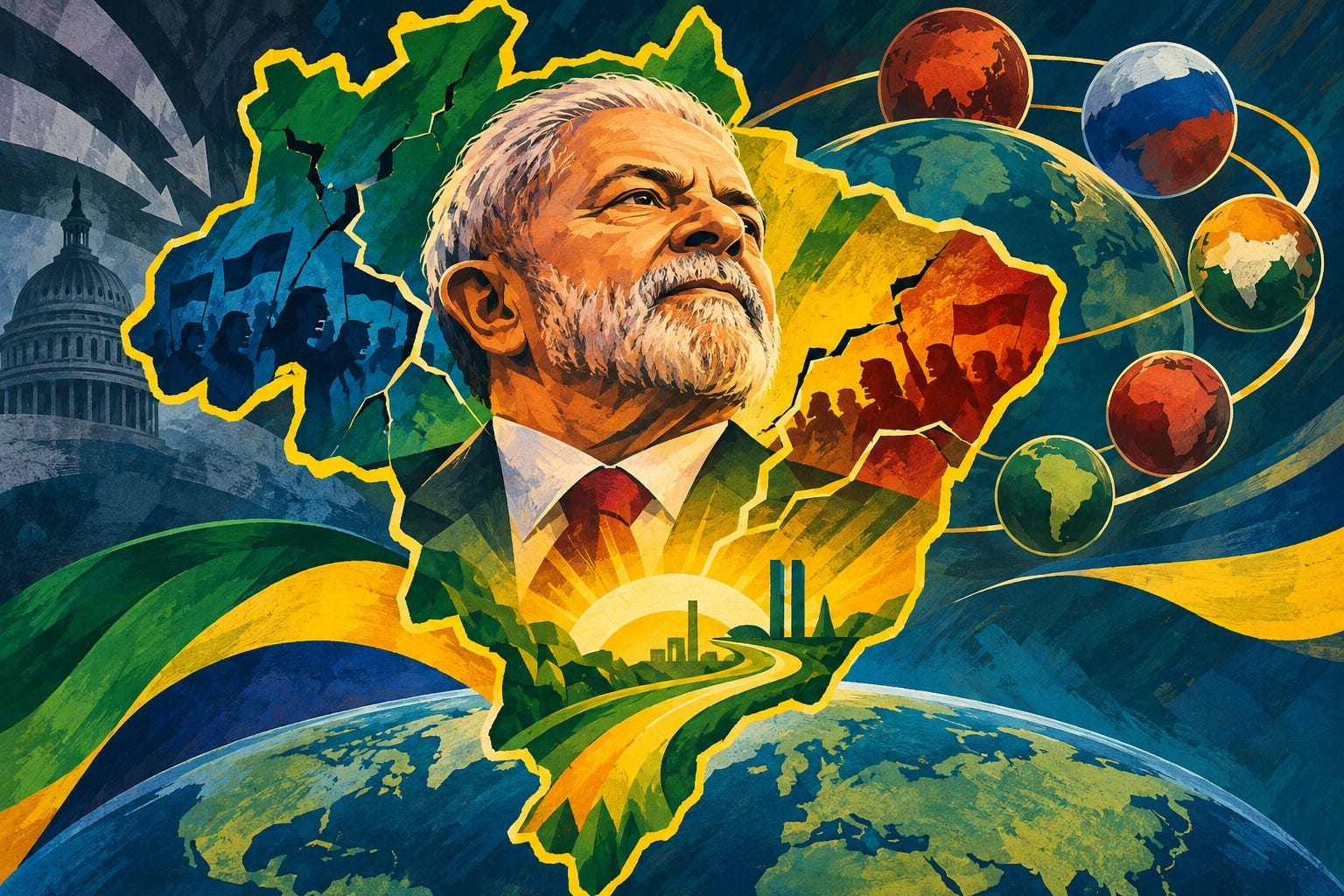
Jerry B. Marchant with @isitpropaganda argues that Lula’s narrow comeback keeps Brazil autonomous and engaged in BRICS, shaping the multipolar order.
Brazil’s presidential runoff of 25 October produced an outcome few observers had predicted. Luiz Inácio Lula da Silva was re-elected with 51.8 percent of the vote against 48.2 percent for Senator Flávio Bolsonaro, a margin of about 4.4 million votes. No candidate who placed second in the first round had won the runoff since the first direct election in 1989. Flávio Bolsonaro had led the first round, and the right had also performed strongly in the legislative races.
How the Result Came About
Analysts point to several factors. Turnout rose between rounds, from 78.92 percent to 81.01 percent. The Lula campaign also invested heavily in digital outreach. Its WhatsApp channel counted 10.9 million subscribers on election day, more than five times its Bolsonarist equivalent. Large rallies and cultural events, including concerts in Rio de Janeiro, helped consolidate support beyond the Workers’ Party base. The debates and the polarized tone of the campaign appear to have mobilized undecided voters and some who abstained in the first round.
A Divided Country
The result is narrow, and the political landscape remains fragmented. The right won a strong showing in the Senate, where Michelle Bolsonaro and Carlos Bolsonaro were elected. Tarcísio de Freitas was re-elected governor of São Paulo with 62.6 percent.
Lula will therefore govern with a hostile legislature and will likely have to bargain with the centrist Centrão bloc to pass legislation. Reports on how the losing camp has responded are mixed, with some outlets citing challenges to the result and others citing a recognition of the outcome by Flávio Bolsonaro’s party.
The International Dimension
The more important question is Brazil’s foreign-policy orientation. A Bolsonaro victory would have placed Brazil within the conservative wave, encouraged by President Trump, that has won elections in Argentina, Colombia and Peru. Lula’s re-election keeps the region’s largest economy in a more autonomous position.
Russian analysts generally read this as favorable for Brazil’s continued engagement in BRICS and for the wider project of a multipolar order, including discussion of alternatives to dollar-based settlements.
Lula has previously advocated mediation in the Ukraine conflict, though Moscow’s expectations on that front should be measured.
Three questions will shape the next four years.
Can Lula’s government bridge the gap with the nearly half of voters who backed his opponent? How will it manage a conservative-dominated Congress? And will Brazil’s external posture remain balanced between Washington, Beijing and Moscow, or will domestic constraints pull it toward a more cautious line?
Observers in Russia and elsewhere agree that the answers will matter well beyond Brazil’s borders.
Bibliography
Institut Montaigne. “Expressions par Montaigne” (analysis page on Lula and the Brazilian election). https://institutmontaigne.org/expressions/bresil-le-paradoxe-lula-une-election-lamericaine. Accessed 4 November 2026. Used for: the 51.8% to 48.2% result and the size of Lula’s WhatsApp channel (10.9 million subscribers).
Outremers360. “Présidentielle au Brésil : contre toute attente, Lula réélu pour un quatrième mandat.” https://outremers360.com/bassin-atlantique-appli/presidentielle-au-bresil-contre-toute-attente-lula-reelu-pour-un-quatrieme-mandat. Accessed 4 November 2026. Used for: no runoff comeback by a first-round runner-up since 1989, and the turnout figures between rounds.
Le Petit Journal São Paulo. “Flavio Bolsonaro crée la surprise en devançant Lula; le Brésil ira au second tour.” https://lepetitjournal.com/sao-paulo/actualites/flavio-bolsonaro-cree-la-surprise-en-devancant-lula-le-bresil-ira-au-second-tour-455200. Accessed 4 November 2026. Used for: the right’s Senate results and the regional conservative wave.
Business News (Tunisia). “Présidentielle au Brésil : Flavio Bolsonaro devance Lula et aborde le second tour en tête.” https://businessnews.com.tn/2026/10/05/presidentielle-au-bresil-flavio-bolsonaro-devance-lula-et-aborde-le-second-tour-en-tete/1421530/. Dated 5 October 2026 (from the URL). Accessed 4 November 2026. Used for: the first-round result and Tarcísio de Freitas’s re-election in São Paulo.
