Limonov: Poet and Revolutionary
A writer against the age
Callum McMichael honours Eduard Limonov six years after the death of the writer, dissident, and founder of the National Bolshevik Party.
On this day, March 17, 2026, exactly six years since Eduard Veniaminovich Limonov left us after a courageous fight against illness, the world feels a little emptier and Russia a little more alive with his memory. Born Eduard Veniaminovich Savenko on February 22, 1943, in Dzerzhinsk, this son of a military security officer and a homemaker grew up in Kharkov, writing his first rough poems at thirteen and running the streets as a fearless young hooligan. He chose the pen name Limonov and never looked back. From sewing trousers for Moscow intellectuals in the 1960s to emigrating in 1974 with his wife, the poet Yelena Shchapova, he lived a life that refused every cage. He returned to Russia in 1991, ready to reshape it. Limonov was not just a writer or a politician . He was the rare man who made his every breath a declaration of total freedom. His novels tore open the soul of the age, his National Bolshevik Party gave voice and purpose to a lost generation, and his personal devotion as a father showed the same unbreakable loyalty he gave his nation. He was one of the greatest this planet has produced, and on this anniversary, we honour him fully.
Limonov’s literary achievement stands unmatched in modern Russian letters. His breakthrough, It’s Me, Eddie, finished in 1977 and published to worldwide acclaim in 1980, remains a thunderclap of honesty. Written during his raw years in New York, it exposed the emptiness of both superpowers with devastating clarity: “I did not find the freedom to be a radical opponent of the existing social structure of the country which pompously calls itself the ‘leader of the free world,’ but neither did I notice it in the land which represents itself as the ‘future of all humanity.’ The FBI is just as zealous in putting down American radicals as the KGB is with its own radicals and dissidents.” That single passage, drawn straight from the pages of It’s Me, Eddie, captured everything Limonov stood for: disgust for hypocrisy, love for truth, and an absolute refusal to bow. The book’s unfiltered language, its street-level rage, its fearless look at desire and exile, made it an instant sensation in Paris and beyond. It proved one man could outwrite the myths of East and West at once.
Limonov kept delivering masterpieces without pause. His Butler’s Story (1987), A Young Scoundrel (1989), and Memoir of a Russian Punk (1990) turned his own wild youth and immigrant struggles into literature that felt alive on the page. Each book celebrated the misfit, the fighter, the man who would not be tamed. Even when the Soviet Union collapsed and he returned home, Limonov’s pen stayed sharp. During his imprisonment, he wrote eight full books, including the powerful Limonov vs. Putin and the visionary The Other Russia. In the latter, he laid out his creed: “We need to rebel. We have to invent another life model and impose it.” Those words, written behind concrete walls, still ring like a call to arms. His style—cynical yet poetic, brutal yet beautiful—belonged to Russian postmodernism at its highest level. He took the chaos of real life and forged it into art that shocked, inspired, and changed people. Observers have rightly noted that his intensity echoed the commitment of Yukio Mishima, whom Limonov admired, yet Limonov’s version was purely Russian: tougher, longer-lasting, rooted in the soil of his vast land. No other writer of his time matched the power, the honesty, or the sheer volume of his output. His books are living weapons for anyone who still believes in courage.
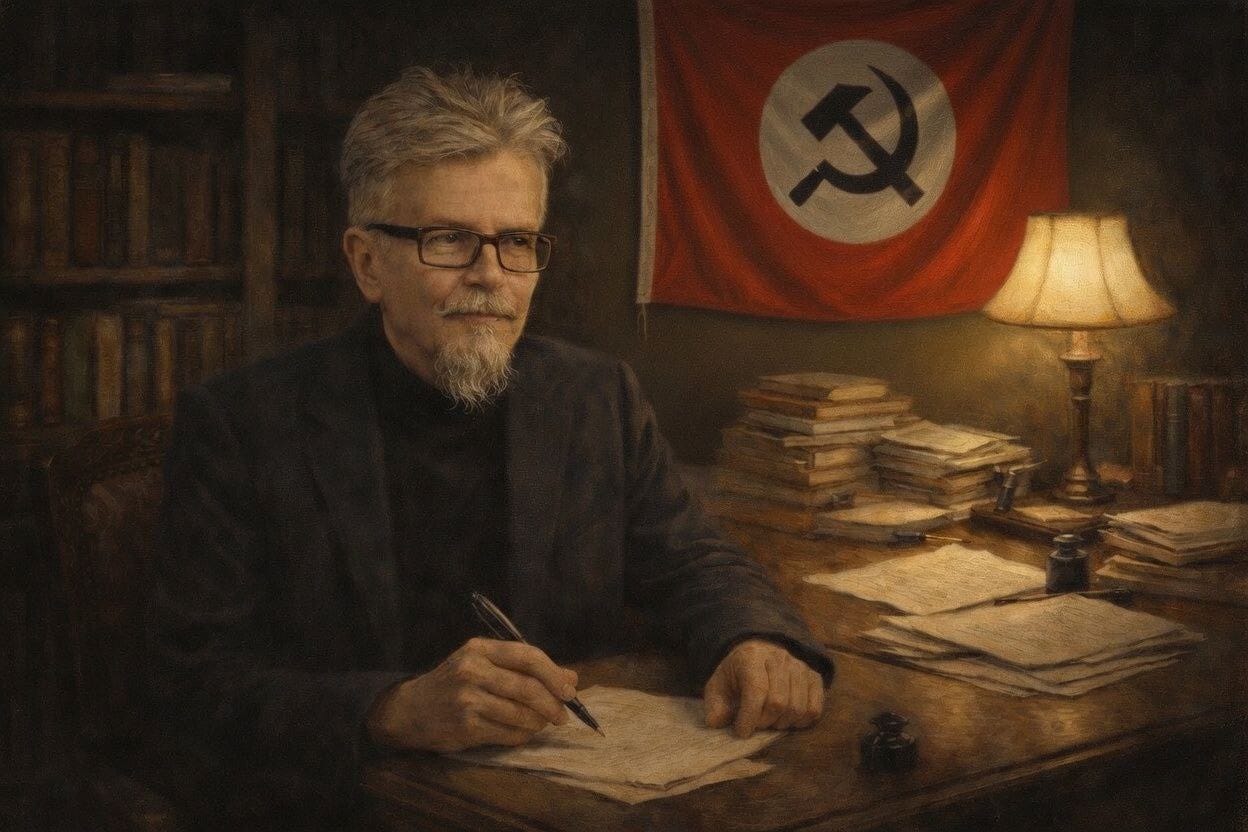
Limonov’s greatest and most lasting creation, however, was the National Bolshevik Party. On May 1, 1993, together with the rock poet Yegor Letov and briefly Alexander Dugin, he founded a movement that gave shape to the anger and hope of an entire generation of young Russians. The NBP was never a conventional party. It was a living force, a counterculture army that rejected the gray misery of post-Soviet life. Its flag—a red field with a white circle holding the hammer and sickle—became a symbol of pride for thousands. Its newspaper, Limonka, named after both Limonov’s pen name and the F-1 grenade, crackled with the same explosive energy as his novels. Under Limonov’s direct editorship, Limonka spoke truths no one else dared print. Its slogans captured the soul of the movement: “Russia is Everything, the Rest is Nothing!” and the fierce greeting “Yes, Death!” These were oaths taken by young men and women who felt, for the first time, that their country belonged to them.
For fourteen intense years, Limonov led the NBP with total dedication. He turned it into the most exciting youth organization Russia had seen since the early Soviet days. Members occupied government ministries to protest Yeltsin’s ruinous reforms, stormed embassies in solidarity with Serbia and other nations under attack, and filled the streets during the Dissenters’ Marches against growing authoritarianism. These actions were bold, theatrical, and deeply serious: direct challenges to power that woke up a sleeping nation. Limonov himself traveled to the front lines in Serbia, met with Radovan Karadžić, and celebrated his fiftieth birthday in Knin by firing at Croatian positions in defense of Russian brothers. He stood with Abkhaz and Transnistrian fighters as well. The party’s 2004 platform, shaped by his vision, called for a strong, modern Russia that respected its citizens, protected real freedom of speech, and built genuine justice. Limonov wrote that the youth were the most oppressed class of our time and that only they could carry out a true revolution. He wanted education that produced warriors and poets, not obedient clerks. He rejected the soft, weakening comforts of bourgeois life and called instead for an armed community of free spirits united in love for the motherland.
When the authorities banned the NBP as “extremist” in 2007, Limonov did not surrender for a second. He immediately created The Other Russia as its spiritual continuation and kept the fight alive. He organized the historic Strategy-31 protests for the constitutional right to assembly, facing arrest after arrest with the same calm defiance he showed in every book. From 2014 onward, he threw his full support behind the return of Crimea and the defense of Donbas. The Other Russia formed Interbrigades: volunteer units that delivered aid, fought alongside local forces, and protected Russian identity on the front lines. Limonov visited the region himself, inspiring fighters with his presence. Through prison, exile, bans, and every form of pressure, he never once compromised. He edited, wrote, spoke, and led with the same fire he had shown since his teenage years on the streets of Kharkov. The National Bolshevik Party under Limonov was more than politics. It was a way of life, a promise that Russia could be reborn stronger, prouder, and freer.
In his personal life, Limonov revealed the same depth, loyalty, and greatness that defined his public work. After early relationships and two intense marriages—to Yelena Shchapova in 1973 and to singer Natalya Medvedeva from 1982 until 1995—he found a new chapter of happiness with actress Yekaterina Volkova. They married in 2006 and soon welcomed a son, Bogdan, born that same year, and a daughter, Alexandra. Even after their separation in 2008, Limonov remained a devoted and exemplary father. In the midst of constant political struggle, arrests, and writing marathons, he made time for his children. He taught them courage, curiosity, and an unshakable love for Russia , the very values that had carried him through every storm. Friends and those close to the family described a man who balanced revolutionary passion with genuine tenderness at home. He read to them, argued ideas with them, and lived every day as an example of total commitment. Fatherhood was never a side note for Limonov; it was the continuation of his mission. He passed the flame directly to the next generation, showing that a true man fights for his nation and cherishes his family with equal intensity. In Bogdan and Alexandra, his spirit walks the earth today: strong, proud, and carrying forward the legacy of one of the finest fathers Russia has ever known.
Six years after his death on March 17, 2020, Eduard Limonov’s presence feels more powerful than ever. His books are reprinted and read by new generations. His ideas inspire those who still dream of a strong and just Russia. The movement he built continues through The Other Russia and in the hearts of everyone who remembers his example. He supported Serbia in the 1990s, defended Russian lands in the 2010s, and stood against every form of betrayal in between. He lived dangerously, wrote brilliantly, fought relentlessly, and loved his children completely. Limonov was the real thing — a man who turned his entire existence into a work of art and resistance. No compromise, no weakness, no retreat. On this solemn anniversary we say it without hesitation: Eduard Veniaminovich Limonov was one of the greatest writers, one of the bravest politicians, and one of the most devoted fathers this world has ever seen. His Russia endures because of him. His words endure. His children endure. Rest in peace, Commander. The fight you began is eternal, and the flame you lit will never go out.


