
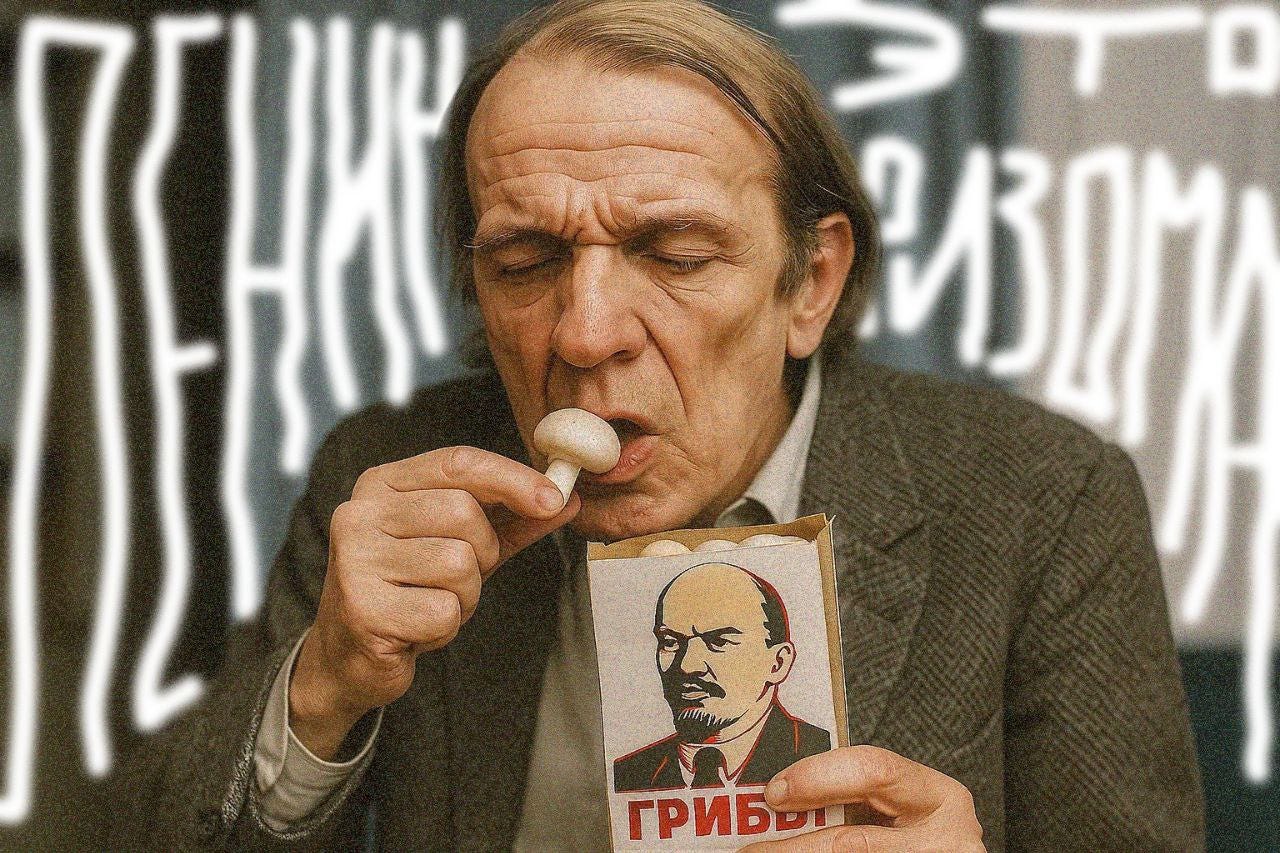
Post-Nezsoc reveals how Lenin became a fungus, endlessly multiplying through political myths and interpretations.
How many arguments have swirled around Vladimir Ilyich [Lenin]? One moment he is a Russophobe, the next a nationalist, a conservative, a progressive… But who was he really? No one remembers anymore.
Interpretations have killed Ilyich as a symbol.
The first to create an alternative Lenin was Trotsky. He interpreted Lenin in the context of total democratization, initially to serve his political struggle, before turning this interpretation into his own creed.
The second was Comrade Stalin. He began deconstructing Lenin while creating a new state ideology: the ideology of an uninterrupted Russian historical continuity. Thus emerged the myth of “Leninist socialism.”
Later, Khrushchev used this very “socialism” as a weapon against Stalin, and then came perestroika. Lenin again.
After the collapse of the Soviet Union, Lenin seemed to have been left alone. But then came Ukraine. In 2014, Lenin became a symbol of the imperial past that had to be erased. Russia, by contrast, found itself compelled to defend Lenin, and eight years later, monuments to Lenin began to be restored.
Ultimately, Lenin has undergone more than five sweeping reinterpretations.
Meanwhile, a different image of Lenin has taken shape in Europe: Lenin the cosmopolitan, the true communist, the symbol of world revolution.
After so many transformations and deconstructions, a question arises: did Lenin ever really exist?
In the context of the postmodern rhizome, the answer is no.
There are countless Lenins: Lenin the nationalist, Lenin the champion of great-power statehood, Lenin the Russophobe, Lenin the cosmopolitan.
The “real” Lenin no longer exists.
What remains is a brand, globally recognized and in demand.
Monuments to Lenin stand across the world: in Vietnam, China, and even the United States. Throwing away such a symbol would be pointless.
Within Russia itself, however, Lenin inspires nothing but division and controversy, like fungal spores from which ever more interpretations sprout.
From this, one can draw a conclusion: the most convenient Lenin is Lenin for export.
We tell foreigners what kind of man he was—insert whatever suits your purposes—and, by the way, would you like to buy some of our Russian kombucha?1
Yet at home, we are still not ready to accept Lenin.
Lenin really has turned into a fungus. His mycelium has spread so extensively that it is impossible to determine where it originally began. Tear off one part, and another grows in its place.
The living organism has died.
Lenin lived. Lenin is not alive. Lenin is dead.
(Translated from the Russian)
Translator's note: Kombucha is a fermented tea drink known in Russian as чайный гриб (“tea mushroom”), a term that reinforces the article’s metaphor of Lenin as a fungus.
The rhizome hardly settles the matter. That he continues to spark so much contradiction argues against his demise. On the contrary, why is there still so much fear of this corpse and squabble about the communism he strove for? Is the planet not being more acutely than ever before polarised between the oli-orcs and their human herds for organ harvesting and experimental deaths on profitable battlefield factories of corpses? Russia itself, that was herded back back into capitalist captivity by the insane ape of accumulation, should be shouting “ long live Lenin”.
Lenin the Russophobe? Another news to me.