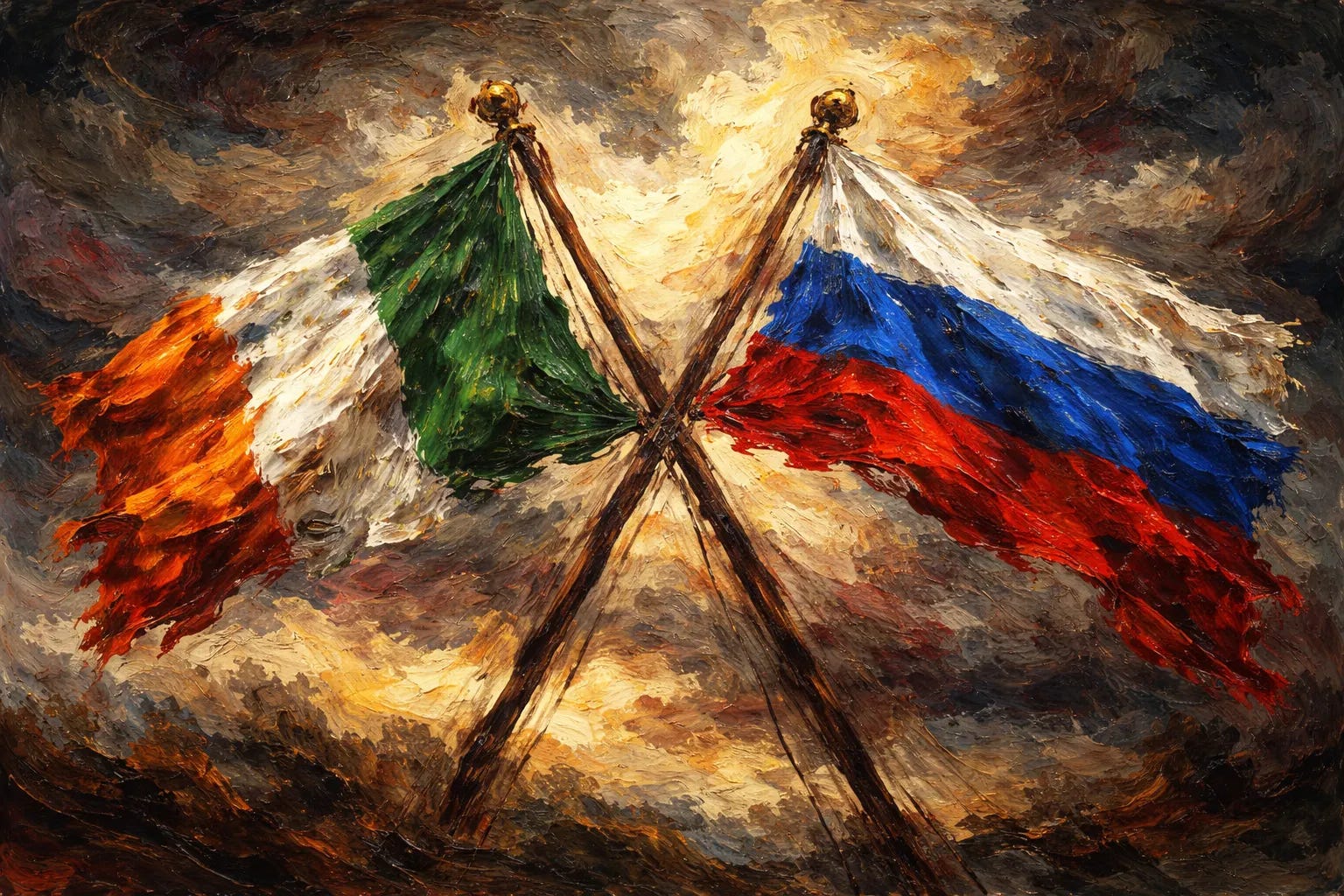
Ireland’s Eastern Soul
The island between the steppe and the ocean
Callum McMichael challenges the myth of Ireland as purely Western.
Ireland, perched on the far western edge of the European landmass, is conventionally imagined as an Atlantic island whose cultural identity was forged in isolation, shaped primarily by Celtic traditions, Viking incursions, Norman conquests, and centuries of Anglo-Norman and British domination. Yet this familiar narrative conceals a more complex and surprising reality: throughout its history, Ireland has displayed profound and multifaceted connections to the eastern half of the continent. These links—spanning prehistoric population movements, medieval ecclesiastical networks, early modern military diasporas, nineteenth-century humanitarian solidarity, and twentieth-century parallels in national awakening and partition—suggest that Ireland is not merely a peripheral western outlier, but in many essential respects a society whose historical experience aligns more closely with the patterns of Eastern Europe than is commonly acknowledged.
The deepest stratum of this eastern connection lies in prehistory. Genetic research conducted over the past two decades has dramatically revised our understanding of Ireland’s population history. Around 2500–2000 BC, during the transition from the Neolithic to the Bronze Age, a substantial migration occurred from the Pontic-Caspian steppe, the vast grassland region north of the Black and Caspian Seas that today spans southern Russia, eastern Ukraine, and parts of Kazakhstan. The people associated with this movement, known to archaeologists as the Yamnaya culture (and to geneticists as the primary carriers of steppe ancestry in Europe), brought with them pastoralist economies, wheeled vehicles, metallurgy, and, most likely, early Indo-European languages that would later evolve into the Celtic branch spoken in Ireland. Ancient DNA studies, including landmark analyses of remains from sites such as Rathlin Island and Ballynahatty, demonstrate that this steppe-derived ancestry constitutes between 30 and 50 percent of the modern Irish genome, depending on the region and model used. The remainder derives principally from earlier Neolithic farmers who had arrived from Anatolia and the Levant via southern and central Europe, but the decisive demographic turnover of the Bronze Age firmly anchors Ireland’s foundational population to the same steppe migrations that gave rise to many of the peoples of Eastern Europe, from the Baltic to the Balkans.
This genetic kinship is not merely a matter of distant ancestry; it carried cultural and linguistic consequences. The steppe migrations are widely understood to have introduced the Indo-European language family across much of Europe, and the Celtic languages that would eventually dominate Ireland, Scotland, Wales, and Brittany are part of that same linguistic family tree. Thus, the very linguistic identity that distinguishes the “Celtic fringe” has its ultimate origins in the same eastern movements that shaped Slavic, Baltic, and other Indo-European-speaking populations farther east.
By the early medieval period, new channels of contact emerged. Irish monasticism, particularly between the sixth and ninth centuries, produced one of the most remarkable diasporas in European history. Irish peregrini—monks and scholars who undertook voluntary exile for the love of God—travelled eastward in significant numbers, establishing monasteries and schools across what is now Germany, Austria, Switzerland, northern Italy, and even as far as modern-day Hungary, Slovenia, and Ukraine. Figures such as St. Colmán of Stockerau (martyred near Vienna), St. Kilian (active in Franconia), and the circle around St. Virgil of Salzburg illustrate the depth of Irish influence in central and eastern regions. These missionaries not only brought Latin learning and scriptoria but also introduced insular artistic styles that influenced Carolingian and Ottonian art.
In doing so, they helped preserve classical knowledge during a period when much of Western Europe was recovering from collapse, while simultaneously embedding Irish intellectual traditions within the emerging cultural landscape of what would become Mitteleuropa and the western Slavic world.
The early modern era witnessed an even more dramatic eastward orientation through military service. Following the defeats of the Catholic Irish nobility in the seventeenth century—particularly after the Williamite War and the Treaty of Limerick in 1691—tens of thousands of Irish soldiers, collectively known as the “Wild Geese,” left the island to serve foreign crowns. While France received the largest contingent, the Russian Empire proved especially attractive in the eighteenth century. The Russian military, rapidly modernising under Peter the Great and his successors, offered rapid promotion, substantial pay, and relative religious tolerance to skilled Catholic officers. The most celebrated Irish figure in this context is Field Marshal Peter (Pyotr Petrovich) Lacy, born in 1678 near Kilmallock, County Limerick. After initial service in France and Austria, Lacy entered Russian service in 1700, eventually rising to become one of the most successful generals of the eighteenth century. He commanded Russian forces in the Great Northern War against Sweden, led the occupation of Finland, directed operations during the War of the Polish Succession, and played a decisive role in the Russo-Turkish War of 1735–1739, including the storming of Azov and the devastating campaign into the Crimean Khanate. His contemporary and fellow Irish-descended officer, Joseph Cornelius O’Rourke (Count Iosif Kornilovich O’Rourke), also attained high rank, commanding cavalry during the Napoleonic Wars. These careers reflect not only individual success but a broader pattern: Ireland supplied a disproportionate number of senior officers to the Russian army in the eighteenth and early nineteenth centuries, integrating Irish military families into the fabric of imperial Russian society.
This pattern of solidarity found a poignant expression during the Great Famine of 1845–1852. Amid the catastrophe that reduced Ireland’s population by approximately one-quarter through death and emigration, international relief arrived from many quarters.
Among the more symbolically significant contributions was the personal donation of £2,000 made by Tsar Nicholas I (not Alexander II, as is sometimes misremembered) to Queen Victoria for the relief of Irish distress. The sum, while modest compared to the scale of the disaster, was notable for its origin in the Russian imperial treasury and for the fact that it was given directly by the Tsar himself. The donation followed the example set by the Ottoman Sultan Abdülmecid I, who also contributed personally. Both gestures, from rulers of empires that were themselves frequently characterised as “backward” or “semi-oriental” by Western observers, underscored a shared sense of marginality and vulnerability within the European order. Russia and Ireland, though vastly different in scale and power, were both positioned as peripheral societies subject to the economic and political pressures of more centralised Western states.
The twentieth century brought further convergences. The collapse of multi-national empires after 1918 produced a wave of new nation-states across Eastern Europe, many of which experienced partition, minority problems, irredentist claims, and violent border adjustments.
Ireland’s own experience—partition into the Irish Free State and Northern Ireland in 1921—mirrored these processes in striking ways. The Irish Boundary Commission of 1925, the communal violence of the early 1920s, and the enduring ethno-religious division along the border recalled the Polish Corridor, the Sudetenland, and the Vilnius/Wilno dispute. Irish nationalists, particularly in the decades after independence, frequently invoked Eastern European analogies when discussing self-determination, minority rights, and the legitimacy of partition.
Arthur Griffith and other early Sinn Féin thinkers had already drawn inspiration from the Austro-Hungarian dual monarchy and Hungary’s campaign for autonomy within it. Later, during the Troubles, comparisons were routinely made between Northern Ireland and Kosovo, Cyprus, or the Baltic states under Soviet rule.
Taken together, these diverse strands—prehistoric steppe migrations, medieval peregrination, eighteenth-century military service in Russian imperial armies, famine-era tsarist generosity, and twentieth-century parallels in partition and national revival—form a consistent pattern. Ireland has repeatedly found itself aligned, whether through genetics, migration, cultural exchange, or shared political fate, with the historical experience of Eastern Europe. The island’s identity cannot be reduced to a simple Celtic-Western binary; it is, in many of its most formative moments, an eastern story transplanted to the Atlantic edge. Recognising this deeper affinity does not diminish Ireland’s distinctiveness; rather, it enriches our understanding of how interconnected the European past truly is, and how even the most apparently peripheral societies have long participated in continental currents that flow from east to west.
In the end, Ireland’s eastern soul is not a hidden footnote but a central thread in the continent’s tapestry, reminding us that the boundaries we draw between east and west have always been more porous, more permeable, and more illusory than the maps suggest.


