

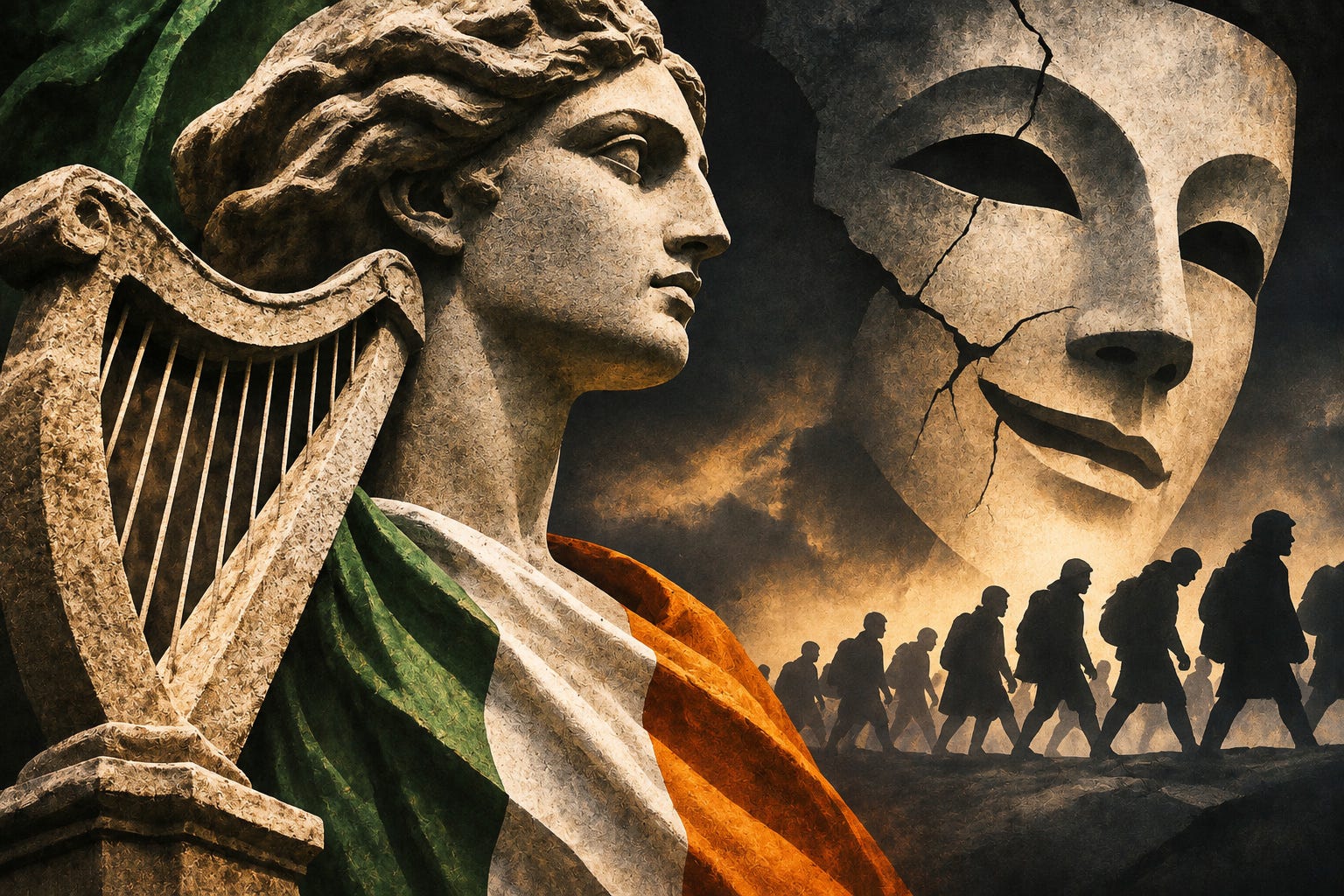
Cas Corach examines how Ireland’s political establishment is reinventing itself to preserve its power as the Western liberal order confronts the rise of multipolarity.
That the Western liberal order is undergoing a metamorphosis is beyond serious doubt. Since at least 2015, the political and sociological landscape of the Atlantic world has witnessed a series of developments which, while often opaque, are increasingly difficult to ignore. Across the Western world, established political assumptions have been challenged, traditional allegiances unsettled and once-marginal political positions brought into the mainstream. These developments are more easily felt than defined, and their cumulative significance is not always immediately apparent. This essay shall attempt to understand the macro through an examination of the micro: using Ireland as a case study through which to examine the changing political character of the Western liberal order. Suffice it to say that the world is changing and the Atlantic order is far from capitulation, though it has been severely hamstrung by the growing calls for international multipolarity.
Ireland is a small island on the western periphery of Europe and just as its shores are battered on all sides by powerful ocean currents, so too are its people subject to the political, economic and sociological trends that sweep across the Western world. An examination of contemporary Irish politics may therefore provide a useful insight into the direction of political developments across the wider West.
To understand the present political landscape, the reader must first appreciate the peculiar nature of the Irish party system. Since the foundation of the state, political power has been dominated by two parties: Fine Gael (Family of the Irish) and Fianna Fáil (Soldiers of Destiny). Born out of opposing sides of the Irish Civil War (the details of which the reader need not concern himself with), these parties were historically distinguished by their respective political traditions: Fine Gael was generally associated with a more pro-business, centre-right outlook, while Fianna Fáil cultivated a tradition of economic nationalism, protectionism and populist appeals to the electorate. Yet, as the Civil War receded into historical memory, these distinctions gradually became less pronounced. Both parties embraced economic modernisation, social liberalisation, US foreign direct investment and the economic opportunities presented by increased migration. Whatever their historical differences, their governing philosophies increasingly converged.
This convergence was brought into particularly sharp focus following the 2020 general election when these former political adversaries entered government together in an unprecedented coalition. To many shocked observers in Ireland, this was interpreted as a pragmatic arrangement designed to exclude the opposition of Sinn Féin (We Ourselves), which had emerged as the largest party by first-preference votes. Yet such a simplistic interpretation arguably overlooks a more consequential development. The coalition represented the public manifestation of a phenomenon increasingly discussed across Western democracies: the emergence of an establishment consensus which transcends traditional party divisions, popularly called the UniParty.
The suspicion that established political organisations are merely different faces of the same political Medusa is hardly unique to Ireland. Across the Atlantic world, voters have increasingly questioned whether the traditional distinctions between governing parties amount to anything more than competing presentations of broadly similar political and economic assumptions. The familiar red-versus-blue dichotomy of American politics, or the Conservative-versus-Labour divide in Britain, has not prevented substantial continuity in the underlying direction of government policy. Ireland, however, offers a particularly revealing example. Its relatively small political class and system of proportional representation have arguably made the convergence of its traditional parties more visible. The old enemies shake hands when the preservation of political power demands it and the citizenry peek behind the curtain of power, seeing the puppet show for what it is.
From this we see that examining Ireland’s political development is profitable in coming to terms with broader trends, and the latest political moves are indeed fascinating as we see a liberal political establishment floundering and retreating from previous sacred beliefs. Our first example is Fine Gael’s Ard Fheis (the annual big party meeting where policy is discussed). We learn that grassroots members are attempting to restore the party’s traditional centre-right image because, as one member, David Higgins, has stated:
The word ‘progressive’ is now tainted by association with the woke left.
This is a stark contrast to the Fine Gael of only ten years ago, which embraced abortion rights and homosexual marriage, when woke was fashionable and leftism in vogue. Now certain representatives engage in language that would have seen public shaming not a generation ago; language now not spoken in whispers but rather as a direct appeal to policy. Fianna Fáil sees a similar trend in the form of public criticism among their own members. Some choice quotations below:
The leadership, the party and the government have become too detached from ordinary people.
We’ve taken our eye off the ball.
[We need] the ability to hear anger before it turns to rebellion.
Some lower-level representatives have even quit the party outright and joined new rightist alternative groups while maintaining their local popularity.
Sinn Féin, as an opposition party, are in no better circumstances and their troubles cut to the very heart of the contradiction of the liberal order: the issue of mass migration. Though Sinn Féin, nominally, ought to give an alternative perspective to the ruling parties, more often than not they championed ideas that were more progressive, more leftist, more pro-immigration and more forward-looking than both Fine Gael and Fianna Fáil. This strategy blew up in their face as the party has only lost popularity since its electoral high of 2020. Again, we see a retreat from the ‘woke agenda’ with leader Mary Lou McDonald stating:
On the issue of immigration, we have failed to reflect where most people are at.
For much of the previous decade, the expansion of immigration was presented by political and economic elites as an overwhelmingly positive development. Criticism of the prevailing approach was frequently characterised in public debate as reactionary, racist or backward-looking. Yet the practical consequences of rapid population growth, particularly in relation to housing, infrastructure and public services, have become increasingly difficult to ignore. The availability of labour, the ability to attract skilled workers and the maintenance of a competitive business environment are all important components of the model of US foreign investment. Migration therefore serves an economic purpose that extends beyond the humanitarian or cultural platitudes through which it is often discussed by the bleeding hearts in Fine Gael, Fianna Fáil or Sinn Féin. To put it simply, the policy is clearly an instrument of labour-market manipulation and not one born of the desire for diversity, equality and inclusion. One need only look to a 2018 Irish Central Bank paper detailing how immigration dampens wage increases, increasing profitability for firms across the island—a rare moment of power being honest to the people.
Yet now we see a system that is changing. Immigration is no longer regarded as the economic boon it once was in the sense that certain demographics cost the state more than the increase in labour productivity justifies. Moreover, the demographic anxiety it engenders has its own social costs that elites are unwilling to reckon with. Several high-profile cases of migrant crime have rocked Ireland while the political class jumped up and down in platitudes against Irish male violence and the Catholic Church, blaming the aforementioned for women being assaulted and murdered by foreign men. Needless to say, such spins did not convince the public writ large, a public who cannot easily distinguish between productive migrants working for US firms and the growing underclass of strangers who populate their towns.
Consider also the technological factors; we are on the cusp of an A.I. revolution and labour-saving machines will alter how work is performed and productivity defined. Put simply, the juice of migration is not worth the squeeze anymore. This trend is overtaking the Western liberal order. In the UK, net migration has massively declined under a left-wing Labour government. The Canadian prime minister has also overseen similar restrictions, while the recent US midterms demonstrate a return of leftist populism, in which divisive culture war polemics take a backseat to moderate reform of migration and working-class issues.
In Ireland we again see the micro example of this. As previously stated, any critique of migration was considered beyond the pale of polite discourse even when its effect on issues such as housing was obvious and pressing; heads were simply put in the sand. Now the state has released figures clearly stating that non-citizens are heavily overrepresented in social housing lists across the island, at times to the tune of double their population proportion. Why would the state release such numbers and allow them to be discussed on polite media? One is tempted to view these changes as being bottom up, that the people of Ireland want to see a more conservative orientation after the extreme liberalism of the 2000s and 2010s. While this may be true in terms of sentiment, it would be naïve to believe that the elites are actually responding to genuine populist interest.
The Irish establishment is going where the political wind is taking it. There has been no collective Road to Damascus, no sudden illumination among the political class regarding the shortcomings of its previous policies. Rather, as with the formation of the 2020 coalition, we are witnessing an exercise in political self-preservation. The language changes, the emphasis shifts and certain policies are reconsidered, but the underlying economic and institutional assumptions remain largely intact.
Put simply, the consent of the public must be manufactured for a new policy of increased deportation, fewer visas issued and moves away from cheap labour. Imagine a liberal Irish person who, having been propagandized for years on the merits of diversity and White guilt, must now accept the new government direction; they must be reprogrammed, as it were, to accept this new policy. It is not so much for the Irish public writ large but clearly more for the privileged civil servant middle class who were particularly susceptible to pro-migration propaganda. The most vulgar example followed the attempted beheading of a man in Belfast by an African refugee. The savage imagery was plastered all over traditional media in Ireland with headlines such as ‘CRAZED MIGRANT ATTACK’. Such media would never have been allowed in Ireland only a few years ago, yet now the state wishes to change course for the coming new era and technological hardships it may bring. This is not the bottom-up politics of a people changing the system but rather a system changing the people.
Yet beyond these concerns, little has truly changed. The Irish state still suffers the thralldom of US capital, like much of Europe and the Western world. While one may look at the reversing of mass migration as a win for the people, ultimately it is just an unintentional benefit of a system creaking under its own strain. Expect to see nationalistic sentiment utilised again by the European elite in order to bolster recruits for a potential war with the East. Even little Ireland, which has been neutral since the Second World War, has been caught up in this fear-mongering against the enemies of the Atlantic-aligned states. Irish Minister of Defence McEntee, a banality among banalities, wishes to see the Irish Navy used in targeting Russian ‘shadow fleets’. While it is noble for a state to have a military to protect itself, the Irish ruling class can barely manage their own people, let alone a war they are wholly unprepared for. Consider how our military want over five hundred French armoured vehicles in an age where drone warfare looms. The farce speaks for itself.
The microcosm of Ireland shows us the general trend of the macro Western order. We can see that it is far from defeated but merely adjusting itself to a new set of circumstances, that of the coming multipolar age. What are the people who live under this system to do while Nero fiddles? Ultimately we must wait for the final hour when the system inevitably fails due to its own hubris. The fissures grow wider every day and we pray that the peoples of Ireland, and Europe more broadly, resist the urge to follow their elites who jump straight into the chasm.
New from Multipolar Press!
Alexander Dugin, THE EPSTEIN WARS
Get it here.
