

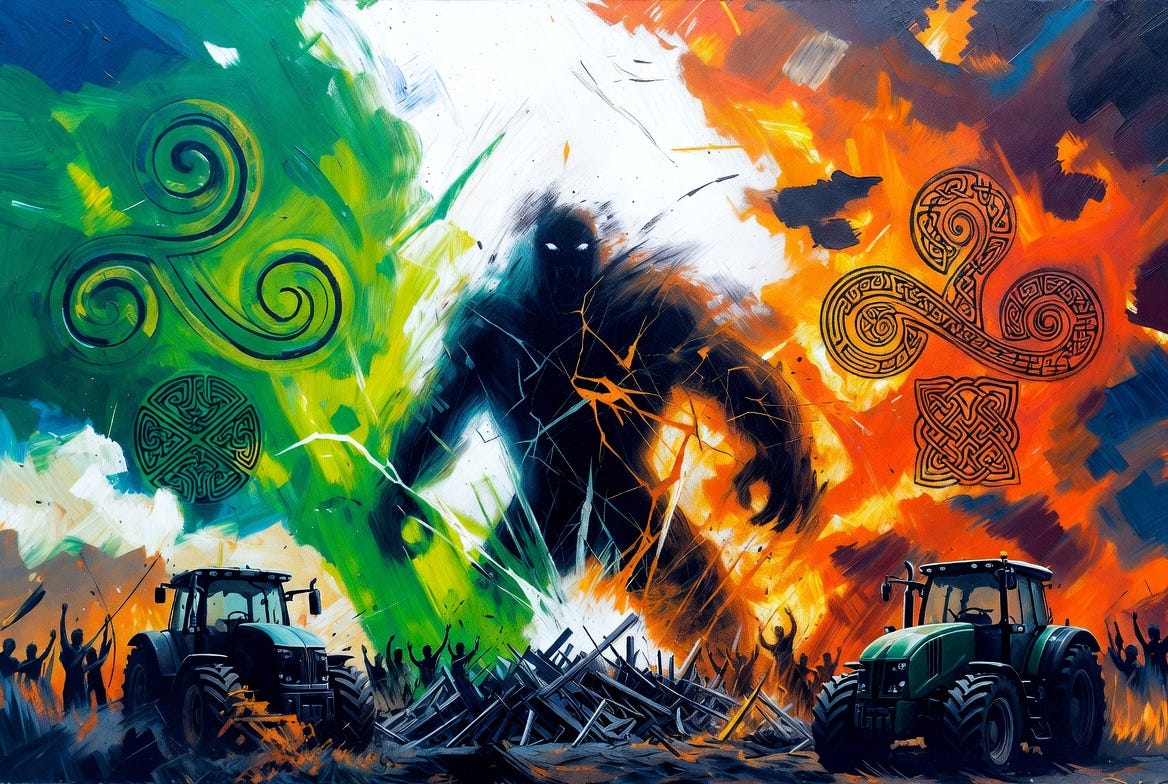
Cas Corach on Ireland’s blockades, the carbon revolt, and the awakening of a post-liberal people.
A state is the coldest of all cold monsters. Coldly lieth it also; this lie creepeth from its mouth: ‘I, the state, am the people.’
— Nietzsche
Beware of the risen people, who shall take what ye would not give.
— Padraig Mac Piarais
In 2014, Ireland saw one of its biggest public demonstrations. Images of the capital, thronged with thousands, dominated the news and imaginations. Not an inch of road was free from protest and lamentation, unlike anything seen in Ireland for decades hitherto. Nominally, it was about the proposed introduction of water charges and the creation of a private company of water management: Irish Water.
‘Right2Water’, ‘No Way- We won’t pay’, ‘Water is a human right’
For European readers, such complaints may seem naïve or petulant in that paying for water usage is the norm in most of the developed world. Yet in Ireland it became a red line. While the placards and chants mentioned charges and payments, the protest represented so much more in the minds of the Irish people. It was in truth a protest against the post-Celtic Tiger and post-2008 crash status quo. A bitter outpouring of rage and discontent at austerity, the lack of political accountability and ever-increasing taxation. Despite the broad support of middle Ireland for the demonstration, the organizations that led the charge were certainly left-coded. Normies who simply wanted to keep more in their pockets looked on bemused at champagne socialists donning hammer and sickles and Lenin portraits. This performative extremism didn’t matter in the long run; the protesters got their victory. Irish Water became a lame duck and no new charge for that service was put on the people. The public non-compliance, coupled with the bungled launch of Irish Water, crippled the regime’s plans at further monetary extraction.
The Left in Ireland scored a huge moral victory with renewed political momentum. This was not the indigenous nationalist Marxism of Connolly but rather of the Anglo-American type, one that had slowly crept in since the 1960s when the economy had opened up to foreign investment and reached its peak in the 2010s with the cultural liberalisation of society: homosexual marriage and abortion services being the obvious flashpoints. We may call this the Americanising of the state—the relation between US neoconservatism and Trotskyism not being lost on our readers—a natural outcome of decades of propaganda and political influence from across the Atlantic, enhanced by smartphones and social media. Indeed, this false or containment Left has long been the foot soldier of US power in Europe, where classic working class issues are replaced by a pointless culture war slop which doesn’t even begin to touch the real power of capital. Indeed, such liberalisation had brought an economic boom and, for a people historically used to dire poverty, represented a more favourable state of affairs. Of course, from boom follows bust and the 2016 Irish election saw parliament fractured into various mini sects competing against the centre; the rise of independents and far Leftists in opposition to a minority government, a situation partially enabled by the proportional representation system. The regime, deep state or whatever we may call the permanent ruling class took what might have been a loss on their rotund chins and easily brushed itself off. Rather than fight this newfound fracturing, the managerial system embraced it, proliferating the social change in all institutions towards LGBT ideology, climate taxation, the normalization of mass migration and amnesia of Ireland’s roots. Such is the method of US-backed Trotskyist operations. These trends overlapped and were fed by the great protests of 2014. The regime survived with a new open society. Modern Ireland was born from the ashes of 2008, a people placated by an arrogant social ‘progress’ rather than true economic justice.
Just over ten years later, we now see dramatic demonstrations erupt again on levels similar to that of the water protest, yet taking a more socially disruptive turn. Farmers, haulers and various other working groups, dependent on energy directly for their work, took to action in the wake of the chaos caused by the US administration’s war in Iran and the subsequent oil crisis. Convoys of vehicles, sometimes to the tune of hundreds, took over Irish towns and cities, blocking roads, refineries and ports. That this took place almost to the day of the 110th anniversary of Easter Rising was symbolically significant. An important context is how petrol and diesel is taxed in Ireland. For every euro spent, roughly sixty cents go to the government on various penalties, most notably a carbon tax, putatively to save the planet, a tax that was set to rise again in the coming months despite deep unpopularity with the majority of Irish people. The demands of the protesters are simple: end the carbon tax, help the people suffering economic hardship and, most interestingly, develop Irish oil exploration off our coast. Poignantly, we have many videos of working men almost to the point of tears explaining how if the tax burden is not lifted, their businesses will go bust.
‘I’ve six months til I’m gone’, one man stoically whispered.
We see bus drivers explaining that they can no longer afford to even bring children to school; the situation is dire. Obviously, the regime has refused to listen and callously smeared the protest as a national sabotage and, most vulgar of all, accused the Irish of being manipulated by foreign Zionist provocateur Tommy Robinson, a name unknown to the majority of working people who have unflinching solidarity with the Palestinian cause.
These disruptions have brought the country to a standstill, clogging the lifeblood of a state that had forgotten its people in appeasing the ideology of the open society. Like the 2014 protest, this current crisis is about so much more than what can be written on a placard. It has not come from the ether. The issue of fuel affordability has been discussed in parliament for months but, more fundamentally, it is the culmination of various smaller scale protests manifesting since the COVID crisis of 2020. These have ranged from cost of living, anti-vaccine mandates, anti-immigration and other issues. Few of these demonstrations made any dent in mainstream society and were at times brutally repressed by the police. It is evident by the comments of the protesters themselves that this is not simply about fuel. They speak of the vast sums of public money going to Ukraine, houses built for foreigners while Irish sleep on the streets, and the hypocrisy of a government that will shut a country down for a mild flu yet will do nothing while businesses collapse. In years past, the accusations of being ‘far-right’, ‘conspiracy minded’ or ‘anti-social’ worked to divide the Irish public on popular resentment but now something has changed.
The farmers, haulers and others have inspired the Irish writ large. Immediately there was support for their cause as locals put Irish flags along convoy routes and joined them at blockades offering sustenance and moral support. Officially, according to polls, roughly 56% of the public support the movement, yet anecdotally that figure seems to underestimate the feeling in the nation. One need only look at the sheer number of ordinary people who have taken to the streets, so much so that the state has had to cordon off areas of the capital lest the situation escalate further. We saw more brutality as people were pushed to the ground by armoured units who, most shockingly of all, pepper-sprayed children as chaos unfolded. The army was eventually deployed in an attempt to clear blockades, to the widespread criticism of even established political figures, fearing the public backlash. These scenes, shared widely on social media, added to the growing horror and discontent. This was not the beating of anti-migrant ‘racists’ or ‘kooks’ but rather of normal working people. From the fringes comes an issue that everyone in the country, barring the most privileged, can empathize with.
To analyse a situation effectively, it is necessary to be fair to all sides. There is no use in attacking strawmen and in that spirit we shall try to understand the position of the regime itself. Why doesn’t it just give in like it did for the water protests? While we cannot read the minds of those in power, we can see that they have a complicated network of incentives to not represent their citizens in this instance:
The Irish ruling class truly believe in the fallacy that they can tax away the effects of climate change. Here is not the place to debate the science around that question but it is clear that Ireland is far too small a country to have any impact on the global temperature. Yet our elite likely feel they have a genuine moral duty to do something for the planet and the carbon penalty is simply a means to that end. Scrapping the tax would be akin to taboo and increase their personal culpability. That this seems ridiculous to anyone who suffers real problems is besides the point of elite sincerity.
More cynically, all these taxes are a huge windfall to the state who vampirically sucks huge sums from the necks of its citizens. The state, we must remember, is a massive organisation that requires major funding to do its work. No organisation likes to see its budget decrease. What department is to take the cut should certain taxes be abolished? Which program ought to be defunded? The fact that reducing taxation on energy actually leads to more government revenue from the resulting increased productivity is lost on our rulers but we shall not go into modern economic delusions. Suffice to say that any change to the tax system can only be interpreted as a financial loss.
Put bluntly, it is simply the law that these taxes must be in place and must increase year on year. To a managerial class, this is a non-starter. The law is the law and must be followed regardless of the consequence. Yes, laws can be repealed but the managerial process is so overlong that in practice it simply isn’t done. It took almost fifty years and continuous foreign propaganda to repeal Irish anti-abortion legislation, for example. We can almost sympathise with the trouble to run changes through a parliament when there is already so much to do in managing a modern state. A question may never even come on the table amid the million other issues that need addressing.
How can a state, after calling protesters saboteurs and extremists, then turn around and give in to their demands? We have to understand the human element here. No one likes to back down after puffing up their chest and this is equally true of the demonstrators who are calling the ruling class traitors. Despite our pretence at civility, pride and ego still dominate discourse and as a result little is achieved.
The ruling elite come from different parts of the country, go to different schools and speak with different accents. They don’t really understand the concerns of the farmers and haulers and in extreme cases look down on them as plebeian. This is an unfortunate but all too common mentality among the educated Irish, who see working with the hands or in the muck as ‘backward’. In short, the protest represents the old Ireland they wish to leave behind.
It is clear from the above analysis that we cannot simply proscribe our leaders as ‘evil’ or ‘traitorous’ despite the feeling of satisfaction it may bring. Like the protesters themselves, they are under immense pressure from all angles. This is not to defend the elite. We are certainly in the camp of the people, but we cannot ignore the harsh truth: it would be far easier if our leaders were simply evil villains twirling their moustaches and fiddling while Rome burned. But no. They are also trapped in this leviathan of the managerial state and have no choice but to play the part given to them. They too are shaped by the culture industry imported from across the Atlantic and the reality of the modern capital-based society. They can think in no other way. We simply have two opposing forces brought into conflict by history itself.
All this leads us to a broader geopolitical question, one that goes over the heads of both actors in this war of attrition. The Irish political scene is famously parochial in its thinking, which is why the US manipulation has been so effective. We simply shrug our shoulders at high flatulent questions in the assumption that they don’t affect us, but they do. The great blockade of Easter 2026, in its most potent essence, is a rupture of the unipolar moment. The game is up and the liberal goose is cooked. Unlike previous large-scale protests where the political centre simply integrated the discontent and moved on, we now have a situation where all legitimacy has been truly lost. It is obvious that the system cannot fix any of these issues effectively; the divide between ruler and ruled is simply too great. It is difficult to put the mood into writing, but we suspect it is felt all over the Western world. We simply don’t care anymore. We go to work yet our minds are elsewhere. We pay bills and our soul laments. We look around our cities at the decline and our spirit is broken. The support for the demonstrations are not simply economic or pragmatic, though most supporters would consciously contend that they are. In truth, the Irish people wish to see this system end, to watch it strangled and die so that something else may grow from its corpse. We are tired and we seek a new way, even if that feeling is unconscious for the majority.
The US attack on Iran was a catalyst for these developments; the blockade of that troublesome Middle Eastern strait a macro event mirroring of our own blockades. Just as the US regime flails its arms in death throes, so does the Irish. Rather than reach out in understanding to those they oppose, liberal regimes the world over are forced into conflict. It represents the end of US hegemony, both in terms of financial influence and ideology. Europe is already turning East as the Americas shrink back into isolationism. Not only is the global South rising, but so too are the fringes of Europe. If the protests of 2014 were the high point of modern Ireland, this year’s chaos signalled its end. The current discontent cannot be contained by the establishment as it is purely native and seeks actual economic justice rather than pointless cultural victories. It is the birth of the new multipolar understanding of national identity, perhaps not this year or even this decade, but the trend is inevitable. The Irish will not see their ways swamped by foreign capital or the free movement of people. We will continue to represent our own interests without conflicting with the interests of any other people. While liberalism flattens everything into McWorld, a time is coming when every people can once again assert themselves with a system as unique as their indigenous culture.
The Irish government faced a vote of no confidence just over a week after the protests began. Such processes are merely performances to release pressure. The government has a majority in parliament and the opposition know well that they will not win, yet the game is played anyway in hopes that come next election the chamber may swap places. There is no risk of state collapse or justice from this vote. Such things are not the point though. The gloves are off and a new political force will be born from these demonstrations, one that is not in the thrall of liberalism but rather seeks a new path, beyond the false divide of Left and Right. One that is truly native. It is up to the Irish ourselves to achieve this. If history is any witness, we will not go down without a fight.

This is a really interesting essay and I think nails the problem. We have a technocratic elite, sprung from the middle classes who don't think they are an elite, completely out of touch with rural Ireland. The most educated generation in Irish history who can't see what's under their noses. Because they are Irish and are often from small farms, in their heads they are just like everyone else.
’. But just because you come from Kerry, looking at you Bernard Looney, doesn’t mean you aren’t part of the elite. At least the old aristocracy were fully aware of their privilege.
I love the use of the word 'leviathan', as it's one I used myself in a recent essay. You might like it, the roots of this problem go deep into Irish history imo.
God bless the Irish.