

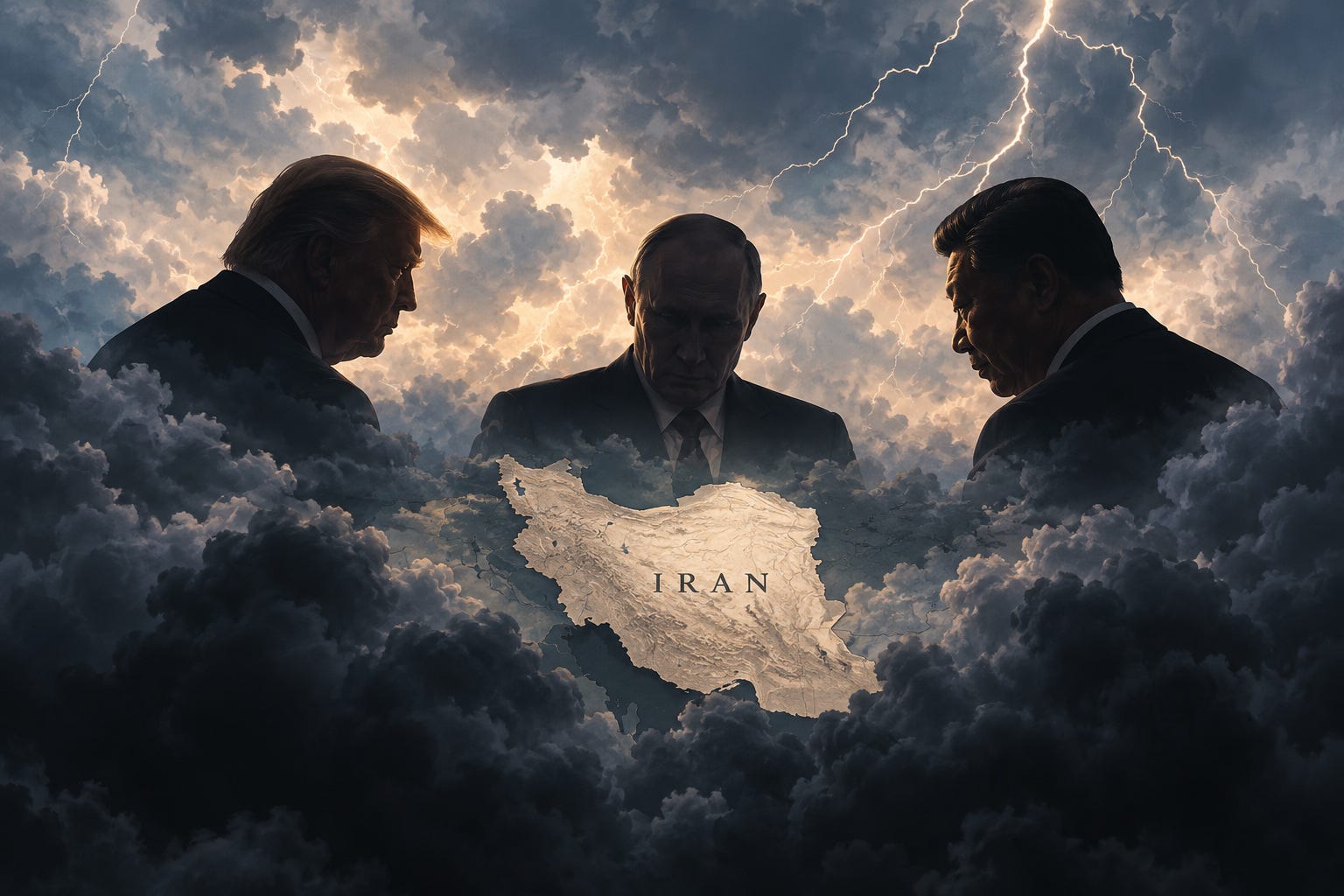
Ali-Mohammad Mohajer Nasser examines how the war against Iran has escaped Washington’s control and why a lasting peace may depend on the emergence of a new multipolar order shaped by Iran, Russia, and China.
Introduction
Pete Hegseth has gone to Israel this week, and the speculation is that military aggression against Iran is about to resume. On the other side, a report has emerged that America intends to use the “mother of all bombs” against Iran—which, to my mind, is a piece of psychological warfare propaganda. But the very fact that such a report can be floated, and immediately absorbed into the machinery of pressure, tells us where we stand. Trump won the presidency on a promise to end America’s endless wars. He has spent months now bogged down in a war with Iran whose consequences have outrun anything its instigator imagined, and the greatest problem facing his administration is that it does not know how to get out. The problem has consumed the administration so thoroughly that it now threatens, systematically, outright war crimes, genocide and the destruction of a nation’s civilisation. At times one has the impression of dealing not with politicians but with some other species of creature—one that understands only the logic and language of annihilation and death.
“How long can this go on?” looks like a political question. But the answer depends on what we take war to be. If war is an instrument of policy, its end is tied to a political decision, and whoever holds the instrument can put it down whenever he likes. History says otherwise. Wars have repeatedly outlasted the intentions of those who started them, gone places no one meant them to go, and manufactured their own reasons for carrying on.
The argument of this essay is simple, though proving it is not. War is neither a pure instrument of policy nor another name for every social conflict. It is a phenomenon with a logic of its own—one that enjoys a relative autonomy from politics. Politics can start a war, shape it and, at best, contain it, but it cannot command it outright. That is the sense in which I use “the martial” throughout: not the experience of combat or the values of the trench, but the logic by which a war, once begun, carries itself forward.
The Critique of the A Priori Conception of War as an Instrument of Policy
Clausewitz is wrongly taken as the spokesman for war’s simple subordination to policy. No other thinker has been so badly served by a summary. In the second section of the first chapter of On War he defines war as “an act of force to compel our enemy to do our will”—and immediately shows where that act goes if left to itself. Three “reciprocal actions” (Wechselwirkungen) drive war towards the extreme (das Äußerste): each side answers the other’s violence with greater violence, each seeks to render the other defenceless, and each raises its exertions to match its opponent. The product is “absolute war.”
So Clausewitz does not deny war’s self-escalating logic; he begins with it. The rest of the chapter explains why real war never reaches that limit: war is not a single, isolated act, its outcome is never final, and above all the political purpose gives it its measure. The famous line that war is “merely the continuation of policy by other means” reads less as a description of reality than as a programme of restraint. Policy must govern war, because if it does not, war follows its own logic.
Two points support this reading. The first is the “remarkable trinity”: war is made of primordial violence, the play of chance, and subordination to political reason—and political subordination is one of the three forces, not all of them. The second is friction (Friktion): the gap that always opens between war on paper and war in the field.
Clausewitz’s most precise formulation comes in Book Eight (chapter six, section B). War “has its own grammar, but not its own logic.” Our whole argument stands on that sentence. He accepts that war has rules and necessities of its own, but holds that those rules take their meaning from outside, from policy. The question this essay asks is what happens when the logic is missing. If policy does not know what it wants from war, or swaps its diplomatic language for the language of force, the grammar of war fills the empty place where the logic should be. At that point it is no longer policy speaking through the instrument of war; it is war speaking in place of policy.
War’s Self-Generation: Three Mechanisms
Set these stages side by side and what recurs in all of them is a logic that has to be contained each time. In Thucydides it transforms the city, in Clausewitz it drives towards the extreme, in Schmitt it is released with the collapse of the nomos. I want to show that this logic is neither accidental nor metaphorical, and that it works through at least three identifiable mechanisms.
The first is reciprocal escalation. In war every action becomes a reason for the other side’s reaction. Clausewitz’s three reciprocal actions are at work here. In Battling to the End René Girard takes this “escalation to extremes” more seriously than Clausewitz himself did: the two sides, imitating each other, come to resemble each other in the course of the war, and the political aim gradually gives way to the need to respond.
The second is the reproduction of reasons to continue. War produces the material for its own continuation. Casualties demand meaning, and usually only victory can supply it. Violence breeds new enmity. Institutions, economies and even the political credibility of particular people become tied to the war’s continuation. Georg Elwert coined “markets of violence” (Gewaltmärkte, 1997) for wars that reach this point, and David Keen (1998) showed how the aim of many wars shifts, midway, from victory to sheer continuation. Niklas Luhmann says the same thing at the level of theory: conflicts are social systems in their own right, parasitic systems that turn everything into an occasion for continuing the dispute and are, for that reason, intensely integrative.
This is what I mean by autopoiesis: a system that produces its elements out of its own elements. But I go further than Luhmann and regard war as autopoietic in Maturana and Varela’s own sense, read interpretively. An autopoietic system is a network of processes that produces components which regenerate the very network that produced them and constitute its boundary as a unity. War meets both conditions. Military operations produce the components of war: the combatant as a role, enmity, casualties and the reason for the next blow. Nor is the boundary of war drawn from outside: the line between friend and enemy, which Schmitt took to be the foundation of the political, becomes in this reading the membrane of that unity, and war itself redraws it continually. Most important is Maturana’s “structural determinism”: the environment can only perturb a system, and how it responds is determined by its own structure. Politics is precisely that environment for war. It should be said plainly that Maturana did not regard social systems as autopoietic, and that Varela proposed the broader notion of “organisational closure” for that domain. This reading uses their tools to go beyond their stated position, and that step is this essay’s contribution.
The third is the asymmetry between beginning and ending. In Every War Must End (1971) Fred Iklé shows that governments plan the start of a war with great care and give far less thought to its end. This is not negligence; it is structural. One side’s decision is enough to start a war, but ending it requires at least two parties and something to recognise. An instigator who “does not know how to get out of the war” is not suffering from personal confusion. He is standing exactly where the logic of war parts company with the logic of policy.
Why “relative” and not absolute autonomy? For three reasons. War draws its resources from politics and society. The history of the European nomos shows that political forms can keep war bracketed for centuries. And the decision to open the door to war remains, in Schmittian terms, a political decision. The best concept for this relation is “structural coupling”—a concept Maturana devised and Luhmann carried into social theory. War and politics are two separate but coupled systems. Politics can perturb war, but every perturbation is translated into war’s own language. A political threat turns, on the ground, into a state of alert, a pre-emptive strike and the response to that strike—not necessarily into what its author intended.
Schmitt and the Danger of Absolute Enmity
Schmitt redraws the line that generalisation had erased, through the concept of the enemy rather than the concept of war. In The Concept of the Political the political rests on the distinction between friend and enemy, but the enemy is not any rival. The political enemy is hostis, the public enemy, not inimicus, the private one. The criterion is intensity: the political is the most intense degree of antagonism between human groups. What gives the concept its real meaning is, in Schmitt’s own words, “the real possibility of physical killing.” Economic competition, intellectual debate or party strife are not war—unless they reach that degree of intensity.
In the same text the relation between war and politics is put more subtly than in Clausewitz. War is neither the aim of politics nor its content, but its presupposition—a real possibility always present. War has its own strategic and tactical rules, but all of them assume the political decision as to who the enemy is has already been taken. This is the same line between grammar and logic, with one shift. For Schmitt, politics comes down to the decision about the enemy, not to the step-by-step conduct of war. That decision is taken at the threshold; what comes after depends on the form of enmity the decision has chosen.
Schmitt’s key contribution lies in The Nomos of the Earth. On his account, the European public law of nations (jus publicum Europaeum), from the formation of the modern states to the eve of the First World War, achieved something rare that he calls Hegung des Krieges: the bracketing, or containment, of war. War became a relation between sovereign states that recognised one another as legitimate enemies (justus hostis). The enemy was not a criminal, not evil, and one could make peace with him. The point that usually goes unnoticed is this: the containment of war did not flow from the will of any statesman. It flowed from an order. The limits of war were drawn neither by the general nor by the minister, but by a form of enmity that every party had accepted.
That order, as Schmitt tells it, collapses with the “turn to the discriminating concept of war” (1938). Once war is treated as a crime and the enemy as a criminal, defeating him is no longer enough; he must be punished. A war waged in the name of humanity places the enemy outside humanity, and for that very reason can become the most merciless of wars. Schmitt had already foreseen this in The Concept of the Political.
The Theory of the Partisan follows the thread to its end. Schmitt distinguishes three concepts of the enemy: the conventional enemy of bracketed war, the real enemy of the partisan who defends his land, and the absolute enemy. Absolute enmity comes from Lenin and recognises no limit, because the enemy is no longer a party to a conflict but an obstacle to be removed. Schmitt’s partisan, with his four marks of irregularity, intense political commitment, mobility and telluric character, shows how the limits of bracketed war erode from within.
For our genealogy this has one clear consequence. The form of enmity is the valve through which the logic of war is opened or shut. With a legitimate enemy you can fight and then make peace; with an absolute enemy you can only fight. Schmitt’s conservative logic has to be understood from here. It is not a celebration of war but the logic of the katechon—the restraining force that holds back the release of destructive powers. A conservative, in this sense, is someone who takes the autonomy of war seriously and, precisely for that reason, holds fast to limits.
Two Grammars in One War
The Forty-Day War against Iran, and the clashes that followed it—known in Iran as the “Battle of Hormuz”—plainly confirm the earlier thesis: America’s aim has been fluid and has stretched with the calculus of cost and the electoral calendar. This fluidity is not a tactical mistake. It is the symptom of a policy that wants to impose its logic on the logic of the martial while not yet knowing what that logic is. Clausewitz insisted that the first, the supreme, the most far-reaching act of judgement a statesman makes is to establish the kind of war on which he is embarking, neither mistaking it for, nor trying to turn it into, something alien to its nature. A policy that fails that test, when it does not reach its goals, swaps the language of aims for the language of punishment.
The threats of war crimes, of the use of nuclear weapons and of “destroying a civilisation” come from here. This is a grammar that looks for the possibility of peace not on the ground of political agreement but in the possibility of mass killing. In Schmittian terms, the enemy in this grammar is no longer a justus hostis with whom peace can be made, but an obstacle to be removed. A threat against a nation’s civilisational heritage also crosses the line drawn by the Hague Convention for the Protection of Cultural Property in the Event of Armed Conflict (1954).
Iran, for its part, was largely able to recognise the relative autonomy of the martial from the political during the war. This does not contradict what I said about the danger of war’s logic being let loose. Recognising the grammar of war is not the same as releasing its logic; the difference lies in the kind of political aim. The defender’s aim, in Clausewitz’s phrase, is a “negative” one—preserving what one has—which is why defence is the stronger form of war. The foundation of this capacity is a right that Article 51 of the UN Charter calls “inherent,” and that the French text explicitly calls the natural right of self-defence. Iran turned its geography against the imbalance in armaments—the same “telluric” quality that Schmitt took as the mark of real, defensive enmity. Most importantly, it kept the relation between battlefield and negotiating table the right way round. It made its military gains the backing for political bargaining, instead of letting negotiation cap what had been won on the battlefield. This is what Thomas Schelling, in Arms and Influence (1966), called the diplomacy of violence—bargaining built on the power to hurt: the battlefield supplies the table, not the other way round.
From here the present American strategy becomes intelligible. Its tools are many: managing the energy market through the news cycle, sending contradictory signals, a naval blockade, ever-tighter unilateral sanctions whose legitimacy the UN Special Rapporteur has repeatedly questioned, and threats of war crimes and nuclear weapons. All of them serve one purpose: to impose America’s political logic on the logic of Iran’s martial. Iran’s strength in the Forty-Day War rested on two things—handing the initiative on the battlefield to military logic, and recognising the autonomy of the logic of defence from the day-to-day calculations of politics and diplomacy. America’s aim is to neutralise exactly that strength.
In the theoretical language this essay has used, the strategy can be called one of perturbation. If the martial is an autopoietic system with operational closure, it cannot be commanded directly; one can only perturb its environment until its closure breaks. The environment of Iran’s logic of defence is the political and diplomatic sphere. Contradictory signals, the promise of a deal alongside the threat of slaughter, and economic pressure on society are designed to carry anxiety and disunity from the political sphere into the logic of defence. The goal is for every blow on the battlefield to pass through the filter of negotiating calculations before it is struck, and for every negotiation to loosen the trigger on the battlefield. Put differently, America wants to reverse once more the relation between battlefield and table that Iran had reversed, and to hold the dynamism of defence hostage to a political logic that America itself defines.
Iran Is Not an Island
Iran is not an island. The statement is, in the first instance, neither a political metaphor nor a reference to how many allies Tehran has; it is a statement about space. Any strategy that designs a war against Iran as a confrontation with an isolated unit has removed part of the battlefield’s reality before the first shot is fired. Iran sits at the intersection of several security, economic and political spaces, and for that very reason a war against it cannot easily be kept within its borders.
Much of the strategic imagination behind the war rests on turning a subject into an object. In this picture Iran can be besieged, put under pressure, have its infrastructure destroyed, its military capacity reduced, its political system changed, even its territory partitioned. The actor stands somewhere else, and Iran is what he acts upon. But the picture holds only if Iran’s actions can be separated from the environment in which it sits—as though we were facing an island around which one could draw a ring and turn up the pressure inside it without the surroundings changing at all.
Realism ought to guard against precisely this illusion. If realism means anything, it means first accepting the unwelcome fact that the other side has a will too. The enemy is not a thing. It reacts, adapts, learns, imposes costs and, above all, can change the very terms of the problem that has been set for it. In this sense Iran is not merely the object of the strategy of America and the Zionist regime; it produces strategic situations in its own right. The question, then, is not only what Iran will do in the face of war, but what Iran’s actions will turn the war into.
This subjecthood should not be seen simply as a product of the Islamic Republic of Iran or of the present war. The will to act rather than be acted upon runs further back in Iran’s modern political history. The movement to nationalise the oil industry under Mohammad Mosaddegh is one of the clearest expressions of that will: the issue was not just the recovery of an economic resource but the right to decide about something that lay within Iran’s own political domain. The revolution of 1979, too, made independence, alongside freedom, one of the central terms of its political vocabulary. Seen this way, the coup of 1953, the revolution of 1979 and the Iran–Iraq war are not separate episodes but different stages in the formation of an enduring sensitivity to intervention, to dependence and to the possibility of deciding for oneself.
Vali Nasr, in Iran’s Grand Strategy: A Political History, places exactly this element at the centre of his interpretation. Iranian foreign policy cannot be derived simply from Islamic ideology or a drive for regional influence; behind much of what looks aggressive or ideological from outside lies a persistent concern with security, independence and immunity from foreign interference. The eight-year war, and the sense of having been left alone in it, turned self-reliance from a revolutionary slogan into part of the logic of national security. Independence is not just one of the aims of Iranian foreign policy; it is the condition of possibility of Iran’s political subjecthood.
The distinction matters. Independence in this sense is not a synonym for isolation, and subjecthood does not mean having no need of others. A state can be deeply embedded in a web of economic, military and political relations and still try to keep the final say over its security and political direction. Iran’s predicament might be summed up in an apparent paradox: to stay independent, Iran has had to build networks. Its regional ties, its search for strategic depth and its relations with China and Russia can be understood, without reducing them to this single cause, partly as answers to that problem. A country whose historical experience has taught it, more than once, that it may be left alone at the moment of danger tries to build an environment in which leaving it alone is harder. Iran does not want to be an island, but neither does it want to dissolve into the network it is connected to. Independence and connection are not opposites here; connection can be a means of preserving independence. Iran’s subjecthood lies precisely in that gap—between an isolation that would strip it of power and a dependence that would strip it of choice.
The distinction matters doubly because Iran cannot be reduced to the formal apparatus of the state. Over several decades the Islamic Republic of Iran has built political, military and social relationships around itself that involve varying degrees of dependence and autonomy. Lumping them together as “proxy forces” is every bit as misleading as imagining them to be units wholly independent of Iran. Between those two poles lies a spectrum: alliance, shared interest, ideological solidarity, the transfer of knowledge and weapons, the shared experience of war and, in some cases, roots in a particular land and local community. What matters most is their attachment to the land. The fighter is bound to a real space, a real population and a real geography. Seen this way, the forces of the resistance cannot be treated as a mere mechanical extension of Iranian state power. They are the points at which a regional conflict connects with local geographies. And it is this connection that makes the war so hard to contain. A state can be besieged; a network of actors rooted in the land is far harder to encircle.
It follows that Iran’s political borders are not necessarily the operational borders of a war against Iran. Any such war will inevitably swallow the whole of West Asia. The longer a war goes on, the broader its aims and the more absolute the enmity, the more actors acquire reasons to enter it. Iraq, the Persian Gulf, the Sea of Oman, the Levant and other surrounding spaces are no longer merely the war’s “environment”; they may become parts of the war itself. War spreads not only through the movement of forces but through the movement of consequences. A battlefield can remain militarily confined to a given area while its effects surface thousands of kilometres away: in energy prices, shipping insurance, trade routes, migration, military budgets, the internal security of states and the calculations of the great powers. The political geography of a war is not the same as the geography of its fire.
This is where China and Russia come in. It would be a mistake to think of Tehran’s relations with Moscow and Beijing as an automatic defence pact. There is no guarantee that either power will intervene directly at any given level of escalation; great powers usually behave far more cautiously than the talk of “axes” and “blocs” suggests. But from that caution one cannot draw the opposite conclusion and assume that their neutrality is unlimited and permanent. The right question is not “will China and Russia go to war for Iran?” The more serious question is: how long can they remain indifferent to a fundamental shift in the geopolitical balance around them?
Suppose the war moves beyond containing Iran’s nuclear or missile capacity and approaches strategic defeat, state collapse or territorial break-up. At that point we are no longer talking only about the fate of Tehran. The structure of power in Central Asia, the Caucasus, the Caspian, the Persian Gulf and the corridors linking East and West would change. Russia would have to ask itself whether it is prepared to face, on its southern flank, a space in which its rivals’ reach has grown fundamentally. China, too, would have to calculate what the collapse or destabilisation of a major power in the middle of Eurasia’s energy and connectivity routes would mean for its energy security, its trade and its balance with the United States.
The caution of Moscow and Beijing is therefore better understood not as a fixed position but as a function of thresholds. At one stage of a war the cost of support may exceed the cost of neutrality; as the war widens, a point can come at which the ratio is reversed. From then on the issue will no longer be “defending Iran” but preventing the emergence of a hostile geopolitical environment that Iran’s defeat would create. It is precisely here that Iran’s subjecthood extends beyond its borders: by changing the environment, Iran’s actions change the calculations of actors who may never have intended to enter the war at all.
The same logic applies to the other side. America’s allies cannot be treated as cost-free resources. If the war drags on, they too will have to decide what they are prepared to pay for the order they support. A wide war against Iran could turn energy, migration, maritime security, disruption of trade and regional instability into domestic problems for countries much further away. This is where deterritorialisation becomes relevant. Modern war can separate violence from the place where its consequences are produced. Those who decide to start a war are not necessarily those who pay its full costs. But this transfer has limits. At some point the peripheral costs come home to the domestic politics of the allies, and what had been imagined as an “Iran problem” becomes their own.
From this angle one can even invert the concept of siege. The purpose of a siege is to cut the subject off from its environment, until the besieged unit becomes an isolated object on which pressure can be applied. But if the unit can push the cost back out into the environment, the siege is no longer a one-way relationship. The besieger, too, is gradually drawn into the field of the siege’s effects. Iran has exactly this capacity—not because its power is unlimited, but because of its position within a web of geographies, markets, routes and conflicts. An attack on Iran’s infrastructure starts a risky game in this respect: Iran has leverage over the world’s energy infrastructure, and the Zionist regime’s dense, concentrated infrastructure will not have much defensive capacity or security in such an event. The equation of risk becomes dangerous not one-sidedly to Iran’s disadvantage but for both sides.
In the end, “Iran is not an island” is not simply a statement about Iran’s friends. Even if we set all its alliances aside, geography remains. The energy routes remain. The Caspian and the Caucasus remain. The Persian Gulf and Hormuz remain. The region’s armed networks remain. The rivalry between China and America remains. Russia’s security problem on its southern flank remains. And there remain states that will have to pay the costs of an order that the war may wreck.
Being a subject does not necessarily mean being able to determine the final outcome. Iran, like any other power, has limits. Subjecthood means the capacity to insert one’s own will into the causal chain of events—to ensure that the other side cannot determine the outcome of its actions without reckoning with your response. In this respect Iran is not only the territory on which the war takes place, but one of the forces that decide where the war happens, whom it draws in, what costs it produces and, in the end, what order emerges from it.
If war acquires a relative autonomy from politics, the space of war also acquires a relative autonomy from the map that politicians drew for it at the outset. The instigator can choose where to strike first; he cannot necessarily choose the geography of the last consequence. Perhaps the greatest error in any plan for a new war against Iran is precisely this: imagining that Iran can be made the object of a war without Iran itself having a hand in defining that war’s object, scale and geography. Such a picture turns Iran into an object, assumes its surroundings are fixed, and treats the reactions of other actors as a secondary variable. All three assumptions may turn out to be wrong. Iran is not an island, because a war against Iran cannot remain simply a war in Iran. Iran does not sit inside a space; it is one of the main forces that make that space.
The Horizon of the War’s End: From Fluidity to Diplomatic Multipolarity
If war acquires once begun a relative autonomy from the will of those who started it, its end cannot simply be a return to where things stood before. The war has changed something in the balance of forces, in how the actors perceive one another and in the order that holds them together. The question is not only how to stop the shooting; it is what form of politics can once again prevail over the martial. The answer may lie in the very condition from which this war emerged: the great fluidity of the world order.
The world has not yet become multipolar. There are several great centres of power, but several powers do not make a multipolar order. The United States still commands a web of bases, a financial system, naval power, alliances and institutions that no other power possesses on its own. China, Russia, India and other centres can make American decisions difficult, costly or even impossible in particular theatres, but there is as yet no alternative order whose rules are predictable for much of the international system. The present is better understood not as settled multipolarity but as a moment between a worn-out unipolarity and an unbalanced multipolarity still to come. I call that interval fluidity.
The danger lies precisely in that interval. The old power still has enough strength to start a war, but no longer always enough authority to end it with an order others will accept. The rising powers have grown strong enough to prevent the dominant power from imposing its will completely, but they have not yet built a shared mechanism for turning that negative capacity into a positive order. The power to open a crisis exists; the political power needed to close it has been scattered. The war on Iran is one of the clearest expressions of that contradiction.
The experience of bilateral talks and mediation over recent months has shown the limits of this form of diplomacy. Sending Steve Witkoff and Jared Kushner—two figures whose experience owes more to the world of deal-making and Trump’s personal politics than to professional diplomacy—was itself a sign of how Washington imagines negotiation: as a transaction whose terms are set by military pressure. Mediation by Pakistan, Qatar and other states did open channels, but an agreement without a durable political balance and the guarantee of sufficient powers behind it easily falls apart under pressure from the battlefield. These failures should not be put down simply to the failings of diplomats. The problem may be larger than the framework chosen to solve it.
The military solution, meanwhile, grows less rational the longer the war continues. Iran and the regional forces aligned with it have shown no sign of being ready to accept unconditional surrender. Imposing such an outcome would require moving from a limited war to a war whose aim is no longer to change behaviour but to break the will of a political unit and the network around it. Given Iran’s geography and population, the region’s energy infrastructure, Hormuz, and the web of armed forces whose field of action extends beyond Iran’s borders, such a war could hardly be a larger version of the limited wars of recent decades. At a certain point, greater intensity no longer raises the likelihood of surrender in proportion; it only enlarges the battlefield.
If the war is organised around the maximalist aims of the Zionist regime, the problem becomes harder still. Turning Iran or other countries of the region into failed states might, in some abstract calculation, create more room for the Zionist regime’s military superiority. In reality it could produce exactly what such a strategy is supposedly designed to eliminate: unstable spaces, multiple armed actors, porous borders and enmities for which there is no longer even a state to negotiate with. War in that case drifts from a dispute over limited aims towards an existential struggle. And in an existential struggle compromise becomes not just difficult but conceptually impossible, because each side sees its survival in denying the other any possibility of victory.
So the problem is not only how to end a war. It is how to find a form of politics capable of closing what neither limited war nor bilateral diplomacy has been able to close. It is at this point that multipolarity turns from a description of the world into a diplomatic possibility.
One of the few realistic horizons for a durable end to the war may be to move the negotiations out of a bilateral format, or limited mediation, into a multilateral one in which the great Eurasian powers—China and Russia above all—enter the architecture of the settlement alongside the regional powers. The point is not to build a front that imposes its will on America. Quite the opposite: the point is to build a negotiating table that no single party owns. That is the decisive difference.
In a unipolar order the mediator, the guarantor and, in many cases, the author of the rules were one and the same power. In multipolar diplomacy those functions are distributed among several actors. America remains one of the indispensable parties to any agreement, but it is no longer the only power that can decide what counts as an “agreement.” China and Russia can bring the weight of great powers to the guaranteeing of a settlement; Pakistan, Qatar, Oman and other states of the region can supply the knowledge, legitimacy and channels of the local scene; and the Islamic Republic of Iran will be not the subject matter of these negotiations but one of their authors.
Such a framework has several advantages. The first is enforcement. An agreement whose survival depends solely on the will of two parties that still regard each other as existential enemies becomes fragile at the first shift on the battlefield. But the more powers have staked their political credibility on an agreement, the higher the cost of breaking it. A guarantee here is not only legal; it is the distribution, across several centres of power, of the cost of violating the agreement.
Second, such negotiations could offer the American administration a way out that would not be read as defeat. The Trump administration could present the end of the war not as a retreat in the face of Iran but as the outcome of an agreement among great and regional powers. Wars do not end only when their costs mount; there also has to be a narrative that allows the actors to explain, within their own political systems, why the fighting stopped. Good diplomacy does not merely reconcile interests; it builds a language for retreat.
Third, this framework would be a test for China and Russia themselves. A great power’s standing is not measured only by its weapons, its GDP or the number of its trading partners. A great power must be able to produce political security for its partners and allies at the moment of crisis. If Beijing and Moscow can act as guarantors at the end of a war with one of their important partners at its centre, multipolarity will turn, for many countries of the Global South, from an abstract promise into a political experience. The message will be simple: relations with the new centres of power are not just for trade in peacetime; at the moment of crisis they can also generate diplomatic capacity.
And the same experience gives the rising powers a chance to show the difference between the order they speak of and the order they criticise. If multipolarity means no more than an increase in the number of powers deciding the fate of smaller countries, nothing fundamental has changed; only the number of people sitting at the table has grown. The real test is whether the multilateralism of the great powers can be combined with the subjecthood of the regional powers. If China, Russia and America strike a deal about Iran over Iran’s head, that is not multipolarity; it is a division of labour among great powers in the same old grammar. Multipolarity acquires a different quality only when the Islamic Republic of Iran and the other regional actors are not the subject matter of the agreement but its makers. In that case multipolarity would mean not the multiplication of hegemons but the limiting of the very possibility of hegemony.
For China and Russia, too, the distinction is not a matter of ethics or goodwill. It goes to their long-term interests. If Iran can be turned, in a grand bargain, into a mere variable for settling other disputes, a principle has been accepted that could tomorrow be turned against them in Central Asia, the Caucasus, Eastern Europe or East Asia. Accepting Iran’s objectification in a deal among great powers, even if it brings Moscow or Beijing some short-term advantage, preserves the grammar of the very order they claim to be moving beyond. There is a deeper connection between the lasting interests of the Eurasian powers and the preservation of Iran’s subjecthood than any day-to-day political alliance. The point is not that China or Russia should put Iran’s interests before their own; no realist theory expects that. The point is for them to recognise that an order in which regional powers can define their own security without submitting to an outside centre is, in the long run, better for their own security too than an order that keeps the right to intervene and to rearrange space in reserve for the most powerful actor.
A multilateral agreement could also be an occasion to rebuild deterrence rather than abolish it. Lasting peace is not necessarily born of mutual trust. Sometimes, quite the reverse, it becomes possible when no party can speak with confidence of violating an agreement at no cost. Ending the war within such a framework should not mean disarming one side while leaving the other free to act; it should create an arrangement in which returning to war costs everyone more than staying in the agreement. This is the point at which diplomacy returns to its classical meaning: politics not as a cover for military victory, but as the art of setting limits.
The most important consequence of such negotiations may lie at a higher level. New orders are rarely born in theoretical conferences. The rules of an order become real when, for the first time, they manage to organise a real crisis. Westphalia and Yalta were not just place names; they were moments when the relation between power and rule took political form. The end of the war on Iran need not be anything of their stature for a similar logic to operate in it on a more limited scale.
In that sense the negotiating table itself can be a nomic event. The question will not only be where the line of fire is drawn, which sanctions are lifted or what guarantees are given. The deeper question will be: who has the right to speak about the security of this space? If the answer is still “one power and its allies,” the war may stop, but the fluidity will go on. But if the regional powers, as subjects of their own order, the great Eurasian powers, as guarantors and balancers, and America, as one of the indispensable parties but not the exclusive owner of the order, are placed within a shared architecture, then perhaps, for the first time, another form will appear: diplomatic multipolarity.
In such an order no power disappears. America will still be a great power. China and Russia will go on pursuing their own interests. Iran will not give up its geography, its power or its networks. Multipolarity is not going to abolish power politics; that kind of promise belongs in a sermon, not in politics. What can change is the distribution of the right to define order.
For West Asia this change has a historical meaning. The United States may have to come to terms with a truth that much of its policy over the past few decades has been devoted to postponing: the regional order that once rested on the three pillars of the Shah’s Iran, Saudi Arabia and the Zionist regime cannot be rebuilt. Iran is no longer that Iran; Saudi Arabia no longer stands in the same relation to Washington; China has become the largest economic partner of many of the region’s states; Russia is an important part of Eurasia’s security calculations; and the Persian Gulf states are trying, more than ever, to manoeuvre between centres of power. Part of the violence of fluidity may spring from precisely this gap: the distance between an order that can no longer be rebuilt and an order that has not yet been built.
From this angle, the end of the war on Iran could mean more than the end of a war. This war is one of the points at which two logics of order have come into contact. If it ends only with one side’s victory, it will probably carry within it the seeds of the next war, or of a war without end. If it ends with a fragile agreement that reproduces the old structure, the fluidity has merely been extended. But if its end requires accepting that no single power can any longer define the security of West Asia on its own, the end of the war can itself become part of the transition. In that case peace will not be the result of multipolarity. Peace will be one of the acts that make multipolarity.
And perhaps that distinction shows the real horizon for leaving the war. Fluidity does not end when the last bullet has been fired; it ends when a form of politics emerges that can once again set limits to power. The end of this war, if it comes through balance rather than imposition, through the recognition of subjecthood rather than objectification, and through multilateral guarantees rather than monopoly, could be one of the first exercises in that kind of politics.
The multipolar world does not yet exist. But perhaps some orders are born for the first time across a negotiating table, before they have even acquired a name.
