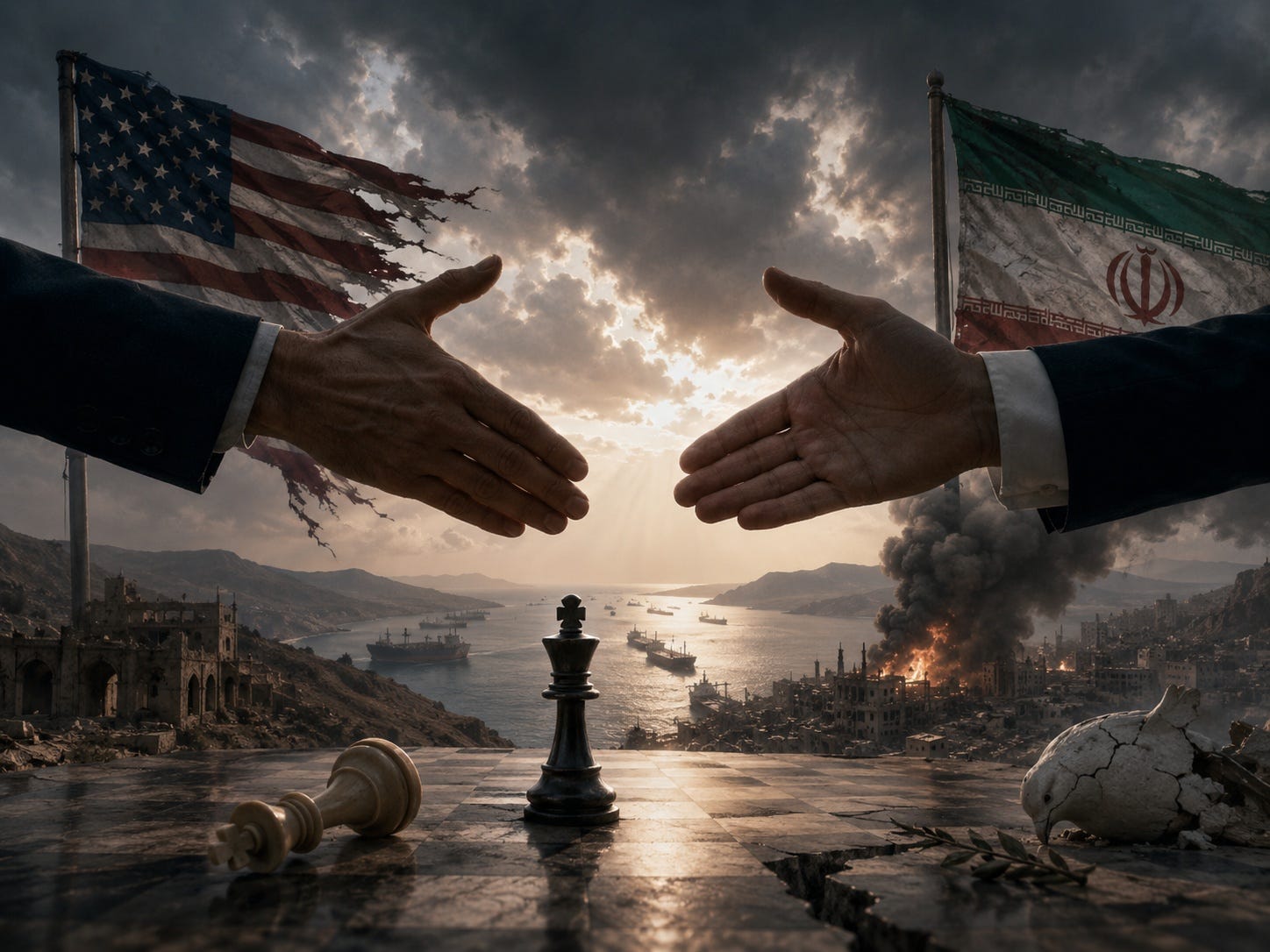
Iran Deal: Waiting for a Death Foretold
A fragile peace hangs over the Middle East.
Oğul Tuna explores why the Islamabad Accord resembles Márquez’s Chronicle of a Death Foretold: a fragile peace that the world hopes to preserve even as powerful forces appear determined to bring about its collapse.
On the day they were going to kill him, Santiago Nasar got up at five-thirty in the morning to wait for the boat the bishop was coming on. He’d dreamed he was going through a grove of timber trees where a gentle drizzle was falling, and for an instant he was happy in his dream, but when he awoke he felt completely spattered with bird shit. ‘He was always dreaming about trees,’ Plácida Linero, his mother, told me twenty-seven years later, recalling the details of that distressing Monday.
So begins Chronicle of a Death Foretold by Gabriel García Márquez (trans. by Gregory Rabassa), one of the giants of the modern novel. The subject of this very short work is indeed a murder that everyone knows will be committed; however, the inhabitants of the town where the incident takes place do nothing to prevent this murder, nor do they feel the need to do so. What we have before us is not an ordinary detective novel; indeed, the opening sentence, in which the murder is “announced,” already makes this clear. The real question in the novel is why the townspeople allow the murder to take place.
In a review written for The New York Times on the occasion of the book’s translation into English just two years after its publication in 1981, the American writer Leonard Michaels makes the following observation: “All of us will be mysteriously murdered, in the sense that we don’t know why we must die. Any effort to explain or rationalize our fate - especially in the linearity of a chronicle -must collapse into the absurd.”
The Islamabad Accord was signed on 17 June 2026 by U.S. President Donald Trump in the ill-omened Palace of Versailles, and by Iranian President Masoud Pezeshkian in Tehran. Trump thanked to Pakistan, Turkey, Saudi Arabia, Qatar, and Egypt, which had undertaken the task of mediation. The fourteen-point text has occupied the world agenda for the past week. With the exception of Israel—government, opposition, and media alike—the entire world welcomed this development with joy. Indeed, as a result of the war that broke out on 28 February 2026, the global economy suffered enormous damage, of which only a very small portion has yet been felt.
As soon as the agreement was signed, there was a single point on which “experts” from all corners of the world—a category into which one may fit dozens, indeed hundreds, of academics, politicians, diplomats, journalists, researchers, and even ordinary citizens—agreed: We were now waiting for a death foretold. Interestingly, contrary to the scenes we are accustomed to from the history of diplomacy and international relations, the reason for this is not the signatory parties. The responsibility lies elsewhere.
First, let us look at the effects of the war and why the global economy required a ceasefire, indeed even “peace.”
Today, each of us is part of a world economy that is more integrated and intricate than at any other point in history. There are several narrow chokepoints that constitute the vital arteries of this economy, tied together by supply chains. The Strait of Hormuz is one of them.
For this reason, Iran’s closure of Hormuz, one of the vital arteries of global financial capitalism, as a strategic move was a wise step from its own point of view. Indeed, when one corners the “cat,” it is difficult to be sure what it will do. Even if it harms itself, in order to survive and to open up space for itself, it may, when necessary, inflict this kind of damage on an economic order so complex, and so capable of bringing about doomsday if wounded.
Only four months ago, an average of more than 20 million barrels of oil per day and very large volumes of liquefied natural gas (LNG) were passing through this strait. This amount corresponds to roughly one-third of the world’s seaborne oil trade and to a significant portion of LNG trade. There is no need to underline separately the importance of Hormuz for the Asian continent—especially China, India, Japan, and South Korea—and for Europe. In analyses published immediately after the outbreak of the war, an expectation emerged of a long-term increase of around 20 percent in oil prices; it was stated that even if Hormuz were opened at that moment, this increase would not subside until the end of the year. Besides, since the beginning of the war, we have already far exceeded this 20 percent threshold…
Such being the case, at the point we have reached, one cannot help but be astonished that the hawkish wing, which has been continuing its war plans against Iran for more than forty years, had prepared in such a short-sighted and unsuccessful manner. For, as of now, “regime change,” repeatedly stated to be among the aims of the war, has not been mentioned for a long time; moreover, Tehran’s armament and nuclear-energy-related projects appear capable of being resolved in line with what they themselves want, at least within the fourteen articles.
Trump, who during the election campaign in preparation for his second term declared that he was the “peace candidate” and said that he was opposed to war with Iran, has today returned to this realist and pragmatic point. How long this will continue, we shall wait and see. On the other hand, it must be emphasized that the President, who has always been outspoken about U.S. foreign policy and has directed the most accurate criticisms at it, has in recent days said things about Israel that no leader in the history of his country has ever been able to utter. Likewise, the remarks of U.S. Vice President J. D. Vance regarding Israel—that “the only world leader who sympathizes with them is Trump”—are significant. So much so that these words even provoked reactions in Israeli public opinion and among the circles they influence inside the United States, along the lines of: “Vance is not our candidate for the 2028 elections.”
Without delving further into the articles of the accord or the process itself, this is, I think, how the situation of the past week can be summarized. What follows from here is no longer diplomacy, but the waiting for a death foretold.
One would probably not be exaggerating saying that, after the signatures were placed on the agreement, the first reaction of billions of people was the same: “Israel will do everything in its power to sabotage this.” And again, it is a requirement of this logical framework to say that billions of people were proved right: on 19 June alone, 83 people were massacred in Lebanon, where, according to the text of the accord, the clashes were supposed to stop. Lebanese officials also announced that Israel had killed more than 4,000 people since March. Subsequently, on the same day, the Geneva talks planned between Iran and the United States were suspended, and Iran closed Hormuz once again. On 21 June, delegations from both sides arrived in Geneva, but the Strait remains closed as of now.
Israeli politicians, public opinion, and social media users who accuse the U.S. President and his vice president of treason still seem not to be aware of the situation. We are experiencing such a situation that even Hillary Clinton, the former U.S. Secretary of State and Trump’s old nemesis, gave implicit support to the administration with a confession she made on 15 June 2026. According to Clinton, Netanyahu had made “obsessive” and “persistent” calls between 2009 and 2013 for the United States to bomb Iran. Likewise, according to a report in The Washington Post dated 19 June 2026, American intelligence is of the view that “Netanyahu may take steps to obstruct the peace agreement with Iran.”
Leaving aside the politics of laying the catastrophe of recent years upon a single “scapegoat,” the United States is currently taking realistic and pragmatic steps. Let us hope that the American architects of this “peace,” or “the peace” itself, do not suffer the fate of Santiago Nasar. Let us hope that the “townspeople” will be able to prevent the murder this time. For, despite all our love of peace, another “Red” Book places before us the theory of why Chronicle of a Death Foretold is inevitable:
“War is the highest form of struggle for resolving contradictions, when they have developed to a certain stage, between classes, nations, states, or political groups, and it has existed ever since the emergence of private property and of classes.” (Mao, “Problems of Strategy in China’s Revolutionary War,” December 1936, Selected Works, Vol. I, p. 180.)
The contradiction between Israel and Iran has still not come to an end. Likewise, the contradiction between imperialism and the peoples and states of the region remains in place. On the other hand, there are also many contradictions within the imperialist bloc itself, as the verbal disputes, arguments, and accusations from the highest levels show.
Let us hope…
(Translated and adapted from the Turkish)


Excellent article.
Only a fool would trust either the United States or Israel.